
Some hiring needs creep up quietly. Others kick the door down and demand results by next week. That kind of pressure has made contingent RPO a go-to solution, and the reason it is suddenly showing up in every recruiter’s vocabulary.
If you have also been Googling what is contingent RPO in search of real recruiting firepower, you are exactly where you need to be. This guide strips away the fluff and gets real about contingent RPO:
- What it is
- What it does, and
- How to decide if it is worth adding to your hiring toolbox
Contingent Recruitment Process Outsourcing (RPO): Pros & Cons at a Glance

| Pros | Cons |
|---|---|
| Cut costs by 15-30% compared to traditional staffing agencies | Expect 3-6 months before everything runs smoothly |
| Get candidates who fit your culture and have the right skills | Works best if you hire 20+ similar temps annually |
| Attract better candidates with your company reputation | Managers need to adapt to new hiring processes |
| Fill positions 30-50% quicker with ready-to-go talent pools | Initial investment before you start seeing savings |
| Quickly increase or decrease hiring as your needs change | Must connect with your existing HR systems |
| Navigate contractor regulations with expert guidance | The wrong provider can delay implementation |
| Access hard-to-find talent through dedicated communities | Less effective for infrequent hiring needs |
| Receive data on talent trends and availability | Provider must accurately represent your company |
What Is Contingent RPO: Understanding The Basics
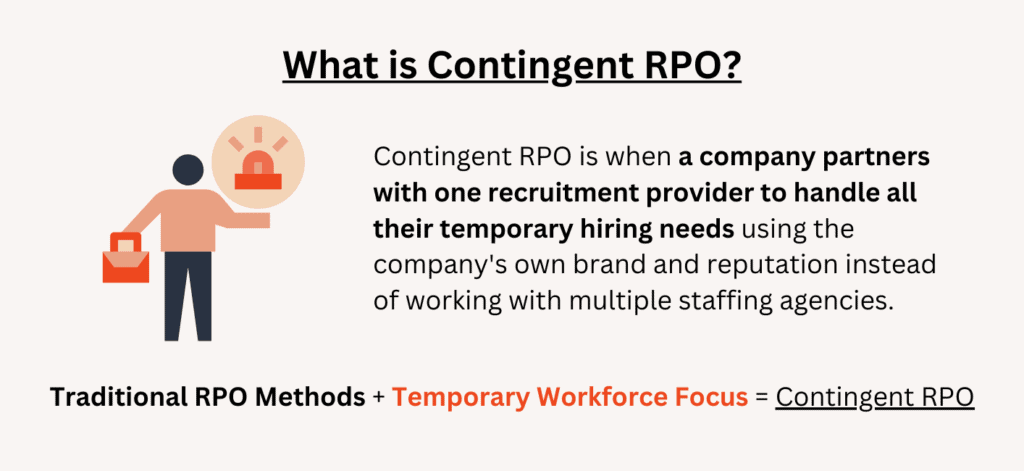
Contingent RPO (Recruitment Process Outsourcing) is a flexible staffing model where an external provider manages recruitment on a contingent basis. In this arrangement, the provider is only paid once candidates are hired, often based on a successful placement.
This model is used for filling non-permanent or temporary positions and allows businesses to reduce upfront costs while accessing expertise and scalable recruitment solutions. It works well for companies with fluctuating hiring needs as it offers a cost-effective approach to talent acquisition without long-term commitments.
How Does Contingent RPO Work?
Contingent RPO is your behind-the-scenes talent partner that handles all the complex moving parts of temporary hiring. Here’s how the workflow functions:
- Needs Assessment: The process begins with the RPO partner analyzing your contingent staffing requirements, including skills needed, project timelines, and budget constraints.
- Talent Pool Development: Your RPO partner builds and maintains a pre-vetted talent community specific to your industry and requirements, creating a ready pipeline of qualified candidates.
- Requisition Management: When a need arises, hiring managers submit requirements through an integrated system that triggers the search process without administrative delays.
- Candidate Sourcing & Screening: The RPO team uses specialized sourcing strategies, technology, and their existing talent pool to identify and evaluate candidates based on your specific criteria.
- Interview Coordination: The provider manages the entire interview process, presenting only pre-qualified candidates to your hiring team, saving significant time.
- Onboarding & Compliance: Upon selection, the RPO partner handles paperwork, compliance checks, and contractor orientation according to your company standards.
- Performance Tracking: Throughout the engagement, the RPO team monitors contractor performance and provides regular reporting on key metrics.
Your Next Must-Read Blogs
🌟 How Much Does RPO Cost? 7 Pricing Models & Rates
🔥 MSP & RPO: 11 Differences, How They Work, & When To Use
💯 What Is Recruitment Process Outsourcing? (RPO Guide)
Why Are Companies Switching To Contingent RPO?
More people want flexible jobs, and more companies want flexible teams. This caused a huge growth in the contingent workforce. Businesses need a better way to manage it—one that’s proactive, cost-effective, and built for long-term success. Contingent RPO does exactly that.
Contingent RPO As A Strategic Advantage: 8 Benefits That Maximize Workforce Value
Here are the 8 advantages of contingent RPO:
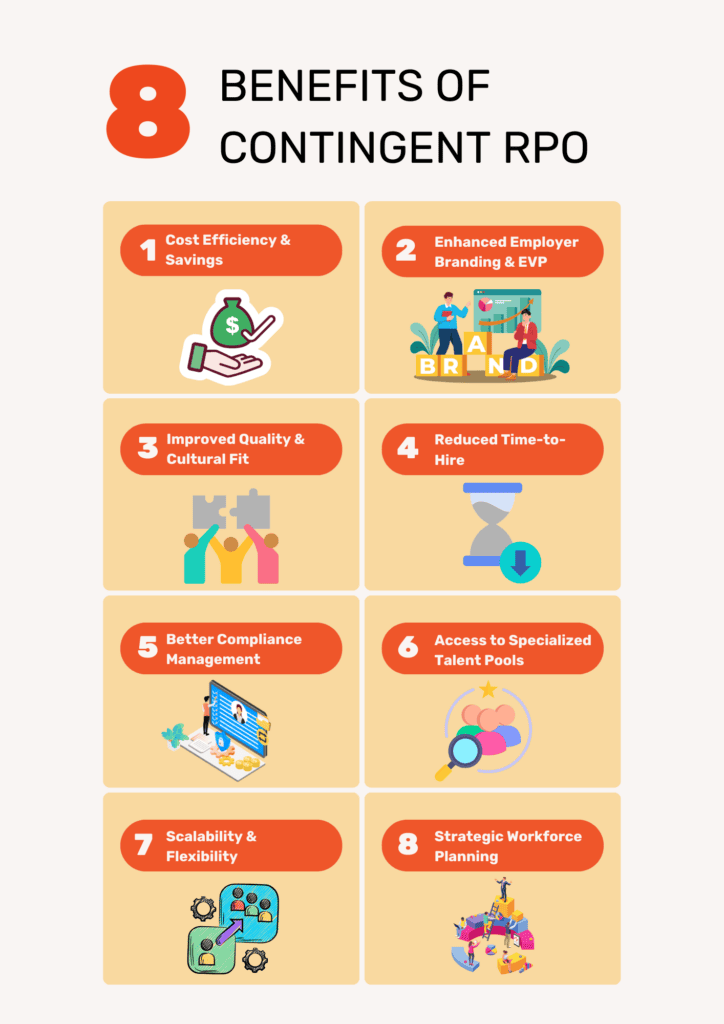
1. Reduce Recruitment Cost
By using contingent RPO, you can cut hiring costs by 15-30% as it eliminates staffing agency markups. Your HR team spends less time on recruitment administration and more time on strategic work.

2. Strengthen Employer Branding
Contingent RPO creates a consistent brand experience across all talent segments. You can attract better contractors by promoting your actual company instead of appearing as just another client of a staffing agency. This approach treats contingent workers as valuable extensions of the team.
3. Improve Talent Quality & Cultural Fit
With dedicated recruitment teams that understand your organization’s culture, values, and specific needs, Contingent RPO delivers candidates who are technically qualified and aligned with your company culture. These specialists develop deep knowledge of your business requirements and can accurately assess both hard and soft skills for higher-quality placements and better cultural fits.
“Contingent RPO transforms how organizations build resilient talent ecosystems. When implemented strategically, it becomes a competitive differentiator.”
— Burkhard Berger, Founder/CEO
4. Fill Positions Faster
Reduce hiring time by 30-50% with pre-vetted talent pools ready when you need them. Instead of starting from scratch with each hire, you’ll have candidates ready to interview immediately.

5. Mitigate Legal Risks
Avoid costly misclassification penalties and compliance issues with expert guidance on contractor regulations. Your RPO partner handles the complex legal requirements across different locations.
6. Access Specialized Talent
Find specialized talent that isn’t actively job hunting or responding to typical job ads. Your RPO partner builds relationships with passive candidates before you even need them.
7. Scale Your Workforce Easily
Quickly add contractors when projects ramp up and reduce staff when work slows down, without the guilt of layoffs. Your RPO partner manages the fluctuations while maintaining relationships with top performers.
8. Data-Driven Hiring Decisions
Gain insights about talent availability, market rates, and hiring trends specific to your industry. Use data instead of guesswork to plan your contingent workforce strategy.
🤔 Did You Know?
Companies with strong onboarding programs see 50% higher employee retention.
4 Contingent RPO Drawbacks & Challenges
Contingent RPO can be a game-changer, but like any strategy, it comes with its own set of challenges to manage:
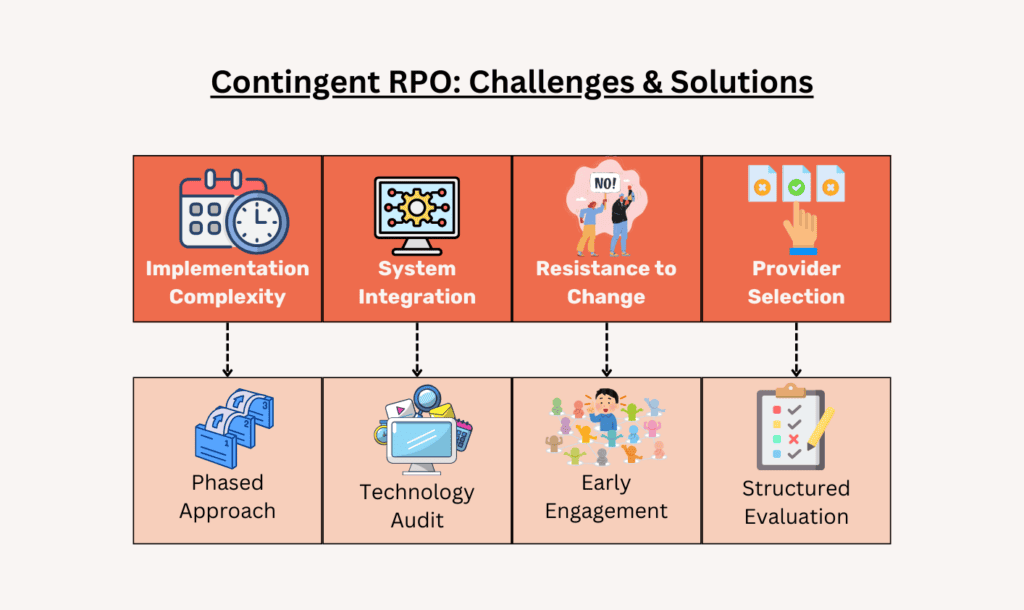
Challenge 1: Implementation Complexity
The Problem: Transitioning from traditional staffing models to contingent RPO involves significant process changes, technology integration, and organizational alignment. The initial setup takes 3-6 months.
Practical Solutions:
- Start with a pilot program in one department or job category rather than a company-wide implementation
- Create a detailed implementation roadmap with clear milestones and accountability
- Assign a dedicated project manager to coordinate between stakeholders
- Break implementation into phases (e.g., talent community building first, then direct sourcing)
- Set realistic timeframes and communicate them clearly to all stakeholders
Challenge 2: System Integration Issues
The Problem: Connecting Contingent RPO platforms with existing HR systems, vendor management systems (VMS), and payroll creates technical hurdles.
Practical Solutions:
- Conduct a thorough technology audit before implementation to identify all integration points
- Prioritize integration requirements based on business impact
- Use middleware solutions to connect systems without extensive custom development
- Implement API-first solutions that are designed for integration
- Start with manual processes for non-critical functions while building automated connections
“The true value of Contingent RPO lies in its ability to eliminate the traditional divide between your core and flexible workforce.”
— Christian Cabaluna, Senior Recruiter
Challenge 3: Resistance to Change
The Problem: Hiring managers accustomed to working directly with staffing agencies resist adopting new processes.
Practical Solutions:
- Engage hiring managers early in the planning process to incorporate their feedback
- Create simple, visual process guides that clearly show the new workflow
- Highlight specific pain points that the new system will address for each stakeholder
- Showcase early wins with metrics that matter to skeptical team members
- Provide extra support during the transition period with dedicated help resources
Challenge 4: Provider Selection Risks
The Problem: Choosing inexperienced or poorly matched RPO companies can cause implementation failures.
Practical Solutions:
- Use the 7-step evaluation process outlined earlier in this article
- Request client references in your specific industry and of a similar size
- Start with a shorter contract term (12-18 months) before committing long-term
- Include performance-based elements in your contract with clear SLAs
- Establish regular review periods to address issues before they become problems
😱 This Might Surprise You
Companies can save an average of 85% on labor costs through strategic outsourcing.
When To Consider Contingent RPO: 4 Real-World Use Cases
To see the true impact of contingent RPO, let’s look at how real companies have used it to solve unique hiring challenges:
1. High-Volume Contingent Hiring
Amazon’s Seasonal Fulfillment Strategy
When Amazon needs to scale up for peak holiday seasons, its Contingent RPO solution helps it hire over 150,000 temporary workers in a compressed timeframe. Their approach includes pre-built talent communities, virtual hiring events, and standardized onboarding. This reduced their hiring cycle by 40% compared to traditional staffing methods.
Takeaway for You: If your business experiences predictable hiring surges (seasonal peaks, product launches, or major projects), Contingent RPO allows you to build a talent pipeline before you need it. Start planning 4-6 months before your peak hiring period to achieve the best results.
2. Specialized Skill Acquisition
IBM’s AI Talent Initiative
IBM faced intense competition for artificial intelligence specialists and machine learning engineers. Their Contingent RPO program created specialized talent communities in these areas, and resulted in 35% faster placements and a 28% reduction in contractor costs compared to premium staffing agencies.
Takeaway for You: For hard-to-fill technical roles where traditional agencies struggle, Contingent RPO delivers better results through specialized sourcing channels and ongoing relationship building with passive candidates. Consider taking help from IT RPO companies when staffing agency fees for niche roles exceed 25% of first-year compensation.
3. Digital Transformation Initiatives
PNC Bank’s Core Banking Modernization
During PNC Bank’s multi-year digital transformation project, they needed specialized talent with expertise in specific banking platforms and technologies. Their Contingent RPO solution provided access to pre-vetted contractors with relevant banking technology experience. This reduced project delays because of staffing gaps by 37% and lowered overall contingent labor costs by 21%.
Takeaway for You: For multi-phase technology projects requiring specific expertise, Contingent RPO provides continuity and institutional knowledge that one-off staffing solutions can’t match. Implement this approach at the project planning stage to build a sustainable talent pipeline throughout the transformation journey.
4. Global Workforce Expansion
Uber’s Market Entry Strategy
When expanding into new international markets, Uber uses Contingent RPO providers with local expertise to quickly scale operations. In one Southeast Asian market entry, they deployed a team of 85 temporary operations specialists within 6 weeks—nearly twice as fast as their previous expansion using local staffing agencies, while ensuring compliance with complex local labor regulations.
Takeaway for You: When entering unfamiliar markets, partner with a Contingent RPO provider that offers local compliance expertise and established talent networks. This approach reduces both time-to-market and regulatory risks that could derail your expansion efforts.
🔎 This Is Interesting
93% of employers plan to continue conducting job interviews remotely.
How To Select The Right Contingent RPO Provider
Follow these steps to work with the right contingent RPO provider:

Step 1: Evaluate A Contingent RPO Provider’s Sector-Specific Experience
- Ask for 3-5 client references specifically from your industry
- Request data on the exact number of placements made in your sector in the last 12 months
- Review industry-specific case studies showing measurable results (cost savings, time-to-fill)
- Verify their average tenure working with clients in your industry (look for 3+ years)
Step 2: Confirm Your Contingent Workforce RPO’s Digital Infrastructure
- Schedule a 60-minute live platform demo with their technical team
- Create a checklist of your required system integrations (ATS, HRIS, VMS)
- Test their mobile capabilities by requesting a demonstration on your phone
- Ask for screenshots of their analytics dashboard and reporting capabilities
- Request their specific implementation timeline for technology onboarding
Step 3: Verify Contingent Recruitment Outsourcing Global Reach
- Provide a list of your hiring locations and ask for confirmation of their sourcing capabilities in each
- Ask for the number and location of their on-the-ground recruiters in your key markets
- Request examples of at least 3 successful placements in your most challenging locations
- Confirm their capabilities for managing remote workers if applicable to your needs
Step 4: Evaluate Contingent RPO Compliance Expertise
- Request their written contractor classification methodology document
- Ask for their compliance audit checklist specific to your industry
- Verify they conduct quarterly compliance reviews and request their process documentation
- Ask specific questions about regulations in your locations (e.g., AB5 in California, IR35 in the UK)
- Request sample compliant contractor agreements for your review
Step 5: Measure Cultural Alignment With Contingent Staffing Partners
- Schedule meetings with the actual recruitment team who would handle your account
- Request 3 examples of how they’ve represented other clients’ employer brands
- Ask for screenshots of their candidate communications to assess tone and messaging
- Provide your company values document and ask how they would incorporate these into screening
- Request their candidate experience survey results from the past 6 months
Step 6: Review Contingent RPO Performance Metrics
- Ask for specific metrics on time-to-fill (average and for similar roles to yours)
- Request data on cost-per-hire improvements for 3 comparable clients
- Ask for contractor retention rates and quality-of-hire improvements
- Request client satisfaction scores for the past 12 months
- Verify which specific metrics will be included in your regular performance reports
Step 7: Confirm Contingent RPO Scaling Capacity
- Ask about their largest client relationship (number of placements annually)
- Request their standard recruiter-to-requisition ratio
- Discuss their specific plan for handling a 50% increase in your hiring needs
- Ask about their bench strength and backup plans for key personnel
- Request their average ramp-up time when hiring demands suddenly increase
Conclusion
Now that you know what is contingent RPO and how it works, the next step is to think about how this model will fit into your current hiring strategy. Maybe your in-house team is stretched thin, or you’re expanding fast and need flexible, high-impact support without long-term contracts. The key is to find a company that understands your business and delivers real results quickly.
And if you’re looking for a recruitment partner that delivers elite global talent without the hefty price tag, Genius can help. We source US-quality full-time employees from the Philippines and Latin America for 80% less. With on-the-ground sourcing, a 6-month talent guarantee, and zero risk interviews, we’re built to scale smarter. Let us find you your next A-player—without the stress or sticker shock.
FAQs
When should a company use contingent RPO?
Companies should consider contingent RPO when they hire high volumes of temporary workers, face skill shortages in critical areas, or want to reduce staffing agency costs.
What roles are usually filled through contingent RPO?
RPO fills technical positions (IT developers, engineers, data scientists), project-based professional roles (project managers, business analysts), and specialized skilled positions with repeatable hiring needs.
How are fees structured in contingent RPO?
Contingent RPO fee structures include a management fee (fixed monthly amount) plus a placement fee per hire that’s significantly lower than traditional agency markups. Some providers offer hybrid models with tiered pricing based on volume or performance-based fee structures with incentives.
Is there a minimum volume of hires required in contingent RPO?
Most Contingent RPO providers require minimum annual hiring volumes, typically 20+ similar contingent positions annually. However, some offer scaled solutions for mid-sized organizations with 10-20 annual positions.