Small hourly operators quietly spend more on hiring than on the schedule itself, which is a problem since the schedule is almost always why the hiring bill keeps growing. This piece covers how to cut hourly hiring costs with a scheduling tool that pays itself back inside the first 30 days on a 40-person team.
The latest BLS JOLTS release landed on November 3, 2026 with September 2026 reference data. The accommodation and food services monthly quits rate is 5.0 percent and retail trade is 3.1 percent. The economy-wide rate is 2.1 percent.
Food services is quitting at over 2x the national pace. That is the baseline hiring cost for anyone who operates in hourly labor.
The 5.0 percent rate is also the highest of any industry in the September 2026 report. A scheduling tool is not a pay-raise substitute. But it is the closest thing on the market to a built-in retention lever that pays off on the hire you already made.
The Overtime Leak Is The Real Hiring Cost
Most operators think of hiring cost as the cost of a new hire. The hidden cost is the overtime the current team runs because the schedule leaks. The BLS Current Employment Statistics release for September 2026 puts average hourly earnings in accommodation and food services at $22.66 with an average week of 25.8 hours.
Retail trade runs higher at $26.55 per hour and 30.2 hours per week in the October 2026 preliminary data. Both numbers are sub-30-hour schedules by design. That means every unplanned overtime hour is a direct leak to payroll the scheduler could have prevented.
An extra three hours of unscheduled overtime per employee per month on a 40-person food services team is roughly $3,260 a month in avoidable payroll at the published average. That is almost $39,000 a year that disappears into the time clock because the schedule shipped without a check against the budget.
The second leak is absenteeism. The BLS Current Population Survey Table 47 for 2025 puts the absence rate in leisure and hospitality at 3.4 percent and the lost-worktime rate at 1.5 percent. Retail trade runs at 3.4 and 1.7 percent on the same measures.
One in every thirty scheduled hours is not on the floor and the manager is covering it from the same roster. That coverage is almost always paid in overtime from the same payroll line.
Three ZoomShift Features That Pay Back Inside 30 Days
The brief asked this post to call out three features. Each one maps to a specific line on the payroll leak which is the reason the economic case is almost embarrassingly obvious on a 40-person team.
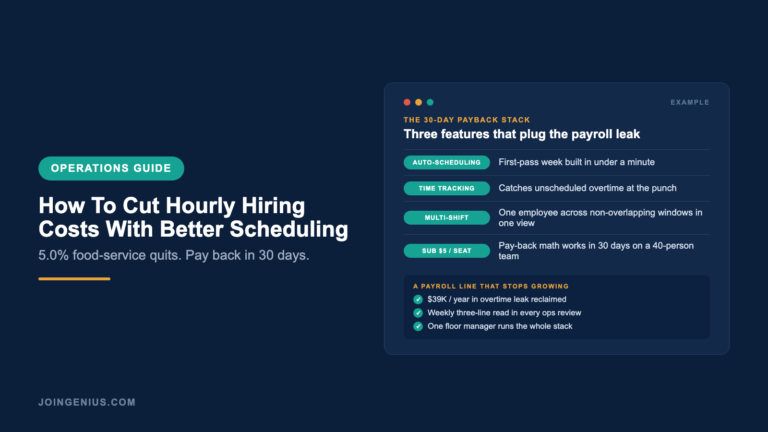
An all-in-one platform like ZoomShift bundles auto-scheduling and time tracking with multi-shift assignments on a sub-five-dollar-per-seat plan. A floor manager can build the week and plug the overtime leak from one workspace instead of three.
Auto-scheduling is the feature that reclaims the manager’s Thursday night. The tool takes employee availability and role requirements and past hours worked and builds a first-pass schedule in under a minute. The manager then edits the ten percent that needs human judgment instead of starting from a blank spreadsheet after close.
Time tracking closes the loop at the back end. If the schedule says Jordan works 4 to 10 but the punch shows 3:52 to 10:23 the tool catches the 20 minutes of unscheduled overtime before it hits payroll. Across the 40-person team that one feature saves more than its annual software bill in overtime alone.
Multi-shift assignments handle the case the spreadsheet never did. A single employee rotating across a morning shift and a close shift inside the same week is impossible to track on a static grid.
A tool that assigns one employee to multiple non-overlapping shifts in one builder view keeps the roster tight. It also keeps the overtime line honest on the payroll report.
The Multi-Shift Assignment Case Most Operators Miss
Multi-shift assignments look like a convenience feature. They are actually a cost feature when the operator runs more than one service window per day. A café with a 6am open and a 4pm pre-close bakery run has two labor peaks that need different shift pools built from the same employee roster.
The failure mode on a spreadsheet is familiar. The manager either double-schedules the strongest employee into both windows and burns them out inside a quarter.
Or they staff the two windows from different cuts of the roster and lose coverage on the one that happens to need it most. Both outcomes are hiring costs that do not show up on the hiring line.
A tool that handles multi-shift assignment inside one view rebalances the two windows week over week without the manager re-doing the whole roster. That is the feature that keeps the strongest employees on the floor for a full year instead of six months.
And it is the feature that keeps the hiring pipeline from having to replace them in month seven. On a 40-person team that is the difference between seven replacements a year and three.
The payback is slower than the overtime fix but it compounds harder. The first hire kept past twelve months saves the hiring cost of a replacement that would have cost something close to 30 percent of their annual wage. The second and third hire kept past twelve months is the floor the operator finally gets to stop over-hiring to defend.
The Floor Manager Who Breaks The Hiring Bill
The tool does not run itself. The 2026 hire for a small hourly operator is a floor manager who treats the schedule as an instrument and not as a chore.
The retail-hourly pool the hire likely comes out of is large but structurally flat. The BLS Occupational Outlook Handbook counts 4.27 million retail sales workers in 2025 at a median wage of $35,560 per year.
The projected change for the decade through 2035 is zero percent. A flat headcount projection on the biggest hourly pool in the economy means owners cannot grow by adding bodies.
They have to extract more hours of productive work from the same number of hires. That is the economic reason a scheduling-capable floor manager pays more than themselves in the first quarter.
The sourcing pass for the role filters on one specific trajectory. Someone who has run a 30-person hourly schedule inside a modern tool at a previous operator is a yes.
Someone who has run the same schedule only on a printed grid is probably not. The muscle memory for the tool is almost impossible to build in the first 90 days.
The interview loop is short. Hand the candidate a mock roster of 20 employees with mixed availability and ask them to build a week in under 15 minutes inside the actual tool. A real hire runs the auto-scheduler and edits the exceptions. A spreadsheet manager rebuilds from scratch and burns the clock on the fifteen-minute timer.
The Three Reads That Catch The Leak Weekly
The scheduling leak shows up on three lines before it ever shows up on the hiring line. The first is schedule-to-actual variance by role which the manager reads every Monday morning. If the posted schedule survived the week the variance is near zero. If the schedule got rebuilt three times the variance is where the overtime was born.
The second line is overtime hours by employee against the budgeted hours in the posted schedule. Any employee over by more than two hours is an alert. Any employee over by five hours is a conversation.
The operators who catch this line every Monday catch the overtime leak inside the week it starts rather than inside the payroll cycle it closes.
The third line is 30-day quit count on employees with ten or more shifts. That is the leading-edge signal the hiring bill is about to grow. A stable number says the schedule is holding the floor. A rising number says the floor is losing the strongest employees and the pipeline is about to carry the cost.
Three lines fit on a half-page print. The operators who run this read weekly catch stalls two weeks ahead of the operators who review the same lines at month-end. That gap is almost always the difference between a flat labor quarter and a payroll line that crept five percent higher without anyone naming it.
Why The Economy-Wide Quits Gap Is The Bigger Signal
The 5.0 percent accommodation and food services quits rate in the September 2026 JOLTS release is not the headline number that matters. The gap to the 2.1 percent economy-wide rate is. That 2.9 point gap has held for the past six quarters and it is not going to close on its own.
Operators who run on the same scheduling cadence as 2023 are paying a structural hiring premium the rest of the economy does not. Every quarter the gap holds is another quarter the hiring bill compounds. A tool that drops the operator-specific quits rate by even one point returns more than its annual license on a 40-person team.
The three features in this piece are not the full story on retention. Pay is still pay and a bad manager is still a bad manager. But the operators who have moved their quits rate inside a single quarter all moved the schedule first. The scheduling tool is the smallest lever that compounds on its own.
The talent pool an operator is hiring out of is not changing fast enough to absorb the current turnover rate. The operators who stop over-hiring to defend the floor are the ones who have stopped treating the schedule as an ops chore and started treating it as the first line on the hiring budget.