
A new product is ready to launch, a new market is on the roadmap, or a supervisor has just published fresh expectations. Whichever it is, the same question lands on the desk of the founder, the COO, or the head of HR: who is going to make sure we get this right?
Hiring a regulatory specialist is harder than it looks. Titles like “compliance officer” or “regulatory affairs manager” cover very different people, and a wrong hire is expensive in both directions. Hire someone too junior, and risks slip through. Hire someone too rigid, and the business stops moving. Before you open the role, it helps to have a clear hiring pipeline in place, because the best candidates in this field are rarely sitting on job boards waiting.
This guide covers how fintech and banking teams think about regulatory roles, which types of specialist exist, how to test real knowledge, where to find strong candidates, and how to assess them fairly.
Why Regulatory Hiring Looks Different in Fintech and Banking
Banks and fintechs both need regulatory expertise, but they tend to need it in different ways.
Established banks usually need depth and formality. They operate under long-standing supervisory relationships, run established governance structures, and often need specialists who can work inside large teams with clear reporting lines. Documentation, audit trails, and process discipline matter a great deal.
Fintechs usually need speed and judgment. A young company may have one or two people covering everything from licensing to financial crime to consumer protection. The person has to be comfortable making calls with incomplete information, explaining rules to engineers and product managers, and building processes from scratch.
One thing both share is constant change. Rules evolve, supervisory priorities shift, and new product types attract new scrutiny. That means the best candidates are not those who know today’s rules by heart. They are those who know how to find out what is changing, judge what it means for the business, and act on it. When you hire for this field, you are hiring a way of learning as much as a body of knowledge.
If you are a young company making a first compliance hire, the advice in this guide on hiring for startups is a useful companion, particularly on defining the role before you post it.
The Types of Regulatory Specialist You Might Be Hiring
“Regulatory specialist” is a family of roles, not one job. Matching the type to your stage and your regulatory situation is the first decision to make.
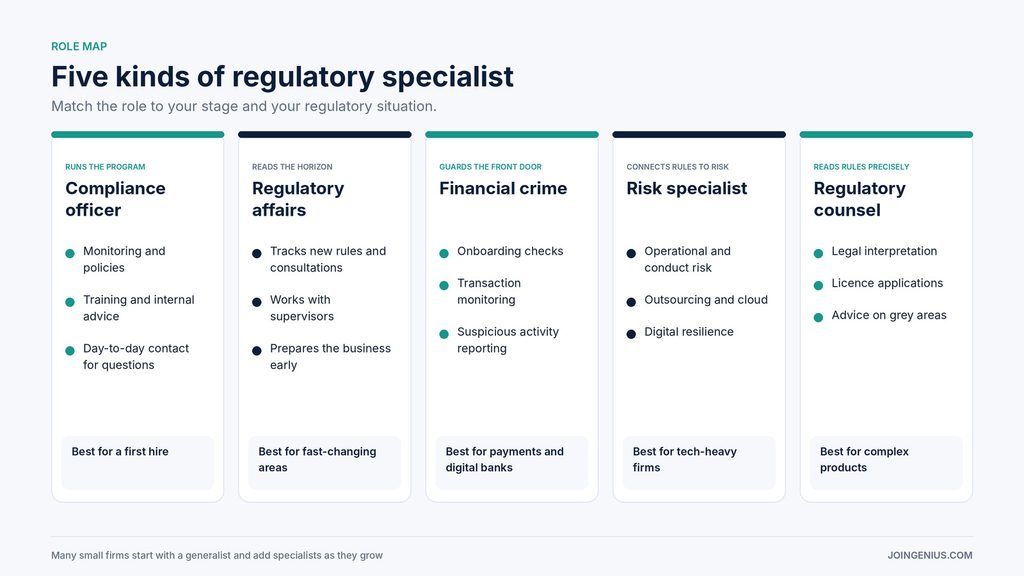
Compliance officers own the day-to-day program. They run monitoring, handle policies and training, and act as the main contact for questions inside the firm.
Regulatory affairs and policy specialists focus on the relationship with supervisors and on tracking change. They read consultations, interpret new requirements, and help the business prepare ahead of time.
Financial crime and anti-money laundering specialists concentrate on onboarding checks, transaction monitoring, and reporting suspicious activity. For payments firms and digital banks, this is often the most urgent need.
Risk specialists connect regulatory requirements to operational, conduct, and technology risk. They are especially useful where outsourcing, cloud providers, and digital resilience are major concerns.
Regulatory counsel brings legal interpretation. For complex products or licence applications, the ability to read a rule precisely and advise on grey areas is worth a great deal.
Many firms need a blend. A small fintech may start with a generalist who can cover several of these areas and add specialists as the business grows. Be honest in the job description about which of these hats the person will wear, and which will come later.
Test Candidates on the Regulatory Topics Your Firm Actually Faces
Credentials and past employers tell you something, but they do not tell you whether a candidate understands the rules that apply to your products. The strongest test is to ask them to talk through those rules in plain language.
Strong candidates can talk through the regulatory topics your firm actually faces, such as DORA, MiCAR, Consumer Duty and anti-money laundering, rather than reciting rules in general terms.
Start by listing the five or six regulatory themes that matter most to your business. A payments firm might focus on safeguarding, financial crime, and operational resilience. A lender might focus on consumer protection and conduct. A firm handling digital assets might focus on crypto-asset rules and marketing restrictions. Public resources that organize rules by topic and by jurisdiction can help you build this list and keep it current.
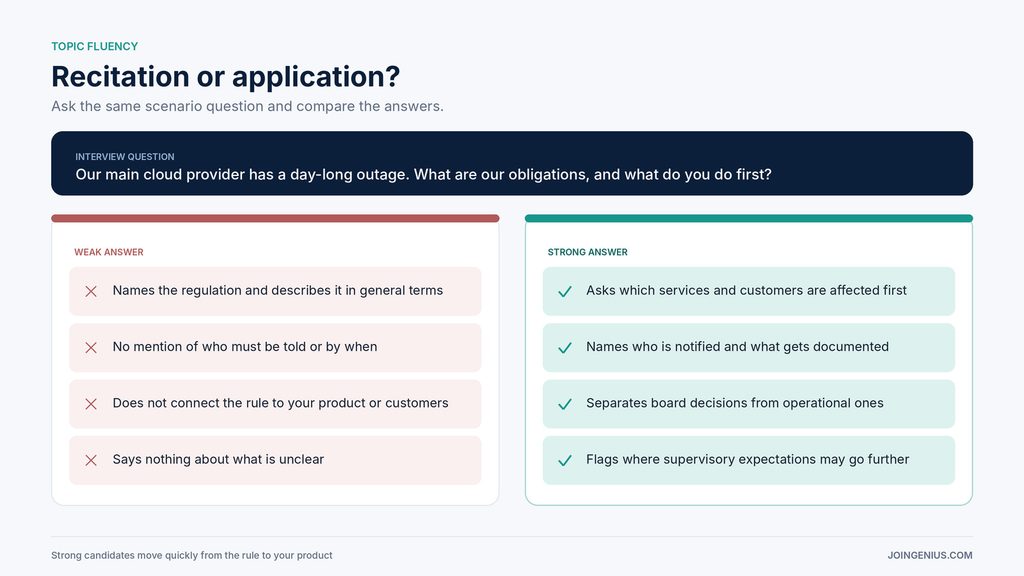
Then build your interview questions around it. Instead of asking “do you know the rules on operational resilience,” ask “if our main cloud provider had a major outage for a day, what would the regulatory obligations be, and what would you do in the first hours?” A candidate who has worked with these topics will answer with specifics, such as who has to be told, what needs documenting, and which decisions belong to the board.
Listen for the difference between recitation and application. A weak answer names the regulation and describes it in general terms. A strong answer connects the rule to your product, your customers, and your processes, and notes where the rule is unclear or where the supervisor’s expectations may go further than the text.
Also check jurisdiction. Rules that sound similar can differ between the UK, Ireland, and the wider EU, and a specialist who has worked in only one regime may need time to adapt. If you operate across borders, ask candidates how they would keep track of differences between markets.
Where Fintech and Banks Find Regulatory Specialists
The best candidates are often employed and not actively looking, so sourcing matters as much as screening.
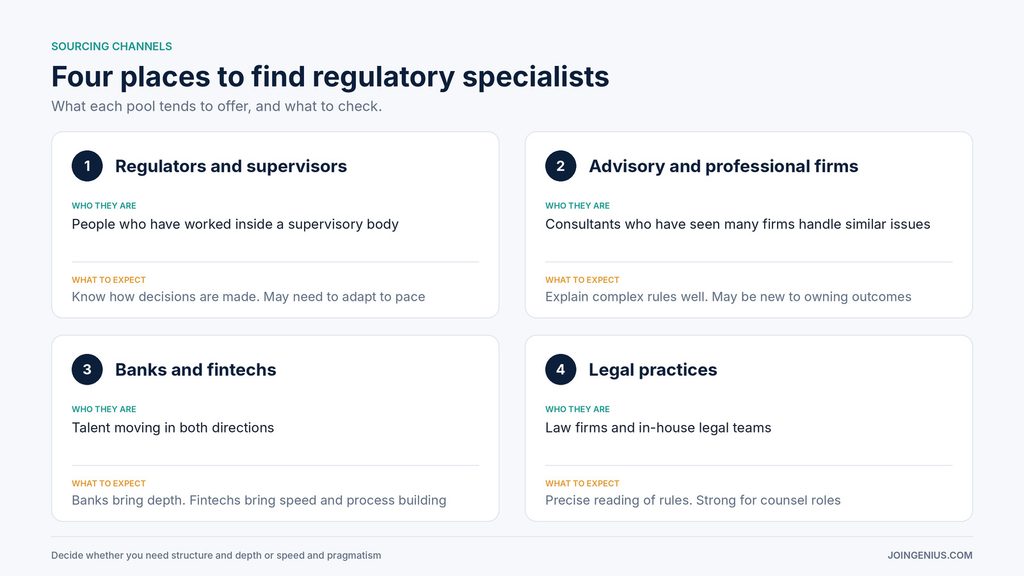
Regulators and supervisory bodies are a strong source. People who have worked inside a supervisor understand how decisions are made and what examiners look for. They tend to be rigorous, though some will need to adapt to the pace of a growing company.
Advisory and professional services firms produce many strong candidates. Consultants have seen how multiple firms handle similar problems and are used to explaining complex rules to non-experts. They may be less used to owning outcomes day after day.
Banks and fintechs trade talent in both directions. A specialist from a large bank brings structure and depth. One from a fast-growing fintech brings pragmatism and experience building processes quickly. Decide which you need more.
Legal practices and in-house legal teams are another pool, especially for counsel roles and for candidates who can read rules with precision.
When the search needs to move quickly or you lack a recruiting team, a specialist partner can help. This overview of IT staffing agencies explains how to compare agencies and what to ask before you commit, and the same questions apply when you brief a recruiter on a regulatory search.
It is also worth asking whether the best person is already inside your company. Promoting a trusted employee who knows your products can be faster and lower risk, though it may leave a gap in deep regulatory experience. This comparison of internal vs external recruitment helps you weigh the trade-offs.
Whatever channel you use, be specific in your outreach. Strong candidates want to know what you are building, which regulatory challenges are live, and whether leadership will support compliance as a partner rather than treat it as a hurdle.
How to Assess a Regulatory Candidate
A good assessment mirrors the work. A few well-designed steps tell you more than a long list of general questions.
Use a case interview built on a realistic regulatory change. Describe a new requirement that affects one of your products and ask what the candidate would do in the first thirty days. Strong candidates ask questions first. They want to know which products and customers are affected, what the current controls look like, and what the supervisor has said. Then they lay out a sequence: assess the gap, prioritize, brief leadership, and track the change.
Test communication. Ask the candidate to explain a complex rule to a product manager or engineer who has no regulatory background. Regulatory specialists who cannot translate rules into practical guidance end up as bottlenecks.
Ask about the hard moments. Have they pushed back on a business decision, handled a regulator query, or reported a problem that was uncomfortable to raise? Specific stories reveal judgment and integrity better than any hypothetical.
Check references beyond the compliance team. Product, engineering, and executive colleagues can tell you whether the candidate helped the business find a safe path or simply said no.
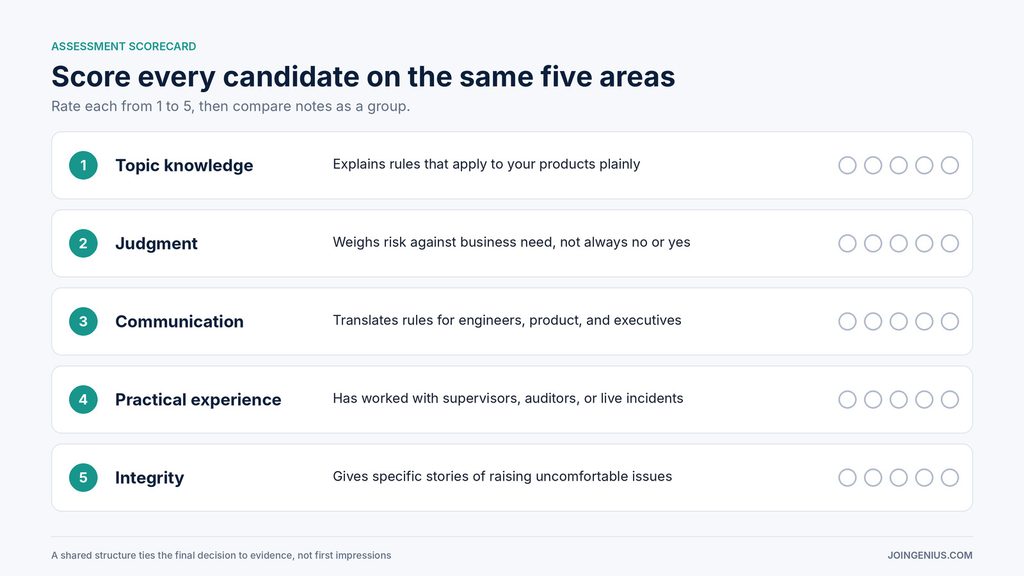
Finally, use the same scorecard for every candidate. Rate topic knowledge, judgment, communication, practical experience, and integrity, and discuss the results as a group. A shared structure keeps the decision tied to evidence instead of first impressions.
Red Flags to Watch For
Be cautious of candidates who recite rules without examples, or who cannot describe a time they worked directly with a supervisor or auditor. Watch for those who treat every request as a no, as well as those who say yes to everything. Both extremes suggest weak judgment. Also be wary of overconfidence about rules that are changing, since good specialists are comfortable saying what they do not yet know.
Hire for Judgment and the Ability to Keep Learning
The best regulatory specialists are not simply people who know the rules. They are people who can interpret change, explain it clearly, and help the business keep moving safely. Look widely, test with real regulatory topics, and assess judgment as carefully as knowledge.
A practical first step is to write down the five regulatory topics your firm faces right now and turn each one into an interview question. That single exercise will sharpen your job description, your screening, and your final decision. If you are building a longer-term plan for scarce specialist talent, this guide to the technical talent pipeline shows how to build relationships with candidates before the role opens.