Every modern fraud detection stack runs on three load-bearing signals. Device fingerprint and behavioral biometrics are the first two. IP geolocation accuracy is the third, and it quietly decides whether your model catches a $4,000 chargeback on a stolen card or rubber-stamps it as a regular customer buying from a familiar market.
IP geolocation is the oldest signal in the stack. It is also the one most teams treat as free infrastructure rather than a model input that needs maintenance. In 2026 that assumption breaks in three measurable ways. This post walks through how, and what a fraud team should hire for to catch it.
Why IP Geolocation Is Still The Load-Bearing Fraud Signal
Device fingerprint and behavioral biometrics are powerful, but they are also noisy and slow to train. IP geolocation sits one layer under them. It is the first thing your system sees when a request lands, before the page renders or a form submits.
Three fraud patterns live or die on IP geolocation accuracy. Card-not-present fraud rings use residential proxy networks to make a fraudulent purchase look like it is coming from the cardholder’s zip code.
Account takeover attackers route credential stuffing through VPN exit nodes in the same country as the victim. Bonus abuse and promo code farming use datacenter IPs in low-cost regions to mass-redeem offers meant for one user per household.
In all three cases, the geolocation signal is the one that either catches the attack in milliseconds or lets it through for a device fingerprint check that costs ten times more compute to run.
The FTC Consumer Sentinel Network Data Book reports that US consumers lost more than $12.5 billion to fraud in 2024, a 25 percent jump from the prior year. The dataset covers 2.6 million fraud reports. Most of that loss flows through transactions where an IP geolocation lookup happened and either caught the attempt or waved it through.
The Three Ways Geolocation Accuracy Quietly Breaks
The accuracy failure mode most fraud teams underestimate is not that the city on an IP is wrong by a few miles. It is three different structural gaps that an engineer has to actively check for.
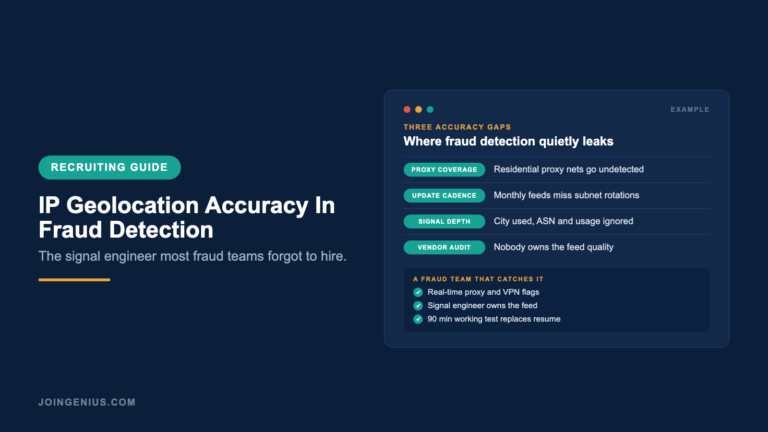
Gap one is proxy and VPN detection coverage. A geolocation database that reports a residential IP in Austin is useless if that IP is in fact a rented residential proxy node. Fraud engineers need a vendor that flags proxy and VPN usage. The hosting type on datacenter IPs is the second must-have, not just lat and long.
Gap two is update cadence. IP ranges are reassigned between carriers and cloud providers every week. A database updated monthly is 30 days behind an attacker who rotates a subnet overnight. Daily or real-time updates separate a usable vendor from a decorative one.
Gap three is signal depth. A good geolocation record carries more than city. It carries ASN and usage type as well (residential or datacenter, mobile or hosting). The ASN and usage type matter more for fraud scoring than the city, yet the city is the field everyone uses in a demo.
The hidden cost of these gaps shows up in the fraud cost multiplier. The LexisNexis True Cost of Fraud Study 2025 reports that US financial services firms now lose $5.75 for every $1 of direct fraud loss, up from $4.00 in 2021.
That multiplier covers chargebacks and labor on manual review. Lost legitimate customers are a third driver of the number. A better upstream signal compresses all three.
The same study finds that 44 percent of North American financial institutions still rely primarily on manual processes to resolve flagged transactions. Automation at the signal layer is where that number moves.
The Vendor Layer Where Accuracy Actually Lives
A fraud detection pipeline is only as accurate as the geolocation lookup that feeds it. The vendor choice is a hiring decision as much as a procurement one.
Teams running a vendor like ipgeolocation get real-time lookups with proxy and VPN flags plus ASN and usage type in a single API call. The fraud model sees the full signal instead of a city string.
The vendor layer is where most of the quiet failures happen. A team that built its risk rules in 2022 against a free geolocation feed is still running them in 2026 against a feed that may or may not flag the residential proxy network that did not exist three years ago.
Rebuilding against a current API is a two week engineering project. The reason it does not happen is not cost. It is that nobody on the fraud team has been hired specifically to audit the signal layer and hold the vendor accountable.
That is the job you need to be hiring for in 2026. Not another ML engineer tuning the ensemble model. A signal engineer who owns the quality of the inputs feeding the model, starting with geolocation.
What To Screen Fraud Engineers On In 2026
Most fraud engineering job descriptions still read like they were written in 2019: Python and SQL on the technical side, plus a line about “attention to detail.” None of that screens for the person who can tell you why your approve rate drops 4 percent every Thursday afternoon.
Four screens matter now. Signal one is network literacy. The candidate should be able to explain the difference between a residential proxy, a datacenter VPN, and a mobile carrier NAT without looking it up.
Signal two is vendor audit experience. Ask them to describe how they would evaluate two geolocation APIs against each other on a 100,000 request sample. A strong answer names a specific metric (match rate, proxy recall, lag from assignment change) rather than “we would test them.”
Signal three is rule writing under constraints. Give them a hypothetical: approve rate just dropped 3 percent on Shopify orders from the UK. They should walk you through the first five queries they would run, not propose a six week model retrain.
Signal four is false positive economics. A strong fraud engineer knows the cost of a false decline on a legitimate high-value customer and designs rules that spend precision carefully. If the candidate talks only about catching fraud and never about annoying good customers, they will build a system that loses you revenue. Build this into your interview rubric.
A Working Test That Replaces The Resume Screen
The fastest way to separate a signal engineer from a model engineer is a 90 minute working test on a real anonymized dataset. The old resume screen cannot do this, because every strong candidate now lists the same stack.
The test is simple to run. Hand the candidate a CSV of 10,000 transactions with an approve/decline flag and a geolocation lookup per row from two different providers. Ask them to find the pattern that explains why the approve rate drops on weekends.
Pay the candidate a flat rate for the 90 minutes at your target hourly comp. You want real effort, not a volunteer screen. Score on three dimensions. Queries they ran and what they noticed are the first two. How they would change the rule set is the third.
Candidates who come back with “the weekend dip is residential proxies in LATAM hitting datacenter geolocation records” are the hires. Candidates who come back with “I would need more data” are not. The test replaces three rounds of behavioral interviewing and a reference call.
Screen your sourcing pipeline against this before scheduling the first real round. Candidates who pass the working test but fail the behavioral round are often the strongest hires on the team six months in, because the thing you need from them is signal reading, not polished interview answers.
Run the test on at least five candidates per open role. A fraud team scaled this way builds a shared language around the input layer that no model-first team can reproduce after the fact.
Hire Fraud Engineers Who Can Read The Signal
The teams catching the 2026 fraud patterns are not the ones with the most expensive ML stack. They are the ones who hired an engineer who understands that the signal layer upstream of the model matters more than the model itself. Geolocation accuracy is the first signal in that stack and the one most often taken for granted.
The hiring window is tight. The US Bureau of Labor Statistics counts 192,900 information security analyst jobs in 2025 with a 21 percent growth projection through 2035, which is roughly 14,100 openings per year against a median wage of $129,180. That is a seller’s market for the exact engineer your fraud team needs to hire.
Genius hires top one percent fraud, risk, and security engineers from the Philippines and LATAM at roughly 80 percent less than local comp. There are no monthly fees and the placement comes with a six month replacement guarantee.
We screen on the four signal engineer tests described above before any candidate reaches a hiring manager, so your risk team hires people who will audit the geolocation feed on day one instead of tuning a model on day ninety.