Most UK Shopify stores clear £20K/month fast and then grind up to £50K where the revenue curve goes flat. This piece covers why Shopify stores plateau at £50K/month and the operational moves that break through the ceiling without doubling the ad budget.
The 2026 market data says demand is not the problem. The ONS Retail Sales bulletin for September 2026 reports UK online sales up 6.8 percent year on year. Internet sales are now 28.8 percent of total Great Britain retail. Shopify’s own Form 10-K for FY2025 put platform GMV at $378.4 billion. That was a 29 percent jump on 2024.
A store flat at £50K while the platform and the channel are both compounding at over 25 percent is not a market problem. It is an operations problem that no amount of paid traffic will outrun. The breakthrough is almost always a hiring decision paired with a checkout decision.
Why The £50K Ceiling Is So Common
The £50K/month figure is not arbitrary. It is the revenue point where a founder-run Shopify store runs out of founder hours. Below £50K a single person can usually own the ads account and the product page copy. They also handle supplier emails and the Monday morning operations review. Above that revenue line nobody can.
What stops moving is almost always the same handful of things at once. The conversion rate stalls because nobody is editing the checkout. The ad account plateaus because nobody is building new creative weekly. The repeat-purchase rate goes flat because nobody owns post-purchase email beyond the Klaviyo welcome flow.
Each one of those is a part-time job in isolation. Together they are a full-time operator role that the founder keeps punting on. The store does not break through £50K until that role gets filled either in-house or through a dedicated agency.
The Conversion Ceiling Is Doing Most Of The Damage
The single biggest leaky-bucket stat in ecommerce has not moved in a decade. Baymard Institute’s running average of 50 cart abandonment studies sits at 70.22 percent as of October 2026. Out of every ten shoppers who add to cart seven leave without paying.
The Shopify-specific picture is worse for stores at the £50K ceiling. Littledata’s November 2026 benchmark across 438 Shopify stores puts the median conversion rate at 1.3 percent. The top 20 percent sit at 2.7 percent and the top 10 percent at 3.6 percent.
A £50K store converting at 1.3 percent would be doing £138K at 3.6 percent on the same traffic. The gap between the median and the top decile is the gap between a plateau and a growth curve.
That 2.8x gap is almost never closed with a design refresh. It is closed by a conversion operator who owns the checkout funnel and ships one test per week. The founder who tries to run that program between supplier calls and warehouse issues ships one test per quarter and never catches up.
The UK Vertical Picture Is Not The Industry Picture
The industry average conversion rate is a trap for a UK Shopify founder. IRP Commerce’s September 2026 UK eCommerce Market Data shows Arts and Crafts at 5.76 percent at the top end and Baby and Child at 0.44 percent at the bottom.
Fashion sits at 1.62 percent. Health and Wellbeing comes in at 2.83 percent. One blended industry average hides a 13x spread between the top and bottom vertical in that single month of data.
The year-over-year moves are starker than the levels. UK Toys and Games conversion fell 43.46 percent YoY in September 2026. Baby and Child fell 35.92 percent in the same month. Arts and Crafts gained 33.19 percent.
A store in a declining vertical that is holding flat is actually gaining share. A store in a rising vertical that is holding flat is losing it. The math of the plateau looks the same in both cases and the diagnosis is the opposite.
The founder who benchmarks against a blended 2 percent average will misdiagnose their own plateau. The right benchmark is the vertical they are competing in this quarter on the UK market data they can pull every month.
What A Shopify Plus Agency Actually Fixes
The move from £50K to £150K is rarely a tooling problem. It is an execution problem on the same Shopify stack the store has been running for eighteen months.
An agency like Create8 is a UK Shopify Plus specialist that rebuilds the acquisition and conversion stack most stores have outgrown by that revenue point and then layers the retention loop on top.
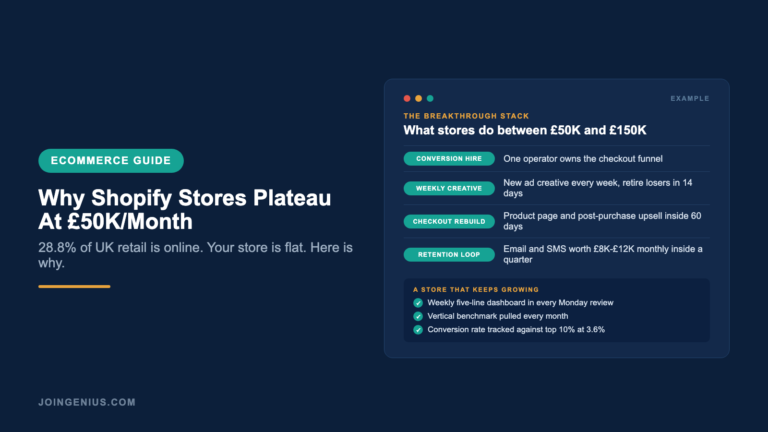
The acquisition rebuild is usually a creative problem rather than a targeting problem. The stores stuck at £50K are running the same five ads from six months ago. The agency ships new creative weekly and retires the losers inside fourteen days. That alone adds two or three percentage points to the ad account’s return on spend in one quarter.
The conversion rebuild is where the compounding sits. A Shopify Plus specialist will touch the product page hierarchy and the add-to-cart flow in the first 30 days. They then rebuild the checkout extensions and the post-purchase upsell in the next 30. A founder running the store solo touches one of those a year.
The retention rebuild is the quiet lever. A proper email and SMS program on a £50K store is usually worth £8K to £12K in incremental monthly revenue inside a quarter. That alone is the agency fee in most cases. The effect compounds through every subsequent month the program keeps running.
The In-House Hire That Breaks The Plateau
Not every store will move to an agency. The alternative is a single in-house ecommerce operator who owns the three stacks above. That role is harder to hire well than most founders expect. The title matters less than the scope. Ecommerce Manager and Head of DTC and Growth Lead all cover the same job on a £50K store.
The hire that breaks a £50K plateau is the one who has already done it once. Someone who scaled a £30K store to £120K has the playbook in muscle memory. Someone who maintained a £500K store does not because the jobs are different. The sourcing pass for this role should filter aggressively on that specific trajectory.
The interview loop that catches a real one is short. Hand them last month’s Shopify analytics and ask which three conversion edits they would ship first. A real hire names the product page gallery and the shipping cost reveal and a post-purchase upsell inside two minutes. A fake hire talks about the brand story.
The second screen is the ad account walk-through. Share the last 30 days of Meta spend and ask what they would cut and what they would scale. The real hire names losing ad sets by creative fatigue markers. The fake hire asks for more data before answering.
The Weekly Dashboard That Stops The Plateau Coming Back
Once the plateau breaks the store needs a weekly operating cadence that keeps it broken. Five lines on one page do most of the work. Conversion rate week over week split by device. Average order value week over week split by new versus returning customer.
Return on ad spend by top three campaigns comes next. Fourth is cart abandonment rate pulled from Shopify directly so the team can watch their own number against the Baymard 70 percent benchmark. Fifth is 30-day repeat purchase rate on the segment of customers who bought in the prior 60 days.
The cadence matters more than the lines themselves. A monthly version is a postmortem on the week the plateau came back. A weekly version is an intervention on the week before. Stores that run this read every Monday catch stalls two weeks earlier than stores that run a month-end review.
The hire who sets up this dashboard inside week one is usually the hire who keeps the growth curve on track past £100K. The founder who still owns the dashboard at £150K is the founder who is about to plateau again at £150K. Retaining that operator past the twelve-month mark is what compounds the breakthrough into a second one.
The Breakthrough Is Operational Not Platform
Replatforming is almost never the answer to a £50K plateau. Shopify itself is not the ceiling. The agency or the hire that rebuilds how the store operates inside Shopify is the lever. Most founders who replatform to a custom stack at £50K end up back at £50K on the new stack 12 months later.
The macro also keeps the pressure on. The ONS data shows UK online retail is still the fastest-growing channel in the economy. A store that fails to break through its own operations plateau in 2027 is leaving market share on the table that competitors in the same vertical are quietly taking.
The three moves that get stores off £50K are the same across almost every UK Shopify operator I have watched break through. They hired a conversion operator in-house or agency-side inside the first 90 days. They put the weekly five-line dashboard in every Monday review from week two.
And they stopped running Meta ads off the same creative library from six months prior. The ones who refuse to make those three moves stay at £50K. The ones who make all three inside a quarter are usually at £120K by the end of the following quarter on the same traffic they already had.