Shopify brands added mobile apps to the stack faster than they expanded the product hiring plan around them, so the role that owns the app ends up unfilled for months. Mobile app product managers sit between native UX and app store operations, and release cycles and experimentation stack on top of that.
The hiring pool is smaller than brands expect and the comp band is wider than the web PM band. The role scope also changes every six months as the app matures. The rest of this piece walks through why the gap keeps widening and how to adjust the hiring process.
The Shopify Mobile Investment That Outran The Hiring Pool
US ecommerce keeps setting new quarterly records, and Shopify brands are adding mobile apps to capture the mobile share. The hiring plan for the role that runs the app has not kept pace.
Where The Ecommerce Shift Shows Up
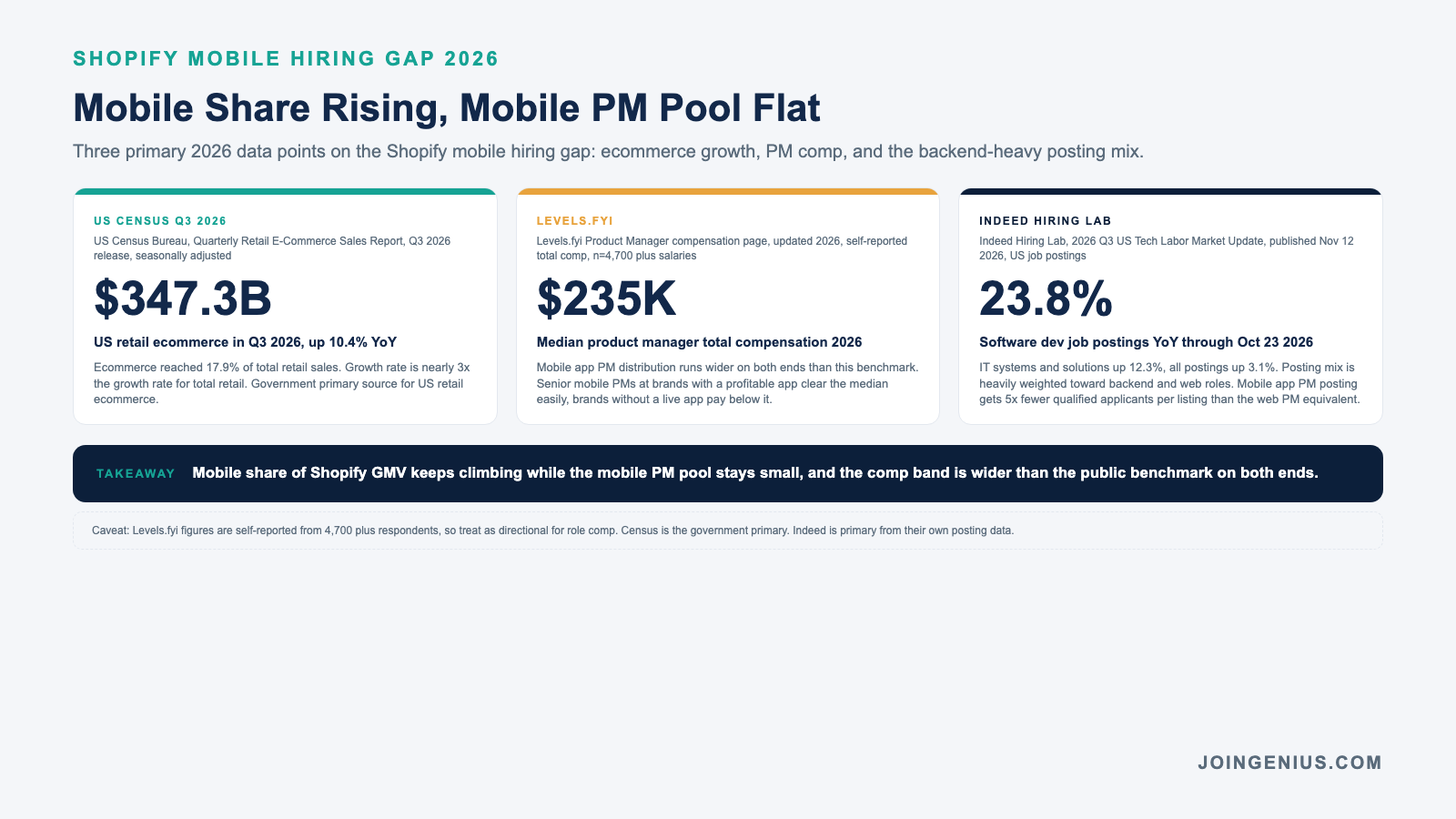
US retail e-commerce sales hit $347.3 billion in Q3 2026, up 10.4 percent year over year, and the share of total retail that happens online reached 17.9 percent per the Census Bureau’s quarterly release.
Shopify brands that measure mobile as a separate channel see the app take a bigger slice of that growth every quarter, and the customer retention curve on the app looks very different from the web curve.
Why App PMs Lag The Market
Software development job postings on Indeed are up 23.8 percent year over year through October 23, but the posting mix is heavily weighted toward backend and web roles. The mobile app product manager posting still gets five times fewer qualified applicants per listing than the web PM equivalent, and the gap holds across comp bands.
The Mobile Share Of New Growth
Mobile accounts for a growing share of Shopify GMV at brands that have launched apps, and repeat buyers migrate from web to app once the app installs. The app PM owns both the acquisition flow and the retention flow for that share, which doubles the role’s P and L weight compared to a web PM covering only one direction.
What A Mobile App PM Actually Owns At A Shopify Brand
The way to see the hiring gap is to look at the role spec most Shopify brands post. Five distinct functions get bundled under one headcount, and the combined scope reads unfamiliar to most PM candidates.
The Five Scopes Of The Role
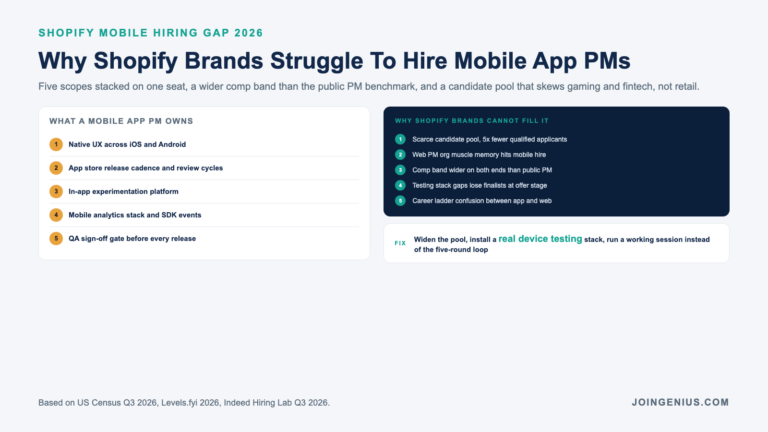
A mobile app PM owns the native UX and the app store release cadence. In-app experimentation and mobile analytics sit under the same role. The QA sign-off gate before every release is a fifth function. Any one scope is a full-time function at a larger company, so stacking all five is where the role breaks.
Where The Role Splits From Web PM
The web PM ships behind a load balancer and rolls back in minutes. The mobile PM ships to two app stores, each with a review window and a forced-update ceiling. The incident model and QA depth are different from web by default. Reviewing the outsourced dev team failure pattern against this split shows which hat to move outside first.
What The Role Does Not Do
A mobile app PM at a Shopify brand does not ship the Shopify Storefront roadmap and does not control the Shop Pay feature cadence. Both arrive as platform updates with their own release notes. The app PM’s job is to integrate against each update without breaking the shipped experience, and teams that skip this scoping lose finalists in week two.
The Comp Gap Between App PM And Web PM
Pay is the next layer where the hiring plan breaks. The web PM band is public and cited everywhere, while the app PM band runs wider and less consistent across companies.
What The Benchmark Says
The median product manager total compensation sits at $235,000 across 4,700 salaries reported to Levels.fyi, but the mobile app PM distribution runs wider on both ends. Senior mobile PMs at brands with a profitable app clear the median, while brands without a live app pay below it. Locking the comp review inside the performance management cycle stops the drift.
The Comparison Table
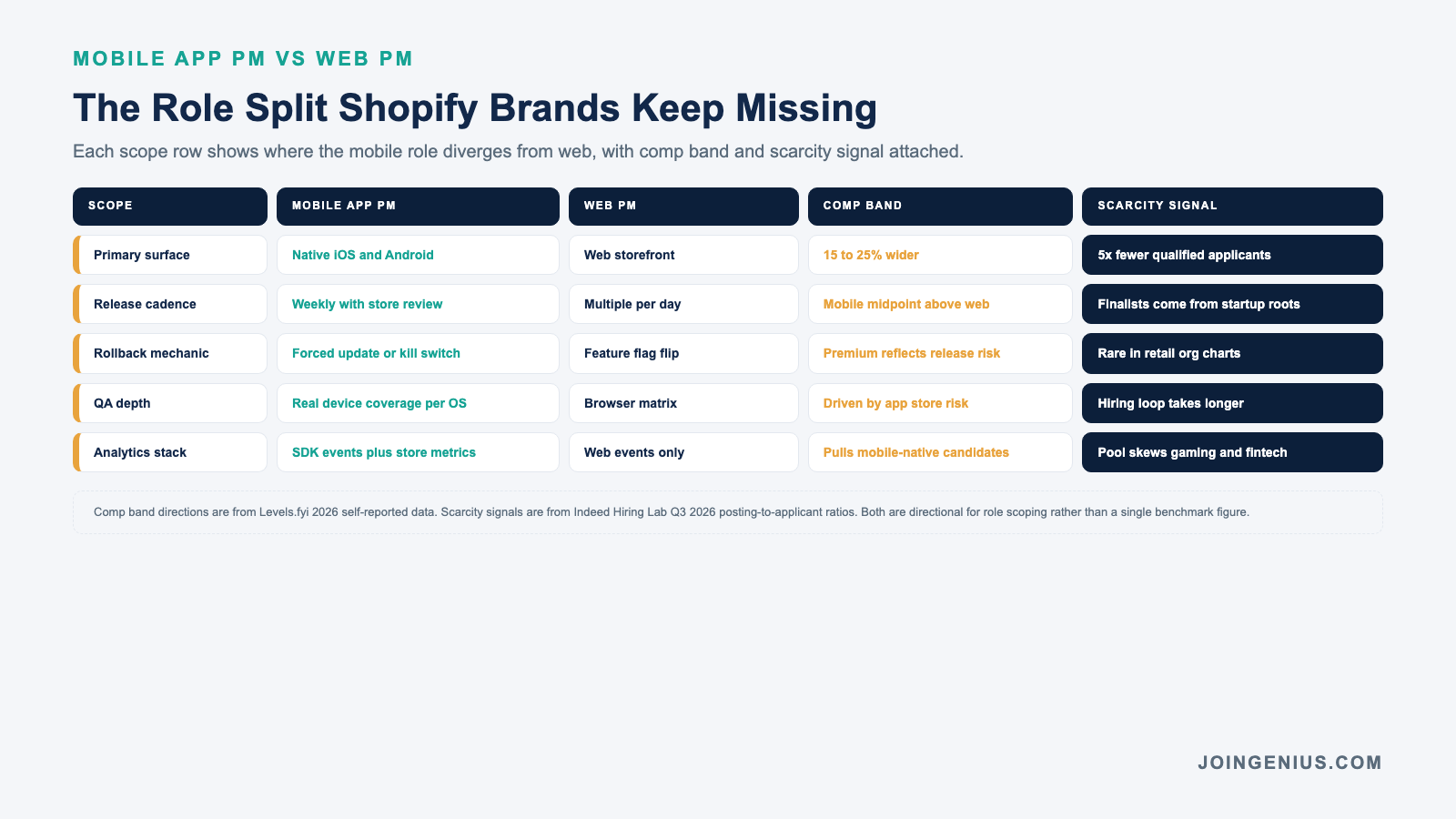
The table below pairs the typical mobile app PM scope against the web PM scope at a Shopify brand, with the comp band and the scarcity signal attached to each.
| Scope | Mobile App PM | Web PM | Comp Band | Scarcity Signal |
|---|---|---|---|---|
| Primary surface | Native iOS and Android | Web storefront | 15 to 25 percent wider | 5x fewer qualified applicants |
| Release cadence | Weekly with store review | Multiple per day | Mobile midpoint above web | Finalists come from startup roots |
| Rollback mechanic | Forced update or kill switch | Feature flag flip | Premium reflects release risk | Rare in retail org charts |
| QA depth | Real device coverage per OS | Browser matrix | Driven by app store risk | Hiring loop takes longer |
| Analytics stack | SDK events plus store metrics | Web events only | Pulls mobile-native candidates | Pool skews gaming and fintech |
The Equity Question
Mobile app PMs at Shopify brands negotiate a different equity mix than web PMs. The reason is that app P and L visibility inside the brand’s finance team is usually weaker than web, so the mobile PM asks for equity to carry the signal the dashboards do not. Brands that prepare for this ahead of the offer land stronger finalists.
The QA And Testing Stack A Mobile PM Will Expect On Day One
The next hiring gap is infrastructure, not candidates. Strong mobile PMs evaluate the testing stack during the offer stage, and brands without a real device coverage plan lose finalists before negotiation.
The Device Coverage Problem
iOS release cycles plus Android fragmentation mean a Shopify brand app needs coverage across dozens of device and OS combinations, not three. Emulator-only coverage misses real-world gesture handling and hardware-specific crash patterns, so release candidates ship with blind spots. The QA lead inherits the cost of every missed combination.
What Strong Candidates Check For
Shopify brands that invest in a mobile app testing stack before posting the mobile PM role get stronger finalists, because the role becomes shippable from week one instead of a six-month tooling procurement project. The offer letter that mentions real device coverage and parallel test runs on day one converts finalists at a higher rate than a salary bump alone.
Why Shopify-Only PMs Are A Different Candidate Pool
Mobile app PMs who have shipped a Shopify-integrated app are rarer than brands expect. The Shopify ecosystem works on different release constraints than a pure-play SaaS mobile app, and candidates who have shipped on both are a small subset of the market.
Platform Native Versus Platform Agnostic
A platform-agnostic mobile PM has built apps on a custom backend and a stack of their own choice. A Shopify-native mobile PM has shipped against the Shopify Storefront API and the Shop Pay flow. The second group is smaller because the platform-native track is younger and the Shopify mobile ecosystem matured in the last three years.
The Supply Side Limit
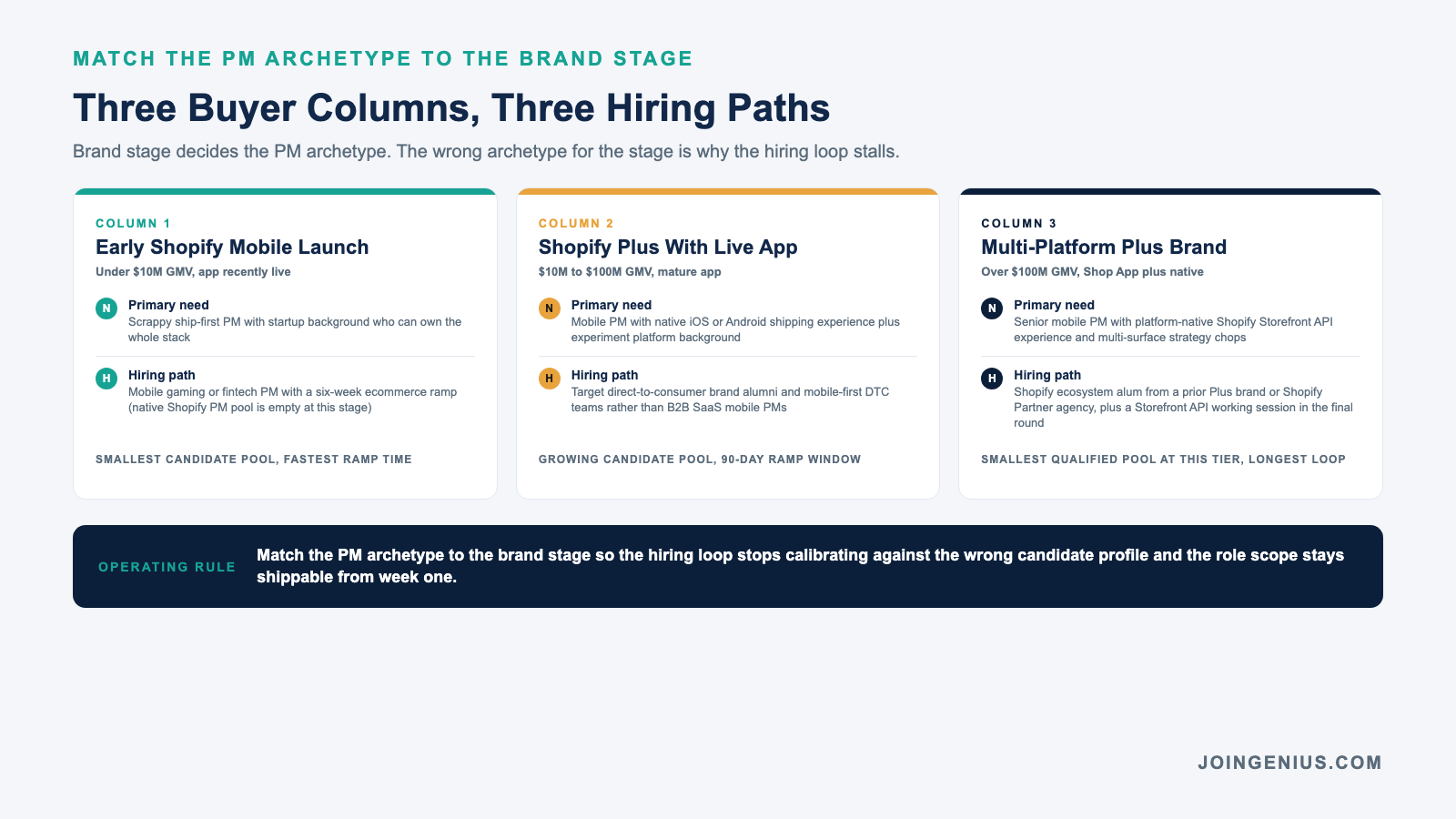
The nearest adjacent pool is PMs from mobile gaming and fintech, who are familiar with store review cycles but not with ecommerce checkout math. Brands that keep rejecting these candidates stay unfilled, and the ones that invest in a six-week ramp fill the seat. Reviewing an outsourcing option against the full recruitment cost tells the brand which path moves faster.
The Agency Alternative
Some Shopify brands skip the direct hire and run the role through a fractional PM or an agency for the first twelve months. The option works when the brand needs to launch before it can staff, and it builds the role spec against real shipped evidence rather than a template job description.
The Hiring Process That Actually Converts Mobile PM Finalists
The hiring process stops the mobile PM pipeline more often than the candidate pool does. Shopify brands run the same five-round loop they use for web PMs, and the top mobile candidates drop out by round three.
Where Most Processes Lose Finalists
The standard loop opens with a product sense screen and a case study, followed by a data exercise and multiple cross-functional panels. Strong mobile PM candidates read this loop as not calibrated for mobile work and move on to a company that runs a working session instead. The time-to-offer data on this role explains the drop-off.
The Working Session Pattern
Brands that convert strong mobile PM finalists run a two-hour working session on a real app constraint, often a store review rejection or a critical path performance regression. The session tests judgment and craft in parallel, and it shows the candidate the actual environment they would ship into. Instrumenting candidate conversion against clear talent acquisition metrics closes the loop.
The Reference Check That Catches Stayers
The strongest predictor of a mobile PM working out at a Shopify brand is a reference check with a prior engineering lead, not a prior product leader. The engineering lead knows whether the PM cleared QA blockers or pushed them to a later release. Brands that run this reference early filter out the archetype that over-promises on the first roadmap.
Conclusion
Shopify brands struggle to hire mobile app product managers because the role bundles native UX with store operations, plus a QA sign-off gate that web PMs never touch. The comp band is wider than the public PM benchmark and the Shopify-native candidate pool is small.
The brands that fill the seat make three changes. They widen the pool to include mobile gaming and fintech PMs who can ramp on ecommerce checkout in six weeks. They install a real device testing stack before posting. They replace the generic PM loop with a working session on a real app constraint.