
“Is IT outsourcing a smart move or a big risk?”
This question challenges business leaders to decide between outsourcing IT functions or keeping them in-house. The decision impacts costs, access to global talent, and control over operations.
Let’s explore the key IT outsourcing statistics to make more informed decisions.
Top 33+ Statistics (Editor’s Picks)
We’ve handpicked 33+ of the latest IT outsourcing statistics, facts, and trends. Here are 6 that we believe will blow you away.
| 1 | The IT Outsourcing market is currently valued at $617.69 billion |
| 2 | The IT Outsourcing market is expected to reach $806.53 billion by 2029 |
| 3 | 92% of G2000 companies outsource their IT tasks |
| 4 | IT services make up 75% of global outsourcing contracts |
| 5 | Outsourcing IT can save up to $6,474/month (85% savings) |
| 6 | Average contract length for an IT outsourcing agreement is 5 years |
Global IT Outsourcing Market Overview

The IT Outsourcing market is currently valued at $617.69 billion (Mordor Intelligence)
This value reflects IT’s role as a competitive advantage in many organizations. Beyond simple cost reduction, IT outsourcing now focuses on enhancing customer experience, business growth, and competitive disruption, especially with the adoption of cloud services.
The IT Outsourcing market is expected to reach $806.53 billion by 2029 (Mordor Intelligence)
It is growing at a CAGR of 5.48%. This growth comes from more than just cost savings. Companies are also focusing on improving customer experience, growing their business, and staying ahead of competition.
64% of IT leaders globally outsource their software development (Statista)

This indicates that software development is the most common IT function that businesses prefer to outsource.
92% of G2000 companies outsource their IT tasks (ISG)

That’s a lot more compared to the 59% who outsource business processes, showing a clear preference for IT outsourcing among these top companies.
76% of executives outsource their IT functions (Deloitte)
This widespread outsourcing is mainly because it helps handle IT needs more efficiently. Companies do this to access specialized tech skills, control costs, and concentrate on their main goals. Outsourcing IT allows businesses to stay competitive by using outside expertise and the latest technology, without the cost of a big in-house team.
IT services make up 75% of global outsourcing contracts (ISG)

This sector reached $30.4 billion, a 13% increase from the previous year, marking its best year ever. Meanwhile, business services outsourcing fell by 14%, generating $10.3 billion.
Average Cost Savings from IT Outsourcing
Outsourcing IT can save you up to $6,474/month (85% savings)

| Country | Average Salary |
| United States | $7,431 |
| China | $2,499 |
| Poland | $2,285 |
| Ukraine | $1,450 |
| Mexico | $1,378 |
| Malaysia | $852 |
| Vietnam | $589 |
| Argentina | $528 |
| Philippines | $395 |
| Brazil | $388 |
| India | $324 |
IT Outsourcing Statistics by Country
20% of US companies outsource all their IT support to other countries (Go Remotely)
Also, 15% send out all their app development and maintenance, and 10% do the same for their data management. It looks like this trend will continue, with about 9% to 11% of companies planning to outsource more IT work abroad.
Ukraine is a major center for IT outsourcing in Central and Eastern Europe (N-iX)

The country has seen its IT workforce grow to 200,000 professionals and hosts over 1,600 IT outsourcing companies, a number that has doubled over the past five years.
India leads the global IT outsourcing market with over 55% market share (Gitnux)
This top position comes from its large number of skilled IT professionals and cost-effective services. India’s good English skills and commitment to quality also make it a preferred choice for companies needing IT outsourcing.
59% of American companies choose India for outsourcing (Orient Software)

Compared to other Asian countries like China and the Philippines, India is a stronger leader in outsourcing. This leadership is expected to continue, with India’s IT Outsourcing market set to bring in $10.51 billion in 2024.
Software development in Asia is projected to grow annually by 9.16% over the next five years (Statista)
This growth highlights Asia’s role as a major hub for software development outsourcing, featuring numerous centers of tech activity across the continent.
The outsourcing industry in Europe is valued at $138.20 billion (Statista)

Eastern Europe contributes significantly and has become a key hub for software development. The region offers competitive rates and nearshoring options for Western European companies.
Mexico is the only North American outsourcing destination that offers a labor cost advantage to Western countries (Statista)
U.S. companies often choose Mexico for software development due to the high English fluency and cultural familiarity.
IT Outsourcing Statistics by Industry
Accounting and IT services are the most popular outsourced processes for small businesses (Clutch)
These functions are the most commonly outsourced due to their complexity, freeing up resources for core business operations. Digital marketing follows closely, with 34% of small businesses outsourcing this area.
84.7% of software development projects are for enterprise applications (Radixweb)

This is the largest category, with business automation making up 53.6% of projects and eCommerce 38.5%.
The IT outsourcing penetration rate in the manufacturing sector is 32% (Gitnux)
This shows that a good portion of the sector relies on external IT services. Manufacturers outsource to get the latest technology and specialized skills without the high costs of managing these services themselves. This helps them improve efficiency, manage costs better, and stay flexible in how they operate.
The financial services sector has the highest outsourcing rate for app development at 72% (Radixweb)
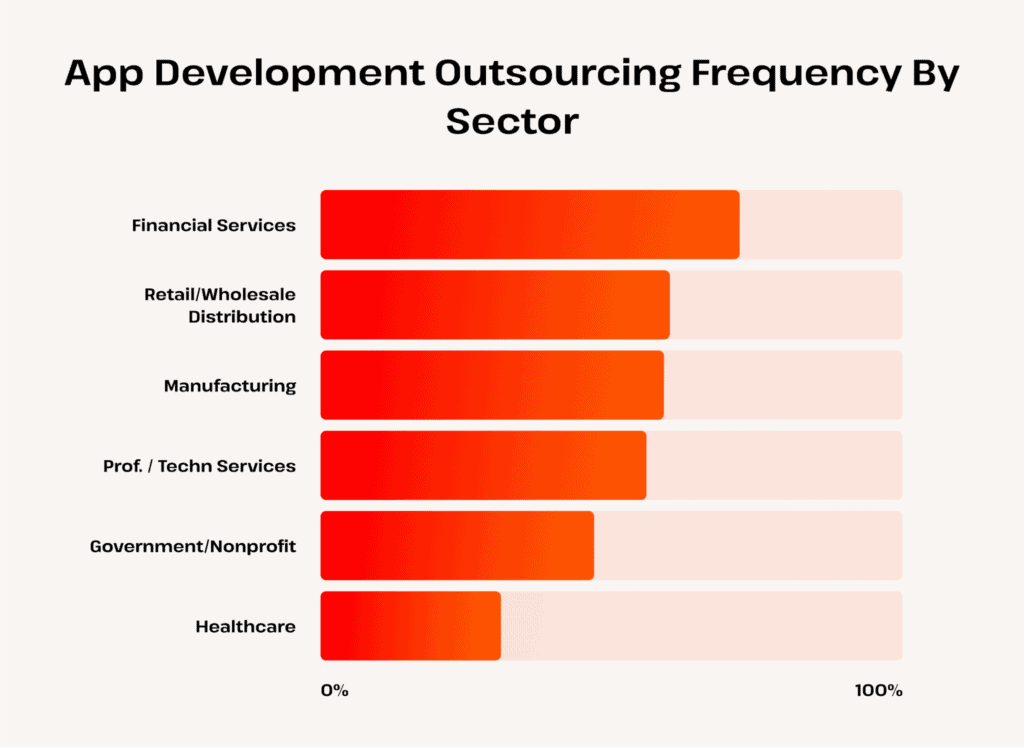
The likelihood of outsourcing app development varies significantly across industries. Retail and wholesale businesses follow at 60%, while the healthcare industry has a lower rate at 31%.
Here is a table showing the percentage of organizations in different sectors that outsource app development:
| Sector | Outsourcing Frequency (%) |
| Financial Services | 72% |
| Retail/Wholesale Distribution | 60% |
| Manufacturing | 59% |
| Professional/Technical Services | 56% |
| Government/Nonprofit | 47% |
| Healthcare | 31% |
Information technology is the most outsourced industry (Radixweb)

About 37% of IT operations are handled by external services, with companies spending an average of 13.6% of their IT budgets on outsourcing, highlighting its importance for improving operations and cutting costs.
IT Outsourcing Future Outlook and Trends
Web development is the most sought-after tech skill (Statista)
58.53% of employees surveyed are looking for staff with web development skills. DevOps skills are next, sought by 35.55% of employees, followed by Database Software skills at 27.5%. Additionally, nearly a quarter of employees are searching for expertise in AI, Machine Learning, and Deep Learning, at 24.6%.
Over 75% of executives plan to outsource IT services (Radixweb)

The most common areas for outsourcing include IT infrastructure services, app and software development, and cybersecurity.
Asia-Pacific is expected to see the fastest growth in the IT outsourcing market (Gitnux)
The growth rate is projected at 6.2% per year. The region’s demand for advanced technology and affordable services drives this growth. IT infrastructure is expanding. Digital transformation projects are increasing. Government policies are supportive. These factors make Asia-Pacific a major hub for IT outsourcing. More international companies are coming here for efficient and innovative IT services.
A 60% increase in revenue is seen by companies that effectively implement Agile (Harvard Business Review)
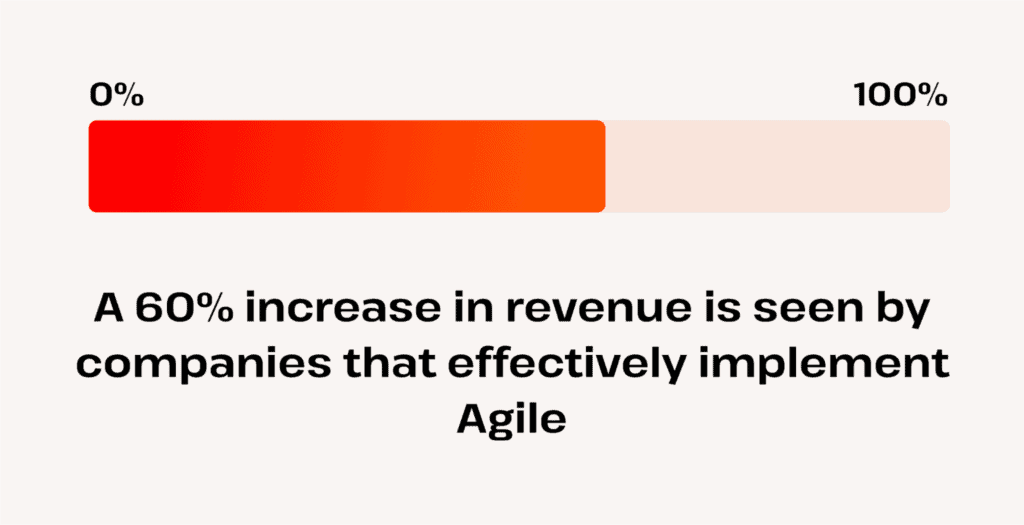
According to the Harvard Business Review, only 18% of companies have successfully mastered Agile, highlighting the difficulties in its implementation.
More than three-quarters of all executives reported plans to outsource IT functions (Deloitte)
Cybersecurity is the top area for outsourcing, followed by app and software development, and IT infrastructure services. This trend reflects the growing need for specialized IT skills and the strategic move to enhance security, innovation, and infrastructure management through outsourcing.
Women constitute about 16% of the global IT workforce (Wise)
This percentage matches the number of women who earn degrees in software engineering, also at 16%, according to data from Wise.
Outsourcing software development can cut the time-to-market for new products by 25% (Mckinsey)
This was highlighted in a McKinsey report on a global hotel chain that managed to speed up its software releases by outsourcing, demonstrating the efficiency benefits of such practices.
81% of executives view cybersecurity as their top technological challenge (Deloitte)

With cybersecurity being a critical concern, 3 out of 4 executives collaborate with external partners to enhance their security measures.
The IT sector is predicted to account for 14% of the world’s carbon footprint by 2040 (Netcorp)
This significant environmental impact makes the adoption of green software crucial. Sustainability is key not only for the planet but also for brands to build trust with environmentally conscious customers.
52% of companies use outsourcing for AI and Machine Learning consulting (Deloitte)

A recent study shows that this approach helps them fill the expertise gap in these rapidly evolving tech fields.
34% of companies are collaborating with external partners to support their Robotics Process Automation (RPA) efforts (Deloitte)
According to Deloitte, this partnership trend is expected to increase as RPA becomes more integral to business operations.
The demand for software developers, testers, and QA experts is expected to grow by 22% in 2030 (US Bureau of Labor)
This makes them the fastest-growing occupations in the country, according to projections by the US Bureau of Labor.
The custom software development market is projected to reach $126 billion by 2026 (Global Market Insights)

This growth, as reported by Global Market Insights, is driven by the increasing demand for customized solutions that meet specific business needs and integrate well with existing systems.
The average contract length for an IT outsourcing agreement is 5 years (Gitnux)
This time frame allows for a stable partnership, helping both the service provider and the client to plan better and achieve long-term IT goals. Longer contracts help ensure consistent improvements and more effective integration of IT services with business operations.
Conclusion
Business leaders often have to choose whether to handle IT tasks themselves or hire outside help.
Most top global companies—about 92%—outsource their IT tasks. The market for IT outsourcing is growing fast and is expected to reach over $800 billion by 2029. Also, companies that outsource IT can save a lot, with possible savings up to $6,474 every month.
These facts show that IT outsourcing can bring big benefits and growth opportunities. It looks like outsourcing IT could be a really smart move.
It’s important to keep up with the latest trends in IT outsourcing. Technologies like artificial intelligence are changing business rapidly, so knowing the latest can help you make smarter choices. By staying up-to-date on IT outsourcing, your company will be better equipped to handle IT challenges.
FAQ
How big is the IT outsourcing industry?
The IT outsourcing industry is valued at over $617 billion and is projected to reach approximately $806.53 billion by 2029.
What percentage of work is outsourced in the IT industry?
About 64% of IT leaders globally outsource their software development, which is the most common IT function that businesses prefer to outsource.
Why do companies choose to outsource their IT functions?
Companies outsource IT to save money, access global talent, and focus on core business areas.
What types of IT functions are most commonly outsourced?
Software development, IT support, and cybersecurity are the most commonly outsourced IT functions.