
A candidate clears every check. The identity is confirmed, the employment history matches, and the references are glowing. Months later, a problem surfaces: a past venture nobody mentioned, a brand that quietly collapsed, or a website that looks suspiciously like someone else’s. The check was not wrong. It simply never looked in the place where the warning was sitting.
Standard background checks are built around a person’s official records. They are good at confirming who someone is and what they have formally done. They are much weaker at showing the digital assets a person has controlled, and that is where many of the more telling details live. If you are tightening up your hiring pipeline, it is worth understanding what the usual screening leaves out and how a lawful, careful domain review can fill part of the gap.
What Standard Background Checks Cover and Miss
Most employment screening covers a familiar set of areas: identity verification, criminal record searches where the law allows them, employment and education confirmation, and in some cases credit or professional licence checks. These are valuable, and nothing in this guide suggests replacing them.
The weakness is scope. These checks are designed around formal institutions that keep records: courts, employers, universities, and licensing bodies. A person’s online ventures rarely sit in any of those databases. A founder who launched three small businesses, closed two of them, and let their websites lapse will not appear in a standard report as anything other than a gap in an employment timeline, or not at all.
That matters most for roles where the person’s history is entrepreneurial rather than corporate. Founders, executives who have run their own companies, and senior hires who come from the startup world often have a trail of ventures that no employer ever verified. The candidate’s own account is frequently the only account available.
What Domain Ownership Records Can Reveal
A domain name has a registration record. That record can show when the domain was first registered, which registrar handled it, and, depending on the privacy settings in place, details about the registrant. Over time, it also shows when ownership or contact details changed.
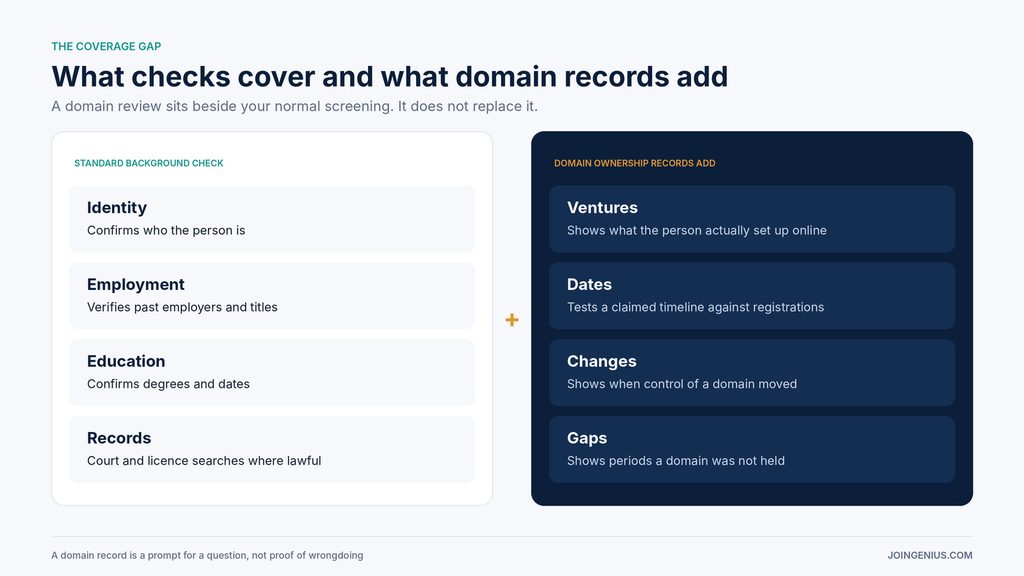
This kind of record adds a different kind of evidence. A standard check tells you what institutions have recorded. A domain record tells you what the person actually set up, held, and let go of online. It can confirm that a business existed when the candidate says it did, or raise a question when the dates do not line up.
It is important to be realistic about what this evidence is. A domain record is a prompt for a question, not proof of wrongdoing. Domains change hands for ordinary reasons. Companies rebrand, founders sell businesses, and registrations lapse by accident. The value of the record is that it gives you something specific to ask about, and a specific question is far more useful in an interview than a general one.
Red Flags Hidden in Domain Ownership
Several patterns are worth watching for. None of them is conclusive on its own, and each has an innocent explanation that you should check first.
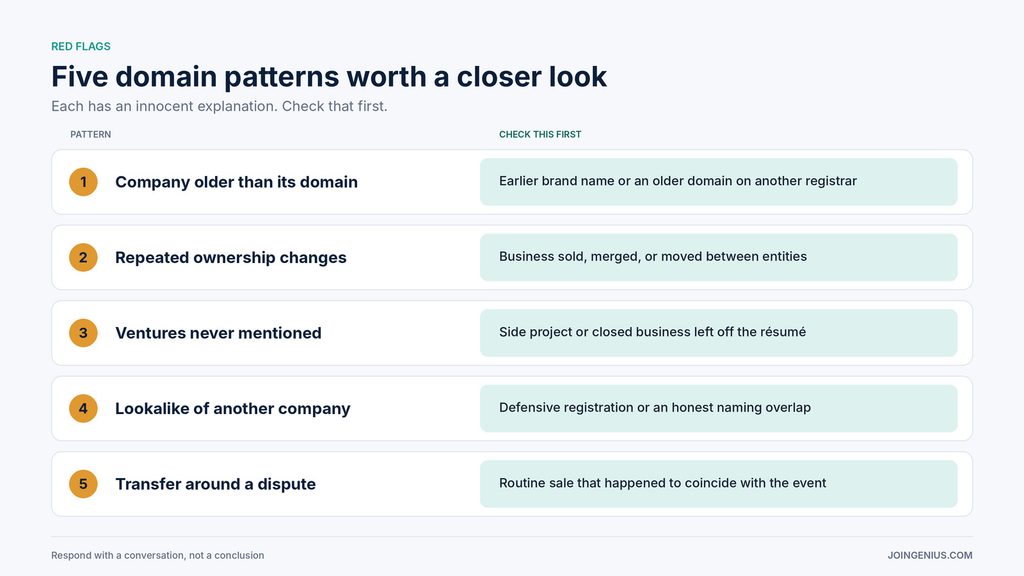
A company that is older than its domain is the first. If a candidate says they built a business five years ago but the only matching domain was registered last year, there may be a simple explanation, such as an earlier brand name. There may also be a gap in the story.
Repeated ownership changes are another. A domain that has passed through several owners in a short time can point to a business that was sold, abandoned, or caught up in a dispute. Ask what happened.
Ventures that were never mentioned deserve attention too. A domain tied to the candidate’s name or company that does not appear on their résumé is not a problem in itself, but it is worth understanding. Side projects are normal. Undisclosed failures are a different matter.
Lookalike domains are a sharper warning. A domain that closely resembles another company’s name, held by the candidate or their business, can indicate poor judgment or something worse. Ask about the intent.
Finally, sudden transfers around a known dispute, such as a lawsuit, a partner leaving, or a public complaint, are worth a closer look. Again, the explanation may be ordinary, but the timing is a reason to ask.
For each flag, the right response is a conversation. Treat the record as the start of a question and let the candidate explain.
Historical Domain Records Show Ownership Changes Checks Overlook
The most useful domain evidence is often not the current record but the history behind it. A current registration shows who holds a domain today. A timeline shows how it got there.
Reviewing historical WHOIS records shows who has registered a domain over time and when its ownership changed, which standard background checks rarely cover.

When you read an ownership timeline, look at four things. The creation date tells you when the domain first existed. Changes in the registrant show when control moved. Registrar changes can indicate a move between providers, which is often routine. And gaps or lapses show periods when the domain was not actively held.
Put those against the candidate’s story. If the timeline shows a domain created when the candidate says their business launched, held steadily through the years they say they ran it, and transferred when they say they sold it, the record supports them. If the dates diverge, you have a specific, fair question to ask.
It is also important to know the limits. Many registrations use privacy services, and registrant details are often redacted. In those cases, a timeline may show dates and changes without showing names. That is a real constraint, and it is one reason domain records should never be used as the only basis for a decision. Where the details are hidden, you simply have less to go on, and you should not read anything into the absence.
How to Add a Domain Review to Your Screening Process
A domain review works best as a short, structured step, not an open-ended investigation.

Begin with consent. Tell the candidate that you will review public records related to the ventures they list, and get their agreement in writing as part of your normal screening consent. This protects the candidate and your company, and it signals that the process is fair.
Next, list the ventures. Ask the candidate to name the companies and projects they have run, along with the domains they used. This keeps the review focused on the business history they have chosen to share, not on anything else.
Then review the records for those domains. Look at creation dates, ownership changes, and gaps, and compare them with the candidate’s account. Record what you find in plain language.
After that, ask the candidate. Bring specific, neutral questions to an interview, such as “I see this domain changed hands in 2021, can you tell me what happened?” Listen for a clear, consistent explanation.
Finally, document the decision. Note what you checked, what you found, what the candidate said, and how it informed the outcome. A written record keeps the process consistent across candidates and helps you defend it if it is questioned.
If you are building a team from scratch and making early senior hires, this guide to hiring for startups offers useful advice on balancing speed with care, and a domain check fits neatly into that kind of lightweight verification.
Legal and Fairness Guardrails
A domain review has to be done responsibly. Get written consent, and follow the screening, employment, and data protection laws that apply where you and the candidate are located. Some places restrict how screening information can be used, and you may have obligations to tell candidates about adverse decisions.
Use only business-related records tied to the ventures the candidate has disclosed. Do not use domain data to look into someone’s home address, family, or private life. Never base a decision on a single signal, and always give the candidate a chance to explain. Apply the same process to every candidate for the same kind of role, so that the review is fair and consistent.
Add One More Question to Your Screening
Domain data does not replace a background check. It adds one more thing to check, in an area the standard process tends to ignore. Used carefully, it helps you test a candidate’s story against the digital trail of the ventures they have run, and it gives you better questions to ask.
A practical first step is to add one domain question to your screening checklist for founder and senior roles: “Which domains did you register for the ventures you have run, and what happened to them?” The answer, and how well it matches the records, will tell you a good deal. If you work in a regulated field, this guide on hiring regulatory specialists shows how verification and judgment fit together in higher-stakes hiring.