
Robots are changing how we work. The global robotics industry will reach $43.32 billion by 2027, with over 2.5 million industrial robots already in operation worldwide. This article covers global market trends, industry adoption rates, automation impacts on jobs, and investment forecasts. You’ll learn how Asia controls one-third of robotics revenue, why electronics leads with 28% of new installations, and how 72% of organizations plan to increase AI investments. These insights will help you make strategic decisions about automation for your business in this rapidly evolving landscape.
Top 6 Robotics Industry Statistics (Editor’s Picks)
We’ve handpicked 55+ of the latest robotics industry statistics, facts, and trends. Here are 6 that we believe will blow you away.
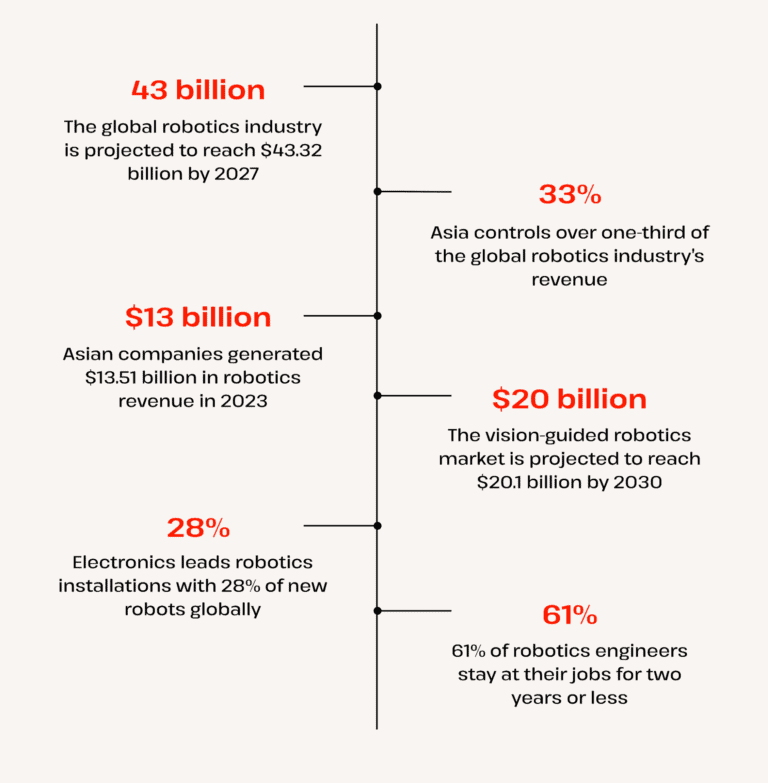
| 1 | The global robotics industry is projected to reach $43.32 billion by 2027 |
| 2 | Asia controls over one-third of the global robotics industry’s revenue |
| 3 | Asian companies generated $13.51 billion in robotics revenue in 2023 |
| 4 | The vision-guided robotics market is projected to reach $20.1 billion by 2030 |
| 5 | Electronics leads robotics installations with 28% of new robots globally |
| 6 | 61% of robotics engineers stay at their jobs for two years or less |
📣 Reads You Can’t Miss!
🔥 35+ NEW Job Automation Statistics 2025
⭐ How Many Software Developers Are In The World? (2025)
🚨 33+ New Software Development Outsourcing Statistics 2025
Robotics Industry Statistics
The global robotics industry is projected to reach $43.32 billion by 2027 (Statista)
The robotics industry is growing rapidly as automation becomes more common across industries like manufacturing, healthcare, and logistics. Advances in AI and machine learning are making robots smarter and more efficient, driving higher adoption rates.
Asia controls over one-third of the global robotics industry’s revenue (GlobeNewsWire)
Asian countries, led by China, Japan, and South Korea, generate more than 33% of the total revenue in the robotics industry. These nations invest heavily in automation, industrial robotics, and AI-driven manufacturing, keeping them at the forefront of the sector.
Asian companies generated $13.51 billion in robotics revenue in 2023 (Market.us)
Asia remains the global leader in robotics, with companies in the region far outpacing competitors in revenue. China, Japan, and South Korea continue to drive innovation and production, securing their position as the top manufacturers.
Europe dominates the commercial service robotics market in revenue (LinkedIn)
More revenue is generated from commercial service robots in Europe than in any other region. Advancements in AI-driven automation and a growing need for service robots in industries like healthcare and retail fuel this lead.
The vision-guided robotics market is projected to reach $20.1 billion by 2030 (NextMSC)
Robots equipped with advanced vision systems are becoming more common in industries like manufacturing, healthcare, and logistics. As demand for precision automation grows, this market is set to expand rapidly over the next decade.
The mobile cobots market is expected to reach $7.66 billion by 2030 (Enterprise Apps Today)
Mobile collaborative robots, or cobots, are gaining traction in industries like logistics, healthcare, and manufacturing. Their ability to work safely alongside humans while navigating spaces autonomously is driving rapid adoption.
Global Robotics Installations by Industry
Electronics leads robotics installations with 28% of new robots globally (Statista)
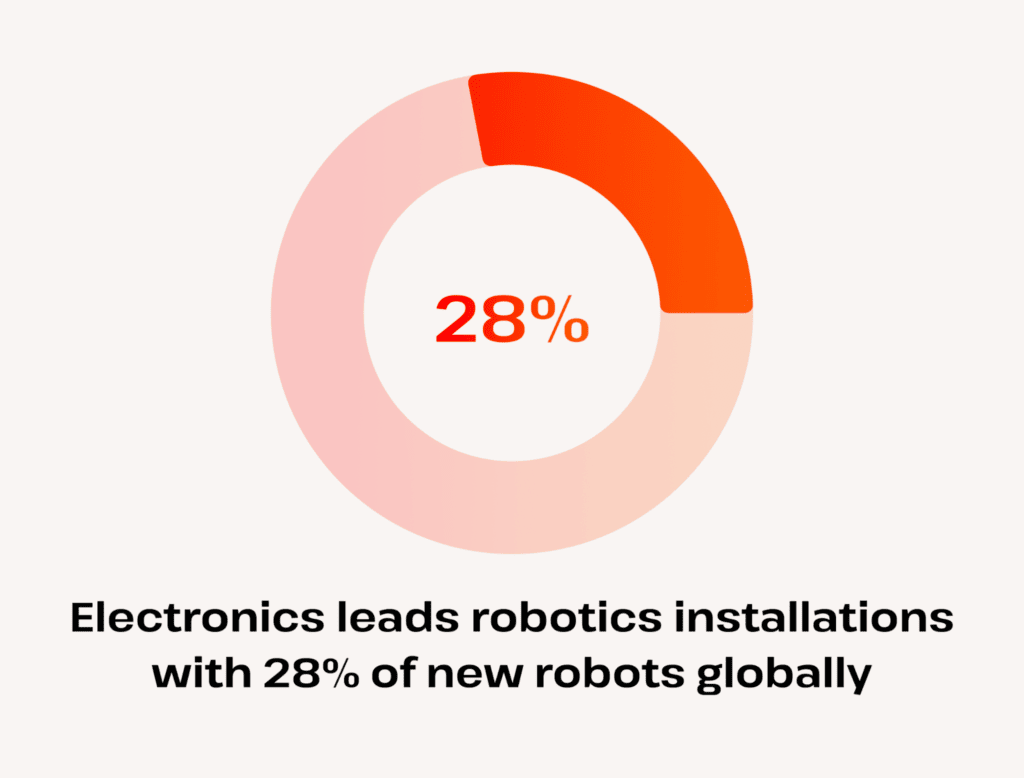
Electronics is the largest customer industry for robotics, accounting for 28% of all newly installed robots worldwide. The high demand for precision and efficiency in electronics manufacturing, particularly for tasks like component assembly and inspection, drives substantial robotics adoption.
Automotive industry follows with 25% of new robot installations (Site Selection Magazine)
The automotive sector makes up 25% of global robotics installations. Robotics in automotive manufacturing improves both productivity and safety, handling tasks such as welding, painting, and parts assembly—areas where automation has become essential for the industry’s efficiency.
Metal and machinery sector accounts for 12% of new robotics installations (IFR)
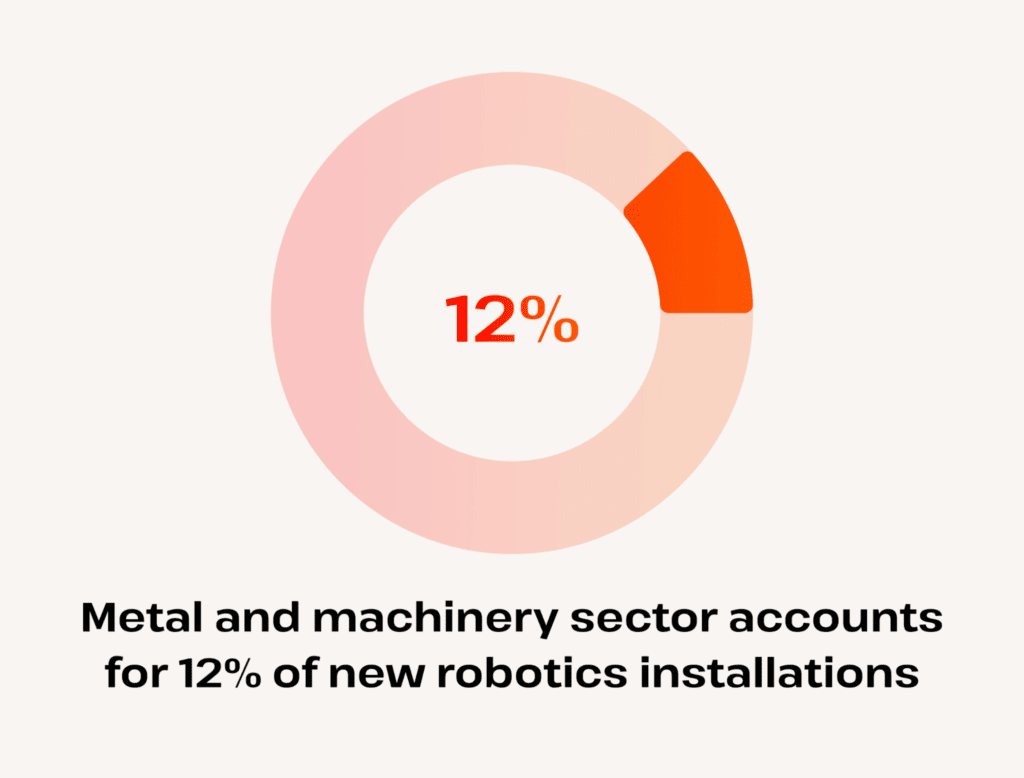
The metal and machinery sector is the third-largest market for robotics, at 12% of new installations. Automation supports metal fabrication processes like cutting, welding, and material handling, reducing manual labor in these high-demand areas.
Plastics and chemicals represent 4% of robotics installations worldwide (Site Selection Magazine)
With 4% of new robot installations, the plastics and chemical industry increasingly turns to robotics to improve production precision and worker safety. Robots in this field help automate material handling, product assembly, and quality control tasks.
Food and beverage sector sees 3% of new robotics installations (Statista)
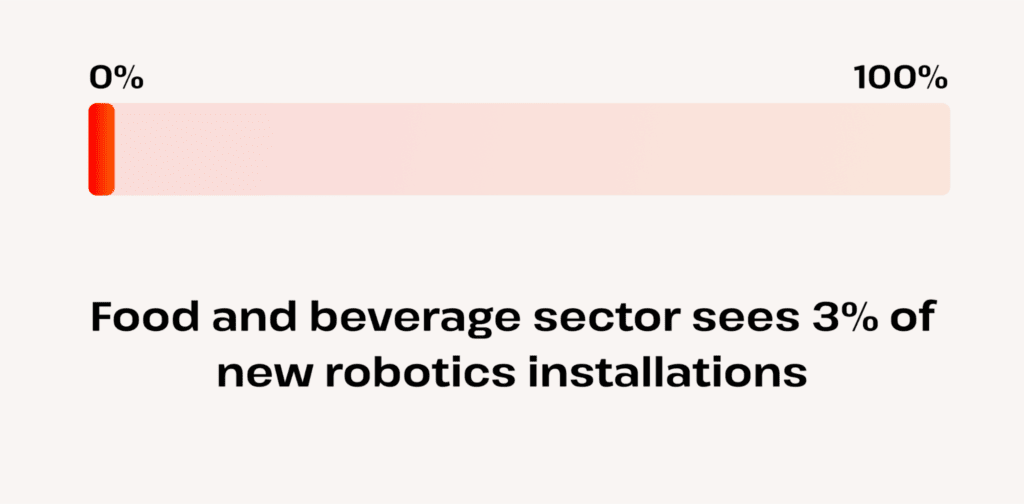
The food and beverage industry accounts for 3% of robotics installations, using robots for packaging, sorting, and quality checks. In this sector, robotics also addresses challenges related to hygiene and speed in handling products, helping meet rising consumer demand efficiently.
Here’s a quick look at the top-ranking countries for robot density:
| Rank | Country | Robot density (per 10,000 employee) |
| 1 | South Korea | 1012 |
| 2 | Singapore | 730 |
| 3 | Germany | 415 |
| 4 | Japan | 397 |
| 5 | China | 392 |
Industrial Robotics Statistics
Over 310,700 industrial robots operate in the U.S. (Zippia)
The United States now has more than 310,700 industrial robots in use, primarily in manufacturing settings. Factories rely on these robots to handle tasks like assembly, welding, and quality control, helping increase production efficiency.
By 2026, industrial automation will become a $264.69 billion market (Kissflow)
Forecasts indicate that the industrial automation services market will expand from $147.06 billion in 2019 to $264.69 billion by 2026. This upward trend underscores a growing reliance on automation across industries seeking operational efficiency.
2.5 million industrial robots are currently in use worldwide (Team Stage)
Across sectors like automotive, electronics, and logistics, 2.25 million industrial robots are in operation worldwide. This growth in robotics underscores a major shift in labor dynamics, as companies balance productivity demands with the cost and reliability benefits of automation.
33% of the global robotics industry’s revenue is dominated by Asia (Exploding Topics)
Asia leads the world in robotics industry revenue, holding over 33% of the global market share. With powerhouse countries like Japan, China, and South Korea investing heavily in automation, the region has become a global hub for robotics manufacturing and innovation.
Job Automation Statistics
By 2030, 46.5% of jobs in the energy, utilities, and mining industries in North America are at high risk of automation (Statista)
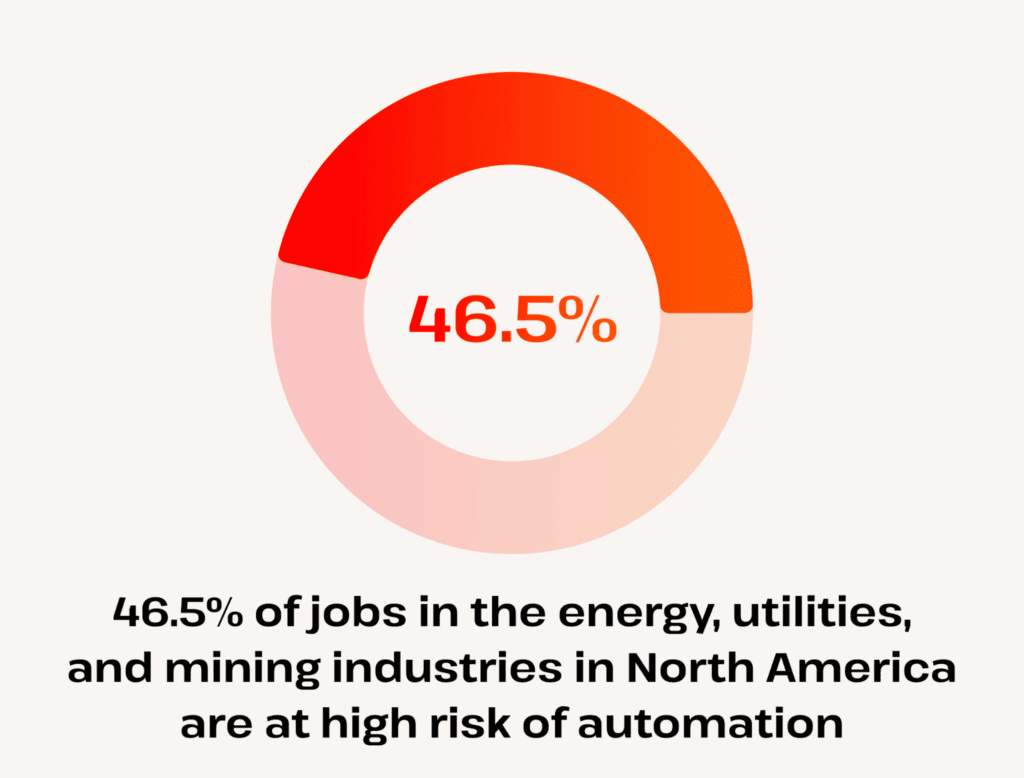
Approximately 46.5% of jobs in North America’s energy, utilities, and mining sectors are considered to be at high risk of automation. This statistic highlights the significant impact automation technologies could have on this industry, as companies increasingly adopt advanced automation tools to enhance efficiency and reduce costs.
41 million retail jobs are at risk from automation by 2040 (edoxi)
By 2040, automation could impact up to 41 million retail jobs, with cashiers, stock clerks, and customer service roles most at risk. Self-checkout, robotics, and AI are driving this shift to boost efficiency and cut costs.
AI and automation have caused wage reductions of up to 70% since 1980 (Forbes)
The rise of AI and automation has led to wage declines of as much as 70% in certain industries since 1980. Sectors with repetitive tasks, like manufacturing, have seen the largest impacts, as automation replaced many roles and lowered the demand for human labor.
1.7 million manufacturing jobs have been lost to automation so far (LEFTRONIC)
Since the year 2000, automation has replaced 1.7 million jobs in the manufacturing sector. Automation advancements, particularly in robotics and AI, have led to streamlined production but have significantly reduced the need for human labor in repetitive tasks.
73% of business leaders believe AI will double employee productivity by 2035 (AMS)
A recent survey shows that 73% of business leaders expect technology and AI to make employees at least twice as productive by 2035. This optimistic outlook reflects the transformative potential of AI tools in improving workflows, decision-making, and time management.
83% of IT leaders say workflow automation is essential for digital transformation (Kissflow)
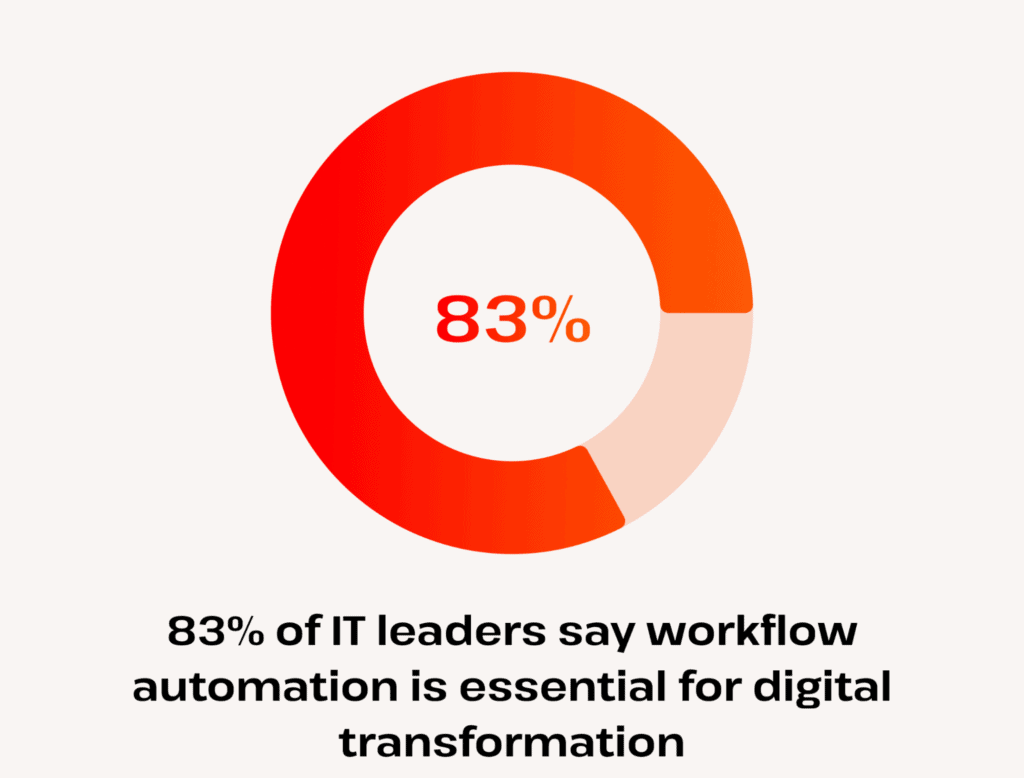
83% of IT leaders see workflow automation as essential for successful digital transformation. Automation makes processes smoother, cuts down on errors, and boosts productivity. These benefits are crucial for keeping up with fast-evolving technology needs.
79% of customer service specialists see AI and automation as crucial to their strategies (HubSpot)
79% of customer service specialists see AI and automation as essential. This shows a clear trend: companies are using technology to boost customer interactions and streamline their processes. To keep pace, businesses should start adopting these tools. This can lead to better service and more efficient operations
75.7% of digital marketers utilize AI tools in their work (Harpa AI Technologies)
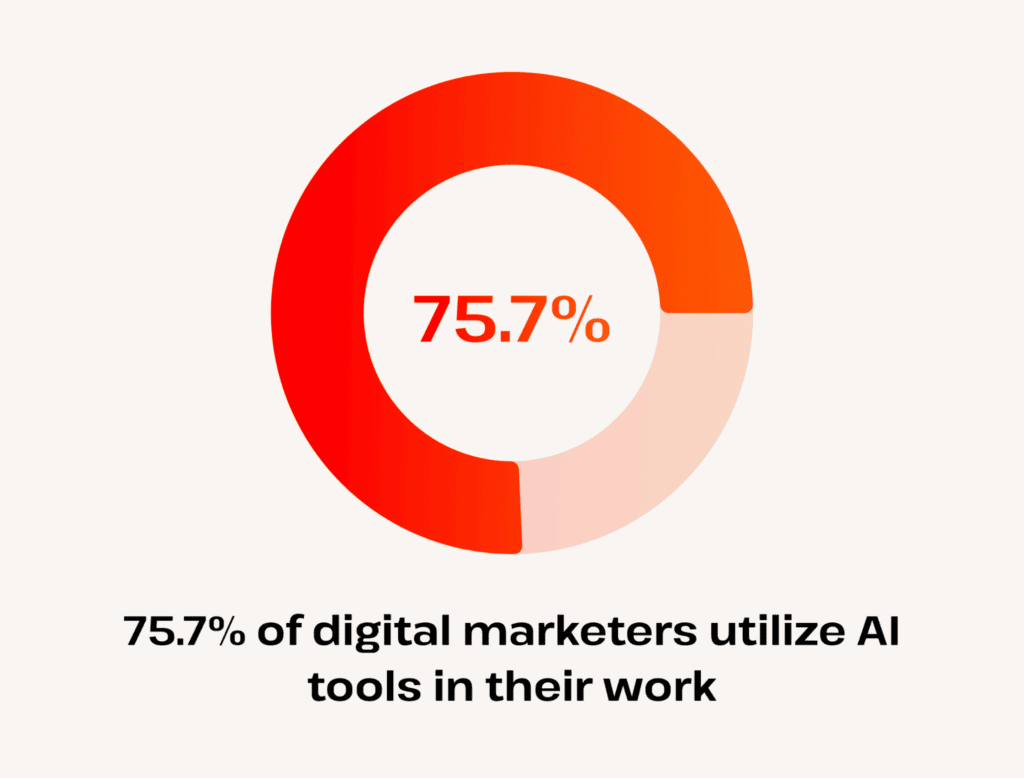
A recent survey reveals that 75.7% of digital marketers now use AI tools to enhance their campaigns. These tools help marketers break down customer data, create personalized content, and make smarter ad spending decisions. In today’s competitive digital landscape, using AI isn’t just helpful—it’s essential.
61% of sales professionals believe generative AI will enhance customer service (Salesforce)
According to survey results, 61% of sales professionals think generative AI will improve their ability to serve customers. This optimism suggests a growing recognition of AI’s potential to streamline service, personalize interactions, and respond more effectively to customer needs.
69% of HR professionals using hiring automation reported a significant time reduction in the hiring process (Kissflow)
A survey revealed that 69% of HR professionals using automation in hiring reported a significant reduction in the time spent on the hiring process. This improvement allows HR teams to streamline their workflows, focus on candidate quality, and enhance the overall efficiency of recruitment efforts.
The market for generative AI in financial services is projected to surge from $0.85 billion in 2022 to $9.48 billion by 2032 (Keymakr)
The Generative AI in Financial Services Market reached a value of $0.85 Billion in 2022 and is expected to increase at a CAGR of 28.1% from 2022 to 2032, which is equivalent to $9.48 Billion, surpassing by a large margin the number in 2022.
72% of organizations are planning to increase their investment in AI (Big Data Wire)
A recent survey shows that 72% of organizations plan to increase their spending on AI technologies. This reflects a clear shift in confidence, as companies see AI’s potential to improve efficiency and sharpen decision-making.
Robotics and Employment Statistics
Nearly 15% of workers have been displaced by robots (BYU)
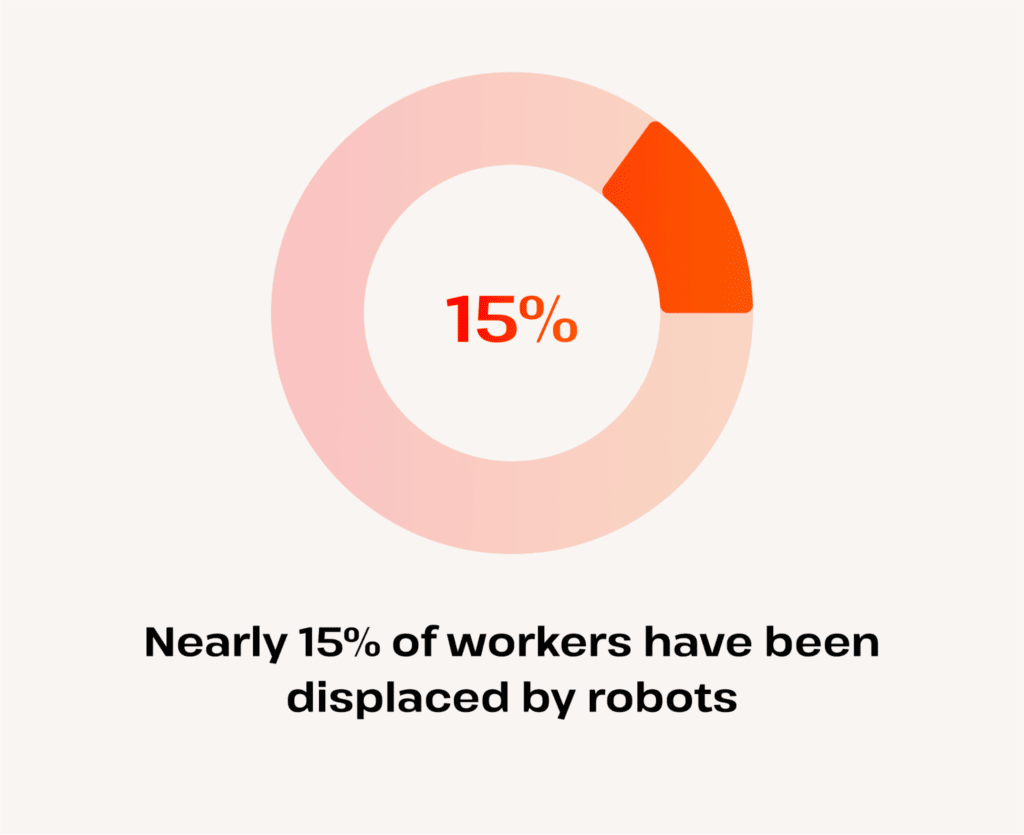
Robotic automation has already replaced jobs in sectors such as production and warehousing. While efficiency increases, the shift raises concerns about job security and the need for retraining programs.
65% of robotics engineers have a bachelor’s degree (Zippia)
The majority of robotics engineers enter the field with a bachelor’s degree, often in mechanical, electrical, or software engineering. While advanced degrees can open more opportunities, many professionals start their careers with just an undergraduate education.
61% of robotics engineers stay at their jobs for two years or less (SEO.AI)
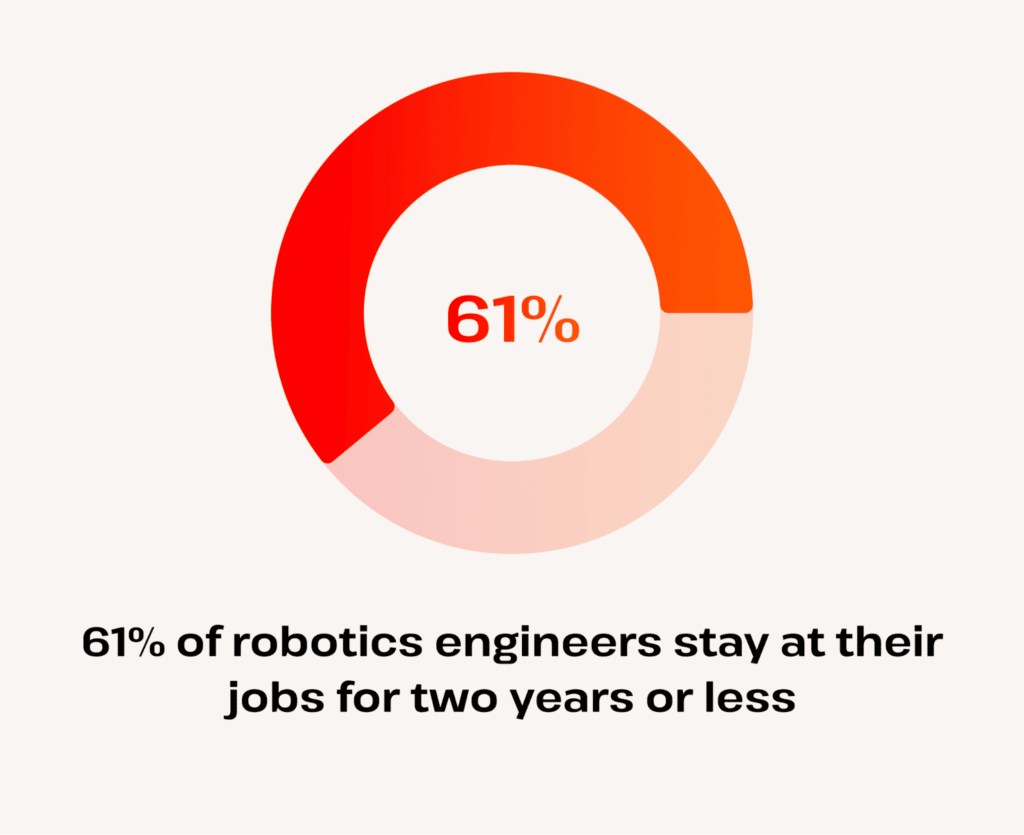
Robotics engineers tend to change jobs frequently, often moving to new roles within two years. High demand for their skills and rapid advancements in the industry create constant opportunities for career growth.
More than half of robotics engineers work in small to mid-sized companies (Zippia)
While big tech firms dominate headlines, many robotics engineers build their careers at companies with fewer than 500 employees. These businesses, ranging from startups to specialized automation firms, are key drivers of innovation in the industry.
How Many Robots Are There?
There are an estimated 3.4 million industrial robots in use worldwide (Stanford)
Industrial robots are a key part of modern manufacturing, handling tasks like assembly, welding, and packaging. With automation on the rise, this number continues to grow each year.
China leads the world in new industrial robot installations (Asia Briefing)
China is installing more industrial robots than any other country, rapidly expanding its automation capabilities. This growth is driven by high demand in manufacturing, electronics, and automotive production.
Professional service robot installations are increasing worldwide (Stanford)

Industries like healthcare, logistics, and hospitality are adopting more service robots to improve efficiency. Demand for automation in tasks like delivery, cleaning, and patient care is fueling this growth.
The global manufacturing industry has 1 robot for every 71 workers (Robotiq)
Manufacturing still relies heavily on human labor, but robots are steadily becoming more common. As industries invest in automation, the balance between human and robotic workers is gradually changing.
AI’s Potential Impact on the Job Market
AI could replace 300 million jobs globally (Forbes)

AI automation may impact as many as 300 million jobs globally, according to industry projections. Roles involving repetitive tasks or data processing are particularly vulnerable to being automated.
AI may alter 10% of tasks for 80% of US employees (The Hill)
With the rise of large language models, 80% of American workers could see changes in at least 10% of their daily tasks. This shift will likely streamline repetitive or administrative duties, freeing time for higher-value work.
65% of retail jobs could be automated by 2025 (World Economic Forum)
By 2025, automation is projected to replace 65% of tasks currently performed in retail jobs. Roles involving inventory management, checkout processes, and customer assistance are particularly at risk.
Over 7.5 million data entry jobs could disappear by 2027 (Forward Future Daily)
Automation and AI tools are expected to eliminate more than 7.5 million data entry jobs by 2027. These tools can process and organize data faster and more accurately than humans, significantly reducing the need for manual input.
47% of US jobs face automation risk in the next decade (CEPR)

Automation could displace nearly half of U.S. workers over the next 10 years, especially in sectors like retail, logistics, and manufacturing. As machines and algorithms handle repetitive tasks, many traditional roles may become obsolete.
Automating 50% of global work tasks will require at least 20 years (McKinsey)
Automation isn’t an overnight shift; projections show it will take at least two decades to automate half of the current global workload. Tasks requiring creativity, critical thinking, and human interaction will remain challenging for AI to replicate.
AI Adoption Rate In The US by Industry
Marketing and advertising leads with 37% AI adoption rate (SEO.AI)
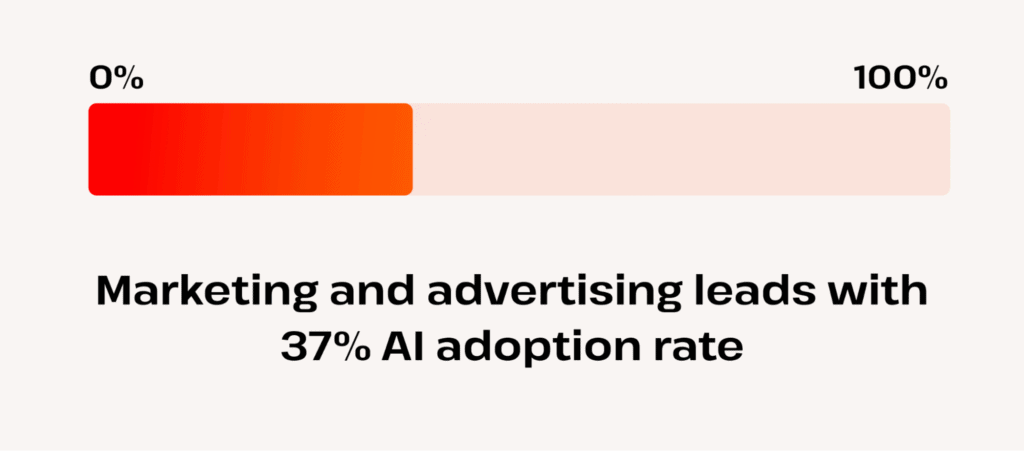
Marketing and advertising lead with a 37% AI adoption rate, using generative AI for content creation, personalized campaigns, and in-depth customer insights to drive innovation and efficiency.
Technology follows with 35% AI adoption rate (Statista)
The technology industry is close behind in AI adoption, with a 35% rate. Companies are using AI to simplify coding, speed up prototyping, and improve debugging. These applications help teams work more efficiently, allowing them to develop and refine products faster.
Consulting reaches 30% AI adoption rate (SEO AI)
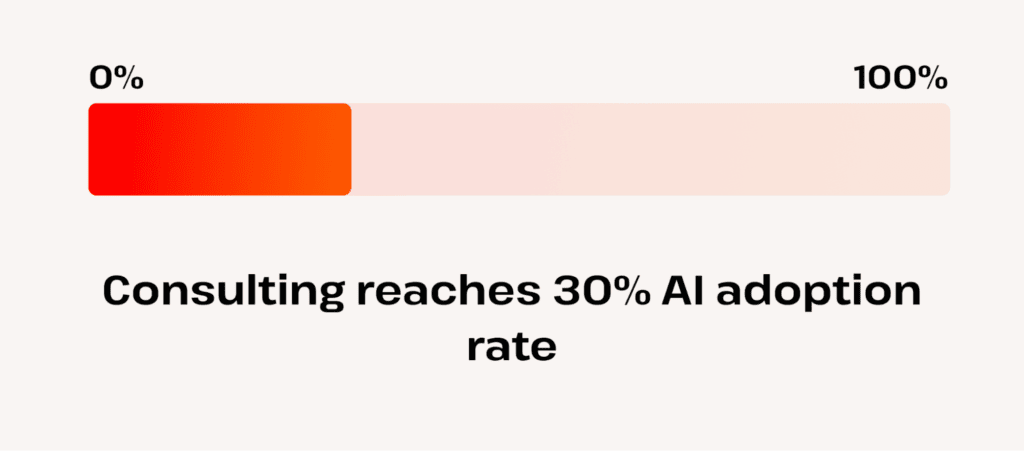
Consulting firms report a 30% AI adoption rate, applying generative AI to data analysis, trend identification, and reporting, enabling consultants to deliver faster, data-rich insights to clients.
Teaching sees 19% AI adoption rate (Statista)
Teaching has a 19% AI adoption rate, with educators beginning to use AI tools for lesson planning and grading, which helps teachers dedicate more time to student-centered learning.
Accounting records a 16% AI adoption rate (InData Labs)
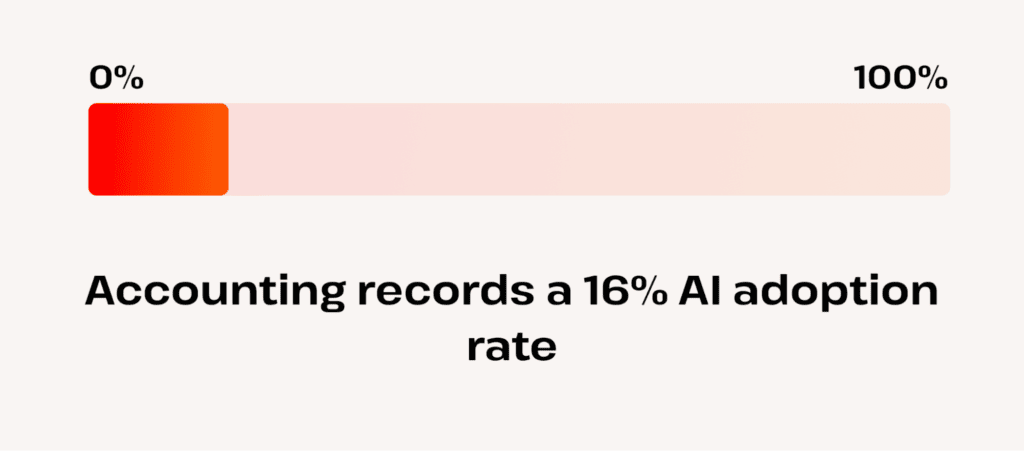
Accounting shows a 16% AI adoption rate, as firms cautiously explore AI tools for data processing and tax preparation to reduce manual tasks while meeting high accuracy standards.
Healthcare holds a 15% AI adoption rate (Statista)
Healthcare maintains a 15% AI adoption rate, with AI mainly supporting administrative tasks like report generation and patient communication, though privacy and compliance concerns slow wider use.
U.S. Cities with Highest Job Automation Risks
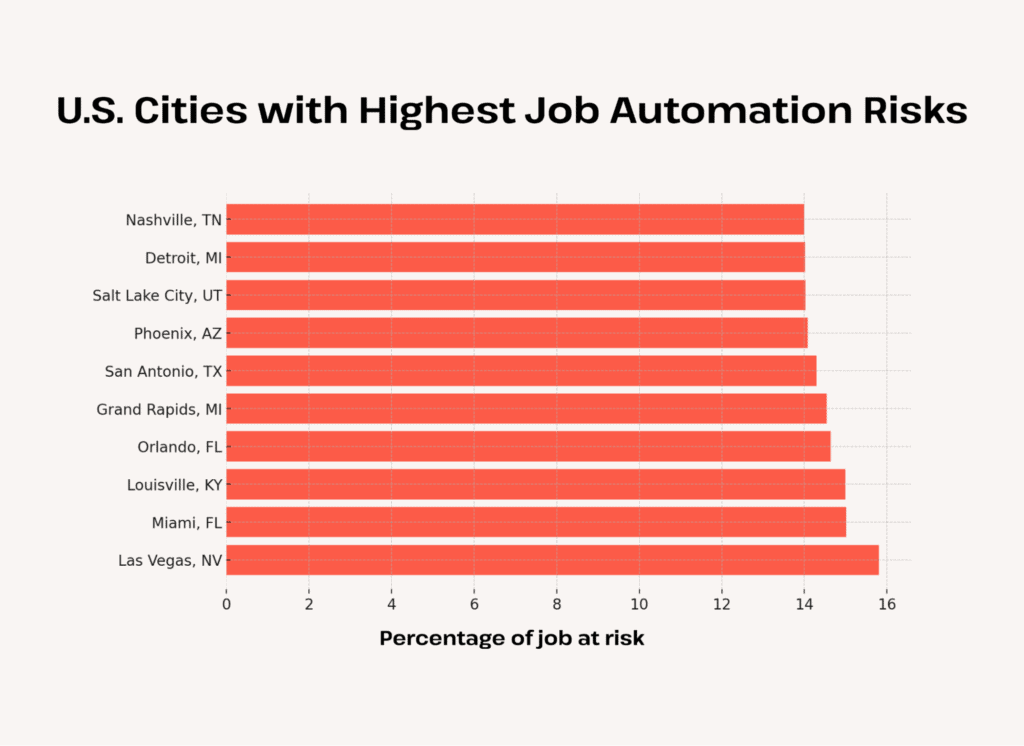
Las Vegas, Nevada leads the list with 15.80% of jobs at risk due to automation (Unmudl)
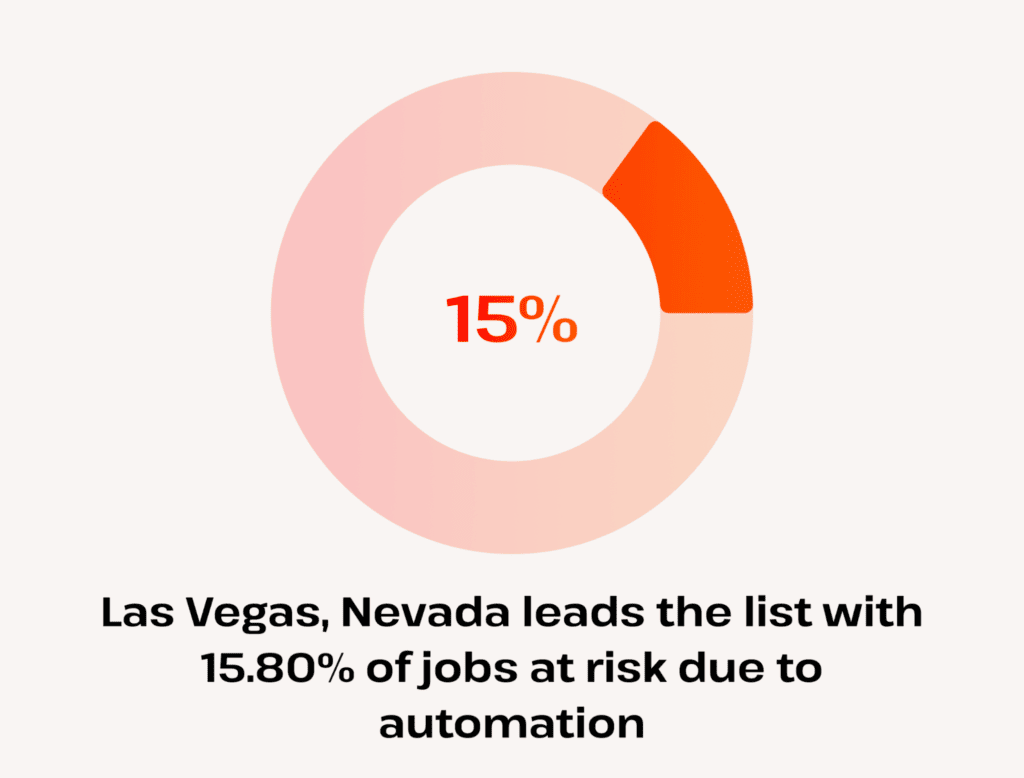
Las Vegas leads U.S. cities in job automation vulnerability, with 15.8% of roles at risk of being automated. The city’s economy is heavily dependent on service jobs in tourism and entertainment, many of which involve repetitive tasks suited for automation.
Miami, Florida ranks second, with 15.01% of jobs at risk of automation ((un)Common Logic)
The city’s large retail, hospitality, and service sectors make it particularly vulnerable to automation, especially in roles that involve customer interactions and routine tasks.
Louisville, Kentucky places third with 14.99% of jobs at risk of automation (Unmudl)
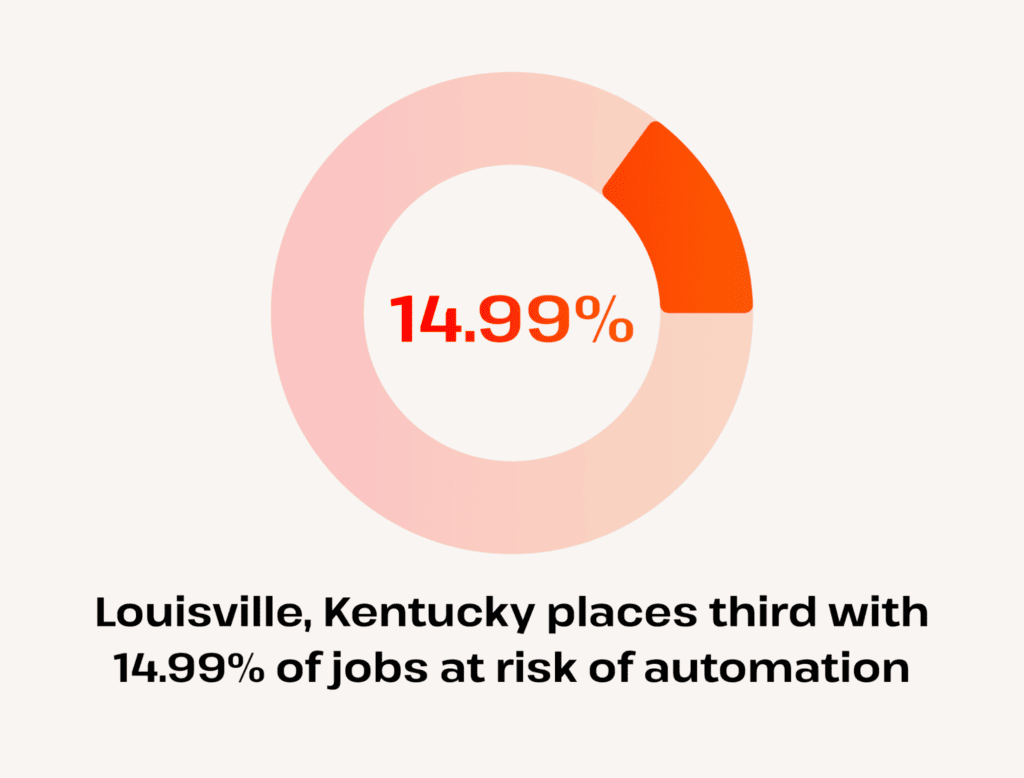
The city’s economy includes a significant number of manufacturing and logistics jobs, many of which face potential automation due to advancements in robotics and AI.
Orlando, Florida is fourth, with 14.64% of its jobs susceptible to automation ((un)Common Logic)
As a hub for tourism, many of Orlando’s service roles—especially in theme parks and hospitality—are highly vulnerable to automation.
Grand Rapids, Michigan comes in fifth with 14.54% of jobs at risk due to automation (Unmudl)
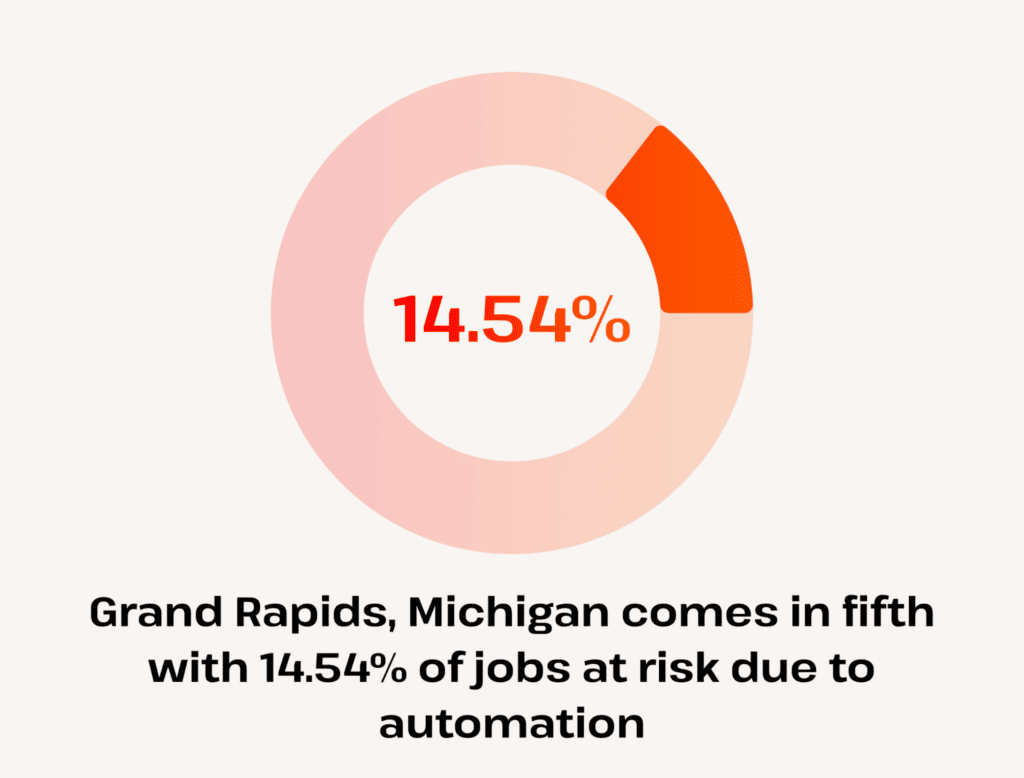
Known for its manufacturing base, the city has many roles in production and logistics, where automation can efficiently replace repetitive tasks.
Here’s a quick look at the top paid jobs with the lowest risk of automation:
| Occupation | Median wage (US) |
| Emergency Management Directors | $83,960 |
| Security Managers | $102,340 |
| Education Administrators | $103,460 |
| Civil Engineers | $95,890 |
| General Internal Medicine Physicians | $223,310 |
| Anthropology and Archeology Teachers | $93,650 |
| Occupational Therapists | $96,370 |
| Clinical Nurse Specialists | $86,070 |
| First-Line Supervisors of Police and Detectives | $101,750 |
| Hospitalists | $236,000 |
Conclusion
The robotics revolution is transforming business at remarkable speed. With the global industry projected to reach $43.32 billion by 2027, 2.5 million industrial robots already deployed worldwide, and Asia controlling one-third of all robotics revenue, the automation trend shows no signs of slowing. As technology costs fall and capabilities improve, even more industries will adopt robotic solutions. Forward-thinking businesses that strategically integrate automation today will gain significant competitive advantages in efficiency, productivity, and innovation tomorrow.
FAQ
What is the market size of robotic industry?
The global robotics market was valued at $39.8 billion in 2023 and is projected to reach $163.51 billion by 2032. This represents a strong growth trajectory with a compound annual growth rate (CAGR) of 17.0%.
How many industrial robots are currently in use worldwide?
There are approximately 2.5 million industrial robots currently in operation worldwide. These robots primarily serve manufacturing, automotive, and electronics industries.
Which region leads the world in robotics revenue?
Asia dominates the global robotics industry with over one-third (33%) of total revenue. Countries like China, Japan, and South Korea are the major contributors to this regional leadership.
Which industry uses the most robots?
The electronics industry leads robotics installations with 28% of all new robots globally. Automotive follows closely behind with 25% of new installations.
Is robotics a big industry?
Robotics is a substantial industry valued at $39.8 billion in 2023 and growing rapidly at 17% annually. With projections to reach $163.51 billion by 2032, it represents one of the fastest-expanding sectors in the global economy.