Your sales team is working harder than ever. They’re making calls, sending emails, and scheduling demos. But somehow, deals keep stalling.
Here’s the uncomfortable truth: 67% of salespeople miss their quota every year. And it’s rarely because they’re not trying hard enough. The problem is they’re not equipped to succeed.
That’s where a sales enablement strategy comes in. When done right, it gives your team the content, training, tools, and processes they need to close more deals in less time. Companies with mature sales enablement programs see 49% higher win rates on forecasted deals.
This guide breaks down exactly how to build a sales enablement strategy that works. You’ll learn the core pillars, the implementation steps, and the metrics that actually matter. No fluff. Just what works.
What Is Sales Enablement (And Why Most Companies Get It Wrong)
Sales enablement is the process of providing your sales team with the resources they need to close more deals. That includes content, training, coaching, tools, and data. The goal is simple: make every rep more productive and effective.
But here’s where most companies mess up. They treat sales enablement like a one-time project instead of an ongoing program. They dump a bunch of PDFs into a shared folder, run a single training session, and call it done.
That’s not sales enablement. That’s wishful thinking.
Real sales enablement is about continuous improvement. It means constantly refining your content based on what’s actually working in sales conversations. It means regular coaching sessions that address specific skill gaps. It means using data to identify where deals get stuck and fixing those bottlenecks.
The term “revenue enablement” has gained traction recently because it captures this broader vision. It’s not just about helping sales. It’s about aligning every customer-facing team around the same goal: driving predictable revenue growth.
📖 What is Sales Enablement?
Sales enablement is the strategic, ongoing process of equipping sales teams with the content, guidance, training, and tools they need to effectively engage buyers and close deals. Unlike one-time training, it’s a continuous program that evolves based on data and results.
Think about it this way. Your best sales rep probably has a mental playbook of what works. They know which case studies resonate with different buyer types. They know the objections that come up and how to handle them. They know when to push and when to pull back.
Sales enablement is about capturing that knowledge and scaling it across your entire team. It’s turning your top performer’s instincts into repeatable processes that everyone can follow. Developing a strong talent acquisition and retention strategy follows the same principle. You identify what works and systematize it.
The real estate industry offers a great example of this approach. When property investors consider transforming a primary residence into a rental property, they follow a systematic, step-by-step process. Sales enablement works the same way. You need a documented framework, not random tactics.
The 5 Core Pillars of an Effective Sales Enablement Strategy
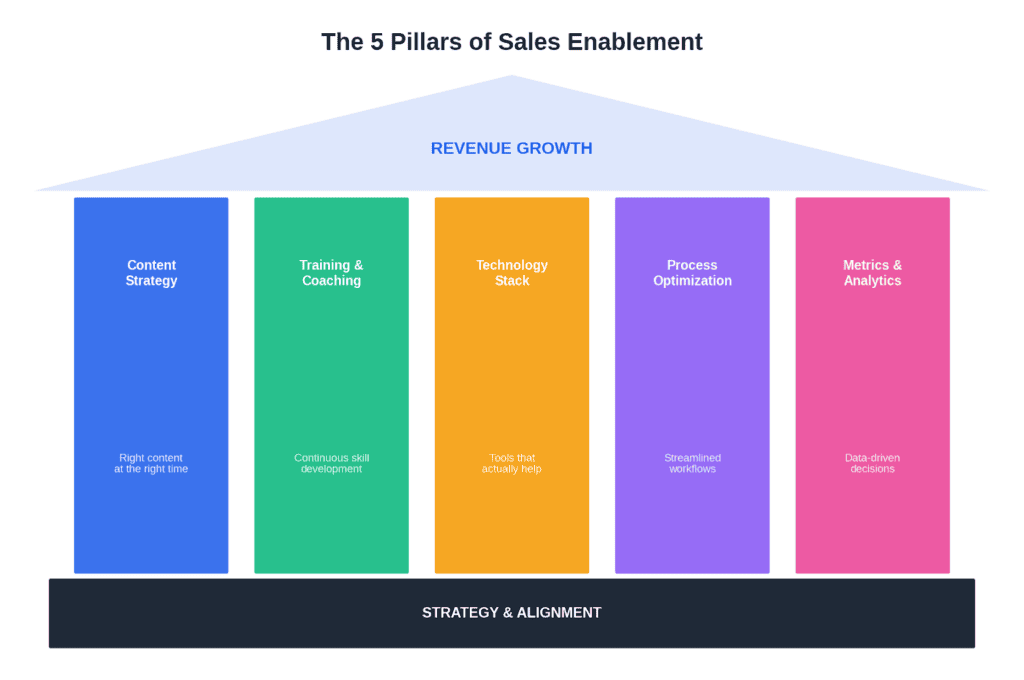
Every successful sales enablement strategy rests on five pillars. Miss one, and the whole structure becomes unstable. Get all five right, and you create a system that consistently produces results.
Content Strategy for Sales
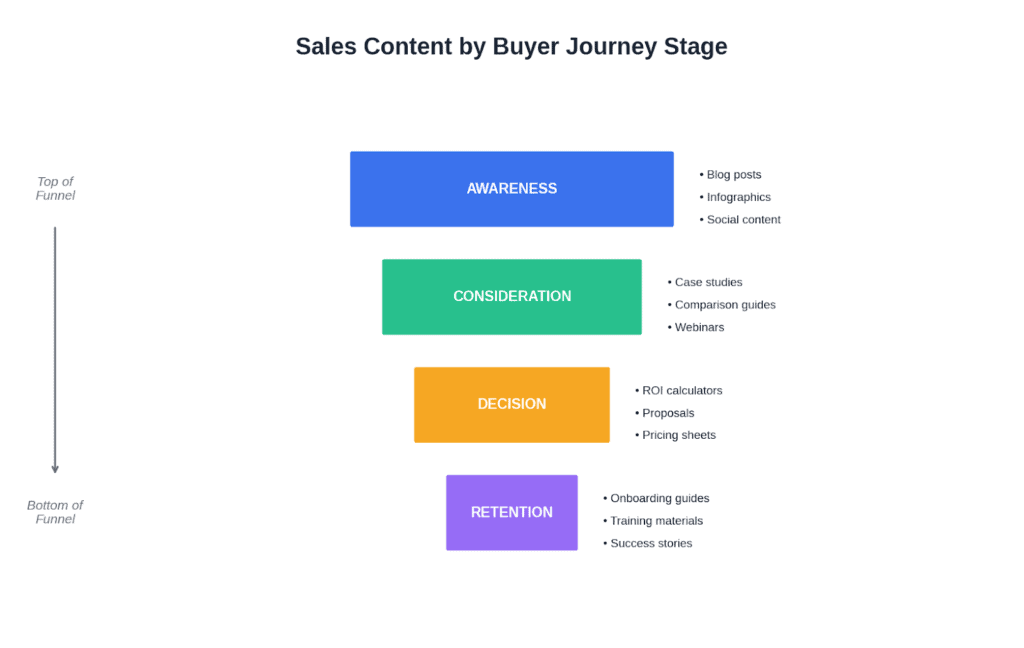
Your sales team needs content for every stage of the buyer journey. Awareness content that gets attention. Consideration content that builds credibility. Decision content that drives action.
The problem? Most companies create content for marketing purposes, then expect sales to somehow make it work. That approach fails because marketing content and sales content serve different purposes.
Marketing content attracts attention. Sales content closes deals.
Effective sales content management means creating assets specifically designed for sales conversations. Case studies that address specific objections. Competitive intelligence sheets that highlight your advantages. ROI calculators that make the value tangible.
| Buyer Stage | Content Type | Purpose |
| Awareness | Blog posts, infographics | Attract attention |
| Consideration | Case studies, comparison guides | Build credibility |
| Decision | Proposals, ROI calculators | Drive action |
| Retention | Onboarding guides, success stories | Reduce churn |
The key is mapping content to specific moments in the sales process. When a prospect asks about pricing, your rep should have a value justification document ready. When they mention a competitor, there should be a battle card that addresses that specific comparison.
This is where sales and marketing alignment becomes critical. Marketing needs to understand what content actually helps close deals. Sales needs to provide feedback on what’s working and what’s missing.
Training and Coaching Programs
Initial sales training programs get reps up to speed on your product and process. But the real impact comes from ongoing sales coaching.
Research shows that continuous coaching improves sales performance by 8% to 28%. One-time training? The effect fades within 90 days.
Effective coaching focuses on specific skills:
- Discovery questions: Are reps asking the right questions to uncover real pain points?
- Objection handling: Can they address concerns without getting defensive?
- Closing techniques: Do they know when and how to ask for the commitment?
- Demo skills: Are they showing value or just features?
The best sales enablement programs include regular call reviews, role-playing sessions, and one-on-one coaching meetings. They use real examples from actual sales conversations, not theoretical scenarios.
💡 Quick Tip
Record your sales calls (with permission) and review them weekly. Identify one specific skill to improve each week rather than trying to fix everything at once. Small, consistent improvements compound over time.
Building strong delegation practices applies here, too. Great sales managers don’t try to coach everything. They delegate appropriate tasks and focus their coaching time on high-impact skills.
Some companies have started using branded merchandise as part of their team motivation strategy. Teams that hit quarterly targets might receive custom athletic socks or other company swag. It’s a small thing, but it builds culture and reinforces team identity.
Technology Stack and Tools
Sales enablement tools fall into several categories:
- Content management: Storing, organizing, and distributing sales content
- Sales engagement: Automating outreach sequences and tracking engagement
- Coaching platforms: Recording calls and providing feedback
- Analytics: Measuring content usage and deal outcomes
The mistake most companies make? They buy too many tools. Each tool requires training, maintenance, and integration work. Before you know it, your reps spend more time switching between apps than talking to prospects.
A lean sales technology stack focused on CRM integration and a few essential tools beats a bloated tech stack every time. Start with your CRM as the foundation. Add tools only when they solve a specific, documented problem.
📊 By the Numbers
Sales reps spend only 33% of their time actually selling. The rest goes to admin tasks, internal meetings, and searching for content. The right technology stack can reclaim 5-10 hours per week per rep.
Process Optimization
Sales process optimization means removing friction from your pipeline. Where do deals get stuck? What steps add unnecessary time? What information do reps need that they currently lack?
Start by mapping your current process. Document every stage from initial contact to closed deal. Then identify bottlenecks. Common culprits include:
- Slow proposal turnaround times
- Too many approval layers for discounts
- Manual data entry that should be automated
- Unclear handoff processes between teams
The goal is a streamlined workflow that keeps deals moving forward. Every day a deal sits idle is a day it might die.
Metrics and Analytics
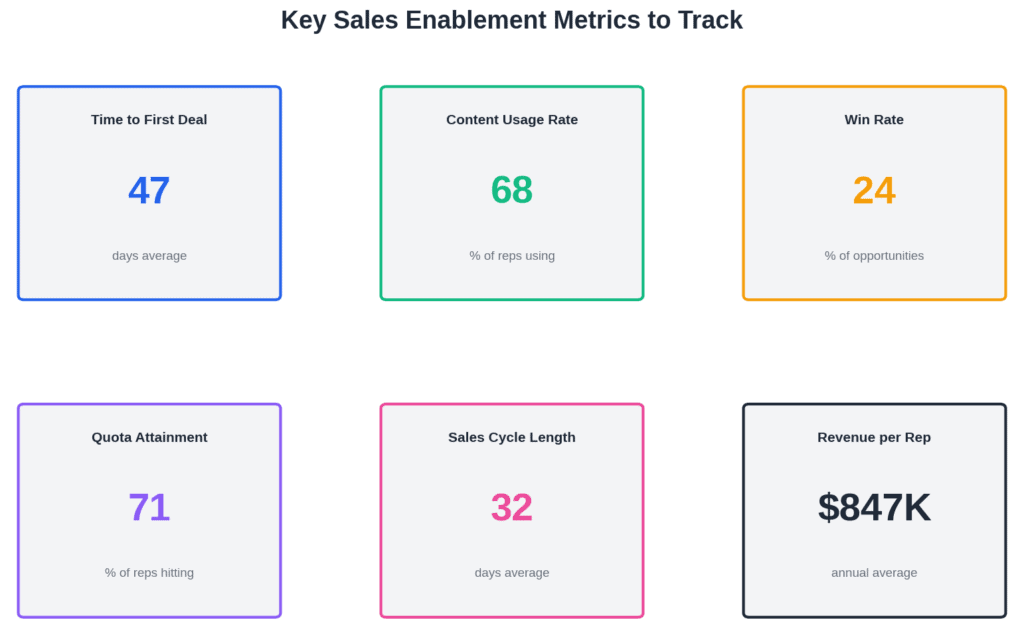
You can’t improve what you don’t measure. Effective sales enablement requires tracking the right sales metrics across three categories:
Activity metrics: Calls made, emails sent, meetings booked. Pipeline metrics: Deals created, stage conversion rates, deal velocity. Outcome metrics: Win rates, average deal size, revenue per rep
The key insight? Activity metrics are leading indicators. Outcome metrics are lagging indicators. If you only track outcomes, you’re always looking in the rearview mirror.
Building Your Sales Enablement Strategy Step by Step
Now let’s get practical. Here’s how to build your strategy from scratch.
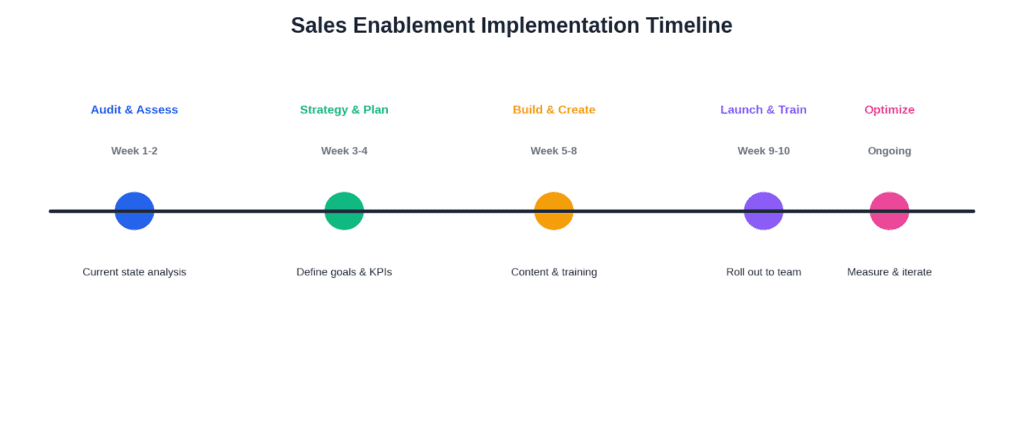
Step 1: Audit Your Current State
Before building anything new, understand what you have. Interview your sales reps. What content do they actually use? What’s missing? Where do they feel underprepared?
Review your win/loss data. Look for patterns. Are you losing deals at a particular stage? To specific competitors? With certain buyer personas?
This audit gives you a baseline for improvement and helps prioritize what to build first.
Step 2: Define Your Sales Playbook
A sales playbook documents your entire sales process. It includes:
- Ideal customer profiles and buyer personas
- Qualification criteria (what makes a good lead)
- Stage-by-stage actions and milestones
- Talk tracks and messaging guidelines
- Objection handling scripts
- Content recommendations by scenario
Your playbook becomes the single source of truth for how sales gets done at your company. Understanding what outsourcing actually involves follows similar documentation principles. When processes are clear, results become predictable.
Building a playbook takes effort, but it pays dividends when onboarding new sales reps. Instead of months of shadowing and guesswork, new hires can ramp quickly using a documented process.
Step 3: Create a Content Calendar
Based on your audit, build a content creation plan. Prioritize content that addresses your biggest gaps. If reps consistently lose deals to a specific competitor, create a battle card for that competitor first.
Maintain a regular cadence for keeping content fresh. Old case studies and outdated pricing sheets undermine credibility.
Communication with your team matters here. Some organizations use a staff notification service to alert reps when new content is available or when existing materials get updated. Whatever system you use, make sure reps know where to find current content.
Step 4: Implement Training Programs
Design a training curriculum that covers:
- Initial onboarding: Product knowledge, process training, tool training
- Ongoing development: Skill-building workshops, role-playing sessions
- Just-in-time learning: Quick reference guides for specific situations
Mix formats to accommodate different learning styles. Some people learn best from reading. Others need hands-on practice. Include both.
⚠️ Common Mistake
Don’t train on everything at once. Information overload leads to retention of nothing. Focus each training session on one skill or concept. Build mastery before moving to the next topic.
Step 5: Launch and Iterate
Roll out your enablement program in phases. Start with a pilot group, gather feedback, refine, then expand. This approach catches problems before they affect your entire team.
Set up regular feedback loops. Monthly surveys, quarterly reviews, and ongoing suggestion channels. The best enablement programs constantly evolve based on what’s working and what isn’t.
Essential Tools for Your Sales Technology Stack
You don’t need dozens of tools. You need the right tools. Here’s what a lean, effective sales technology stack looks like:
CRM (Foundation): Everything else integrates with your CRM. Choose one that your team will actually use. Salesforce offers power and flexibility. HubSpot provides ease of use. Pick based on your team’s technical comfort level.
Content Management: A dedicated sales content platform beats shared folders. Look for features like usage tracking, version control, and easy search. When reps can find content in seconds instead of minutes, they actually use it.
Sales Engagement: Tools that automate sequences and track engagement save massive time. But use them wisely. Automation should enhance personalization, not replace it.
Coaching Platform: Call recording and analysis tools help identify coaching opportunities. Look for AI features that flag specific moments for review, like competitor mentions or pricing objections.
Every industry can benefit from enablement thinking. Even specialized businesses, like those selling custom golf carts, use sales enablement principles. They document what configurations sell best, train reps on customization options, and track which features drive purchases.
Exploring the right talent acquisition tools follows similar logic. The tools you choose should solve specific problems, not create new ones.
Measuring Success: Metrics That Actually Matter
Tracking metrics without context is pointless. Here’s how to measure sales enablement impact effectively.
Leading Indicators (Early Signals)
- Content usage rate: What percentage of reps use enablement content regularly?
- Training completion: Are reps finishing their development programs?
- Time to first deal: How quickly do new reps close their first sale?
These metrics tell you if your enablement program is being adopted. Low usage suggests a content or accessibility problem. Low training completion signals a relevance or time-commitment issue.
Lagging Indicators (Results)
- Win rates: Percentage of qualified opportunities that close
- Deal velocity: Average time from opportunity creation to close
- Quota attainment: Percentage of reps hitting their targets
- Sales performance consistency: Is success concentrated in a few reps or distributed?
Track these monthly and quarterly. Look for trends, not single data points.
| Metric | What It Tells You | Target Range |
| Content usage rate | Adoption of enablement materials | 70%+ of reps |
| Win rate | Effectiveness of sales process | 20-30% for enterprise |
| Time to first deal | Onboarding effectiveness | Under 90 days |
| Quota attainment | Overall team health | 60%+ of team |
📌 Key Takeaway
Focus on improving one or two metrics at a time. Trying to boost everything simultaneously dilutes your efforts. Pick the metric with the biggest potential impact on revenue and concentrate there.
4 Common Mistakes That Kill Sales Enablement Programs
Even well-designed programs fail. Here are the most common pitfalls and how to avoid them.
Mistake 1: Creating Content Nobody Uses
If sales reps aren’t using your content, it’s not their fault. It’s a signal that the content doesn’t help them sell.
Fix it by involving sales in content creation. Run regular feedback sessions. Track which assets get used and which gather dust. Kill the content that doesn’t work.
Mistake 2: Ignoring the Frontline Perspective
Executives design enablement programs. Sales reps execute them. When there’s a disconnect, the program fails.
Build in mechanisms for rep input. Regular surveys. Open office hours. Skip-level meetings. The best ideas often come from the people doing the actual selling.
Mistake 3: Neglecting Team Wellbeing
Sales is stressful. When reps burn out, their performance craters. Sustainable sales performance requires attention to well-being.
Some companies address this through wellness initiatives, recognizing that team morale directly impacts results. Others provide resources for stress management. There’s growing research around nutritional support for cognitive function. Some professionals swear by supplements like supplements for migraine prevention, which affect their ability to perform under pressure.
The point isn’t that you need a specific wellness program. It’s that burning out your sales team is a strategic mistake, not just an HR concern.
Mistake 4: Building Without Measuring
Intuition is valuable. Data is better. Without measurement, you can’t prove what’s working or identify what needs fixing.
Establish baseline metrics before launching your program. Track changes monthly. Report results to stakeholders quarterly.
🎯 Pro Insight
The companies that win at sales enablement treat it like a product, not a project. They have a roadmap, gather user feedback, release updates, and track adoption. When you adopt a product mindset, continuous improvement becomes natural.
Getting Started This Week
You don’t need to build everything at once. Start with these three actions:
First: Interview five of your sales reps. Ask them what content they wish they had. Ask where they feel underprepared. Write down their answers.
Second: Pull your win/loss data from the last quarter. Look for patterns. Where do deals stall? What reasons do lost deals cite?
Third: Pick one gap to address. Create one piece of content, design one training module, or fix one process bottleneck. Ship it within two weeks.
Small wins build momentum. Momentum builds programs. Programs build results.
The companies that dominate their markets aren’t always the ones with the best products. They’re the ones that enable their sales teams to succeed. Your sales enablement strategy is your competitive advantage. Build it deliberately, measure it rigorously, and improve it constantly.