The engineer who left your perf team last quarter did not quit over pay. They quit because an LCP regression showed up on a Tuesday and nobody else on the team could explain it. Performance engineering burnout looks different from the rest of the industry’s exhaustion because the work never has a finish line.
Product engineers ship features. Platform engineers ship uptime. Perf engineers ship a number that moves every time a browser updates. Talent acquisition and retention for a perf team has to be built around that reality. Below, we cover where the hidden hours go and what fixes it before the next resignation.
What Makes Performance Engineering Different From Other Engineering Specialties
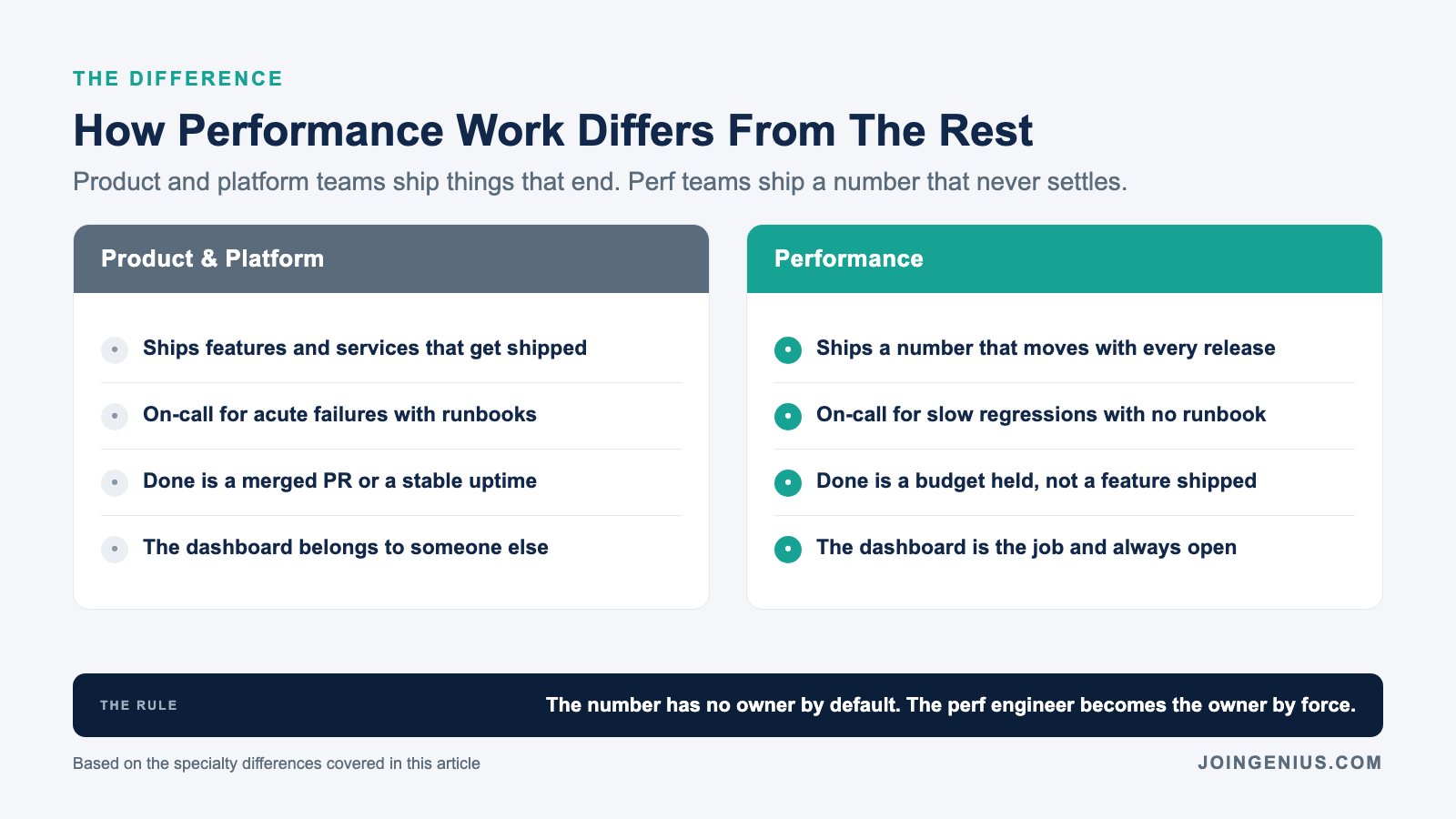
The performance engineering job description looks like other backend or frontend work on paper. In practice, the shape of the work is nothing like a product team’s, and that mismatch is where performance engineering burnout starts.
Measurement Never Stops
A product engineer finishes a feature and moves on. A perf engineer finishes nothing. Every LCP number is a live sample from real users and it shifts every hour. The dashboard is the job and the dashboard is always open.
Every PR Can Regress the Numbers
Someone adds a third-party script on a landing page. Someone else swaps a font. The number moves and the perf engineer gets the email. Unlike unit tests, which fail loudly in CI, performance regressions arrive quietly in CrUX a week later.
Success Looks Like Nothing Happening
The best outcome of a perf week is that nobody noticed anything. There is no shipped feature to point at and no demo to run. That makes the work hard to defend in headcount reviews and harder to feel proud of after months of it.
The Daily Fires That Fill a Performance Engineer’s Week
Most of what fills a perf engineer’s week is not strategic work. It is the same recurring fires nobody puts on a roadmap.
Image Bytes That Nobody Audits
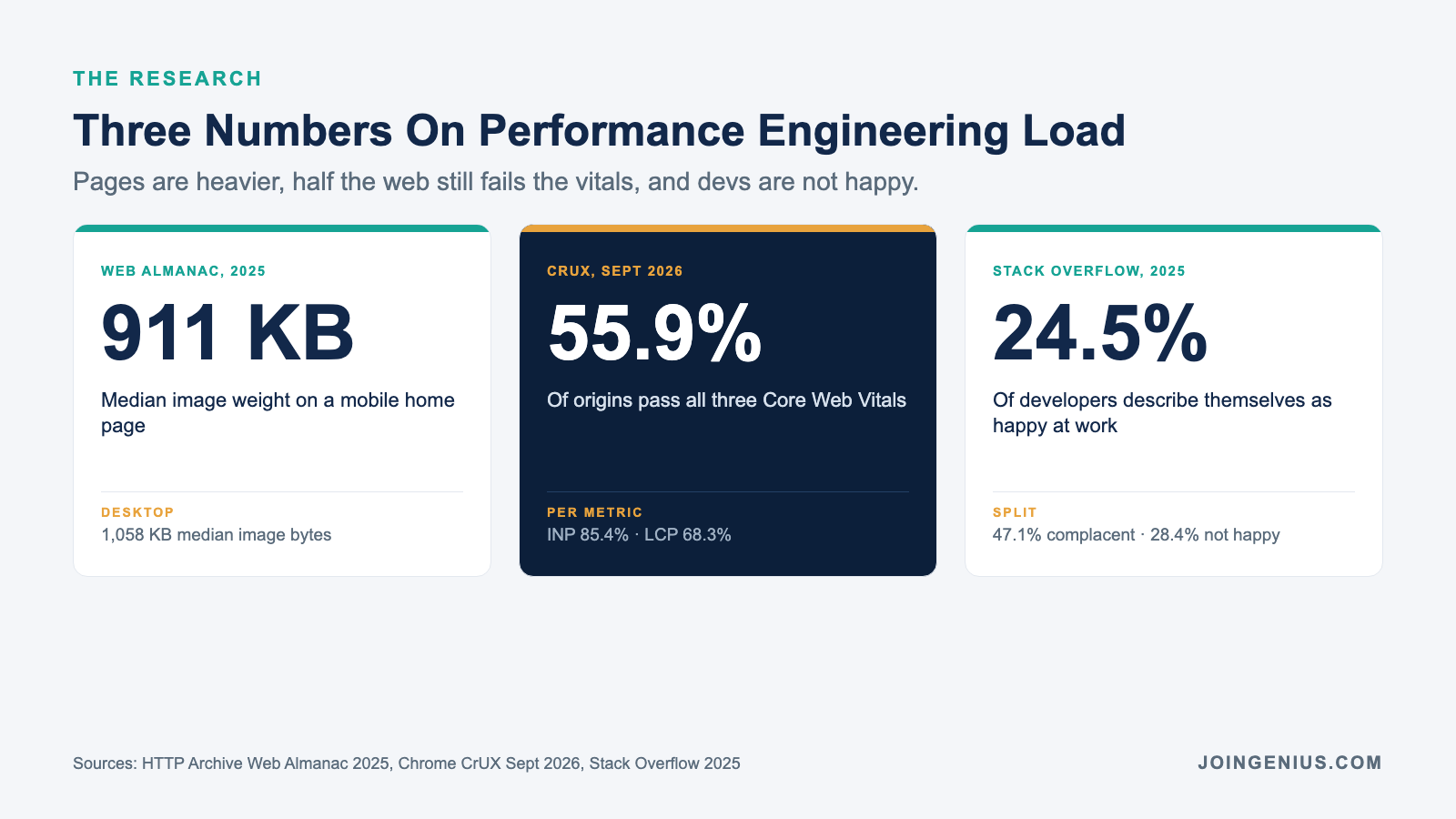
The median mobile home page shipped 911 KB of images in 2025 and the desktop version shipped 1,058 KB, per the Web Almanac 2025 Page Weight chapter. A perf engineer who has to hunt for compression settings on every new upload is the one who stops showing up on Friday.
On a WordPress site, a dedicated image optimizer that handles bulk compression and WebP conversion at upload turns a whole class of regressions into a one-time setup. That is the difference between the perf engineer owning the bytes forever and signing off on them once.
Third-Party Scripts That Marketing Added
Analytics and chat widgets sneak onto landing pages without a perf review. A/B testing scripts and tag manager rules show up the same way. The engineer finds out when the LCP median crosses its threshold and the alert fires.
Bundle Size That Grows Every Sprint
Every new feature ships a few more kilobytes into the main bundle. Nobody tracks the running total until the budget breaks and the perf engineer has to find what caused it. Code splitting helps once. Keeping it split takes a weekly review nobody has time for.
Why Standard On-Call Rotations Don’t Help Performance Teams
Platform teams and SRE groups built the on-call model for acute failures. Performance work does not fail acutely, so the model does not apply and the performance engineering burnout clock runs anyway.
Perf Regressions Are Slow, Not Loud
Most regressions are not a 2 am page. They are a two-percent slip in LCP that compounds over three releases. By the time anyone pages, the cause is in a commit from last week and the context is cold. Hiring remote employees in other countries only helps perf work when the handoff carries real context, not just the alert text.
The Pager Rotates, The Dashboard Does Not
Even on a healthy on-call rotation, one person ends up as the dashboard owner by default. That person stays mentally on call every day of the week. The team looks balanced on paper and is quietly uneven in practice.
Weekend Alerts Have No Playbook
A payments alert has a runbook. A Core Web Vitals alert has a comment thread and a theory. The perf engineer who gets paged on Saturday loses the weekend reading commits instead of fixing anything.
The Metrics That Quietly Grind Performance Engineers Down
Perf metrics look clean on a dashboard. They are not clean to live with, because the targets move and the field data argues with the lab.
Core Web Vitals Targets Keep Shifting
Chrome replaced FID with INP as a Core Web Vital in March 2024, which quietly reset the pass rates for anyone measuring responsiveness. Google’s September 2026 CrUX release reported 55.9% of origins passing all three Core Web Vitals, with INP at 85.4% and LCP lagging at 68.3%. For a perf team, that gap is the week’s homework.
A Short Metric Table
| Metric | What It Measures | Why Perf Engineers Fight With It |
|---|---|---|
| LCP | Largest content paint on first view | Image bytes and server response, both outside the perf team’s commit history |
| CLS | Visual stability during load | Driven by late-loading ads and dynamic banners |
| INP | Responsiveness to real interactions | Fluctuates with every new third-party script |
Synthetic Numbers and Field Numbers Disagree
Lighthouse scores climb. CrUX stays flat. The perf engineer explains the gap to a stakeholder who wanted one number and gets a follow-up meeting instead of a thank you. Over a quarter, that explaining takes more hours than the actual optimization.
Every Report Starts a Conversation About Blame
When a page gets slower, product blames engineering. Engineering blames marketing’s third-party scripts. Marketing blames the CDN. The perf engineer owns the number without owning the inputs, and that mix drives performance engineering burnout faster than other specialties.
How to Structure and Hire a Performance Team That Lasts
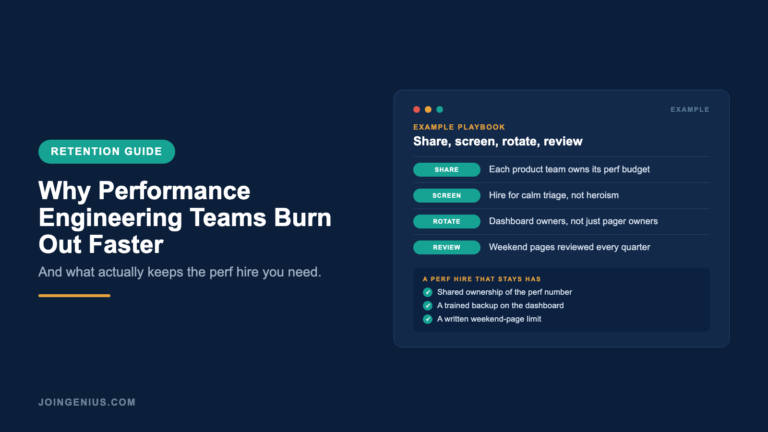
Fewer fires is one half of retention. Who owns what and how you hire the next person is the other, and the structural fix for performance engineering burnout starts with shared ownership of the number.
Make Product Teams Own Their Perf Budget
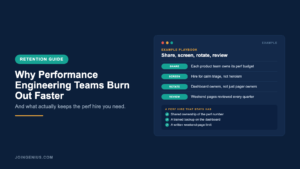
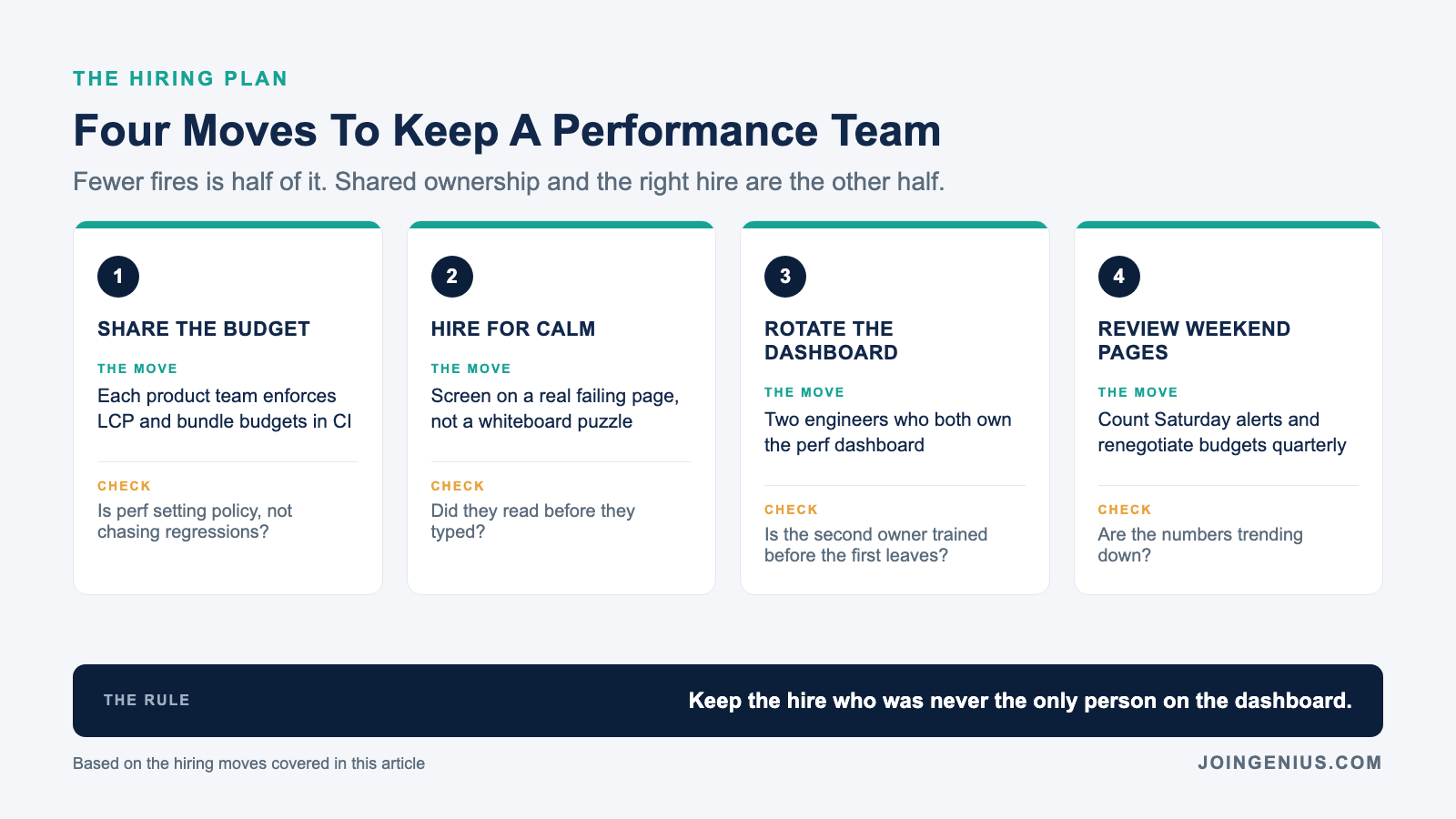
The perf team cannot be the only owner of the number. Each product team should carry its own LCP and bundle budget, enforced in CI. The perf team becomes the group that sets the budget and reviews breaches, not the group that chases every regression.
Hiring for startups gets subtle here, because the first perf hire shapes who owns the number for every team after them. Pick the person who will negotiate budgets with product, not the one who will fix every regression themselves.
Hire for Calm, Not Heroism
The engineer who shipped a Saturday fix is not the one you want to keep hiring. Screen for calm triage on a real failing page and watch who reads before typing. Technical screening questions land better when the exercise is a real regression, not a whiteboard puzzle.
Keep the Team Small and Deep
A three-person perf team with deep context beats a six-person team pulled off other projects part-time. Engineering recruitment agencies see perf hiring go sideways most often when teams try to scale without picking a lead. Pick the lead first, then build around them.
Stack Overflow’s 2025 Developer Survey found that only 24.5% of developers describe themselves as happy at work. The other three quarters split between complacent and not happy, and the perf corner of that complacent group is where you lose people without a resignation letter.
Conclusion
Performance engineering burnout is not a workload problem. It is a boundary problem. The number has no owner by default, so the perf engineer becomes the owner by force. Rebuild the team around shared ownership and the pager stops meaning the same thing to one person. The hire you keep is the one who was never the only person on the dashboard.
We built Genius so engineering leaders can hire that kind of calm, deep perf talent without the local-market tax. We place the top 1% of engineering and operations hires from the Philippines and Latin America at around 80% less than comparable local hires. Every placement comes with a 6-month replacement guarantee and no monthly agency fees. If the person who owns your LCP dashboard is the hire you keep losing, see how we source and place engineering talent.