Performance marketing teams work inside the loudest feedback loop in marketing. Every launch, every bid change, every creative test lands back on the dashboard inside hours. The volatility of the channels and the shortness of the feedback loop are what keep the role sharp.
That same loop makes it the first marketing role to break. Low morale on a brand team looks like fewer sign-offs, but on a performance team it shows up as missed targets and bidding slip. This piece covers why performance marketing teams burn out faster, the pressure points, the early signs, and how to protect the team.
Why Performance Marketing Teams Burn Out Faster
Marketing Week’s 2026 Career And Salary Survey of 2,350 marketers found 65.3% felt overwhelmed over the past twelve months, up from 58.1% a year earlier. Performance marketing teams sit at the sharp end of that curve. The role is measured daily, judged weekly, and reset quarterly, with the measurement window getting shorter each year.
The reason the burnout curve is steeper for performance than for brand or content is the feedback loop. A brand campaign ships and rests for a quarter. A paid campaign ships and updates every few hours as the platforms serve it. The dashboard is a live scoreboard, and the team is reading it on a Sunday night.
Constant scoring removes the pause that lets a team recover. There is no quiet month in a paid media role because every month has a target and every target has a weekly check-in. The reset button that other marketing teams get between campaigns is simply not in the role.
Performance teams also own the number in a way few other teams do. When a brand team misses an awareness metric, the explanation is complicated. When a paid team misses CAC, the explanation is simple: it was you. That clarity is useful. It also wears people down.

The Pressure Points That Compound Each Quarter
Platform volatility is the first pressure. Google and Meta push bidding and measurement changes on their own calendar, not the team’s. One week the team is retargeting; the next the pixel is deprecated. Stacked across a year, these shifts add up to a job that is never done the same way twice.
The second pressure is AI content expectations. HubSpot’s 2026 State Of Marketing surveyed over 1,500 marketers and found 83.5% now face higher output expectations because of AI. The team is expected to ship more creative and more landing-page variants with no extra headcount. AI makes drafts cheaper. It does not make the testing and the brand reviews cheaper.
The third pressure is attribution. Multi-touch models from the pre-privacy era no longer reconcile with cookieless tracking and consent gates. The team spends hours defending the numbers before anyone discusses what to do with them. Half the weekly review is a methodology conversation. The other half is a shrinking window to talk about actual decisions.
The fourth pressure is budget. Finance pulls spend when the pipeline dips. The team is then asked to recover the pipeline on less. Each pressure is manageable on its own. All four together, every quarter, is what breaks a team. The team is not fragile. The pile is heavy.
These four pressures compound because they share a calendar. A platform change arrives the same week the AI output quota comes down from the CMO. Attribution breaks the same quarter finance cuts spend. The pressures are not spaced out across the year the way a reasonable workload would be. They arrive together, and they repeat.
The Early Signs A Team Is Breaking
The first sign is bid slip. A tired team stops questioning the auto-bid recommendation and starts rubber-stamping it. Spend stays steady but efficiency slips, and nobody flags it until the quarter closes. The team is still working. The quality of thought is just lower, and the only person reading it carefully is the one who wrote it.
The second sign is reporting avoidance. The weekly deck gets later. Charts get busier so the bad metric is harder to find. A team doing good work can be plain. A team covering slip is ornate. Watch for colored arrows that used to be numbers. Watch for a one-month view where there used to be a trailing-twelve.
The third sign is quiet turnover. The strongest analyst takes a Friday off. Then a week. Then a job somewhere else. Our breakdown of why marketing ops hires don’t stay past 18 months walks through the pattern. Performance roles follow the same curve. The best people leave quietly because they still have a job to finish on the way out.
The fourth sign is scope creep without scope removal. The team picked up email, then landing pages. SEO content came next, with nothing taken off. The job title is still “paid media lead” but the actual job is five jobs stacked. The people who did it best were the first to notice. They were also the first to leave.
These signs are quiet before they are loud. The weekly numbers can hide them for a quarter. By the time the signs show up in a dashboard, the recovery is a six-month project. By the time they show up in headcount, it is longer.

How To Protect A Performance Marketing Team From Burnout
The highest-leverage move is cutting scope, not adding wellness perks. A performance marketing team that owns paid and SEO on top of email and landing pages will burn out in every climate. Pick what the team owns best, and route the rest off.
The simplest route-off is pairing the team with a growth partner that already runs SEO or content as a service. The in-house team keeps the paid channels where speed and ownership matter most. The partner carries the longer-horizon channels that compete for the same attention. Our breakdown of whether to outsource SEO and content covers the trade-offs.
The second move is a hard calendar rule. One day a week with no reporting and no performance stand-ups. Teams that run a “focus Friday” recover attention faster than teams that work through the gap. The counter-argument is always that performance moves too fast to pause. The counter is wrong. Performance moves fast because the team is still thinking.
The third move is adding senior review, not more hands. A fractional CMO or senior consultant who reads the weekly numbers and makes the hard calls lifts the team off the political load. Our list of sites to hire a fractional CMO is a starting point. Senior pattern recognition is cheaper than another junior hire.
The fourth move is removing permanent emergencies from the calendar. Not every quarter needs a surge. Setting a baseline target that can be hit sustainably matters more than a stretch target that nobody survives. A team that hits plan for four quarters outperforms a team that stretches and misses twice.
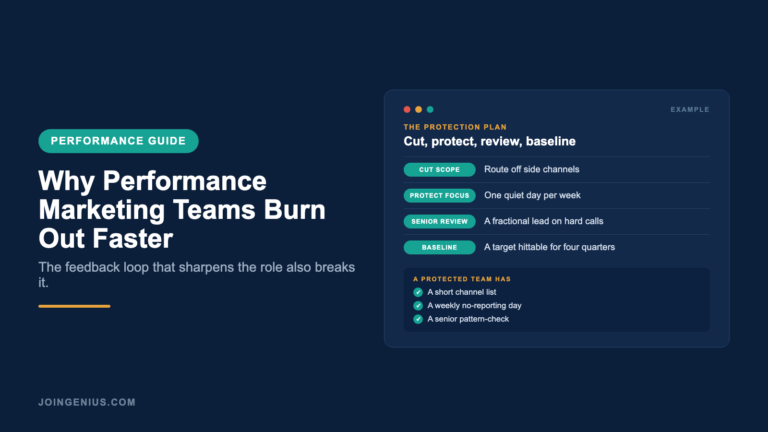
The four moves are easier to run as a system than as separate projects.
| Move | What To Do |
|---|---|
| Cut scope | Route off channels that don’t fit the team’s edge |
| Protect focus time | One day a week with no reporting and no stand-ups |
| Add senior review | A fractional lead who makes the hard calls |
| Set a sustainable baseline | A target the team can hit for four quarters, not two |
Build A Team That Can Keep Running
Dotdigital’s 2026 US marketer survey of 500 respondents found 31% are planning to leave marketing — not change jobs, leave the field. Among those considering leaving, 19% cite workload and burnout. For performance teams, where ramp time runs six to nine months, every exit is a quarter of lost output and a quarter of rebuild.
Retention on these teams is less about retention programs and more about the shape of the work. A good analyst leaves because they are tired, not because they are bored. Give the analyst work that scales their judgment, not their click count. Automate the reports. Keep the thinking in the room.
That shift usually requires one of two moves. Either narrow the team’s channel ownership so each person goes deeper. Or add a senior coaching layer so the team gets better at hard calls instead of running more experiments. Both moves cost less than another hire.
Our write-up on delegation examples that actually work is a useful reference for the first move. For the second, treat it as a leadership question and not a hiring one. The best senior layer is one you borrow before you build. Fractional first, then full-time once the shape is proven.
A team that can keep running is one that has stopped stacking channels without stacking people. The best performance teams move fast on fewer things, and they move for longer.

Conclusion
Performance marketing teams burn out faster because they live inside the feedback loop that makes the role sharp. The fix is not grit. It is scope and senior layer. Pick the channels the team owns best. Route the rest to specialists. Protect a weekly focus block. Keep senior review in the room.
If adding specialists on marketing or ops without the overhead of local hiring is on the list, Genius is the easiest route. We vet the top 1% of applicants across the Philippines and LATAM and place them full-time at roughly 80% less than an equivalent local hire.
No monthly fees. Every hire ships with a six-month replacement guarantee if the fit is wrong. The team’s job is to recover its focus. Our job is to make sure the next hire is already filtered and ready to work on day one.