Candidate no-show rates on interviews are the quiet metric that breaks a recruiting pipeline. One missed first-round is lost prep time. Twenty missed first-rounds in a quarter is a hiring plan that will not land, and most teams never see it as a fixable system — they see it as individual candidates being flaky.
The data says otherwise. Modern recruiting workflows have changed how candidates expect to be scheduled, confirmed, and reminded, and the teams keeping their no-show rate low are the ones that updated the mechanics. Below, we cover why the rate keeps rising, what research says actually brings it down, the exact playbook high-performing teams run, and the moves to stop making before another panel sits in an empty Zoom.
Why Candidate No-Shows Keep Getting Worse
The classic recruiting playbook assumed a candidate who had one offer in play and would show up grateful. That candidate is rare in 2026 and the playbook has not caught up.
Strong Candidates Have Options
A good engineer, operator, or analyst is in three to five processes at once. The company that treats scheduling like a formality is the company that gets ghosted when the Thursday 10 am slot competes with a final round somewhere else.
Scheduling Friction Pushes Them Out
Every back-and-forth email after the offer-to-interview step is a chance for the candidate to drop. Teams that take four days to confirm a 30-minute call lose candidates before the call ever happens, and they rarely connect the dots.
Email-Only Reminders Stopped Working
A reminder email that lands in the promotions tab 24 hours before the call is not a reminder. The candidate never sees it, the recruiter checks a box, and the panel wastes 30 minutes waiting.
What the Research Says Actually Reduces No-Shows
The hiring methods literature and the healthcare appointment-reminder research point to the same three levers, and most recruiting loops only pull one of them well.
Automated Reminders Beat Manual Confirmations
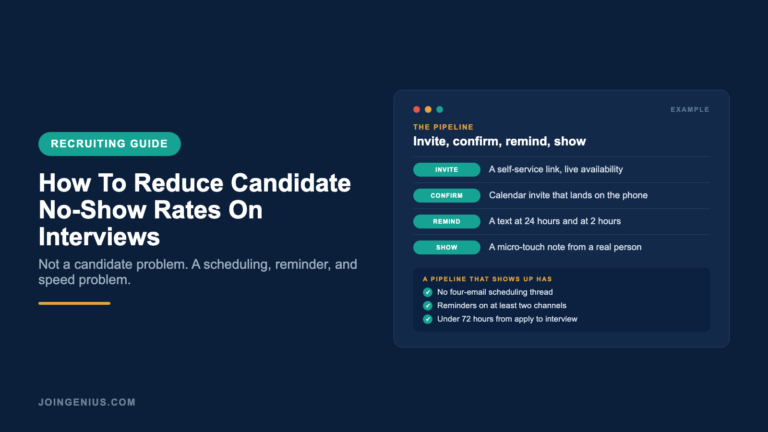
A text reminder outperforms an email reminder, and a two-channel reminder — text plus calendar invite — outperforms either alone. The lift is not small and the implementation cost is close to zero on modern tooling.
Self-Scheduling Beats Email Tag
Letting the candidate pick the slot from a live calendar removes the friction and the asymmetric effort of coordinating. The recruiter stops being a bottleneck and the candidate stops dropping between the “hi, can you do Tuesday?” and the actual Tuesday.
Speed From Apply to Interview Matters More Than Everything
Candidates who wait more than a week between the first touch and the first interview show up less. The reason is simple — by day seven, another company has already scheduled them. A workable approach to calendar management for recruiting is about compressing that window, not stretching it.
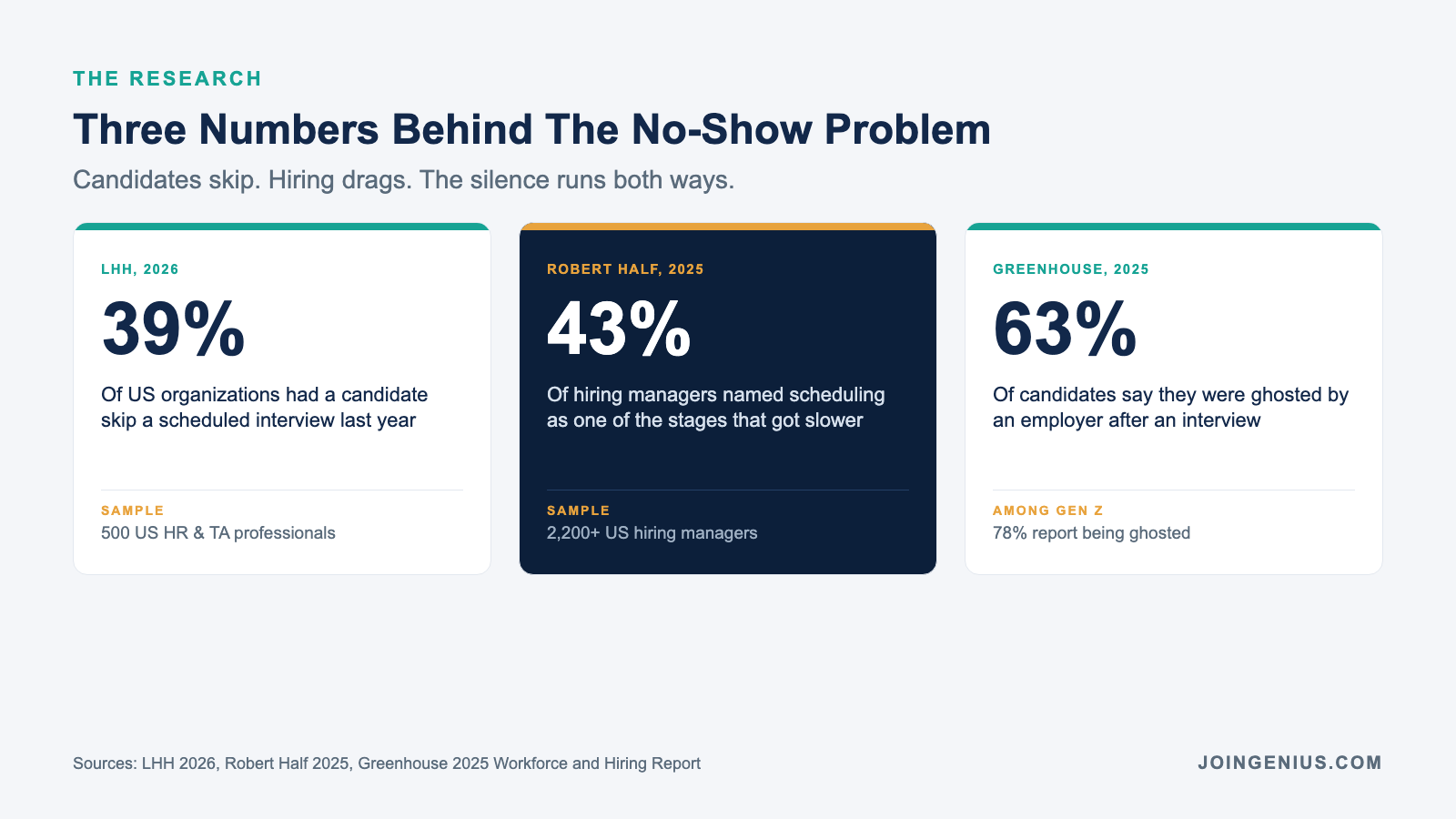
A July 2026 study by LHH (Adecco Group), surveying 500 US HR and talent-acquisition professionals, found 39% of organizations had candidates fail to appear for a scheduled interview in the past 12 months — and 59% said no-shows are more frequent than two years ago. The rate is not stable and it is not getting better on its own.
The Playbook Recruiting Teams Actually Use
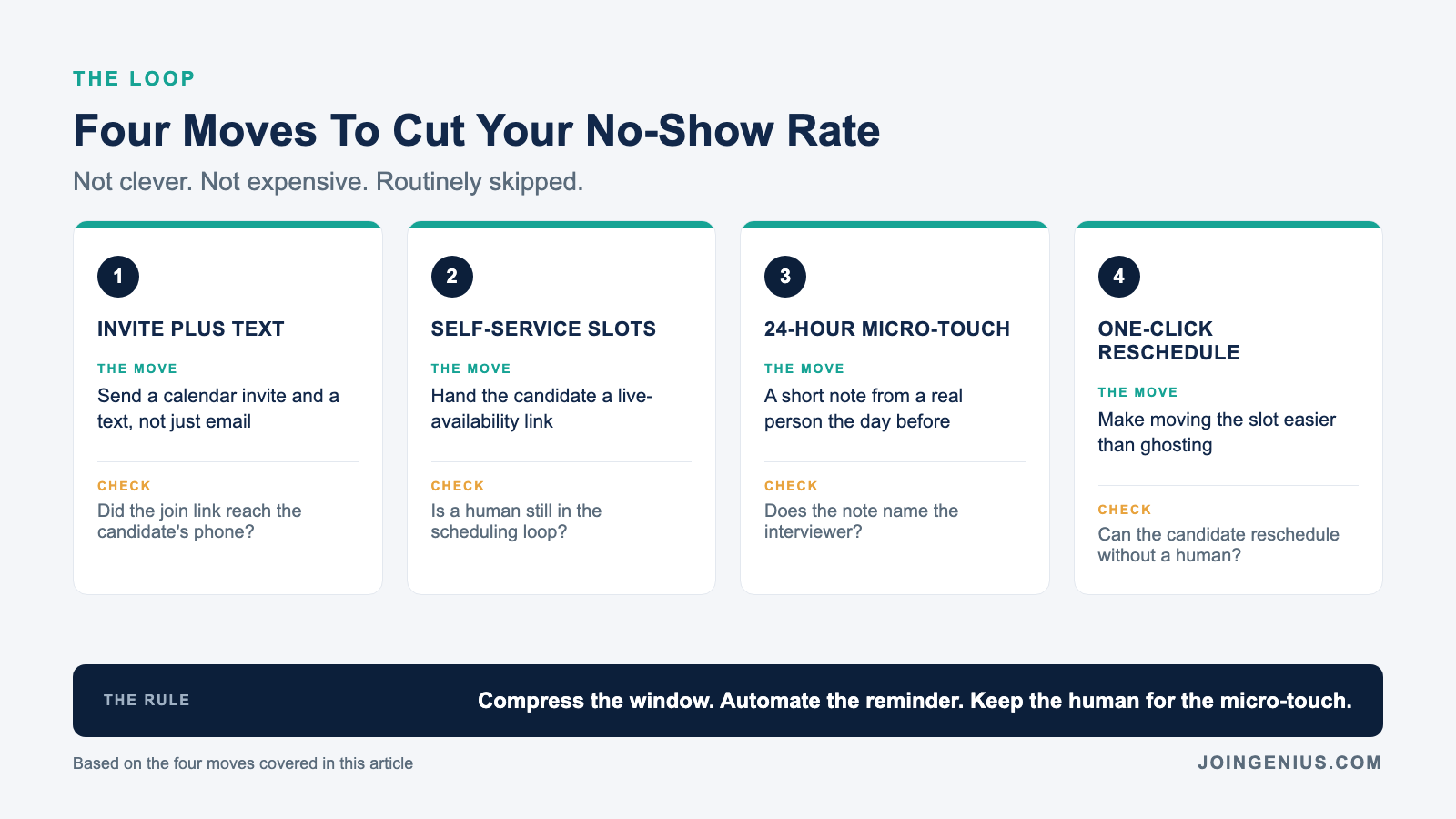
Four moves separate a 25% no-show rate from a 6% no-show rate. Not one of them is clever and all of them are routinely skipped.
Send a Calendar Invite and a Text, Not Just an Email
The calendar invite does the heavy lifting. It lands in the candidate’s own calendar, surfaces on their phone, and triggers a native reminder the morning of. The text is the belt-and-suspenders layer that catches the candidate whose email is a mess.
Give Candidates Control Over the Time Slot
A live-availability link beats a four-email thread, every time. Teams that lean on a dedicated candidate scheduling tool hand candidates a page where interviewer availability, time-zone conversion, and automated reminders are already baked in — so the slot gets picked, confirmed, and reminded without a human in the loop.
Build a Pre-Interview Micro-Touch Point
A short note 24 hours out, from a real person, with the interviewer’s name and the first question, drops the no-show rate on its own. It also raises the quality of the interview, so the win compounds.
Make Rescheduling Easy, Not Shameful
A candidate who needs to move a slot and cannot find the reschedule link ghosts the call. A candidate who can self-reschedule in one click shows up to the new one. The second behavior is what you want.
Robert Half’s June 2025 hiring survey of more than 2,200 US hiring managers found 93% say the hiring process now takes longer than two years ago — and 43% named “scheduling and conducting interviews” as one of the stages that got slower. The scheduling layer is where most teams lose the time, and it is also the layer easiest to fix.
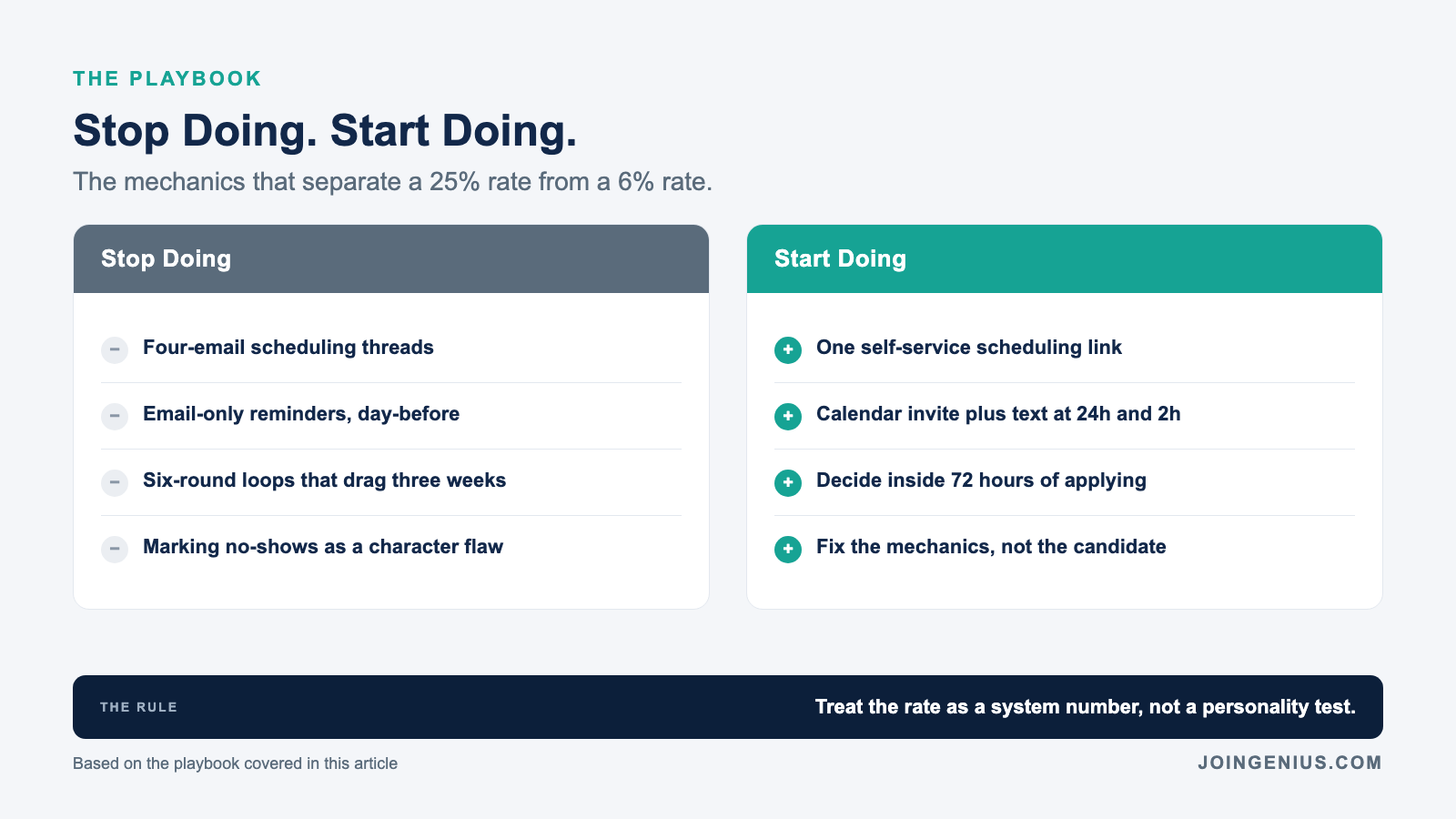
What to Stop Doing (It’s Making Your No-Show Rate Worse)
The moves that quietly inflate the rate are rarely the ones hiring teams audit. These are the four to cut first.
Six-Round Loops That Drag for Three Weeks
Every extra round is another chance to lose the candidate. A loop that stretches past two weeks does not identify better hires — it filters for candidates with no other options, which is the opposite of what you want. Hiring for startups especially cannot afford this slippage.
Confirmation Emails Candidates Never Read
A plain-text confirmation with a Zoom link buried on line four is not a confirmation. If the candidate has to search their inbox the morning of the call, the call is already compromised. Put the join link in a calendar invite that lands on their phone.
Treating a No-Show as a Character Flaw
The recruiter who marks every no-show as a “red flag” is marking the symptom. Most no-shows are process failures and most of them repeat because nobody looked at the mechanics. Treat the rate as a system metric, not a personality test.
Scoring a No-Show Only After It Happens
By then the loss is already baked in. The signal that matters is which candidates confirm the slot within 24 hours of being invited — that early signal is where the intervention actually works.
How to Measure and Improve the Rate Over Time
A fix only compounds if you can see it. The decision step is where most recruiting teams quietly leak visibility.
Track the Rate by Stage, Not Just Overall
The first-round no-show rate and the final-round no-show rate have different causes and different fixes. A healthy approach to talent acquisition analytics means slicing the number by stage, by source, and by day-of-week — not reporting one blended figure that hides every lever.
Measure the Confirmation Lag, Not Just the Show Rate
The time between the invite going out and the candidate confirming is the early signal that predicts the no-show. Teams that measure it can intervene before the panel is wasted.
Attribute No-Shows to Process, Not People
The interviewer whose candidates no-show at twice the team average is not unlucky — the loop around that interviewer has a mechanics problem. Fix the loop before you blame the recruiter.
A Short No-Show Diagnostic Table
| What to Check | Weak Signal | Strong Signal |
|---|---|---|
| Reminder channel | One email, day-before | Calendar invite plus text, 24 hours and 2 hours out |
| Scheduling flow | Four-email thread | Self-service link with live availability |
| Time from apply to interview | 7+ days | Under 72 hours |
| Reschedule option | Hidden or awkward | One-click, no human needed |
Greenhouse’s 2025 Workforce and Hiring Report, based on a survey of over 6,000 workers, found 63% of candidates say they were ghosted by an employer after an interview — up from 61% in 2024, with 78% among Gen Z. The silence runs both ways, and the no-show on the day is often the mirror of a slow confirmation the week before.
Conclusion
Candidate no-show rates are not a candidate problem. They are a scheduling, communication, and speed problem — and all three are fixable with mechanics any recruiting team can run inside a week. The teams that treat the rate as a system number, measure it by stage, and automate the reminder flow are the teams that get the panel they booked.
We built Genius so growing teams can run that kind of loop with candidates they otherwise would not meet. We place the top 1% of recruiting, operations, and engineering talent from the Philippines and Latin America, at around 80% less than comparable local hires. The relationship stays direct, with no monthly agency fees and a 6-month replacement guarantee on every placement. If the next hire is the one your current pipeline keeps losing to a scheduling gap, see how we source and place talent that actually shows up.