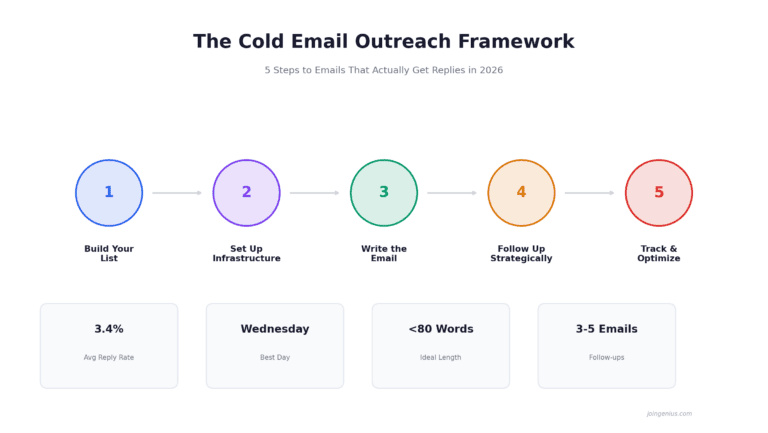
Most cold emails get ignored. That’s not an opinion. The data backs it up. The average reply rate for cold email outreach in 2026 sits at just 3.4%. That means for every 100 emails you send, roughly 96 people don’t respond.
But here’s what’s interesting. Some teams consistently hit 15 to 20% reply rates. Same inboxes. Same prospects. Completely different results.
The difference isn’t luck. It’s method. In this guide, you’ll get the exact cold email strategy that separates the emails people reply to from the ones they delete without reading. Every tactic here is backed by real data from 2026 benchmarks.
Why Cold Email Still Works in 2026
Cold email outreach is far from dead. In fact, B2B email outreach remains the highest ROI channel for sales teams and agencies. The numbers tell the story.
For every $1 spent on email outreach campaigns, companies see an average return of $36. That’s higher than paid ads, social selling, and cold calling combined. The catch? Only if you do it right.
📊 By the Numbers
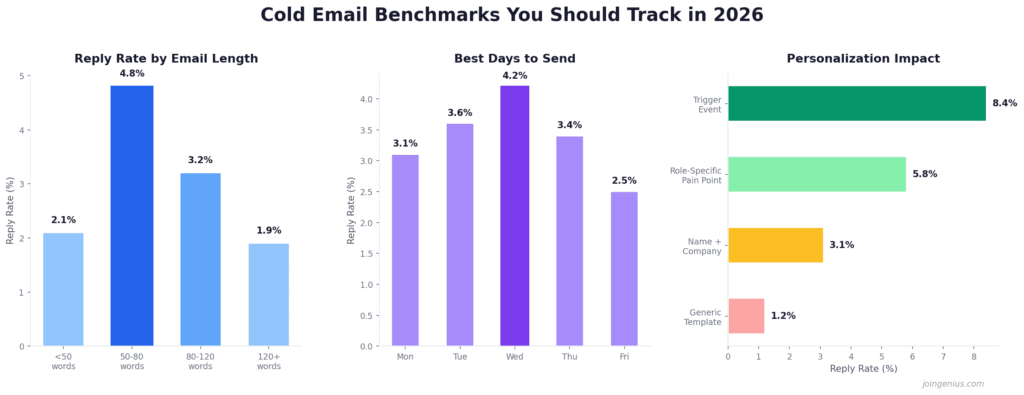
Average cold email reply rate in 2026: 3.4% (down from 8.5% in 2019). But personalized, trigger event emails see reply rates of 8.4%. That’s nearly 2.5x the average. (Source: Woodpecker, 2026 Benchmark Report)
The drop in average reply rates isn’t because cold email stopped working. It’s because most people still send the same generic templates they used five years ago. Buyers got smarter. Inboxes got more crowded. But the teams that adapted? They’re doing better than ever.
Outbound email marketing works when you treat it like a conversation, not a broadcast. That’s the key shift most people miss.
Build a Prospect List Worth Emailing
Your cold email is only as good as the person receiving it. The best email in the world won’t work if it lands in the wrong inbox. Prospect list building is where most campaigns succeed or fail.
Define Your Ideal Customer Profile First
Before you open any tool, write down exactly who you’re looking for. Not “marketing managers.” Something like: “Marketing managers at B2B SaaS companies with 50 to 200 employees who recently raised Series A funding.”
That level of specificity changes everything. When you know exactly who your ideal prospect is, the research becomes easier and the talent sourcing tools you already use for recruiting can apply the same filtering logic to outbound prospecting.
Focus on Trigger Events
The best targeted email campaigns are built around trigger events. These are things happening at the company right now that make your offer relevant. New funding rounds. Leadership changes. Product launches. Hiring sprees.
When someone just got promoted to VP of Sales, they’re thinking about building their team. That’s when your message about hiring for startups hits differently than a generic pitch.
- Job postings on LinkedIn signal growth and budget
- Funding announcements mean new initiatives are coming
- Tech stack changes reveal specific pain points
- Leadership hires often mean strategy shifts
💡 Quick Tip
Set up Google Alerts for your top 50 target accounts. When news breaks about them, you have a natural reason to reach out. Trigger event emails get an 8.4% reply rate versus 1.2% for generic templates.
Verify Before You Send
Bad email addresses kill your deliverability. Bounce rates above 3% tell email providers you’re sending to unverified lists. That’s a fast track to the spam folder. Run every address through a verification tool before adding it to your campaign.
Set Up Your Sending Infrastructure
This is the part most people skip. And it’s the part that matters most. Your email deliverability determines whether your emails actually reach inboxes. Without proper setup, nothing else in this guide matters.
Warm Up Your Domain
Never send cold emails from your primary domain. Buy a secondary domain, set up SPF, DKIM, and DMARC records, and warm it up for at least 2 to 3 weeks before sending any outreach. Email warm up tools automate this by gradually increasing your sending volume and simulating real inbox interactions.
The average time to hire keeps climbing, so teams that invest time in proper infrastructure now save weeks of wasted effort later.
Sending Limits and Timing
Start with 20 to 30 emails per day from a new domain. Increase by 10 to 15 per week as your domain reputation builds. Most email automation tools let you set these limits automatically.
| Day | Best Send Time | Reply Rate | Why It Works |
| Monday | 10:00 AM | 3.1% | People clearing inbox |
| Tuesday | 9:00 AM | 3.8% | Settled into the week |
| Wednesday | 8:30 AM | 4.2% | Peak productivity window |
| Thursday | 10:00 AM | 3.9% | Before weekend planning |
| Friday | 8:00 AM | 2.6% | Low attention, weekend mode |
Writing Emails That Actually Get Replies
This is where email copywriting separates good campaigns from great ones. The structure of your cold email matters more than most people think. After analyzing thousands of successful cold emails, one pattern keeps showing up.

Subject Lines That Get Opened
Your cold email subject lines determine whether your message gets seen at all. 33% of recipients decide to open based on the subject line alone. The best performing subject lines share three traits: they’re short (4 to 7 words), specific, and curiosity driven.
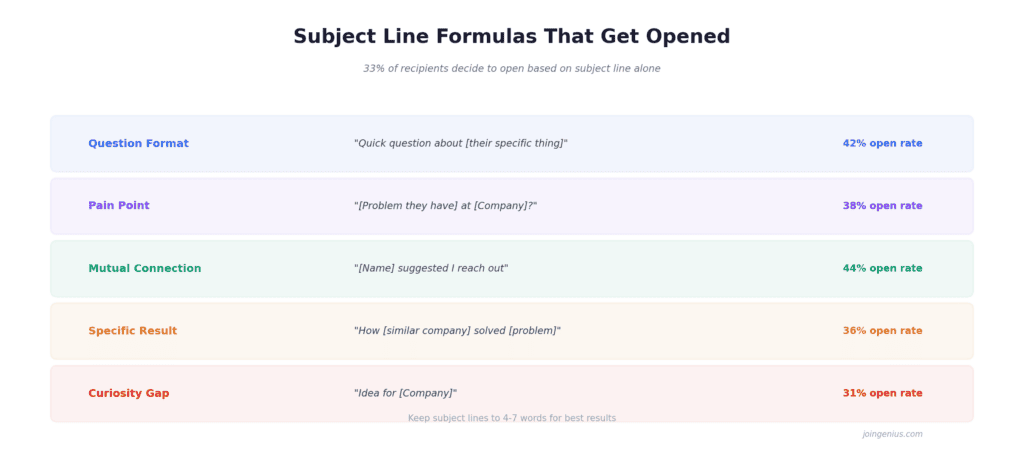
Avoid anything that screams mass email. “Quick question about [company]” consistently outperforms generic lines like “Partnership opportunity” or “I’d love to connect.” Your email open rates depend on making the subject feel like it was written for one person.
⚠️ Common Mistake
Don’t use ALL CAPS, excessive punctuation, or words like “free,” “guarantee,” or “limited time” in subject lines. These trigger spam filters and make you look like every other mass emailer. Keep it lowercase and conversational.
The Body: Keep It Under 80 Words
Here’s a stat that surprises most people. Cold emails under 80 words get a 4.8% reply rate. Emails over 120 words? Just 1.9%. Shorter emails work because they respect the reader’s time and feel more like a real conversation.
Your email body needs four elements and nothing more. A personalized hook that references something real about their company. A value proof that shows one specific result you helped someone similar achieve. A soft CTA that asks a single, low friction question. And that’s it.
Teams that understand the talent acquisition process know this principle well. You don’t dump every qualification in the first conversation. You earn the next step.
Personalize Beyond the First Name
Putting someone’s first name in the greeting is the bare minimum. Real email personalization means referencing something specific to them. Their recent LinkedIn post. A company announcement. A challenge their industry is facing right now.
Trigger event based personalization gets 7x more replies than name only personalization. When someone sees you’ve actually done your homework, they’re far more likely to respond.
🎯 Pro Insight
Spend 3 to 5 minutes researching each prospect before writing. Check their LinkedIn activity, company news, and recent hires. One specific observation (“Saw you just opened a new office in Austin”) beats ten generic compliments.
The Follow Up Sequence That Gets 42% of Replies
Here’s the most underrated stat in cold email. 58% of replies come from the first email. But 42% come from follow ups. Almost half of your results come from the cold email follow up sequence. And most people give up after one email.
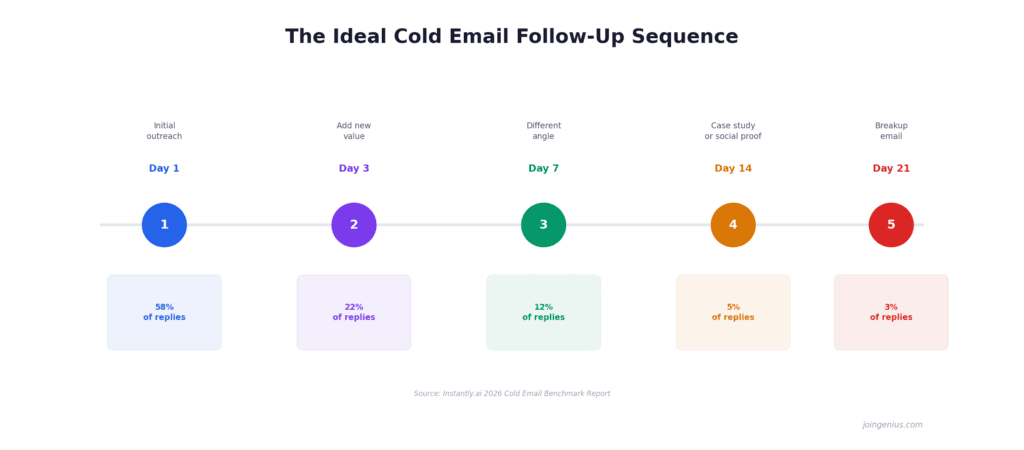
The data on sales email sequences is clear. Three to five follow ups is the sweet spot. Fewer than three and you leave replies on the table. More than five and you start annoying people.
The 5 Email Sequence That Works
- Email 1 (Day 1): Your core pitch. Lead with value, not features.
- Email 2 (Day 3): Add a new angle. Share a relevant case study or data point.
- Email 3 (Day 7): Short and direct. “Did my last email make sense for your team?”
- Email 4 (Day 14): Provide a resource. Link to something genuinely useful.
- Email 5 (Day 21): The breakup email. Let them know this is your last message.
Notice the spacing. Your follow ups should get further apart, not closer together. This mirrors how real conversations work. If a friend doesn’t reply to a text, you don’t send five more in the same hour.
The same talent acquisition and retention strategies that work for keeping good employees also apply here. Stay persistent without being pushy. Add value with every touchpoint.
📌 Key Takeaway
Each follow up should add new value. Never just “checking in” or “bumping this to the top.” Share a relevant insight, a new data point, or a resource they’d actually find useful. Every email earns (or loses) the right to send the next one.
The Mistakes That Kill Your Reply Rate
The difference between a cold email that gets replies and one that gets flagged as spam is smaller than you think. Most cold email mistakes come from trying too hard to sell instead of trying to help.
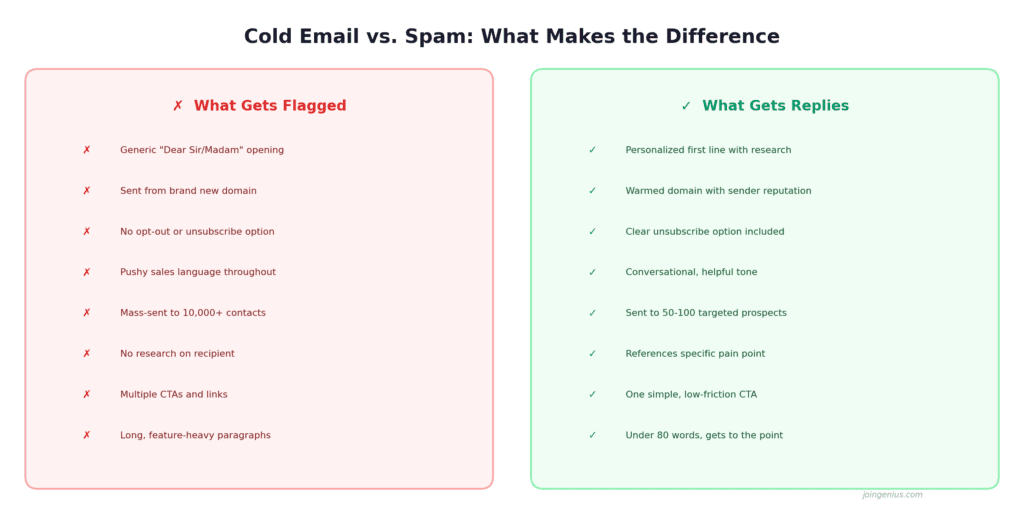
| What Gets You Flagged as Spam | What Gets You Replies |
| Generic “Dear Sir/Madam” opening | First name with a specific observation |
| 200+ word essays about your company | Under 80 words focused on their problem |
| “Buy now!” or aggressive CTAs | Soft question: “Would a quick call make sense?” |
| Sending from unverified domains | Properly warmed domain with SPF/DKIM/DMARC |
| Same template to 10,000 people | Personalized message to 100 right people |
| No unsubscribe option | Easy opt out in every email |
The biggest mistake? Treating cold email like a numbers game. Blasting 1,000 generic messages doesn’t work anymore. The teams getting results in 2026 are sending fewer, better emails to carefully selected prospects.
Companies that understand outsourcing best practices know that quality beats quantity in every business process. Cold email is no different.
Track What Matters (and Ignore Vanity Metrics)
Your cold email metrics tell you exactly what’s working and what needs fixing. But only if you track the right ones. Too many teams obsess over open rates when they should be watching reply rates and conversion rates.
The Metrics That Actually Matter
- Reply rate: Your most important metric. Aim for 5 to 8% as a starting benchmark.
- Positive reply rate: Not all replies are good. Track how many show genuine interest.
- Bounce rate: Keep this under 3%. Higher means your list needs cleaning.
- Cold email conversion rate: Replies that turn into meetings or next steps.
- Unsubscribe rate: If this spikes, your targeting or messaging needs work.
Open rates are useful as a directional signal for subject line testing. But with privacy tools blocking tracking pixels, they’re less reliable than they used to be. Focus on replies and conversions instead.
The same data driven approach that powers talent acquisition analytics should drive your email outreach. Test one variable at a time, measure the impact, and double down on what works.
💡 Quick Tip
Run A/B tests on subject lines with at least 100 sends per variant before drawing conclusions. Small sample sizes lead to false winners. Test one element at a time: subject line, opening sentence, CTA, or send time.
Putting It All Together: Your First Campaign in 7 Days
You don’t need to be perfect. You need to start. Here’s a realistic timeline for launching your first high quality cold email campaign.
| Day | Focus | Key Action | Deliverable |
| 1 to 2 | Research | Define ICP and find 50 prospects | Verified prospect list |
| 3 | Infrastructure | Set up secondary domain and DNS | Warm domain sending |
| 4 to 5 | Writing | Draft 3 email variants and sequence | 5 email sequence ready |
| 6 | Testing | Send first 20 emails, check delivery | Inbox placement confirmed |
| 7 | Launch | Begin full sequence at 20 to 30/day | Campaign live and tracking |
The teams that see the best results treat cold email like an ongoing process, not a one time blast. Just like effective talent acquisition strategies, the best cold email programs get better every week through testing and iteration.
If you’re building a remote team or growing your sales function, cold email outreach gives you a predictable, scalable way to fill your pipeline. And with the framework in this guide, you’ll be ahead of the 96% still sending generic templates.
Start Small, Iterate Fast
Cold email outreach in 2026 rewards precision over volume. The teams hitting 15%+ reply rates aren’t sending more emails. They’re sending better ones to fewer, more relevant people.
Pick one thing from this guide and try it this week. Tighten your prospect list. Rewrite your subject lines. Add a follow up sequence. Small changes compound fast when your foundation is solid.
Your next great customer, hire, or partnership might be one well written email away.