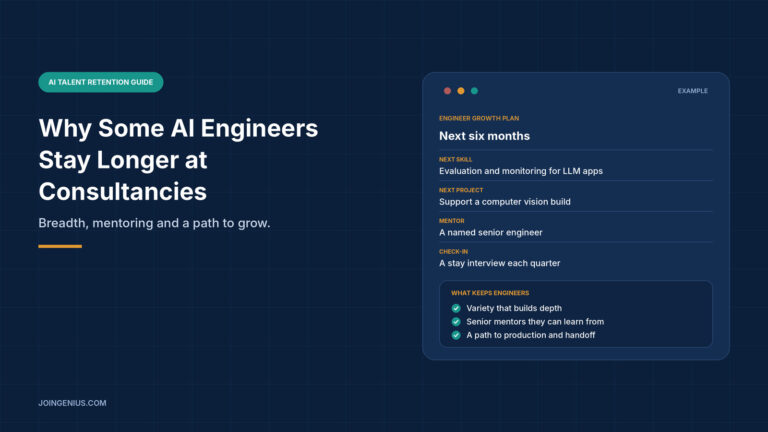
Plenty of hiring managers assume AI engineers leave consultancies quickly and settle into product companies. Some engineers do the opposite, and the reasons are worth understanding. This guide looks at the conditions that make AI engineers more likely to stay at a consultancy: breadth of work, close mentoring, end-to-end ownership and a visible path to grow. It also says plainly when a product company is the better home, and it ends with a table of warning signs that an engineer may be about to leave.
We could not find a reliable public comparison of AI engineer tenure at consultancies and product companies, so treat this as practical reasoning rather than a statistical claim. It is general information, and every employer is different.
What the Data Does and Doesn’t Say
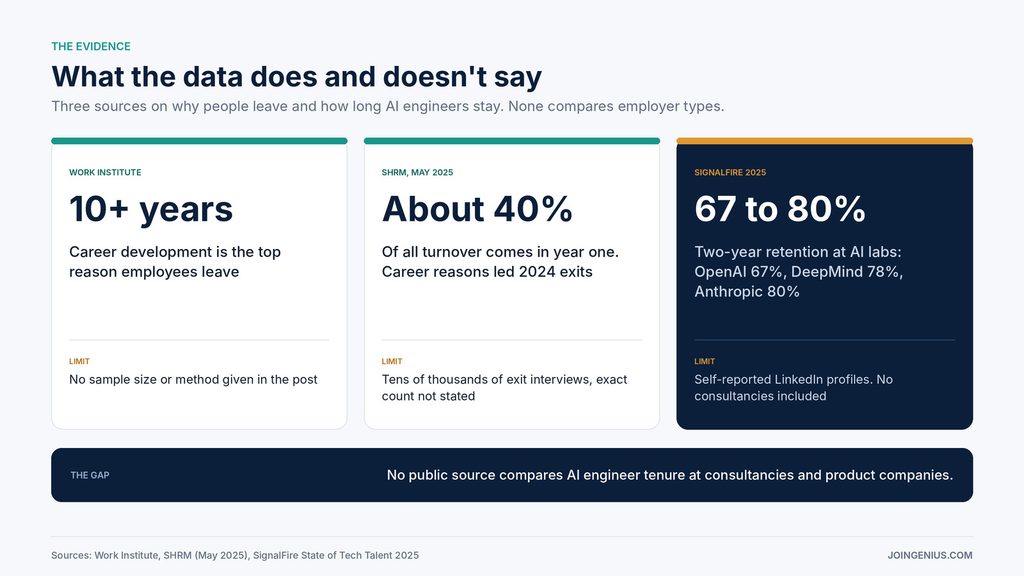
Start with what the evidence can support. Work Institute, which analyses exit interviews, says a lack of career development has been the top reason employees leave for more than ten consecutive years, and that one in five employees who took a job with a new employer in 2019 cited it. The post does not give a sample size or method. A May 2025 SHRM article by Roy Maurer draws on Work Institute’s analysis of exit interviews covering 2024 turnover. It reports that career-related reasons such as limited growth, weak progression and insufficient development were again the top driver of departures, and that first-year attrition accounts for about 40% of all turnover.
None of that compares employer types. The closest data on AI engineers comes from the SignalFire State of Tech Talent Report 2025, which measured two-year retention at AI labs: 80% at Anthropic, 78% at DeepMind and 67% at OpenAI, against 64% at Meta. The report relies on public, self-reported LinkedIn profiles and warns that they may be inaccurate, and it has no figures for consultancies.
What it does show is that retention varies widely even among product-side AI employers, so “product company” is not one retention story. Read these sources as signals about what people say when they leave, not as proof of what makes them stay, because exit interviews capture the reasons given at the point of departure. If you want to measure your own numbers, the guide to employee retention rate explains how.
Breadth of Work: Why Consultancy Roles Keep AI Engineers Learning
Hackman and Oldham’s job characteristics model, which is more than 50 years old and is described here through a summary from Toggl, lists skill variety as one of five core job characteristics. It defines skill variety as “the degree to which a job requires a variety of skills to complete the necessary activities associated with the position”. A consultancy is a natural place to find it, because the work changes with the client.
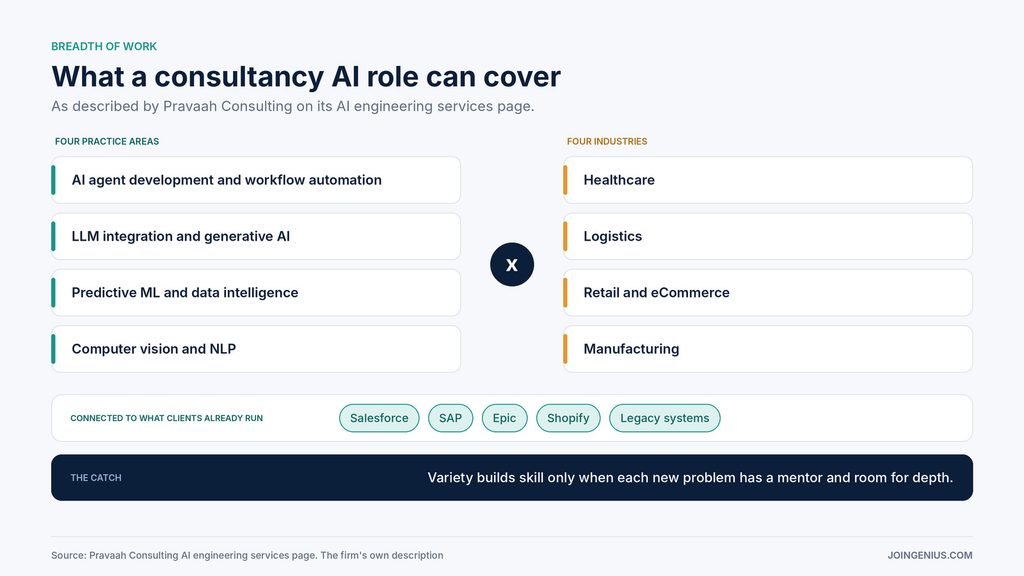
Pravaah Consulting’s AI engineering services page shows what that breadth can look like. The firm describes four practice areas: AI agent development and workflow automation, LLM integration and generative AI, predictive ML and data intelligence, and computer vision and NLP.
It applies them across healthcare, logistics, retail and ecommerce, and manufacturing. It also says it connects AI to what clients already run, citing systems such as Salesforce, SAP, Epic and Shopify, as well as legacy systems with no modern API. For an engineer, that is a wide mix of model, data and integration problems in a short span. The page describes the firm’s services and does not say how long its engineers stay.
Breadth only helps retention if it builds skill rather than scatter. An engineer who touches six tools in a year without going deep on any may feel busy but not better. Plan the variety: pair each new problem type with someone who has done it before, and give the engineer room to go deeper on the area they want to own.
Mentoring, Ownership and the Handoff
Two other conditions show up in how Pravaah describes its work. First, engagements start with a business case workshop, and clients can talk to a senior AI engineer on a discovery call. Junior engineers who join those conversations can see how a senior person frames a problem before any code is written. Second, the firm says it builds documentation, runs workshops and trains clients’ teams, and that its handoff to production “isn’t a Jupyter notebook” but containerised, monitored and version-controlled work.
Engineers who see their work through to production, and explain it to the people who will run it, usually have more to learn than those who stop at a prototype. That is our reasoning, not a finding from the firm’s page. Make the mentoring specific, too. A named senior engineer who reviews design choices, sits in on client calls and comments on handoff notes does more than an open-door policy. Agree how often they meet, and ask the engineer after a quarter whether the time was useful.
Check whether all of this is true on your own team. A stay interview lets you ask engineers directly what keeps them and what would make them consider leaving, so you hear it before an exit interview does.
When Product Companies Win
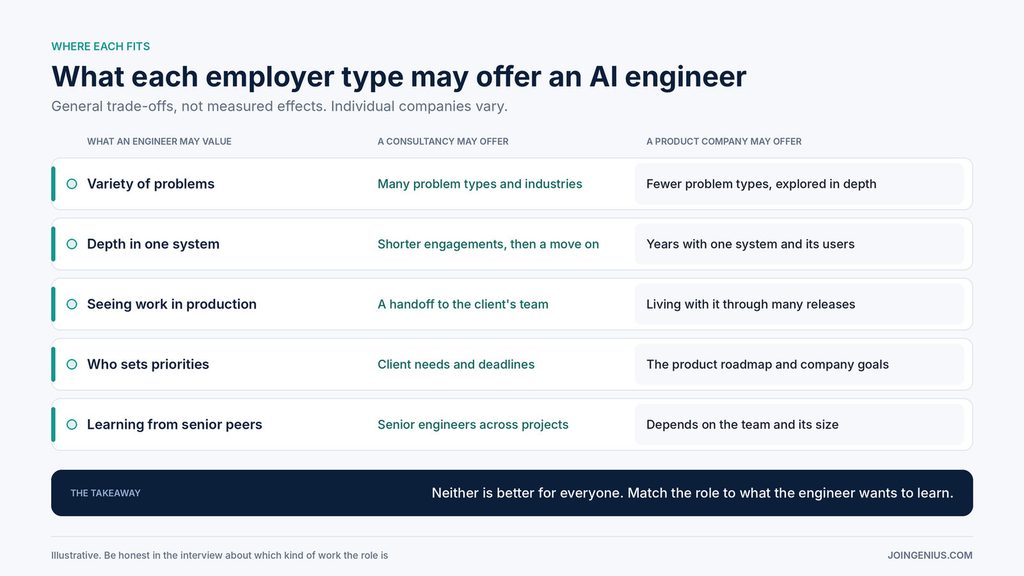
A consultancy is not the right home for every AI engineer. Product companies tend to offer something consultancies find hard to match: the chance to own one system for years, to watch how real users behave over time and to improve a model across many releases. Engineers who care most about depth in a single domain, or who want to follow one product from first release to maturity, may find that more satisfying than variety.
Consultancy work also carries its own strains, including switching context between clients and working to client priorities and deadlines. These are general trade-offs rather than measured effects, and they vary by company. The practical point for a hiring manager is to be honest in the interview about which kind of work the role is. SHRM’s article quotes its chief human resources officer saying employers have not explained what employees will learn from a role or how long they are expected to stay in it. Mismatched expectations are an avoidable reason for leaving.
How Employers Keep AI Engineers Longer
Whichever kind of employer you are, the same few habits help.
- Name the next step. Tell each engineer what skill and project come next, so growth is visible rather than assumed.
- Rotate with support. Move engineers across problem types with a mentor, and let them go deep on one area they choose.
- Own the finish. Make the path to production and the handoff part of the job, so engineers see results.
- Listen early. Run stay interviews each quarter and read exit interview answers for patterns.
- Treat the first year differently. SHRM’s article suggests structured onboarding with regular check-ins and realistic job previews, because first-year exits make up about 40% of turnover.
None of this needs a large budget. It needs someone to decide in writing what each engineer will learn over the next six months, and to check back. If nobody owns learning in your team, consider giving the job to a learning and development manager or an equivalent role, so growth plans do not depend on a busy engineering lead.
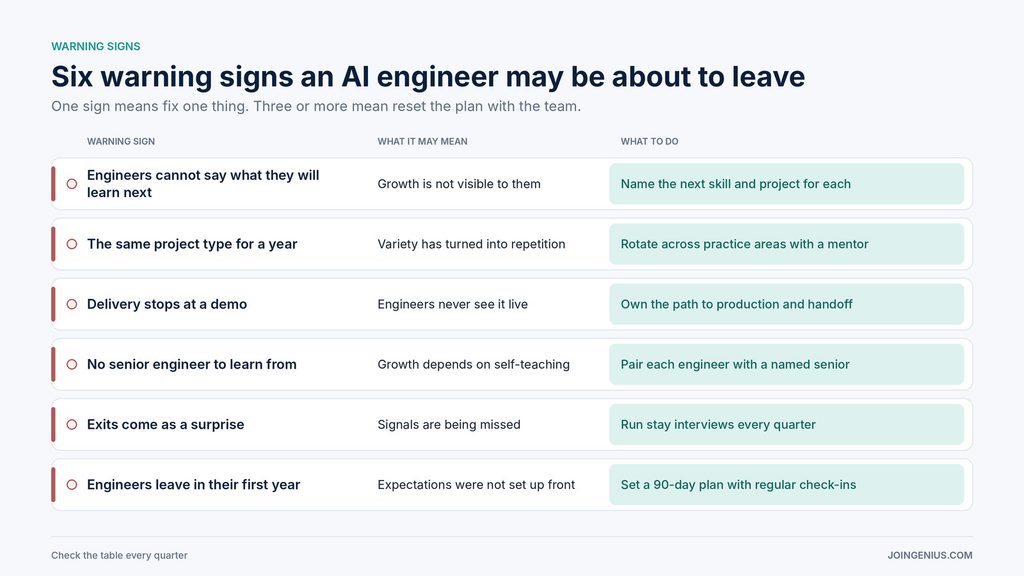
Warning Signs Your AI Engineers Are About to Leave, and What to Do About Each
Check this table every quarter. One sign means fix one thing. Three or more mean sit down with the team and reset the plan before you lose someone.
Keep Engineers by Keeping Them Learning
Career development has been the top reason people leave for more than a decade, according to Work Institute, and AI engineers are unlikely to be the exception. Consultancies can offer breadth, mentoring and end-to-end ownership, and product companies can offer depth and long-term ownership. Either can keep AI engineers longer when growth is visible, mentors are named and expectations are honest from the first interview.