Product marketers are easy to hire for the wrong fluency. One candidate writes polished launch copy but has never watched a developer try to install a tool. Another talks easily about APIs but has no plan for getting a product in front of the people who would use it. Neither is guaranteed to help a developer product get found, and the question of how a product gets found now includes AI assistants as well as search and word of mouth.
This guide explains how to hire developer-first product marketers, meaning marketers whose audience is developers, not marketers who are developers themselves. It covers what the role asks for, how developers find tools, where AI assistants fit in, how to test whether a candidate understands both, where to source people and how to score them fairly. It ends with a table of warning signs. We found no study showing which developer marketers perform best or how developers first discover tools, so the advice is practical reasoning built on related research. It is general information, and the right profile depends on your product and team.
What “Developer-First” Means in a Job Posting
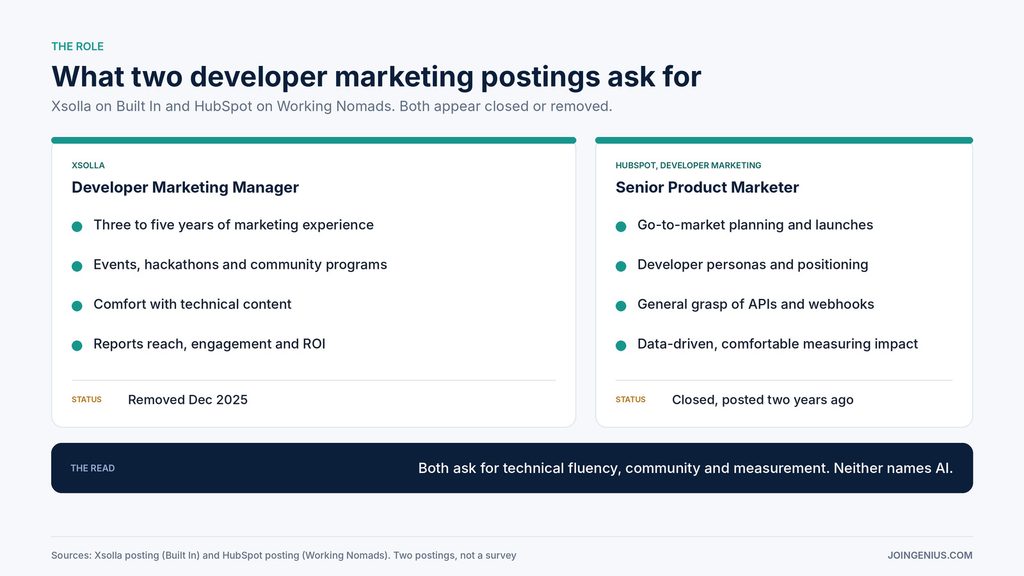
Postings show how companies write the role down. Xsolla’s Developer Marketing Manager posting on Built In asks for three to five years of marketing experience, regional events, hackathons and community programs, and comfort with technical content and “understanding developer needs”. It also asks the person to “Monitor and report on: Campaign reach, engagement, and ROI”. HubSpot’s Senior Product Marketer, Developer Marketing posting on Working Nomads asks for go-to-market planning, developer personas and positioning, a “general understanding of technical products like APIs, webhooks, Objects and the developer audience”, and someone “data-driven and comfortable measuring impact”.
Both listings appear to be closed or removed, and two postings are an illustration, not a survey. They do show that the role mixes technical fluency, community work and measurement. Neither lists AI assistants as a channel or a skill, which is the gap this guide tries to fill. For the wider search, the guide to hiring an internet marketer covers a related profile.
How Developers Find Tools
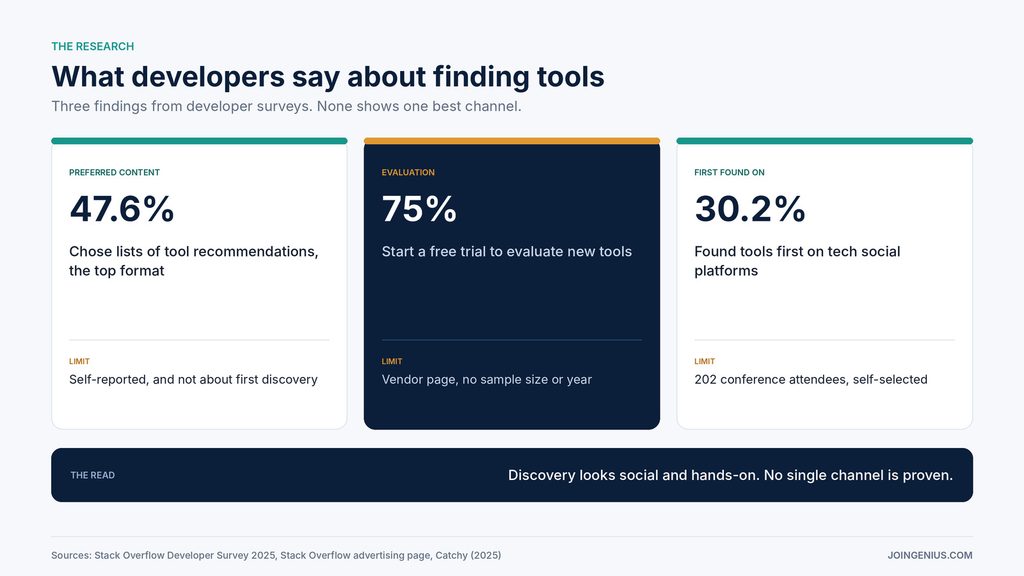
The evidence points to peers, communities and hands-on trial. Stack Overflow’s advertising page for B2B marketers says 75% of respondents start a free trial to evaluate new tools, almost 73% ask technologists they know and 61% visit communities such as Stack Overflow. The page gives no sample size or year, and Stack Overflow sells advertising, so read it as a vendor’s view.
Catchy, a developer-marketing agency, surveyed 202 attendees at All Things Open in October 2025. Tech social platforms led as the place respondents found tools (30.2%), followed by word of mouth (20.3%), general social media (19.8%), meetups (18.8%) and GitHub browsing (10.9%). The agency also reports that 34.7% would abandon a tool if setup is difficult, and that only 12.9% start with documentation. The sample is small and self-selected, some of the article’s figures do not reconcile and Catchy sells services, so use it lightly.
The 2025 Stack Overflow Developer Survey, with more than 49,000 responses from 177 countries, found that the most-selected content format was lists of recommendations for tools and technologies (47.6%), ahead of long-form articles (40.8%). That is about preferred content, not first discovery. Taken together, discovery looks social and hands-on, and no source shows one best channel. A marketer who knows only paid ads and launch posts is missing most of it, and B2B community marketing is a useful place for them to start.
Where AI Assistants Fit In
AI use among developers is now common. The same Stack Overflow survey found that 84% of respondents use or plan to use AI tools, up from 76% the year before, and 51% of professional developers use them daily. Trust is lower: 46% distrust the accuracy of AI tools and 33% trust it, and 66% cite “AI solutions that are almost right, but not quite” as their top frustration.
A 2025 arXiv preprint by Ebtesam Al Haque, Chris Brown, Thomas LaToza and Brittany Johnson adds detail. It combined 128 retained survey responses with 17 interviews, and 83.6% of survey respondents actively used AI tools. When the assistant fell short, people turned to Stack Overflow, official documentation, Reddit and colleagues. The sample skews younger and less experienced, and the paper is about information seeking in software work, not about finding tools. The fair reading is that assistants are one source among several and developers check them.
What makes a product easy for an assistant to use? The best independent evidence we found is the GEO paper by Pranjal Aggarwal and colleagues, presented at KDD 2024. On a benchmark of 10,000 queries, the authors report that adding statistics, quotations and citations raised visibility in generative engine responses by up to 40%, while keyword stuffing performed poorly. Results varied by domain, and the study did not test developer tools or product listings. It suggests that clear, evidenced content may be easier for these systems to use, but that is reasoning, not proof. Our guide to AI search engines explains the basics.
Test Whether Candidates Know How Developers and AI Assistants Find Tools
A candidate who understands both sides can walk through discovery for a tool they have never marketed. PeerPush, which describes itself as a product discovery platform for people and AI, is one example of the structured listings such a marketer might use. Its developer page lists tools alongside discovery signals, including whether a tool exposes an API or MCP server so AI agents can call it, and says it delivers product data to AI engines. Those figures are the platform’s own, so we do not rely on them, and the page says nothing about hiring. It does show the kind of thing a candidate should be able to discuss: structured information about a product that both people and machines can read.
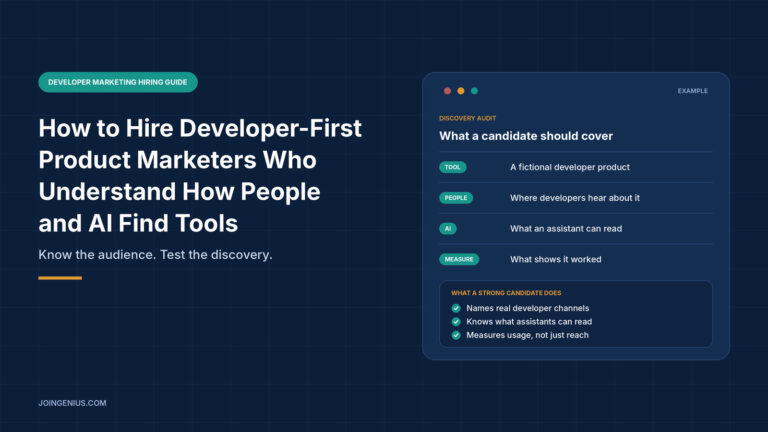
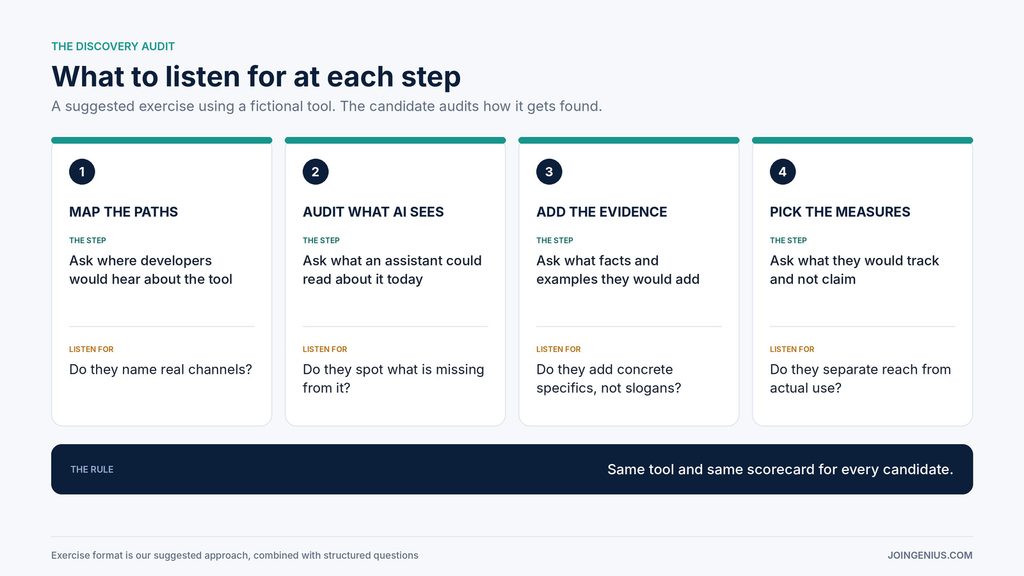
Turn that into an exercise. Give the candidate a short description of a fictional developer tool. Then ask four things. Where would developers hear about it, and what would they try first? If someone asked an AI assistant for a tool like this, what could it read about the product today, and what is missing? What facts and examples would you add? What would you track to know it worked, and what would you not claim? Listen for real channels, specific gaps and a clear line between reach and usage.
Where to Source Candidates
Start with people who have already marketed to developers: developer marketing and developer relations staff, product marketers at product-led software companies and community managers who have run launches. Referrals from engineers help, because an engineer can tell you whether the marketer understood the product. A specialist marketing recruitment agency can shortlist for you, and the guide to talent sourcing tools covers ways to organise the search. If your product grows through trials, the guide to product-led growth shows what that background looks like.
No channel has been shown to produce better developer marketers than the others. We looked for evidence and found none, so judge each channel by what it gives you: candidates who can describe a launch to developers and say what they measured. Screen for that early.
Score Fairly
A 2022 study by Paul Sackett and colleagues in the Journal of Applied Psychology, summarised in SIOP’s TIP by HumRRO researchers, estimated that structured interviews had a mean validity of .42 and work sample tests .33 for predicting job performance. These are averages across many jobs, not figures for marketers. The practical reading is to combine them: ask every candidate the same questions about past launches, then add the audit exercise.
Write the criteria on an HR scorecard so every interviewer rates the same things, and use a consistent interview guide. Score independently before comparing notes, because awareness of interviewer bias matters when a fluent speaker sounds more capable than they are. Interview feedback examples help interviewers record evidence rather than impressions.
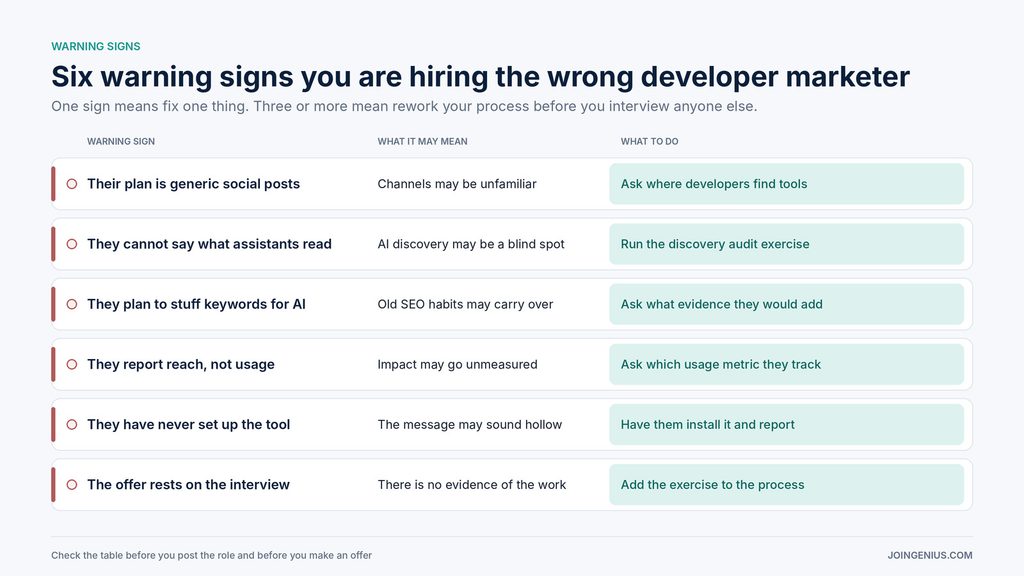
Warning Signs You Are Hiring the Wrong Developer Marketer, and What to Do About Each
Check this table before you post the role and again before you make an offer. One sign means fix one thing. Three or more mean pause and rework your process before you interview anyone else.
Hire for Understanding of the Audience
The marketer worth hiring knows where developers actually look, what an assistant can and cannot read about a product, and how to tell reach from use. Define those skills first, source people who can describe real launches, test them with the audit exercise and check what they say against references. If the scorecard, the exercise and the references agree, you are probably hiring someone who can help developers and AI assistants find your product.