
A property owner who lives hours away from her rental hires a manager she found through a listing. The first month goes smoothly. By month three, guests are complaining about cleaning, a plumber has been paid for a repair nobody approved, and she cannot tell from a distance whether the work was done.
That is an illustration, not a case study, but it shows the central problem of remote ownership: you cannot walk through the property, so you have to vet people on paper, by phone, and by test.
This guide explains how to vet remote property management contractors, meaning the managers, co-hosts, cleaners, and maintenance vendors who act for an owner who is not on site. It covers defining the job, what evidence exists, a checklist, keeping a record of who does what, a four-step plan and a table of warning signs.
We found no study showing which vetting steps predict good outcomes in remote property management. The advice rests on general guidance for hiring contractors, research on online reviews and hiring methods, and our reasoning, which we label as such. It is not legal advice, and licensing and contract rules vary by location.
Define What You Are Hiring For
Property management contractors do different jobs, and a vague brief invites disputes. A manager may handle guest or tenant communication, pricing, and bookings. A co-host may share some of that work. A cleaner turns the property over between stays. A maintenance vendor fixes problems as they arise. Each role needs its own scope.
For each one, write down what the contractor does, what they must ask about first, and the amount they can spend without approval. That spending limit matters most when you are far away, because you will often learn about a repair after the invoice arrives. The right limit depends on your property and your risk tolerance, so we do not suggest a number. Our guide to job design is a place to start on building a role around real tasks.
What Evidence Exists on Vetting
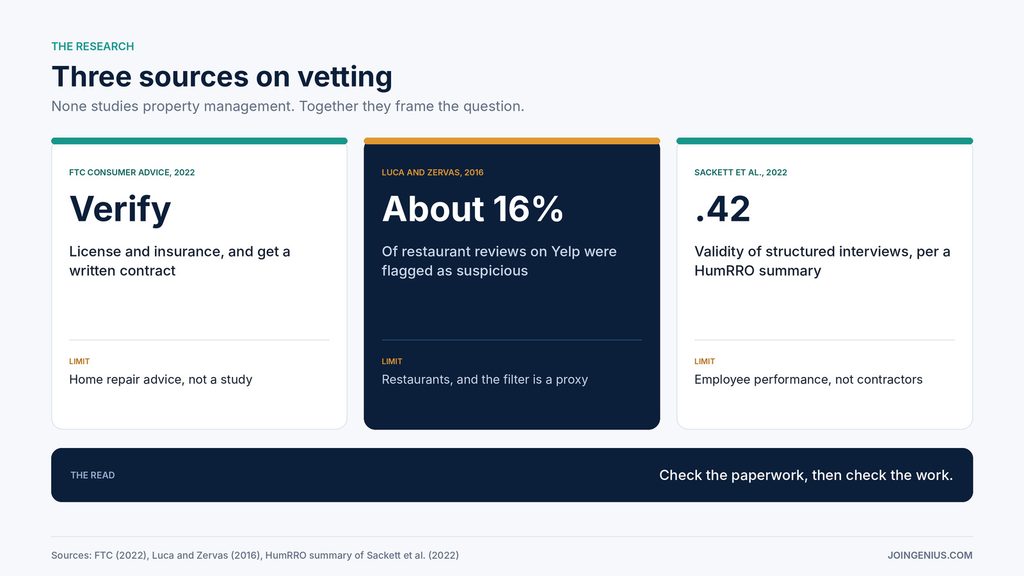
We found three sources that bear on the question. None studies property management, and each has limits.
The U.S. Federal Trade Commission’s consumer advice on avoiding a home improvement scam, dated July 2022, is guidance and not a study. It says to consider only contractors who are licensed and insured, to confirm the license with the state or county government, and to ask for proof of insurance. It advises getting several written estimates and not automatically choosing the lowest.
It says the contract should include the contractor’s name, contact details, license number, and start and completion dates. It also advises against paying the full amount up front or making the final payment before the work is done, and it lists pressure for an immediate decision and cash-only demands as red flags. The advice is written for home repairs, so we treat it as a baseline for maintenance vendors and a model for other roles.
Michael Luca and Georgios Zervas studied review fraud on Yelp in a 2016 Management Science paper. They used reviews that Yelp’s filter flagged as suspicious as a proxy for fraud, and about 16% of restaurant reviews were filtered.
They also found that businesses with weaker reputations were more likely to commit review fraud. The data cover restaurants, not rentals, and the filter is only a proxy. The result is still a reason not to rely on online reviews alone, and the FTC advice likewise says to read reviews critically.
For choosing among candidates, a HumRRO summary of a 2022 Journal of Applied Psychology paper by Paul Sackett, Charlene Zhang, Christopher Berry and Filip Lievens reports validity of .42 for structured interviews and .33 for work sample tests. The authors say earlier estimates were inflated by range restriction corrections and that validity varies considerably.
These figures describe general job performance of employees, not contractors, and we read a summary and not the full paper. Our reasoning is that the same logic carries over: asking every candidate the same questions and having them do a small piece of real work should tell you more than a polished profile. That is an inference, not a finding.
A Vetting Checklist for Remote Contractors
Run the same checklist for every candidate. It is our suggested process, informed by the sources above.
- Verify the license and insurance. Confirm the license with the state or county and ask for proof of insurance. Requirements vary by place and by role, so ask the regulator or local counsel what applies to property managers.
- Call references. Speak to two or three recent clients with a property like yours. Ask what went wrong and how it was handled.
- Read reviews critically. Read the negative ones and look for patterns, not for a score.
- Ask the same questions. For example, how would you handle an after-hours leak, how do you document a turnover, and how often do you report? Compare the answers side by side.
- Get it in writing. The agreement should cover scope, spending limit, reporting schedule, who holds account access and guest or tenant data, and how either side can end it. Consider having a local professional review it.
Ending a relationship cleanly is part of vetting, because a contract with no exit terms is hard to leave. Our guides to how to fire a contractor and to an independent contractor termination letter cover that end of the process.
Keep a Log of Who Does What
Remote ownership makes it easy to lose track of who did what. BNBCalc offers a free material participation hours tracker that logs hours for the owner, property managers, co-hosts, and cleaners as separate participants. We cite it as an example of keeping a record of who does what, not as tax guidance.
Its page says it is record-keeping support and not tax advice, so tax questions belong with a CPA. We have not tested the tool, and the tax claims on that page are BNBCalc’s own.
The idea carries over to vetting even without the tool. A simple shared log with dates, who did the task, and what evidence exists, such as photos or invoices, lets you see in the first weeks whether a contractor does what they said. It also gives you something concrete to discuss in a review, and it shows when two contractors overlap or when a task falls to nobody. If you want help keeping the log, our guide to hiring a virtual real estate assistant lists sites to look at.
A Four-Step Vetting Plan
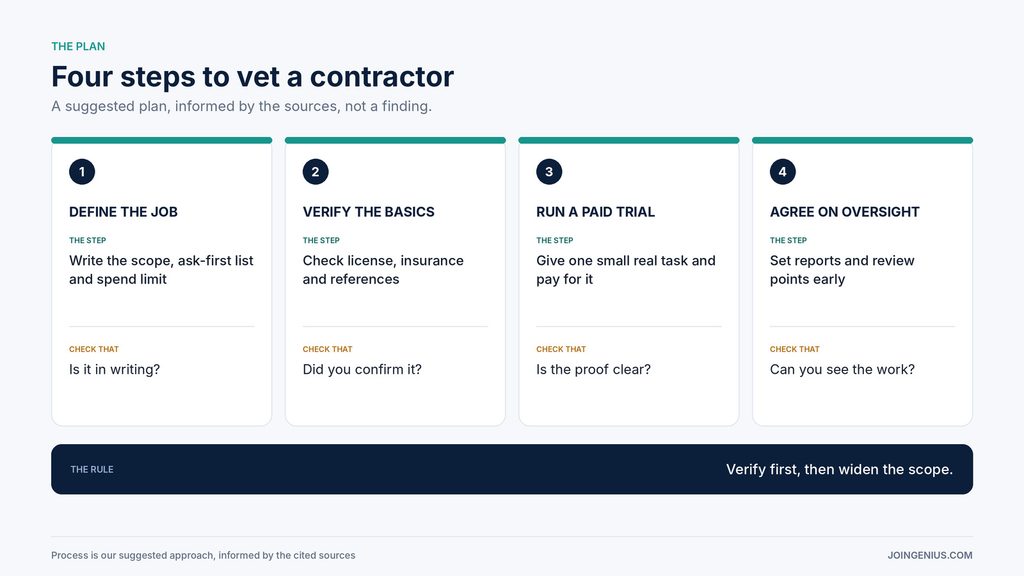
Use this four-step plan for each new contractor. It is our suggested process, and the day markers are not findings.
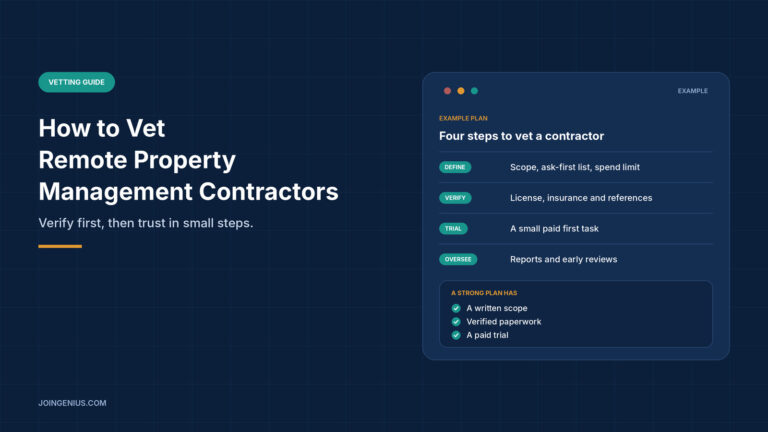
- Define the job. Write the scope, the ask-first list, and the spending limit.
- Verify the basics. Check the license, the insurance, the references, and the written agreement.
- Run a paid trial. Give one small, real task, such as a single turnover with photos or a repair estimate, and pay for the time. Unpaid tests ask people to work for nothing and may put off experienced candidates. That is our view, not a finding.
- Agree on oversight. Set a reporting schedule, decide who has access to what, and review at set points, such as 30 and 90 days.
The order matters because trust is extended in small steps. A contractor who passes the trial has earned more scope, and one who struggles has cost you little. Our guide to vetting founder and executive candidates is another example of structured checks before a hire.
Measure Whether Vetting Worked
Track how quickly the contractor responds to issues, how many repairs were approved before money was spent, how many guest or tenant complaints arrive, and whether turnovers come with photo proof. Compare actual repair costs with the estimates you were given. With one or two properties, the numbers will be small, so read them as prompts for a conversation and not as proof. These measures are our suggestions, not findings.
Warning Signs a Remote Property Contractor Is Not Ready, and What to Do About Each
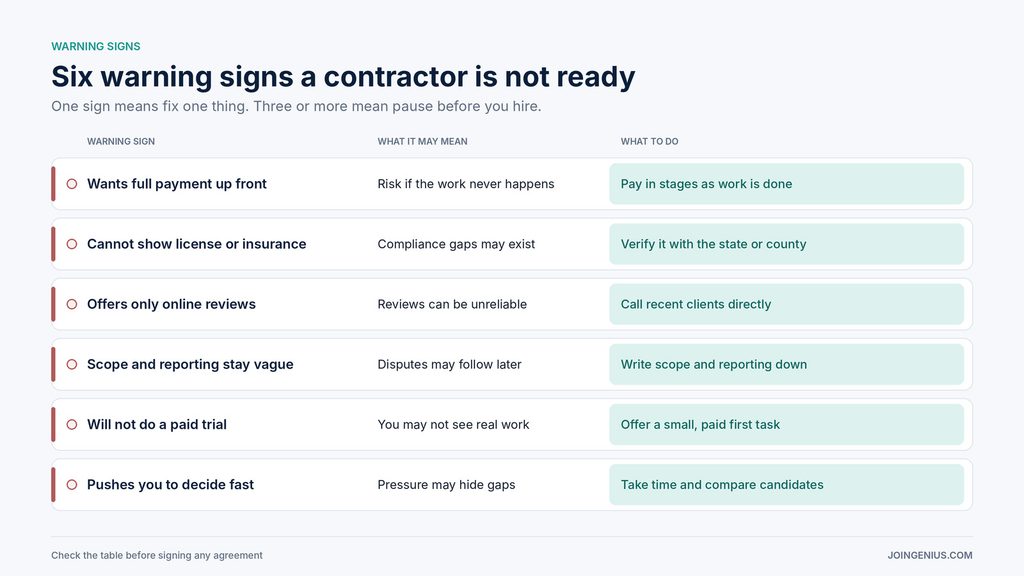
Check this table before you sign anything. One sign means fix one thing. Three or more mean pause before you hire.
| Warning sign | What it may mean | What to do |
|---|---|---|
| Wants full payment up front | Risk if the work never happens | Pay in stages as work is done |
| Cannot show license or insurance | Compliance gaps may exist | Verify it with the state or county |
| Offers only online reviews | Reviews can be unreliable | Call recent clients directly |
| Scope and reporting stay vague | Disputes may follow later | Write scope and reporting down |
| Will not do a paid trial | You may not see real work | Offer a small, paid first task |
| Pushes you to decide fast | Pressure may hide gaps | Take time and compare candidates |
Verify First, Then Trust in Small Steps
Vetting a contractor you cannot meet on site comes down to paper, references, and proof of real work. Define the job, verify the license and insurance, ask every candidate the same questions, run a small paid trial and agree on how you will see what happens at the property.
We found no study proving that this process leads to better outcomes, and the sources behind it have limits. But each step replaces an assumption with something you can check. If the contractor passes the trial and the log shows the work was done, you have a better reason to extend their scope than a polished profile could give you.