Technical onboarding documentation fails so reliably that most engineers expect it to. A new hire opens the setup guide and hits step three. The command errors out because the doc predates two refactors, so they ping a teammate and lose the morning waiting. Multiply that across every new engineer and you have a tax nobody budgeted for.
The usual fix is to blame whoever wrote the doc. That misses the real issue: these docs fail by design, from when they get written to who keeps them alive. Below, we cover why technical onboarding documentation breaks down and who should own it, then how to build docs that survive past week one, which also shapes retention.
Why Technical Onboarding Docs Fail More Often Than They Work
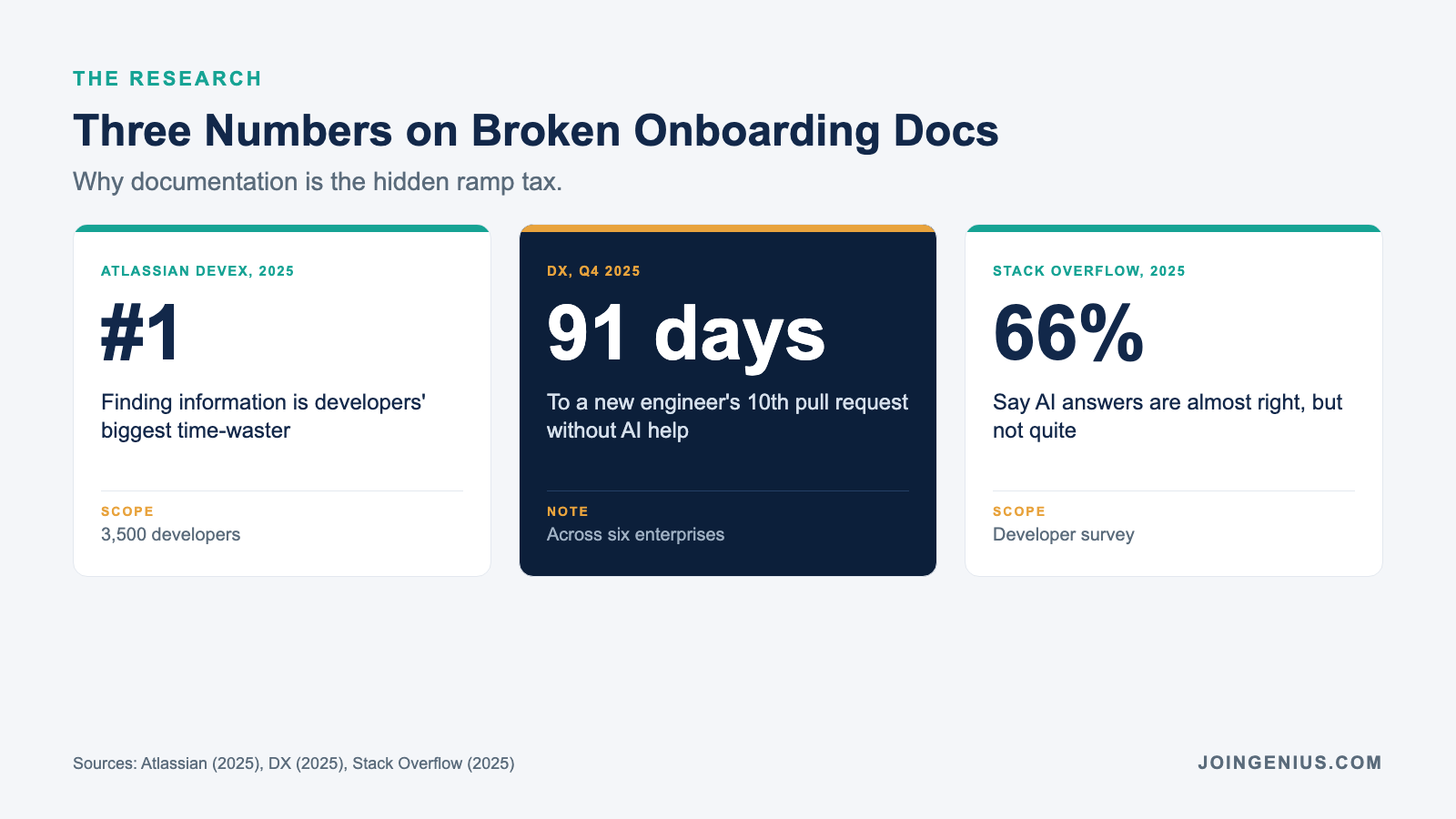
Onboarding docs are not just neglected; they are built to fail. In Atlassian’s 2025 survey of 3,500 developers, finding information ranked as the single biggest time-waster, ahead of technical debt. Three patterns explain how onboarding docs end up that way.
They Get Written During a Crunch, by Whoever Onboarded Last
The person who just suffered through a broken setup is the one told to document it, usually in the same week they are trying to ramp. They write from raw memory under time pressure, and ship something half-complete. It is better than nothing, and it is also wrong within a month.
They Document the Happy Path, Not the Real Environment
Good setup docs have to account for the messy parts, like the undocumented env variable or the dependency that only installs on an older runtime. Those are exactly the parts the writer already solved and stopped seeing.
So the doc describes the clean install that works on one machine, and a new hire on a slightly different setup is stuck at the first real obstacle. Feeling lost in week one does more damage than most managers expect.
Nobody Owns Them, So They Fail Quietly
A wiki page has no on-call. When the build changes, the doc does not throw an error or page anyone; it just gets a little more wrong. Without a named owner, each small gap goes unnoticed until a new hire trips over it. By then the doc has lost trust, and people stop opening it.
What Broken Onboarding Docs Actually Cost
The cost is not the hour a new hire loses on a broken command. It is everything that hour sets in motion.
Time-to-First-Commit Stretches From Days Into Weeks
Ramping a new engineer already takes months. In one 2025 analysis of six enterprises, new engineers reached their 10th pull request in 91 days without AI assistance. A broken setup guide or an undocumented service pushes that line out further, and the business pays for every extra week of a salary that is not yet producing.
Senior Engineers Become the Documentation
When the docs fail, new hires route around them by asking the nearest senior engineer. That turns your most expensive people into a live help desk, answering the same setup questions every onboarding. The interruptions also wreck their focus, so one weak doc quietly costs two people’s time instead of one.
And the questions never stop: the same gaps greet every new hire until the doc is fixed for good.
New Hires Who Struggle Early Start Looking Early
A rough first month is not just unpleasant; it shapes whether someone stays. People decide how a job feels long before they are productive, and onboarding that makes them feel incompetent plants doubt early. It is the same pattern behind hires who don’t stay past their first stretch, where the early experience sets the exit in motion.
Who Should Own Technical Onboarding Documentation
Most documentation problems are really ownership problems. Decide who is accountable and the quality question mostly answers itself.
Why “The Whole Team Owns It” Guarantees No One Does
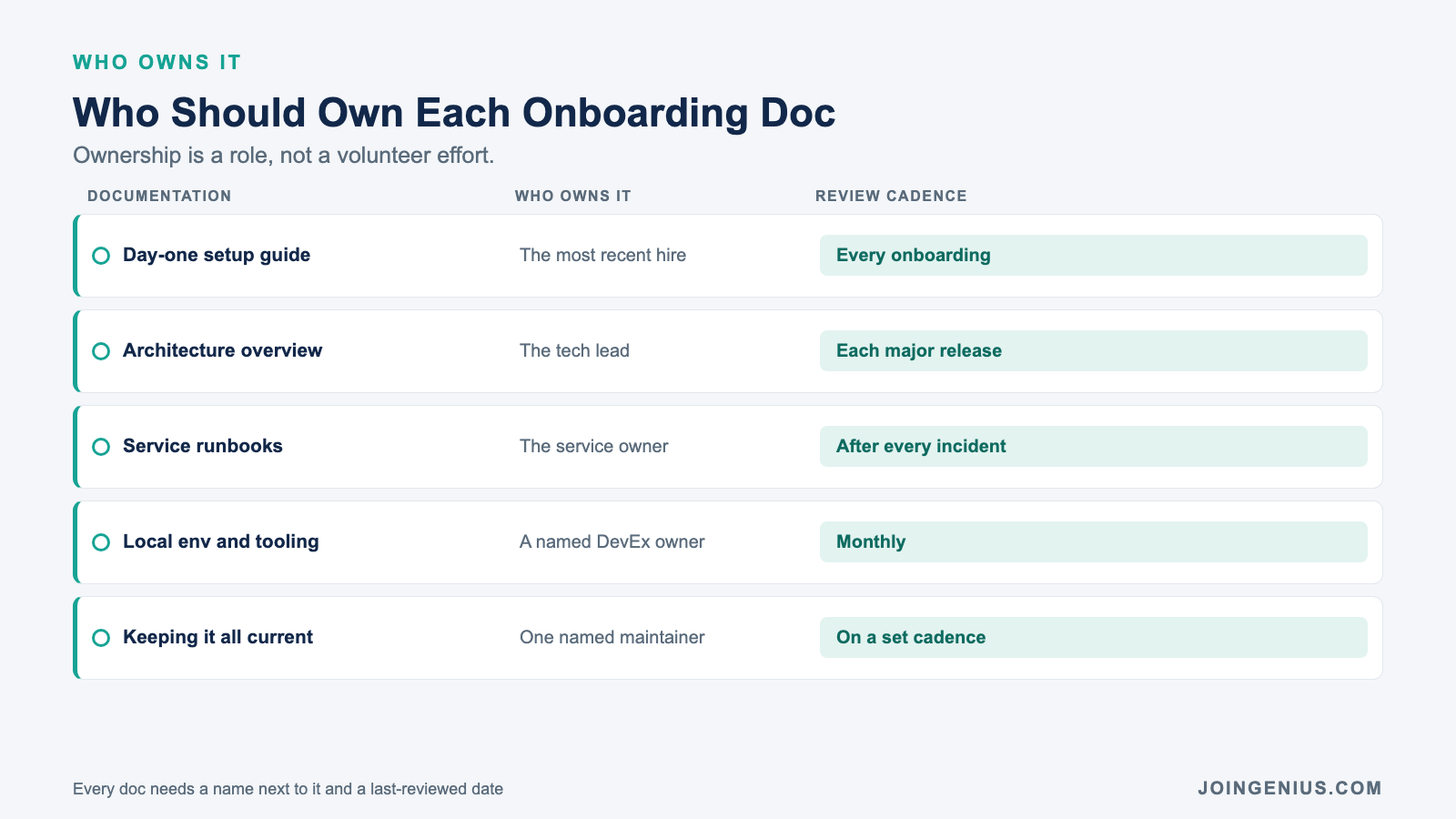
Shared ownership sounds healthy and almost always leaves the docs an orphan. When everyone can edit and no one is accountable, updates depend on goodwill between deadlines. Documentation that survives has a single name attached, the same way you would hand any real responsibility to one owner rather than a committee.
The Newest Hire Is Your Best Auditor
The person who just went through onboarding is the only one who can see what is missing, because they do not already know it. Give every new engineer a standing first task: fix the doc that failed them while the gaps are fresh. You get free QA on every onboarding, and the new hire gets a real first contribution.
Give a Named Maintainer the Final Say
Auditing is not the same as owning. Someone on the team, usually the tech lead, needs the final say on structure and accuracy. Their job is not to write every page, but to make sure each critical doc has a current owner and a last-reviewed date. Accountability sits with a person, not the wiki.
Capture the Process, Don’t Just Write It Down
Even with a clear owner, text has a ceiling. Some knowledge is hard to write and easy to show.
Static Text Loses the Steps People Do Without Thinking
The hardest things to document are the ones experts do on autopilot, like the exact order of setup or the config that only matters on a fresh machine. Writing them down means first noticing them, which is the step that gets skipped.
That is also why generic or AI-written docs fall short here. In Stack Overflow’s 2025 survey, 66% of developers said their biggest frustration with AI answers was solutions that are almost right but not quite. It is the same failure mode as a doc that looks complete and isn’t.
Record the Real Setup Once, Then Keep It Searchable
A faster path is to capture the work while it happens, instead of reconstructing it from memory later. An engineer narrates a task once on screen, and the recording becomes the documentation, including the parts they would never have thought to write down.
Tools that turn those recordings into a searchable internal knowledge base let a new hire ask a question and jump to the exact moment it is answered, rather than scrolling a wiki page nobody maintains. The process and the real screen are both captured, not just a summary of them.
Because the record is your own internal workflow, the documentation stays tied to how the team actually works, not a generic template.
The difference between the two formats is easy to see side by side:
| Dimension | Static text docs | Recorded, searchable docs |
|---|---|---|
| Captures tacit steps | Rarely | Shown on screen |
| Staying current | Manual rewrites | Re-record the changed step |
| How new hires search | Scroll and Ctrl-F | Ask and jump to the moment |
| Effort to create | High to write well | Narrate the task once |
Neither format updates itself, though, which is why the last piece matters most.
How to Build Onboarding Docs That Stay Current
Owning and recording the docs only helps if the system keeps them honest over time. Three habits do most of the work.
Make Fixing the Docs Part of Onboarding Itself
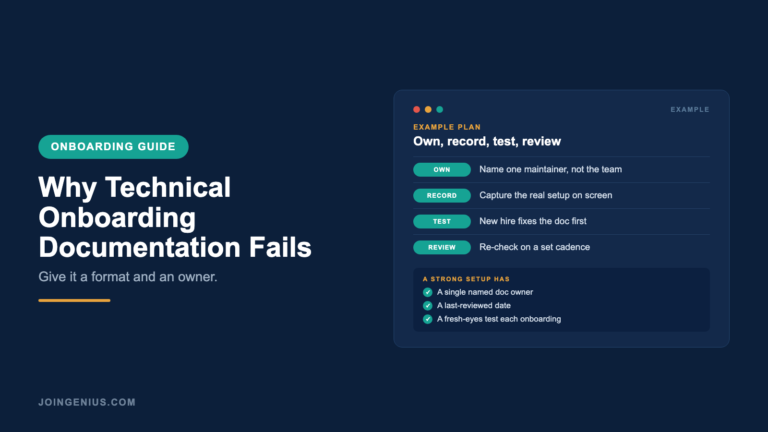
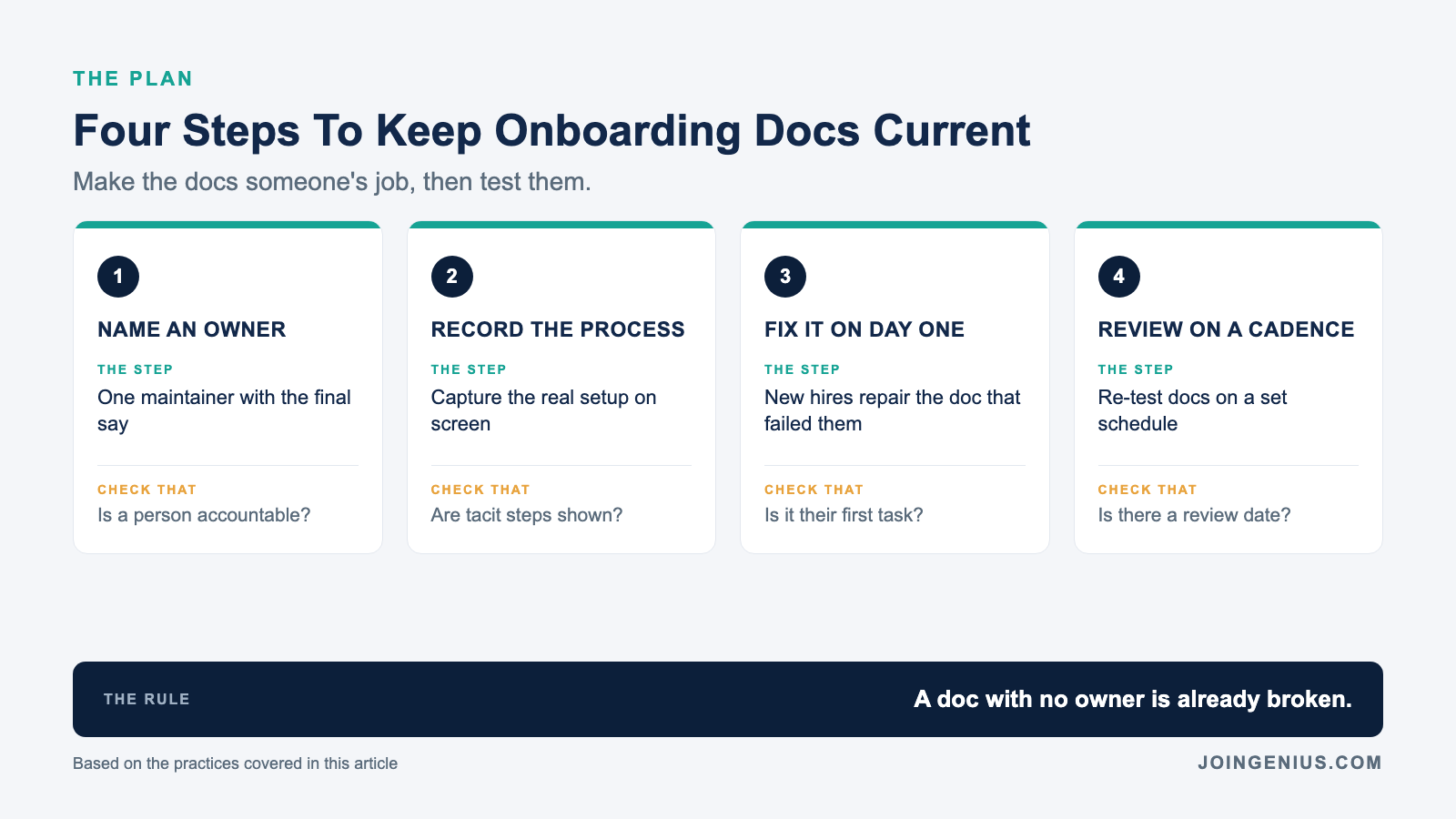
The cheapest time to catch a broken doc is the moment it breaks, during someone’s first week. Build the fix into the onboarding plan so it happens by default, not by goodwill.
- Assign each new hire the setup doc as their first pull request.
- Have them log every step that was missing or out of order.
- Require a doc update before onboarding is marked complete in the tracker.
- Review their edits with the named owner so changes actually get merged.
Run a Fresh-Eyes Test on a Cadence
Docs that are not exercised go wrong silently. Put onboarding docs on a schedule so they get tested even when no one is being hired, and tie each critical doc to a last-reviewed date and an owner. A doc past its review date is treated as broken until someone confirms otherwise.
A quarterly pass is enough for most teams, as long as it actually happens.
Expect It to Hurt Fast-Growing Teams First
The faster you hire, the more each gap compounds. A broken setup doc that annoys one new engineer a quarter becomes a daily fire when you onboard every week. Fast-growing teams feel this first, which is why they are usually the ones who fix documentation ownership before anyone else.
Conclusion
Technical onboarding documentation does not fail because people are careless. It fails because it is written once and owned by no one, then expected to stay true on its own. Fix the ownership and the format, and most of the rest follows. Teams with great docs just made onboarding documentation someone’s real job.
If the deeper problem is that you are scaling an engineering team faster than you can onboard one, that is worth getting help with. At Genius, we help companies hire the top 1% of engineering and operations talent from the Philippines and Latin America, at around 80% less than local hires.
You get vetted people and keep the relationship direct, with no monthly agency fees and a 6-month replacement guarantee. If onboarding your next engineer is the real bottleneck, see how we source and place talent.