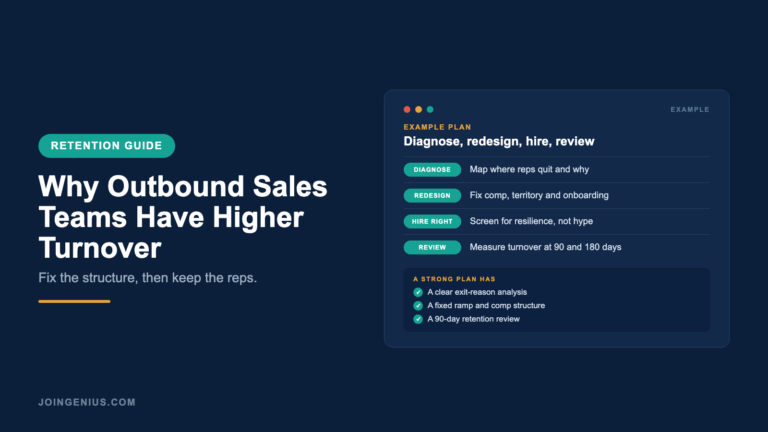
Outbound sales teams have higher turnover than almost any other seat in the company, and most leaders treat it as the cost of doing business. A rep ramps for a quarter and makes hundreds of cold calls. They miss target twice and start looking elsewhere. You backfill, and the clock resets.
This isn’t a motivation problem, and another SPIFF won’t fix it. The churn is built into how the role is structured and paid. Below, we lay out why reps leave faster here than anywhere else. Then we cover the signals before a resignation and what actually improves retention.
Why Outbound Wears Reps Down Faster Than Other Sales Roles
Every sales job carries pressure. An outbound sales role concentrates the harshest version of it into the first hour of every morning.
Rejection Volume Is Structurally Higher in Outbound
A booked meeting can take 80 to 100 touches, and most of those end in silence or a flat no. Account executives work pipeline that someone already warmed. SDRs manufacture interest from a cold list, a different job entirely.
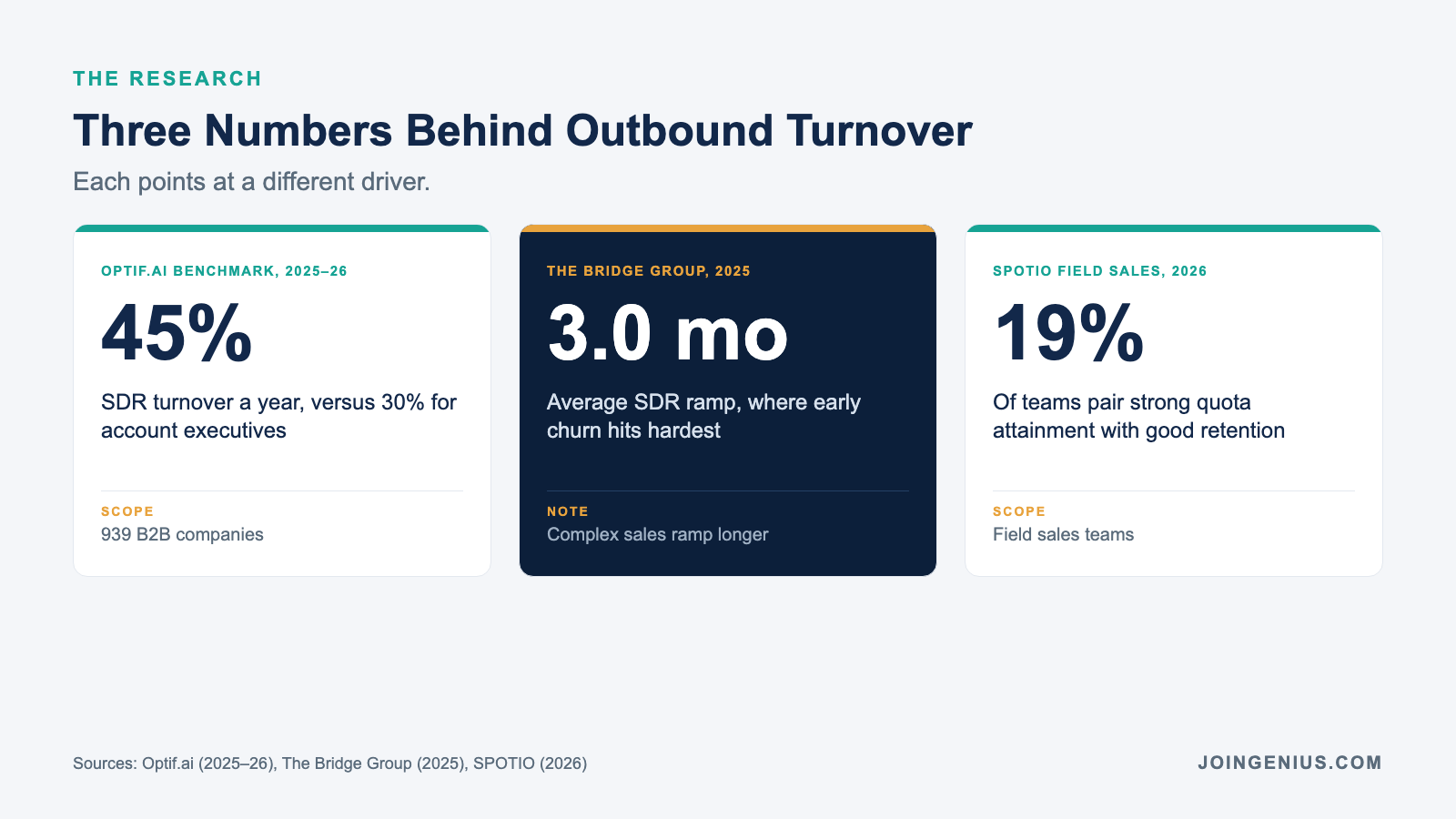
That gap shows up in the exit data. One 2025 to 2026 benchmark of 939 B2B companies put SDR turnover at 45%, against 30% for account executives. Same company and product, very different survival rate. Constant rejection wears on people, and morale slides well before anyone gives notice.
The Activity-And-Quota Double Bind
Outbound reps get measured twice over. There is the activity layer of dials and emails, and the outcome layer of meetings and pipeline. When outcomes dip, most managers push the dial count up.
More dials into a weak list only produce more rejection, faster. Those activity metrics can look healthy on a dashboard while the outcomes that pay the rent quietly stall.
The Long Lag Between Effort and Reward
Cold outreach pays on a delay. A sequence you send this week might book a meeting next month and close the quarter after that. For weeks, a rep can do everything right and watch a flat scoreboard.
That delay is tolerable once you have pipeline in motion. It is punishing for anyone in their first few months, who sees all of the rejection and none of the eventual payoff.
Put the outbound seat next to the roles around it and the pattern is hard to miss:
| Factor | Outbound SDR | Account Executive |
|---|---|---|
| Pipeline source | Self-generated from cold lists | Inherited and inbound |
| Daily rejection | High and constant | Moderate |
| Feedback lag | Weeks | Days |
| Comp volatility | High during ramp | Lower once established |
| Typical annual turnover | 45% | 30% |
The wider research puts hard numbers behind that gap.
The Comp and Quota Design That Quietly Pushes Reps Out
Pay structure does more quiet damage than any manager’s style. Reps rarely quit over a single bad month; they quit over a plan that makes bad months inevitable.
Ramp Periods and Draw Cliffs That Leave Reps Short
Most outbound reps get a draw during ramp, a guaranteed floor while they build pipeline. The trouble starts when that draw is recoverable.
A rep who misses early can finish ramp owing money back against future commission. Plenty resign before they ever climb out.
Quotas Benchmarked on the Team, Not the Territory
Many quotas get set from the top down, divided evenly across reps from a number finance needs. Two reps with identical quotas can inherit very different territories.
One gets a patch with budget and warm accounts. The other gets a region picked over for two years. Same target, but very different odds. The rep in the thin territory reads that gap as a personal failure and leaves.
When OTE Looks Strong but Take-Home Doesn’t
On-target earnings make the offer letter look strong. Take-home is another story when attainment runs low across the whole team.
If most reps hit half of quota, the variable half of the plan is mostly theoretical. People signed up for one number and bank another for months. That distance between promised and actual pay quietly pushes reps toward the door.
The First 90 Days: Where Most Outbound Attrition Starts
Not all tenure is equal. The riskiest stretch for an outbound sales hire is the opening quarter, before they have a single proof point that the job works.
Why the Fastest Churn Hits Before Ramp Ends
The average SDR ramps in about 3.0 months, by The Bridge Group’s 2025 research. That same window is where the most doubt sets in.
A new rep has absorbed weeks of rejection with nothing closed to show for it. When the early months are all pressure and no traction, a share of new hires decide the job was oversold and go.
Onboarding That Teaches the Tool, Not the Motion
Most outbound onboarding front-loads software. Reps learn the CRM and the sequencer in week one, then get a list and a quota. What they rarely get is coaching on the motion itself, like how to open a cold call and handle the first brush-off.
Designing Early Wins That Keep New Reps In
New reps stay when they feel progress early, and progress has to be engineered rather than hoped for. The first 90 days should be built to produce small, visible wins on a schedule.
- Set a first-week goal of booked conversations, not dials or emails sent.
- Pair every new rep with a closer who shares live account context.
- Review real call recordings weekly and coach one specific skill at a time.
- Celebrate the first booked meeting publicly so early effort gets visible recognition.
Warning Signs a Rep Is About to Quit
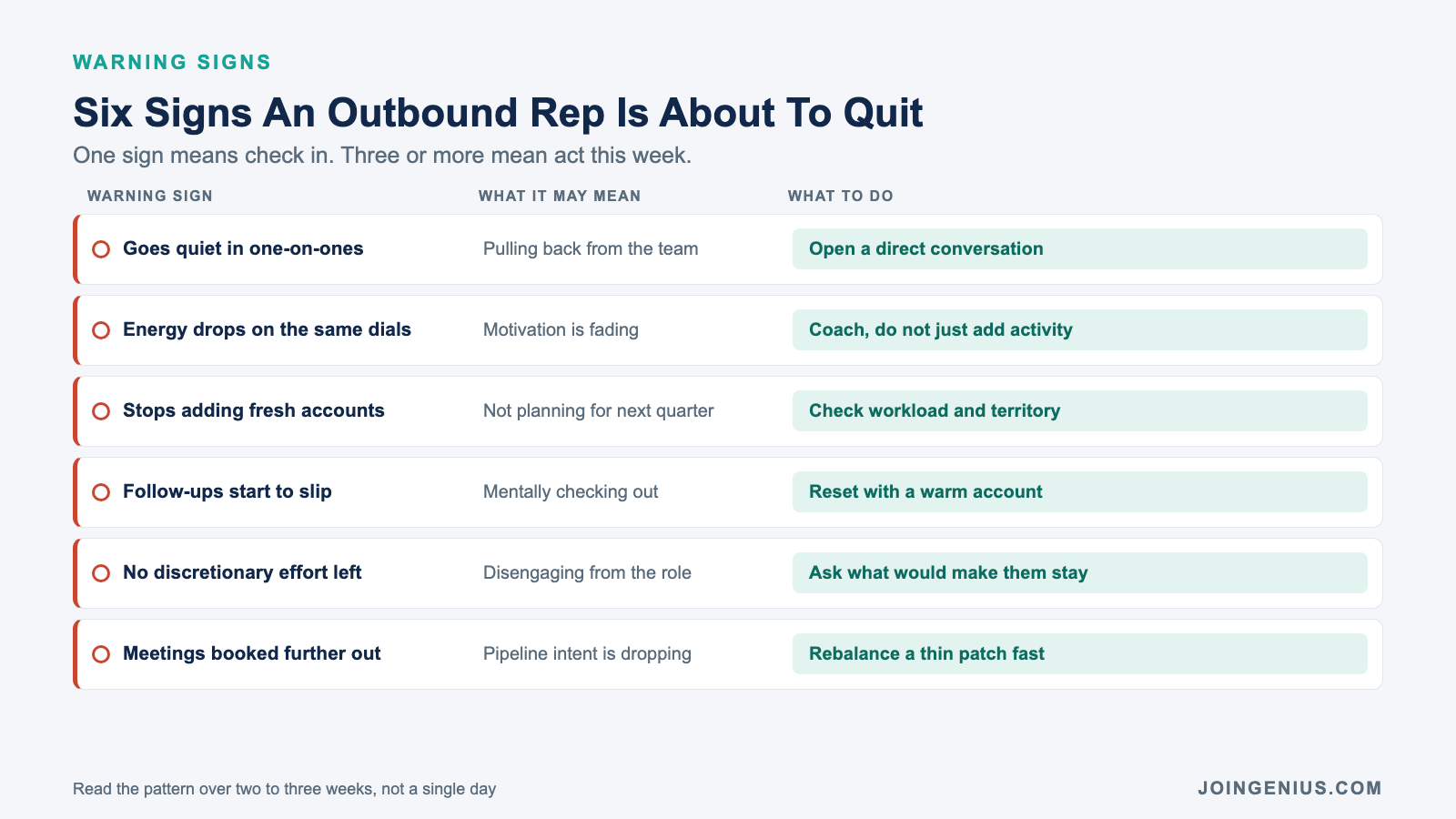
Resignations rarely come from nowhere. For weeks beforehand, an outbound rep usually shows a pattern a manager can read, if they are looking.
Activity and Tone Shifts That Come Before a Resignation
The first tells are behavioral. A rep who used to push for feedback goes quiet in one-on-ones. Dial counts hold steady, but the energy behind them drops and the call recordings sound flat.
You also see less discretionary effort, like staying late on a tough account or testing new angles. It is the same slow fade you find when hires stop staying past their first stretch.
Pipeline and Calendar Signals Managers Overlook
The CRM leaves fingerprints too. A rep on the way out stops adding fresh accounts and plans nothing for next quarter. Meetings get booked further out and follow-ups start to slip. None of these is proof alone, but together over a few weeks they form a reliable pattern.
What to Do the Moment You Spot One
A disengaging rep is not always a lost one. The window to act is short, and a direct conversation usually beats waiting.
- Have a candid one-on-one about workload and pay before the resignation, not after.
- Rebalance a thin territory fast if the numbers show an unfair starting point.
- Pull them off a cold streak with a warm account or a reset.
- Ask what would make them stay, then act on one answer this week.
What Actually Lowers Outbound Sales Turnover
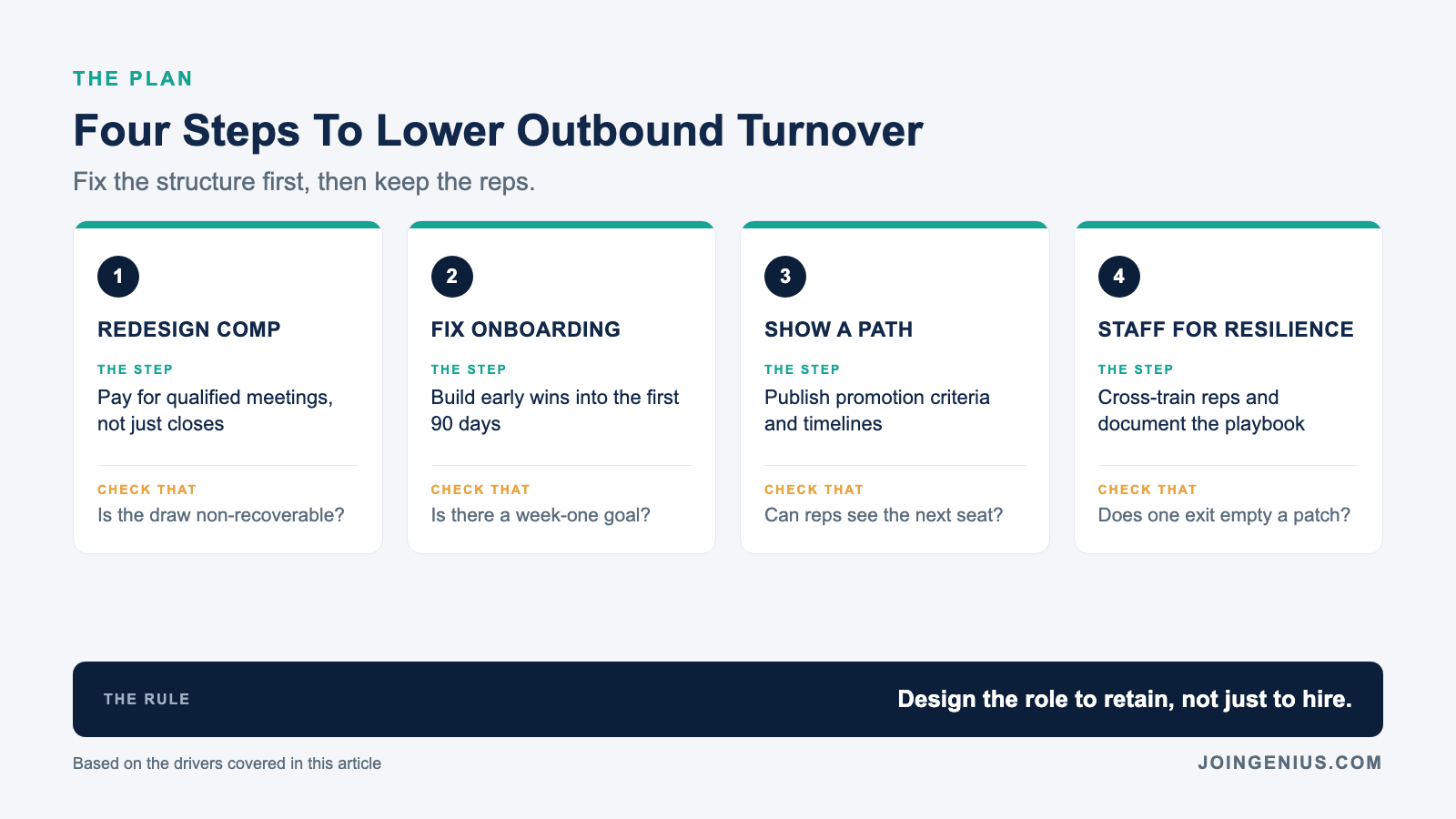
Perks and team lunches do not fix structural churn. In SPOTIO’s 2026 field-sales research, only 19% of teams combined strong quota attainment with healthy retention, which tells you the fixes have to be structural.
Redesign Comp Around Ramp and Retention, Not Just Closes
Begin where the damage begins. A structure that only rewards closed business ignores the weeks of pipeline-building that make any close possible. Pay for leading indicators that track with revenue, like qualified meetings rather than raw dials. Make the ramp draw non-recoverable so a slow first month does not follow a rep for two quarters.
Build a Career Path Reps Can Actually See
Outbound often gets sold as a stepping stone, then run as a dead end. Reps work the phones with no visible timeline to the AE seat they were promised.
Publish the promotion criteria and the typical months to get there, then hold managers to it. People tolerate a hard job far longer when they can see where it leads, which is the same point behind most advice on how to attract and keep strong people.
Staff Outbound So Coverage Survives Attrition
Some turnover is unavoidable, so the smart move is to make the team resilient to it. That means cross-training reps and documenting the playbook, so one resignation does not empty a territory for a quarter.
It is also why some teams hand part of the motion to a managed outbound partner. A trained external team runs the sequences and absorbs the churn an in-house seat would otherwise take.
A managed outbound program usually covers the campaign strategy and the data work behind a target list, then runs the email and LinkedIn outreach at the top of the funnel. Coverage stops hinging on whether any one rep stays.
Conclusion
Outbound turnover is mostly a design outcome, not a hiring mistake. Before you replace another rep, audit what actually drives exits. Usually it is the comp plan and the territory split, with the first 90 days close behind. Fix those and the people you were losing start to stay, instead of paying to refill the same seat every few months.
If strong outbound reps are expensive and hard to keep, that is worth solving at the source. At Genius, we help companies build teams with the top 1% of talent from the Philippines and Latin America, at around 80% less than comparable local hires.
You own the relationship directly, with no monthly agency fees and a 6-month replacement guarantee on every placement. If outbound sales turnover keeps resetting your pipeline, see how we source and place sales talent.