Portfolios flatter. A freelance designer’s reel is a greatest-hits cut of someone else’s brand palettes, which tells you they can execute, not that they match yours. When you source freelance designers to work inside your brand for six months, taste alignment fails first, not technique.
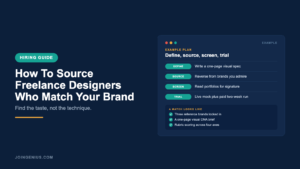
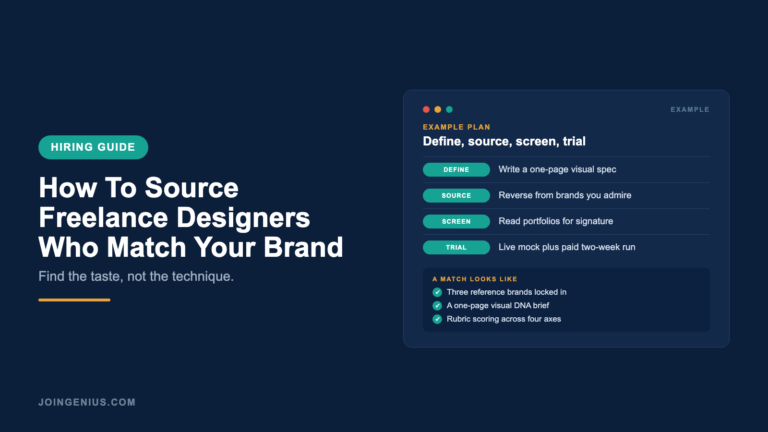
Five steps follow, borrowed in shape from our approach to sourcing playbooks on harder roles. Pin down your visual DNA before opening any marketplace. Go where thoughtful design is the default. Read portfolios for signature. Swap the written brief for a live mock. Run a paid trial against a rubric.
Pin Down Your Brand’s Visual DNA Before You Open Any Marketplace
You cannot filter against a vibe. Write down the references and anti-examples that will act as your sort filter before you post the job.
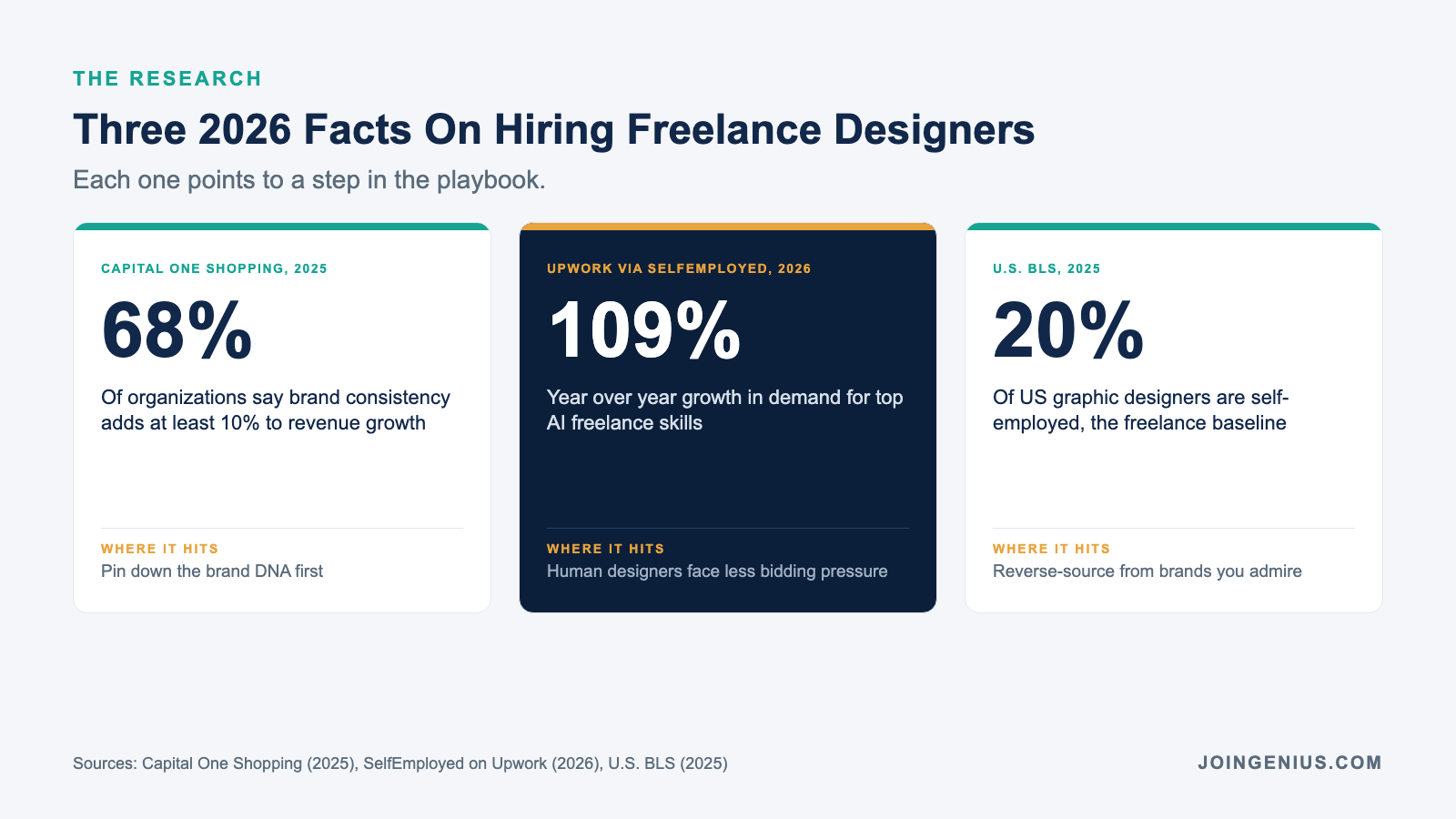
Capital One Shopping’s 2025 branding analysis found 68% of organizations say brand consistency has contributed at least 10% to their revenue growth, which means the match in your hire shows up in the P&L.
The Three Reference Brands That Filter 80% Of Applicants
Three references do more work than ten. Each slot signals a different axis, so applicants who do not share your axes self-select out.
- Direct inspiration: a brand whose palette and type you would happily be mistaken for
- Mood reference: an unrelated brand that captures how users should feel on a quiet day
- Fair comp: a mid-sized brand you will be benchmarked against by prospects and investors
- Visual floor: your best past work, setting the baseline no trial can drop below
Anti-Examples: The Look You Refuse To Produce
Taste is defined as much by what you reject. Pair every reference with an anti-example on the same axis, so the candidate sees the lane to stay inside. Three anti-examples are plenty.
Translating Taste Into A One-Page Visual Spec
The one-page spec is what a candidate needs to be filtered in or out in sixty seconds. Keep it one page, and send it before any screening call.
- Your logo plus two brand colors with hex codes next to each one
- Two type pairings, one for headings and one for body copy
- The three references and three anti-examples on a single strip
- One plain-English line on how the brand should feel to a first-time visitor
Look Where Thoughtful Design Already Exists
Generic marketplaces reward volume and ratings, both of which penalize distinctive taste. If you want a designer who already thinks in your niche, source freelance designers from channels where niche is the default signal.
Upwork’s 2026 In-Demand Skills report, covered by SelfEmployed, showed demand for top AI skills grew 109% year over year while foundational skills like graphic design held steady. Thoughtful human designers are still active and under less bidding pressure than you would expect. Our round-up of talent sourcing tools is a good starting point.
Dribbble And Behance, Searched By Niche Not By Skill
Default searches pull the trending shots, where everyone else is already looking. Switch to niche-tag searches that match your category and your mood: “fintech dashboard muted editorial” beats “logo designer” every time.
Reverse-Source From Brand Sites You Respect
Pick five brands whose visual system you would happily inherit, then find who designed them. The credit shows up in About pages and in designer case studies. Reaching out to the person behind a brand you already like is shorter than scrolling marketplaces for weeks.
Specialist Communities And Designer-Run Newsletters
RGD’s job board and Working Not Working give you a pool pre-filtered by the venue. Invite-only Slacks like Designer Hangout and the Brand New hiring thread add another layer, where taste is the room’s price of entry.
When An Agency Alumnus Beats A Solo Generalist
Studio alumni arrive with range and systems thinking in hand. A solo generalist can match that, but you have to pressure-test it. Ask who held the pen on their favorite piece and listen for an answer that names a decision, not a tool.
Read Portfolios For Signature, Not Range
A good portfolio shows ten things done well. A great one shows one taste repeated ten ways across ten clients.
Spot The One Visual Tic They Repeat
Look at the first three thumbnails from different projects without clicking in. Three distinct clients and one recurring choice equals signature. The choice might be a specific weight of type, or a palette that is never fully saturated. If you cannot name their tic in thirty seconds, there is probably not one.
Pressure-Test Range: How Many Distinct Brands?
Signature without range is a one-trick portfolio. Count the distinct brand voices held across the last ten projects. Four or five is healthy. One or two means they paint everything in their favorite palette. When you source freelance designers who skew one-note, polished formatting cuts both ways on review.
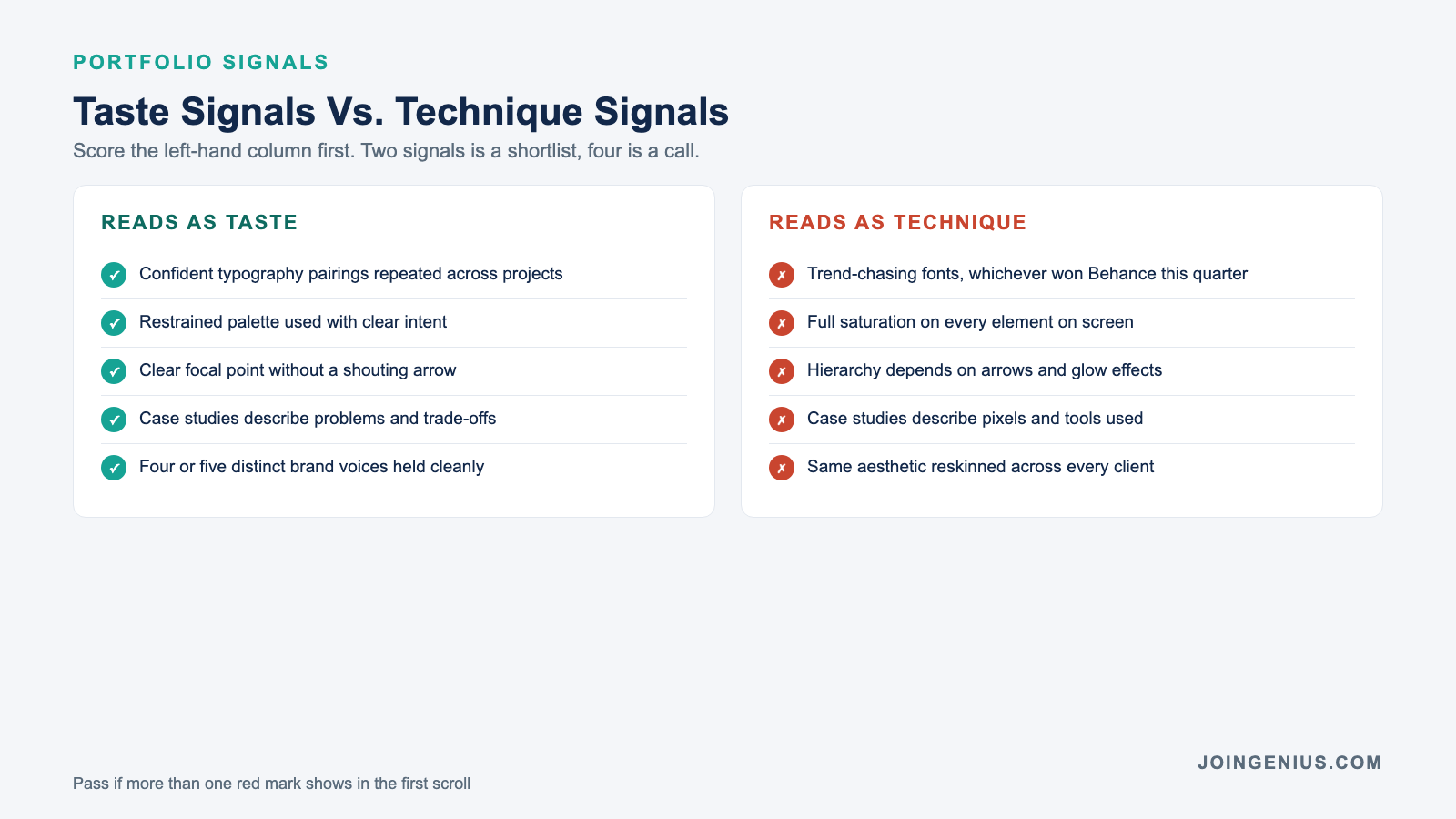
Taste Signals Vs. Technique Signals
Portfolios blur the two together. The table below splits them, taste on the left and technique on the right.
| Signal in the work | Reads as taste | Reads as technique |
|---|---|---|
| Typography | Confident pairings repeated across projects | Whatever font won Behance this quarter |
| Color | Restrained palette used with intent | Full saturation on every element |
| Hierarchy | Clear focal point without a shouting arrow | Depends on arrows and glow effects |
| Case studies | Describes the problem and trade-offs | Describes the pixels and the tools |
| Range | Four or five voices held cleanly | Same aesthetic reskinned across clients |
Two signals on the left is a shortlist. Four means you call them today.
Red Flags To Pass On Early
Four quick disqualifiers. If more than one shows up in the first scroll, pass without a call.
- Every project rendered on the exact same iPhone mockup from the same template pack
- Case studies that walk through pixels and tools, never the problem or the trade-offs
- Trend labels pasted on every project with no explanation of why the trend fit the brand
- No process work shown anywhere, no sketches and no iteration between first and final
Brief With The Tool, Not With A Document
A PDF brief is a hiring artifact that benefits the writer more than the candidate. A working-file brief flips that around.
Why The Written Brief Kills The Signal
Written briefs read as blueprints. The designer pattern-matches and comes back with a mockup that satisfies the words you wrote, which is different from matching the look you wanted. Taste shows up in the first fifteen pixels on an empty canvas, not in the paragraph describing it.
The 60-Minute Live Mock Challenge
Give the candidate a shared template with your brand assets already loaded and a sample content block to lay out, inside a 60-minute window.
The brief that gets you a signal in a day is the one that hands the candidate a working file, so swapping the usual PDF brief for a quick mock in an online graphic editor like Pixelixe lets you see the designer’s taste against your actual brand palette before you ever sign a contract.
What To Score From What They Ship Back
Three things, in order. First, the first thing they moved on the canvas, because taste surfaces before technique. Second, how closely the end state matches your reference brand. Third, the short note they send with the file, the fastest read on their revision style.
Run A Paid Trial Against A Rubric, Not A Hunch
A live mock gives you a 70% read on taste. The last 30% comes from how they ship across two real projects at the pace of your team.
Trial Scope And Payment Terms You Don’t Negotiate
Scope the trial as two real projects over two weeks, paid at their quoted rate. Three projects is tighter than most freelancers can hold; one is not enough signal. Pay the first invoice before the second project ships. When you source freelance designers across borders, our take on hiring remote employees covers the payment plumbing.
The Four-Axis Rubric And What Each Score Means
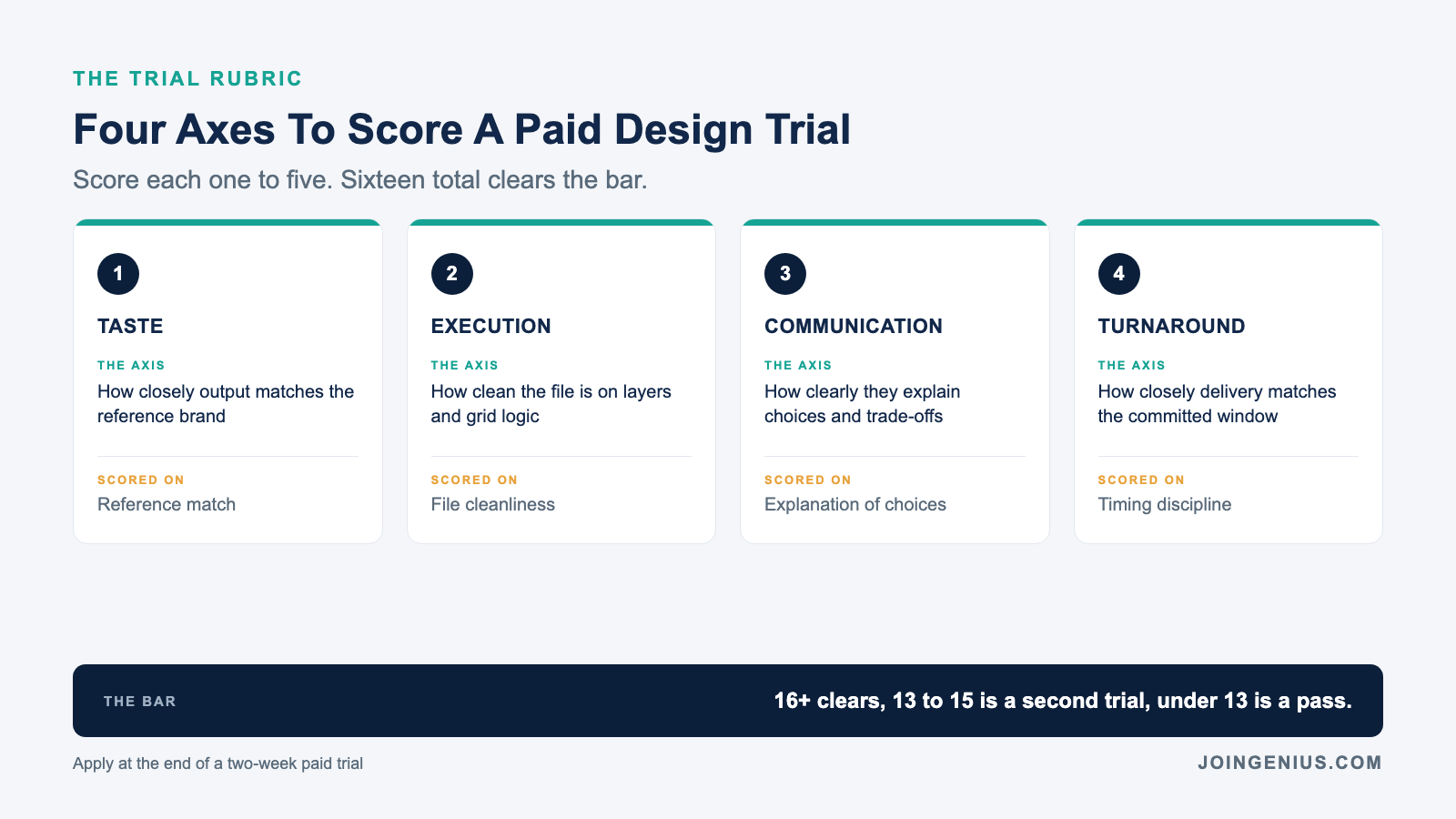
Score each delivery on four axes, one to five on each. A combined 16 clears the bar; 13 to 15 is a maybe worth a second trial; under 13 is a pass.
- Taste: how closely the output matches the reference brand on your one-pager
- Execution: how clean the file is when you check layers and grid logic
- Communication: how clearly they explain their choices and ask about trade-offs
- Turnaround: how closely their first-draft timing matches the window they committed to
Rate Ladder And Committed-Hours Arrangement
Once a freelancer clears the trial, lock in a rate ladder tied to monthly hours. Twenty holds at the quoted rate. Forty earns 10% off, and sixty earns 15% off.
They get predictable income, you get first-chair access on a quick turnaround. Clean rubric scoring also feeds into measuring recruiting ROI without spreadsheet chaos at the quarter.
Conclusion
If the five steps collapse to one, it is this. The designer’s taste is the hire. The only reliable way to see taste is to put the candidate in front of your real brand assets for an hour before any contract exists. Everything upstream is filtering noise, everything downstream is paperwork.
At Genius, we built our recruiting around that same principle for every role, not just design. We staff top 1% talent for 80% less, hired from the Philippines and LATAM. No monthly platform fees, and a six-month guarantee covers the hire if the fit does not hold.
If you would rather have a vetted shortlist delivered than scroll Dribbble for weeks, we are happy to walk you through how we would source freelance designers for your next brand hire. Start a conversation at joingenius.com.