A founder needs a working demo in front of investors in two weeks. She hires an engineer whose portfolio is full of polished prototypes, and the demo lands. Six months later, the same code is struggling under real users, and nobody can say which shortcuts were deliberate. This is an illustration, not a real case, but it describes the risk of hiring for demo speed without checking what happens afterward.
This guide explains how to source founding engineers who ship demo-first products and how to check that their work survives contact with users.
It covers what the role involves, where to find candidates, what research says about assessing them, a paid test built around the gap between a demo and a shipped job, a four-step plan, and a table of warning signs. It draws on research about sourcing and assessing engineers. For the posting side, see our guide on why technical hiring fails.
What a Demo-First Founding Engineer Does
A demo-first engineer builds a visible, working slice of the product quickly, shows it to users or investors, and learns from the reaction before polishing anything. At a young company, that habit is valuable, because the main risk is building the wrong thing slowly.
The same person is also the founding engineer, which means the demo eventually has to carry customers. Someone has to decide which shortcuts to keep, which to pay back, and which to throw away. The strongest candidates do not skip that step. They know what they cut, why they cut it, and what it will cost later. That is the difference between demo-first and careless, and it is the thing to test.
In practice, write down three things before you source anyone: what the first demo must prove, who will see it, and what happens in the ninety days after it. Those answers tell you whether you need someone who can build a convincing prototype alone, someone who can also run it in front of customers, or both. A candidate who has done only the first will look excellent on a portfolio page and may still be the wrong hire.
Where to Source Them
Engineers who work this way usually leave visible traces: public repositories, small launched products, hackathon entries, and open-source contributions. Start there, and add referrals from founders who have watched the person ship. Demo days and hackathons are worth a look, but ask what happened to each project after the event, since the event itself shows only the first week.
Founder networks help too, because a founder who worked beside an engineer can tell you what broke after launch and how fast it was fixed. Our guides to building a technical talent pipeline and to hiring open-source maintainers go deeper on both.
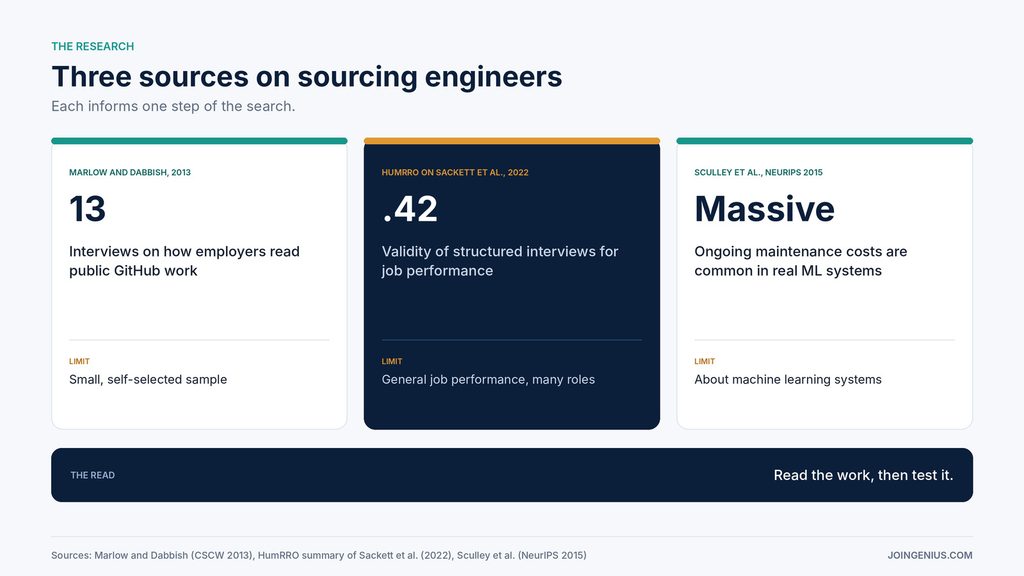
Jennifer Marlow and Laura Dabbish interviewed seven employers and six job seekers for a 2013 CSCW paper on how public GitHub activity shapes hiring. All the employers said a GitHub account gave more reliable insight into technical ability than résumés or out-of-context code samples, because the archived history and third-party acceptance of contributions are harder to fake.
The cues they read as signals were active open source involvement, contributions accepted by high-status projects, project ownership, and side projects. Watcher and fork counts were treated as an unreliable sign of ability, and merely copying someone’s project did not signal investment.
The sample was small and self-selected, and private work does not show on GitHub. For a demo-first role, the practical lesson is to read what a candidate built and how it changed after the first version.
What the Research Says About Assessing Them
Paul Sackett, Charlene Zhang, Christopher Berry and Filip Lievens revisited the validity of hiring methods in a 2022 Journal of Applied Psychology paper. A HumRRO summary reports validity of .42 for structured interviews, .40 for job knowledge tests, and .33 for work sample tests.
The authors say earlier estimates were inflated by overcorrecting for range restriction, and that validity varies. These numbers describe job performance across many roles, not founding engineers, so they support structured methods in general. For this role, that means asking every candidate the same questions and giving each a comparable piece of real work.
D. Sculley and colleagues describe in a 2015 NeurIPS paper how quickly built machine learning systems can carry high hidden costs. They report that real-world systems often accumulate massive ongoing maintenance costs and list risks such as entanglement, hidden feedback loops, undeclared consumers, and data dependencies. The paper concerns machine learning systems, but the point applies to any demo that becomes a product: building it fast is the cheap part, and keeping it running is where the cost builds up.
Together, the sources suggest a simple approach. Read public work to find people who ship. Use structured questions and a work sample to compare them. Then test specifically for what happens after the demo.
Test Sourced Candidates on the Gap Between a Demo and a Shipped Job
Kingy.ai’s production benchmarks show what the gap between a demo and a usable result looks like. In its product-ad benchmark, all nine generated ads passed the automated file checks, which covered format, duration, portrait dimensions, and full decoding of every frame.
A later AI-assisted review of 135 sampled stills then flagged a bottle cap overlapping the headline in one ad, and the page says file checks do not show whether an ad is usable. It also records the cost of the runs and notes that human acceptance and correction time remain unmeasured. That is a useful model for a hiring test: a result that passes the first check is not yet a result you can ship.
Build the test around the same two stages. In stage one, ask the candidate to build a small working demo in a day. In stage two, ask for a hardening pass: handle one failure case, write a short cost note, and list what broke or was cut. Score both stages with the same rubric for every candidate.
Useful rubric lines are whether the demo runs end to end, how the code handles the failure case, whether the cost note is specific, and whether the list of cuts is honest and ordered by risk. A short written handoff matters as well, because a founding engineer’s notes are what the next hire inherits.
Our guide to hiring browser automation engineers uses a similar test-based approach for another role. Pay for the time, since unpaid tests ask people to work for nothing and may put off experienced candidates.
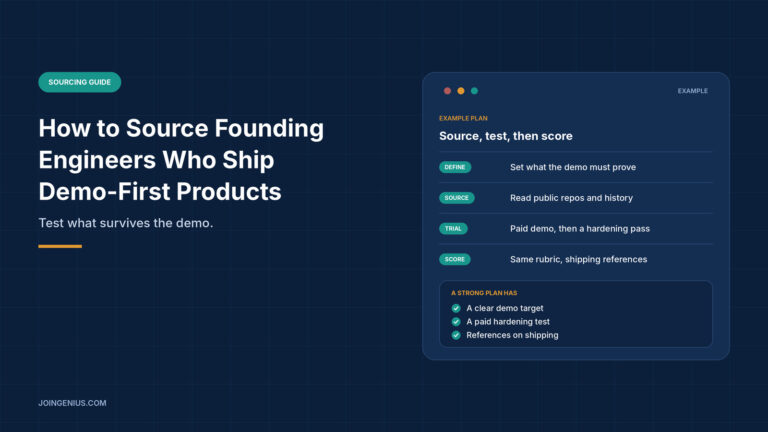
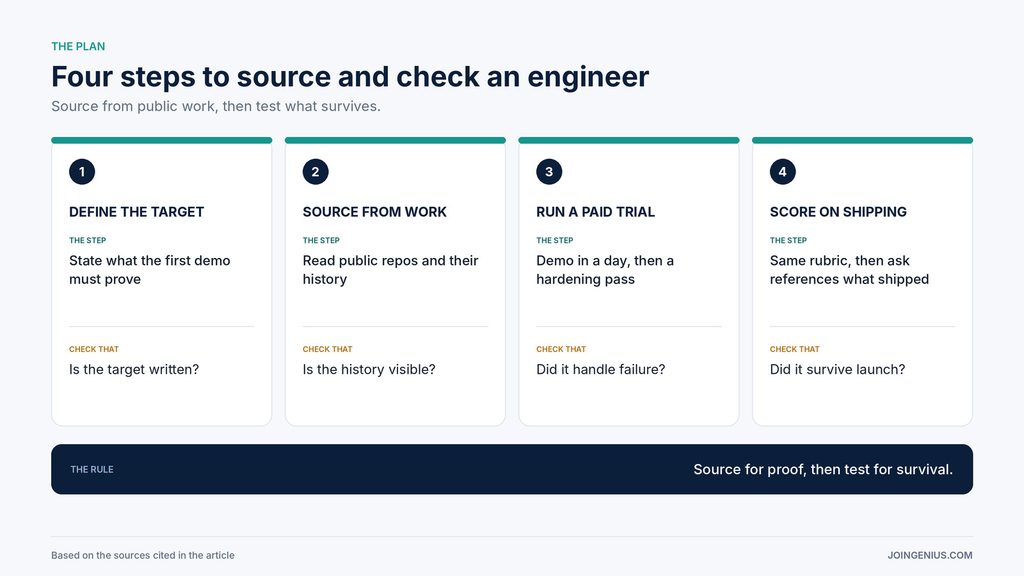
A Four-Step Plan to Source and Check a Founding Engineer
Use this four-step plan for each search.
- Define the target. Write what the demo must show, what must survive launch, and what can be cut.
- Source from public work. Review repositories, launched side projects, and referrals, and read both the code and its history.
- Run the paid trial. Ask for a demo in a day, then a hardening pass.
- Score on shipping. Use the same rubric for everyone, and ask references what happened after launch: what stayed up and what was rewritten.
The last step separates engineers who build fast from engineers who build fast and keep things running. Our guide to building a hiring rubric for AI agent infrastructure roles shows one way to structure the scoring.
Measure Whether the Hire Works
Track the time to the first demo, the share of demo code that survives into production, incidents in the first 90 days, and time spent on rework. Compare them with the target you wrote in step one. With one or two hires, the numbers are small, so use them to start a conversation with the engineer and not to grade them. A low survival share is not automatically a problem, because some demo code is meant to be thrown away. What matters is whether the engineer predicted which parts would be, and said so before launch.
Warning Signs a Founding Engineer Hire Is Risky, and What to Do About Each
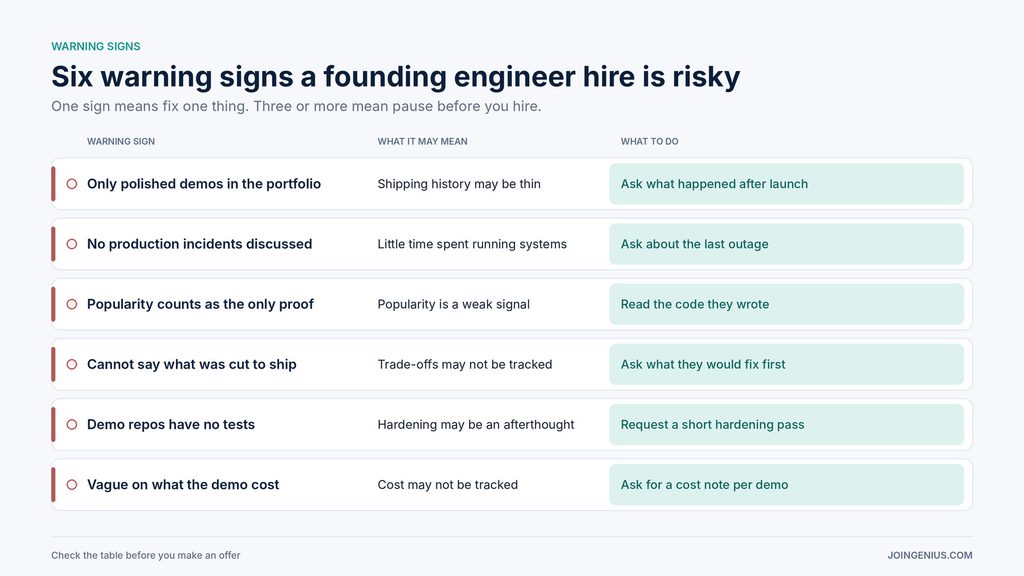
Check this table before you make an offer. One sign means fix one thing. Three or more mean pause before you hire.
| Warning sign | What it may mean | What to do |
|---|---|---|
| Only polished demos in the portfolio | Shipping history may be thin | Ask what happened after launch |
| No production incidents discussed | Little time spent running systems | Ask about the last outage |
| Popularity counts as the only proof | Popularity is a weak signal | Read the code they wrote |
| Cannot say what was cut to ship | Trade-offs may not be tracked | Ask what they would fix first |
| Demo repos have no tests | Hardening may be an afterthought | Request a short hardening pass |
| Vague on what the demo cost | Cost may not be tracked | Ask for a cost note per demo |
Hire for Speed, Then Test for What Survives
Founding engineers who ship demo-first products are valuable because they learn fast. The risk is hiring on demo polish alone. Source from public work, read the code, run a paid trial that includes a hardening pass, and ask references what happened after launch. Each step replaces a guess about shipping with something you can check.
If the candidate can say what they cut, what it cost, and what they would fix first, you have found someone who builds quickly and knows what it takes to make the work last. For more on hiring at an early stage, see our guide to hiring for startups.