A chief executive pays for a monthly coach. The sessions are thoughtful, and the questions are good, but when the hard call comes – a hiring decision or a pricing change – she still makes it alone. Across town, another executive brings the same kind of problem to a room of leaders who have each faced it.
This is an illustration, not a case study, but it describes the choice many senior leaders face when they decide where to spend their development budget.
This guide compares peer groups and one-on-one coaching for senior leaders. It covers what each format is, what research says about coaching, peer meetings, and group support, why peer groups can outperform coaching on cost and learning, how the two work together, a four-step plan, and a table of warning signs.
The guide reads trials of coaching, peer meetings and group consulting side by side. For the related question of coaches versus interim hires, see our guide to when to hire a business coach vs a fractional executive.
What Each Format Actually Is
One-on-one executive coaching pairs a leader with a coach for private sessions. The coach brings a method and an outside view, and the agenda is the leader’s own. The leader hears one perspective at a time.
A peer group puts several leaders in a room, usually non-competing and often with a facilitator. Each member brings a live issue, and the others respond from their own experience. The leader hears many perspectives at once and gives advice in return, which is a different skill from receiving it.
A hybrid joins the two. The group meets together, and the facilitator also coaches each member privately. Most of the evidence below compares the first two formats, and the hybrid is covered later.
What the Research Says About Coaching
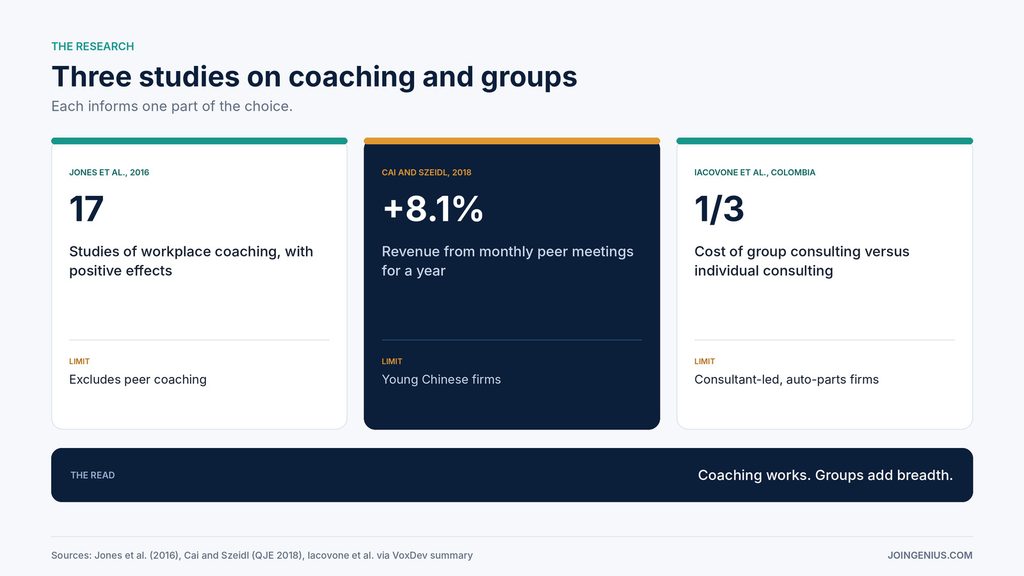
Rebecca Jones, Stephen Woods, and Yves Guillaume meta-analyzed 17 studies of workplace coaching in a 2016 paper in the Journal of Occupational and Organizational Psychology. The abstract reports positive effects on organizational outcomes (δ = .36), skill-based outcomes (δ = .28) and affective outcomes (δ = .51).
Effects were stronger for internal coaches than for external ones, while the format of coaching and the number of sessions made no significant difference. The review covered coaching by internal or external coaches and excluded peer coaching and manager coaching.
The takeaway is plain. Coaching works, and any case for peer groups starts from there. The question is not whether coaching helps. It is what a group can add, and at what cost.
What the Research Says About Peer Groups
Jing Cai and Adam Szeidl ran a randomized trial of peer meetings among business owners. Their paper in The Quarterly Journal of Economics in 2018 randomized 2,800 young Chinese firms. Owner-managers in the treatment groups met in small groups every month for a year, and a control group did not meet.
Meetings raised firm revenue by 8.1%. Profit, inputs, the number of business partners, borrowing, and a management score also rose, and the effects persisted a year after the meetings ended. Firms randomized into groups with better peers grew faster.
Managers improved most in the areas they discussed, so firms that talked about management, partners, or finance gained in that same area. The authors also found that managers shared more useful information when they were not competitors, and that regular meetings produced more business partnerships than one-time meetings.
The firms were young Chinese businesses, and the meetings were organized by the researchers, so the trial shows what regular peer contact can do and does not describe any one membership organization.
Groups Versus Individuals Head to Head
The closest direct comparison comes from Colombia. Leonardo Iacovone, William Maloney and David McKenzie randomly assigned 159 auto-parts firms to one of three arms, according to a VoxDev summary of their paper. One group received a two-week diagnostic report only.
One received individual consulting, 500 hours over six months at $29,000 per firm. The third received group consulting in subgroups of three to eight firms from the same region, 408 hours in total at $10,500 per firm.
Both consulting arms improved management practices by 8 to 10 points. Group consulting cost about a third as much. It also raised employment by a statistically significant 6 to 15 workers, while the individual arm’s gain of 2 to 7 workers was not statistically significant.
The study compared consultant-led sessions, not executive coaching, and it covered auto-parts firms in one country. Even so, it is a randomized comparison of the same help delivered to groups and to individuals, and the group format held up at a fraction of the price.
Why Peer Groups Can Outperform Coaching
Taken together, the trials point to three advantages for the group format.
Cost per leader. In Colombia, the group format reached comparable gains at about a third of the cost. A budget that buys one executive a year of private coaching might fund several leaders in a group.
Breadth of experience. Cai and Szeidl found that managers learned from what their peers shared, especially when the peers were not competitors. A coach brings one career’s experience. A group of ten brings ten, and each has recently faced a different version of the problem.
Accountability that lasts. In the Chinese trial, the gains outlasted the meetings by a year, and regular meetings produced more partnerships than one-time ones. A group that meets monthly gives each leader a standing date to report what they did about last month’s issue. A private session can give that too, but a group adds peers who ask about it.
One-on-one coaching keeps its place. A leader weighing a sensitive personal decision may want a private conversation, and the meta-analysis shows coaching helps on its own. The case for peer groups is that they add breadth and accountability, often at a lower price per person. Our guides to learning and development managers and to cross-training employees cover how teams learn from one another inside a company.
How Peer Groups and One-on-One Coaching Work Together
The two formats do not have to compete. Vistage, for example, runs CEO peer advisory groups where local, noncompeting peers meet monthly, and each group’s Chair adds monthly one-to-one coaching. It acts as a guide who keeps meetings productive and keeps members accountable. That structure puts the group’s breadth and the coach’s focus in one membership.
Whatever the provider, the hybrid answers a common objection. A leader who wants private coaching does not have to give up the group, and a leader who wants a group does not have to go without personal attention. If you are choosing, ask how often the group meets, who the other members are, how many are non-competing, and how the facilitator handles an issue that needs a private conversation.
A Four-Step Plan to Choose and Test a Format
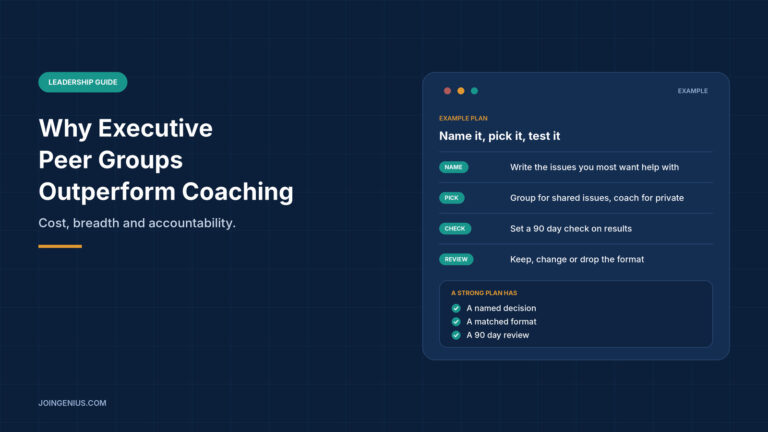
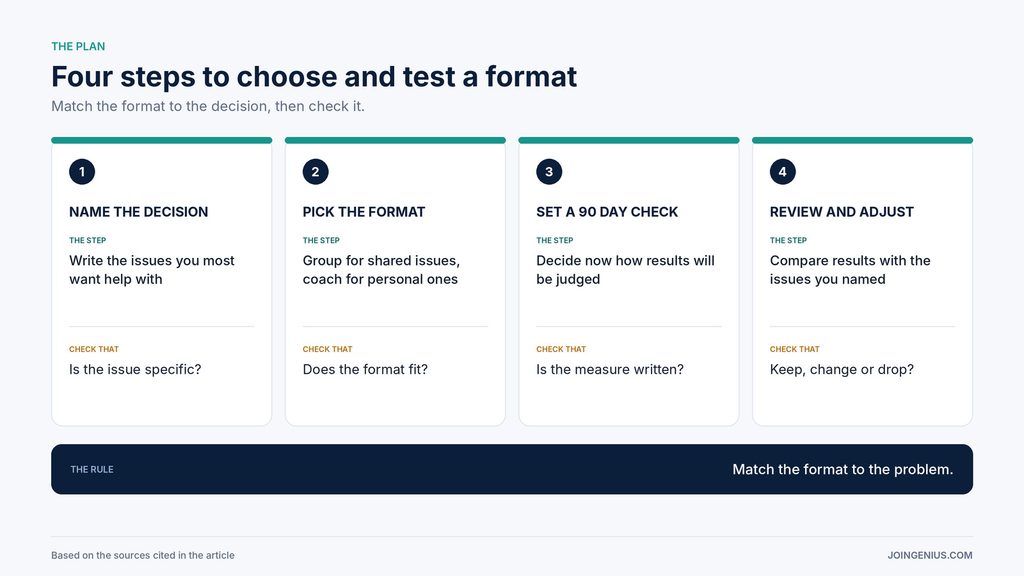
Use this four-step plan before you commit a budget.
- Name the decision. Write the one or two issues you most want help with, such as hiring, pricing or succession.
- Pick the format. Match it to the issue. Choose a group for problems others have solved, and private coaching for personal questions.
- Set a 90-day check. Decide now how you will judge it, such as decisions made or actions completed.
- Review and adjust. At 90 days, compare results with the issues you named, and keep, change or drop the format.
The first step carries the most weight, because the right format depends on the problem. Our guide to common leadership problems is a place to start when the list of issues is long.
Measure Whether It Works
Track how many decisions you made faster, how many actions from each meeting you completed, and how long a recurring issue stayed open. Add your own rating of the format at 90 days and again at a year. With one leader and one group, the numbers are small, so use them as prompts for a conversation with the facilitator and not as a score.
Warning Signs Your Peer Group or Coaching Is Not Working, and What to Do About Each
Check this table at each 90-day review. One sign means fix one thing. Three or more mean rethink the format.
| Warning sign | What it may mean | What to do |
|---|---|---|
| Same issues return each month | Advice is not being acted on | Assign one action per issue |
| Peers who compete with you | Members may hold back details | Seek non-competing members |
| Facilitator talks most of the time | Peer input may be crowded out | Ask for more peer discussion |
| Advice with no follow-up | Nobody is holding you to it | Report back at the next meeting |
| Attendance keeps dropping | The group may not fit your needs | Ask members what would change it |
| No decision changed in 90 days | The format may not suit the goal | Reset the goal or try another format |
![Table of six warning signs your peer group or coaching is not working, what each may mean and what to do about it]](https://joingenius.com/wp-content/uploads/2026/10/body-3-peer-groups-warning-signs-1024x576.jpg)
Choose the Room, Then Test the Results
Executive peer groups can outperform coaching where cost, breadth, and accountability matter most, and coaching remains a strong choice for private questions. The research behind this shows regular peer meetings lifting firm results, group formats matching individual ones at a third of the cost, and coaching producing positive effects on its own.
Name the decision you need help with, choose the format that fits it, set a 90-day check, and keep what works. If the group changes what you do on Monday morning, it is earning its seat. For more on getting outside help at the top, see our guide to fractional CEOs.