Most SaaS stacks fit the company that bought them at twenty headcount and quietly stop fitting at two hundred. The CRM gets bolted to the billing tool with a Zapier. The ops tool gets bolted to the CRM with another Zapier. The data team exports to a spreadsheet every Friday because nothing actually agrees on what a customer is. Six months after the Series A, the stack is a dozen seats across thirty tools with half of them paid for and forgotten. The leadership team is quietly asking whether the whole thing should just be one platform built against the workflow that actually runs the business.
The right question is not whether custom beats off-the-shelf in the abstract. It is whether the workflow you actually run every day is covered by the generic SaaS shape, or whether your real workflow has already diverged enough that you are paying for a stack of near-fits plus the engineering time to glue them together. Modern operating workflows have compressed time to value sharply, but speed does nothing if the data model drifts every quarter. This piece is about how scaling teams can tell when the off-the-shelf stack has hit its ceiling, and the one build move that reliably collapses the sprawl into a platform the team actually opens.
The Off-The-Shelf Stack Looks Nothing Like Your Actual Workflow
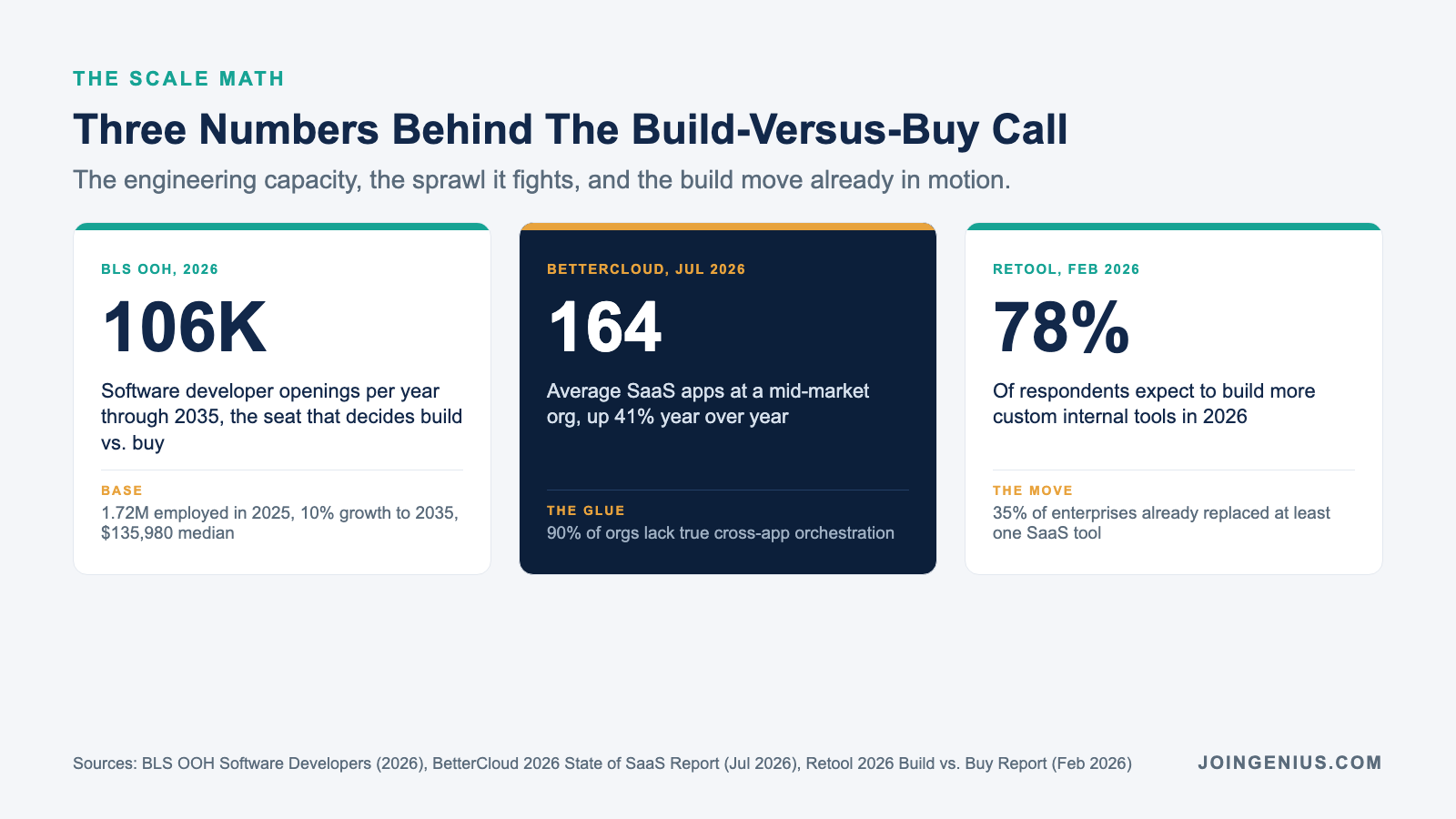
The US Bureau of Labor Statistics Occupational Outlook Handbook for Software Developers lists about 1,717,800 US software developers in 2025 and projects 10% employment growth from 2025 to 2035, adding roughly 174,700 jobs and generating about 106,100 openings per year at a $135,980 median wage as of May 2025. Those seats are the engineering capacity your business is either paying to glue together off-the-shelf tools or paying to build the platform your workflow actually needs. The build-versus-buy decision is a direct call on where that capacity goes.
The Generic Tool Was Built For The Generic Buyer
Every horizontal SaaS vendor sells to the widest possible buyer, which means the product is scoped for the median workflow across thousands of orgs. Scaling teams are rarely median. Your onboarding looks different from everyone else’s because your product does. Your pipeline looks different because your sales motion is yours. The generic tool is optimized to be a 70% fit for a million companies, not a 95% fit for yours.
The Stack Is Glued Together, Not Integrated
A stack of twelve SaaS tools connected by eight Zapiers and a nightly ETL job is not integration. It is glue. Glue breaks every time a vendor pushes a schema change, which they will do at least quarterly without asking, and the ops team spends a week each quarter rebuilding the plumbing that let the business run the previous one.
The Shelfware Tax Compounds Every Renewal
Every tool in the stack has a seat count sized against the headcount at the last renewal and a feature surface sized against the demo. The ratio of paid seats to opened seats drifts down every quarter, because people leave and features never got rolled out. The quiet renewal negotiation is where the shelfware shows up, and it compounds every twelve months.
What Actually Separates A Fitting Platform From A Glued-Together Stack
Three forces compound each other, and any one of them would be a scaling problem. The three together produce ops meetings where the agenda is the tools instead of the business.
The Data Model Decides Whether Anything Agrees
A stack with twelve tools has twelve data models. The CRM thinks a customer is an account, the billing tool thinks a customer is a subscription, the support tool thinks a customer is a contact. Nothing agrees, and the data team becomes a reconciliation shop that spends more time harmonizing records than answering the question leadership actually asked.
The Workflow Shape Decides Where The Judgment Work Happens
A tool scoped against the median workflow forces your team to do judgment work inside spreadsheets and Slack threads, because the tool does not have a place to put the judgment. A platform scoped against your actual workflow puts the judgment inside the system, where it stays visible and auditable. The shape decides where the operator actually spends their day.
The Engineering Time Decides Whether The Stack Is Free
Off-the-shelf looks cheaper on the invoice and more expensive on the engineering calendar. Every integration, every custom field hack, every nightly reconciliation job is engineering time the business did not price in when it signed the vendor contract. The real cost of the stack is the invoice plus the engineering salary against the glue, and the second number is rarely tracked.
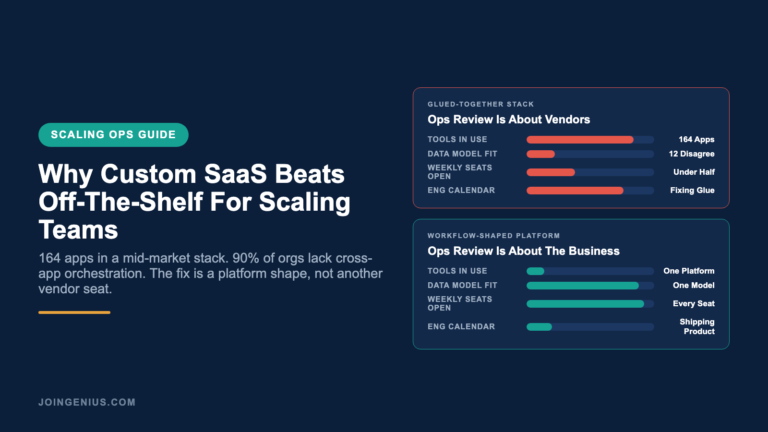
BetterCloud’s 2026 State of SaaS Report, published July 15, 2026 against a survey of 525 IT and security professionals at SaaS-first organizations, found that mid-market organizations now run an average of 164 SaaS apps (up 41% year over year from 116) and that only 56% of apps in use have IT approval. 62% of IT leaders say manual work across the stack prevents strategic projects, and 90% of organizations lack true cross-app orchestration. The glue layer is not a theoretical cost. It is the number IT leaders name first when asked what is slowing the business.
The Lever Most Teams Miss
Collapse The Stack Into A Platform Shaped Against Your Workflow
Before you renew another five seats on the tool you have already outgrown, ask whether the workflow that actually runs the business would be better served by one platform built against it. Xgenious is a custom software development company that builds SaaS platforms for teams that have outgrown off-the-shelf tools. For scaling teams, that means a single data model instead of twelve and a workflow the operators actually run instead of the median one the vendor sized for. The engineering calendar is freed from quarterly schema-break fire drills, and the ops conversation shifts from tool administration back to the business itself.
The point is not that custom replaces off-the-shelf for every org. The point is that once the real workflow has diverged far enough from the median one, the stack that fit at twenty people is actively slowing the company at two hundred, and the renewal conversation is the moment to measure that divergence honestly. The teams that scale cleanly are the ones who build when the fit breaks, not the ones who buy another adjacent tool to patch the gap.
Retool’s 2026 Build vs. Buy Report, published February 17, 2026 and based on a survey of 817 engineering and operations practitioners conducted in late 2025, found that 35% of enterprises have already replaced at least one SaaS tool with a custom build and that 78% of respondents expect to build more custom internal tools in 2026. The build move is already a mainstream choice at the scaling tier, not an edge case.
What Day 180 Looks Like When You Get It Right
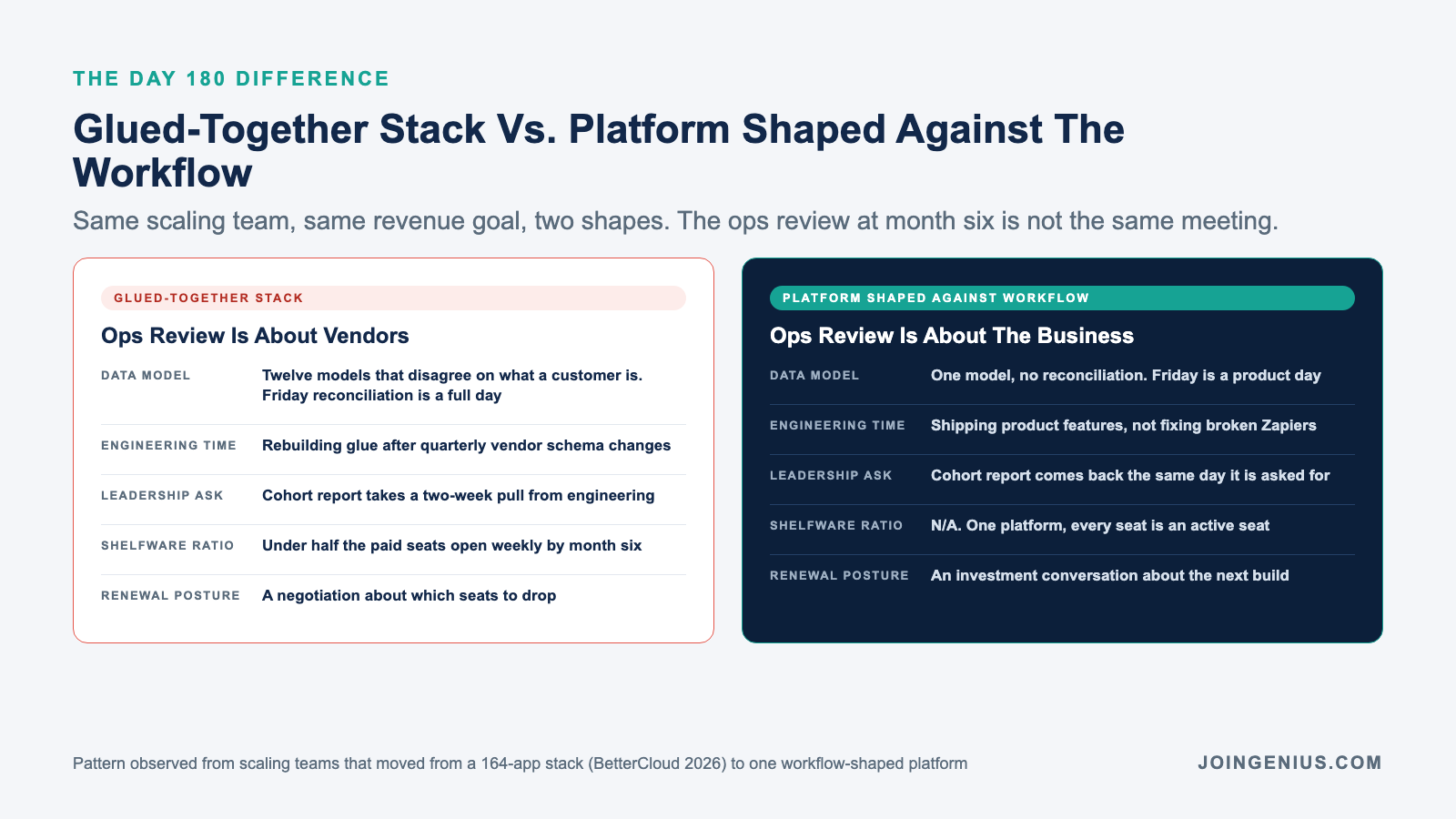
The difference between the two approaches shows up at the day 180 ops review, which is also the moment leadership finds out whether they should have renewed the stack or built against the workflow.
The Before Version
In the before version, the team has spent six months adding tools and rebuilding integrations that broke after a vendor schema change. The data team spends every Friday reconciling the CRM and the billing tool against last week’s exported spreadsheet. Leadership is asking for a cohort report nobody can produce without a two-week pull from engineering. The quarterly renewal cycle is a negotiation about which seats to drop, which puts the team back in the same stack decision they just made. Low morale at work often sits highest on ops teams whose weeks are spent on vendor-schema fire drills instead of the business work they were hired for.
The After Version
In the after version, the team has spent six months routing the workflow through one platform built against it. The data model is one model. The reconciliation job is gone because nothing diverges in the first place. Leadership asks for a cohort report and gets it the same day. The engineering team is shipping product features instead of fixing broken Zapiers. The ops review is about business metrics, which is the conversation that moves the company forward instead of the stack.
A Four-Move Playbook For Deciding When Custom Beats Off-The-Shelf
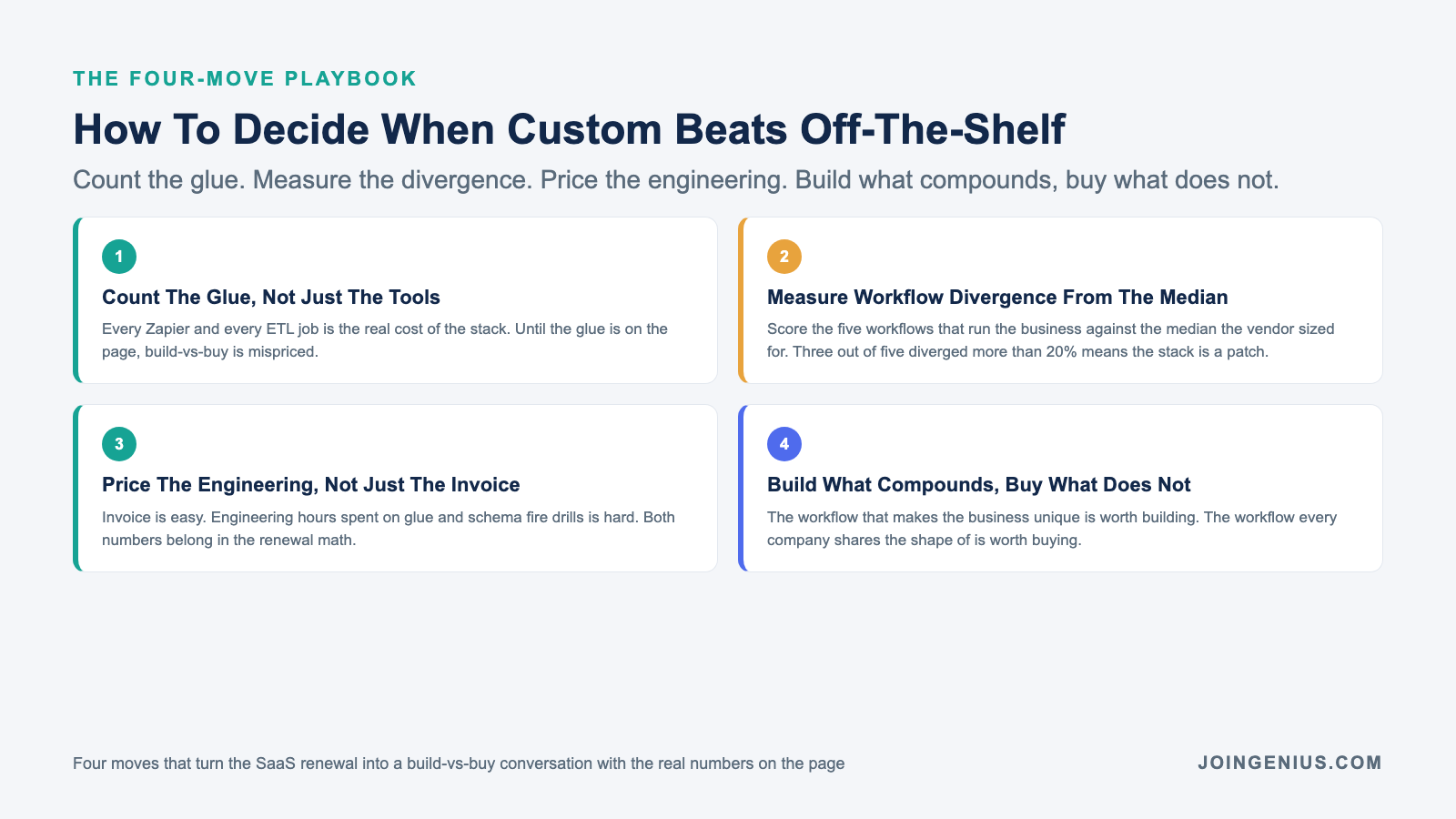
The four moves in order.
1. Count The Glue, Not Just The Tools
Before you compare build against buy, count every Zapier and every nightly ETL job, plus every spreadsheet that reconciles two tools. That glue layer is the real cost of the off-the-shelf stack, and until it is on the page, the build-vs-buy conversation is mispriced.
2. Measure Your Workflow Divergence From The Median
List the five workflows that actually run the business. Score each one on how much it looks like the median workflow the vendor sized for. If three of the five have diverged more than 20%, the off-the-shelf stack is a patch, not a platform. A structured ops process is worth zero if the tooling it runs on fits the median workflow instead of yours.
3. Price The Engineering Time, Not Just The Invoice
The invoice is the easy number. The hard number is the engineering hours spent on glue and custom fields, plus migration pain and vendor-schema fire drills. Price both before you renew, because the real comparison is invoice plus engineering, not invoice alone.
4. Build For The Workflow That Compounds, Buy For The One That Does Not
The workflow that makes the business unique is the one worth building against. The workflow that every company has the same shape of is the one worth buying off the shelf. Mix the two in the right order, and the stack stays sharp. Mix them in the wrong order, and the stack becomes shelfware.
The playbook is in the image below.
The One-Page Check Before The Next Renewal
Before you renew the next vendor contract, ask one question. If you built a platform shaped against the workflow that actually runs the business, would the renewal conversation still be about dropping seats?
If the answer is no, the stack was never the fit it was sold as. The shape was. Fix the shape by building against the workflow that compounds, and buy off the shelf only for the workflows that do not. The platform you ship against that question will stay open past day 30 and the data inside it will stay aligned past month six, and the ops review will stop being a vendor-management meeting. The stack you buy against the median workflow will drift into the next renewal and you will be back where you started.
Conclusion
Scaling-team ops is a workflow problem that most teams misdiagnose as a tool-shopping problem, and the misdiagnosis costs a stack of near-fits and an engineering calendar that never ships product. Count the glue. Measure the divergence. Price the engineering. Build what compounds and buy what does not. Then renew the stack you actually need, which is a platform shaped against the workflow that runs the business, not a dozen tools glued against the median one.
We built Genius so scaling operators can staff the ops and engineering work their custom platform surfaces, without expanding the local headcount their budget cannot support. We place the top 1% of operations and technical talent from the Philippines and Latin America, at around 80% less than comparable local hires. The relationship stays direct, with no monthly agency fees and a 6-month replacement guarantee on every placement. If the next hire is the one who finally makes the stack decision pay back, see how we source and place the operators who scale with the build.