Most virtual event postmortems end with the same chart. Registrations hit the target. Attendance hit the target. The engagement numbers did not. Average minutes watched slid under twenty. Chat went quiet by session three. The follow-up email opened at a quarter of the previous year’s rate. The CMO asks what changed and nobody has a straight answer, because the team ran the same playbook they ran last year and the only thing that moved was the result.
The right question is not whether virtual events still work. It is whether the platform you ran yours on was built around the engagement your attendees actually came for, or whether it was built around the production your team runs at the back. Modern event workflows have scaled reach sharply, but reach does nothing if the engagement curve inside the event keeps sliding. This piece is about why engagement keeps dropping on the webcast-first stack and the one platform-shape move that reliably rebuilds the number that actually matters, which is minutes watched per registered attendee.
The Virtual Event Market Looks Nothing Like The Virtual Event Metrics
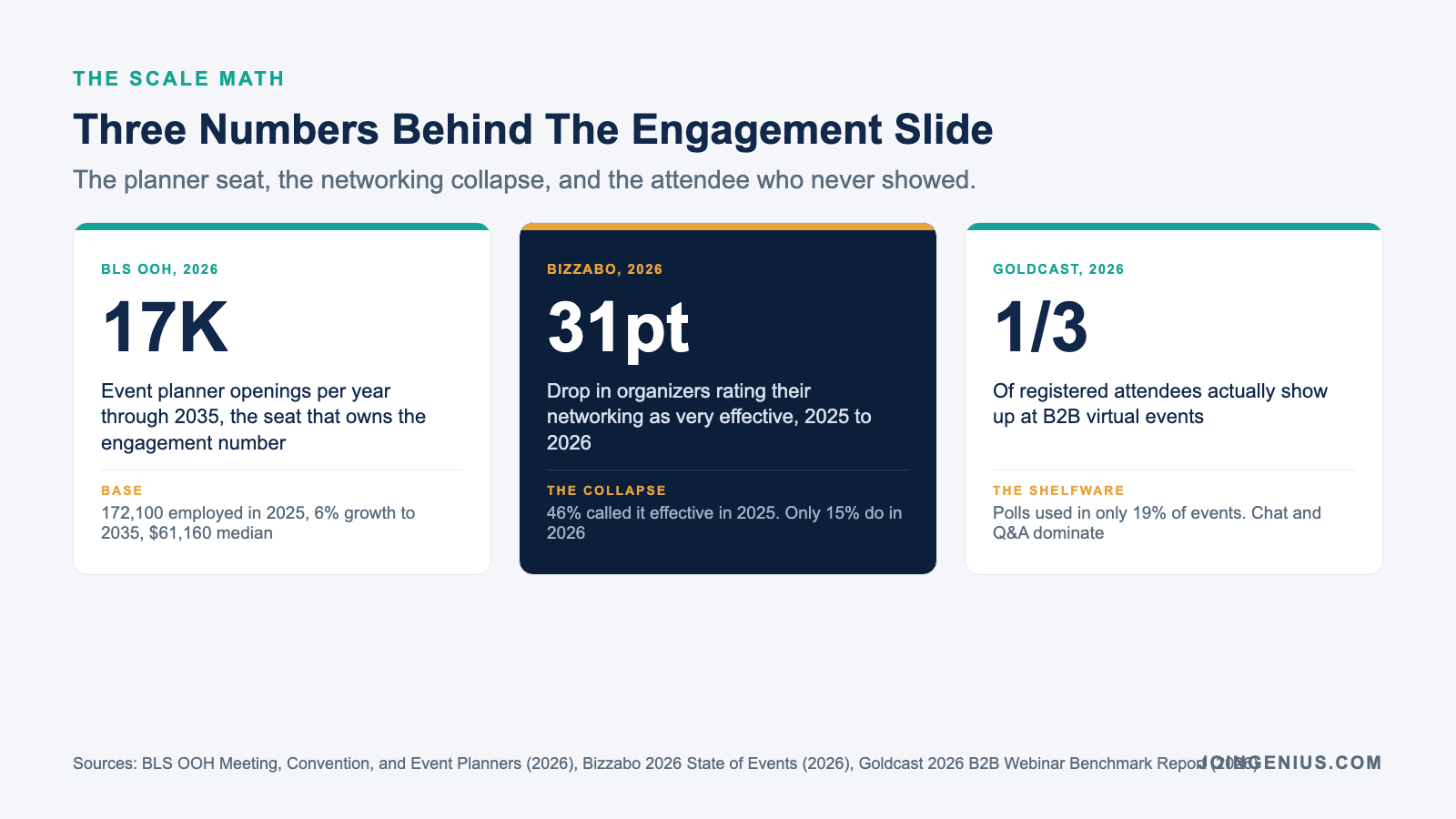
The US Bureau of Labor Statistics Occupational Outlook Handbook for Meeting, Convention, and Event Planners lists about 172,100 US event planners in 2025 and projects 6% employment growth from 2025 to 2035, with about 16,800 openings per year at a $61,160 median wage as of May 2025. Those seats are the people whose quarterly review turns on an engagement number that has been sliding for three cycles. The planner headcount keeps growing. The engagement outcomes the planner is measured on do not.
Registration Is The Easy Metric, And Teams Optimize For It
Registration is a one-click form fill that happens weeks before the event. It feels like a win on the Monday report, which is why most teams keep running the playbook that produces it. The problem is that registration is vanity. The metric that moves pipeline is minutes watched after the keynote, and very few teams measure that one at all.
The Webcast Stack Was Built For Broadcast, Not For Participation
Most virtual event stacks are webcast-first, which means they were built so one person can talk to a thousand. Attendee participation is bolted on as a chat sidebar and a poll module. Those are production features, not engagement features, and the attendee who wanted to actually talk to a peer in session three drops off because the platform never gave them a way in.
The Agenda Is Built Around Content, Not Around Connection
A twelve-session virtual agenda built around what the speakers want to say produces a one-hour watch time on the opener and a five-minute drop-off on every session after. An agenda built around what attendees came to meet and discuss produces a return pattern across the day. The agenda shape decides the drop-off curve before the first session goes live.
What Actually Separates A High-Engagement Virtual Event From A Low-Engagement One
Three forces compound each other, and any one of them would be an engagement problem. The three together produce events where the second-day drop-off is 60% of the opener.
The Platform Shape Decides Whether Attendees Can Reach Each Other
A virtual venue where attendees can see who else is there and route into a conversation is a different shape from a webcast with a chat column. The first produces lateral engagement, the second produces passive viewership. Which shape the attendee lands in is a platform decision made before the invites go out.
The First Fifteen Minutes Decide The Rest Of The Day
If the attendee is in a conversation or a hands-on moment inside the first fifteen minutes, they come back for the second session. If they are watching a slide with a muted speaker, they close the tab. The opening is not a warm-up. It is the retention lever for every session that follows, and the platform shape decides whether a real opening is even possible.
The Follow-Up Mechanism Decides Whether Pipeline Comes Out The Other Side
Engagement without a clean follow-up path is just entertainment. If the platform does not pass qualified attendee signal to the sales and partnership follow-up motion, the event does not generate pipeline regardless of how good the sessions were. The connection between engagement and pipeline is a tool capability, not a willpower problem.
Bizzabo’s 2026 State of Events Benchmark Report, published in 2026 against survey data from event professionals and analysis of platform benchmarks from high-performing programs, found that the share of event organizers rating their networking as very effective dropped from 46% in 2025 to 15% in 2026, a 31-point collapse in a single cycle. Average event attendance held at 52% of registrations, and 40% of organizers still struggle to prove event ROI. The engagement number is sliding because the networking surface the event is built on no longer produces engagement, and the business is noticing.
The Lever Most Teams Miss
Run The Event On A Platform Built Around Engagement, Not Broadcast
Before you book another webcast production for a conference-shaped event, move the program to a virtual event platform like Meetyoo that puts the venue and the engagement tooling at the center instead of a webcast with chat bolted on. For communications and marketing teams, that means attendees land in a venue they can actually navigate and engagement signal flows out of the venue into follow-up. The production team manages a show that was shaped around participation from the start, and the event conversation shifts from registration count to minutes watched and meetings booked.
The point is not that a venue-shaped platform replaces a webcast for every event. The point is that a conference-shaped program needs a venue-shaped platform, and running a conference on a webcast stack is the single biggest reason the engagement number keeps sliding. The teams whose virtual events compound year over year are the ones who matched the platform shape to the event shape, not the ones who optimized the registration page one more time.
Goldcast’s 2026 B2B Webinar Benchmark Report, based on platform telemetry across 26,190 webinars from 522 B2B organizations in 2025, found that only a third of registered attendees actually showed up (2.22 million out of 6.8 million registrants) and that polls were used in only 19% of events despite chat appearing in 62% and Q&A in 56%. The engagement tooling that drives participation is on the shelf. The webcast features that drive broadcast are in heavy use.
What Day 180 Looks Like When You Get It Right
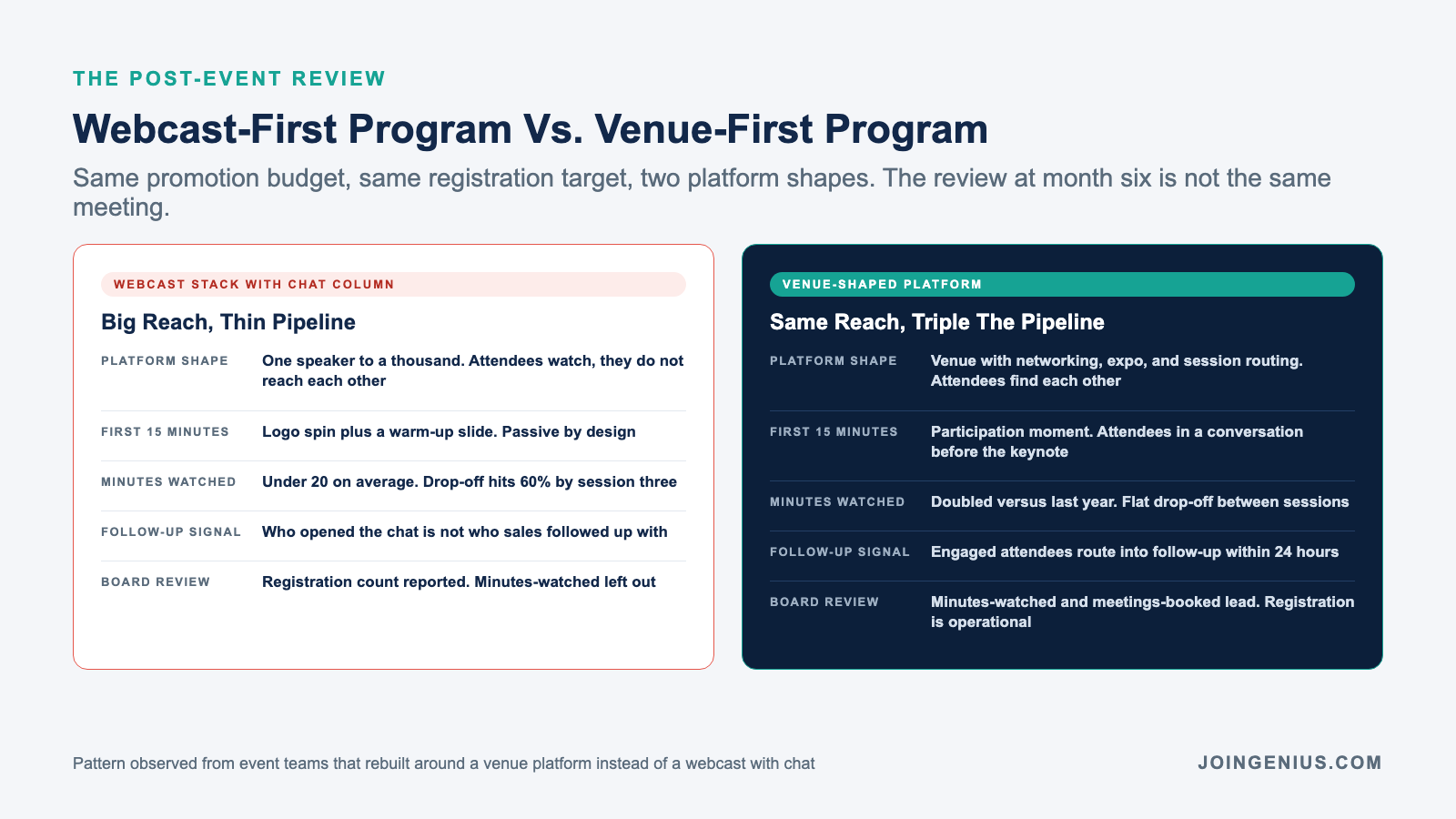
The difference between the two approaches shows up at the post-event review, which is also the moment leadership finds out whether the program is a brand cost or a pipeline lever.
The Before Version
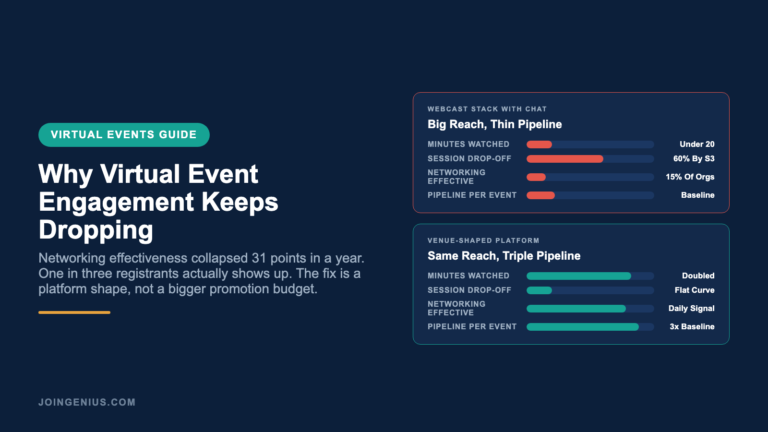
In the before version, the team has spent three months promoting a webcast program with a chat column. Registration hit the target. Attendance hit the target. Average minutes watched slid under twenty, drop-off hit 60% by session three, and sales took thirty-eight follow-up meetings that went nowhere because the event did not route who was actually engaged. The next quarter’s plan is a bigger promotion budget on the same shape, which is the same event with a larger registration number at the top of the same drop-off curve. Low morale at work often sits highest on event teams whose postmortems keep returning the same slide.
The After Version
In the after version, the team has spent three months building a venue-shaped program with networking and expo tooling at the center. Average minutes watched doubled against last year. Drop-off between sessions flattened because attendees had a reason to stay in the venue between them. Sales took the same volume of follow-up meetings, but the meetings came from the attendees who actually engaged, and the pipeline conversion was triple the previous event. The post-event review is about pipeline rather than reach, which is the review that funds the next event.
A Four-Move Playbook For Rebuilding Virtual Event Engagement
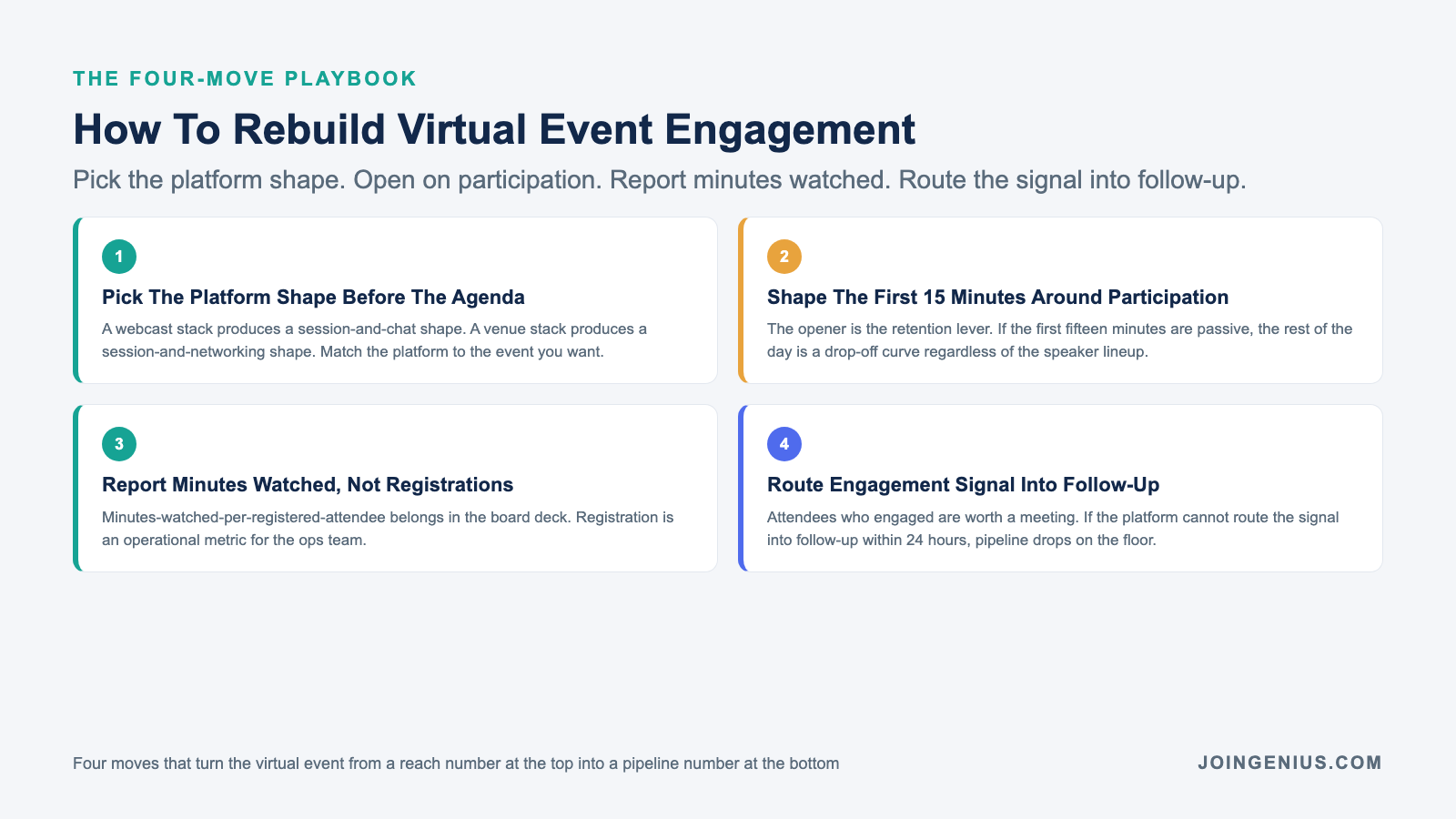
The four moves in order.
1. Pick The Platform Shape Before The Agenda
The platform decision is upstream of everything else, because it decides what the agenda can do. A webcast stack produces a session-and-chat shape. A venue stack produces a session-and-networking shape. Pick the platform against the event shape you want, then build the agenda inside it.
2. Shape The First Fifteen Minutes Around Participation
The opener is the retention lever. Design the first fifteen minutes so the attendee is in a conversation or a hands-on moment, not watching a logo spin. If the first fifteen are passive, the rest of the day is a drop-off curve regardless of how strong the speaker lineup is. A structured program process is worth zero if the first fifteen minutes of each event leaves the attendee passive.
3. Measure Minutes Watched, Not Registrations
Report minutes-watched-per-registered-attendee and session-to-session retention in the board deck. Registration belongs on an operational dashboard the ops team watches, not in the leadership review where the actual engagement number should live. What gets reported is what gets optimized.
4. Route Engagement Signal Into Follow-Up Automatically
The attendees who engaged are the attendees worth a follow-up meeting. If the platform cannot route who stayed and who interacted into the follow-up motion inside twenty-four hours, the event drops its highest-intent pipeline on the floor. Platform capability is what turns engagement into pipeline.
The playbook is in the image below.
The One-Page Check Before The Next Virtual Event
Before you brief the next virtual event, ask one question. If you ran it on a platform shaped around a venue and attendee participation and reported minutes-watched instead of registrations in the board deck, would the post-event review be about pipeline or about reach?
If the answer is pipeline, the registration number was never the lever. The platform shape was. Fix the shape by running conference-shaped events on venue-shaped platforms, then let registration sit where it belongs, which is an operational metric the team watches on the way to the real one. The next event you ship against that question will hold the engagement curve past session three and convert the attendees who stayed into pipeline past day thirty. The next event you ship against a bigger promotion budget on a webcast stack will produce the same chart you already have.
Conclusion
Virtual event engagement is a platform-shape problem that most teams misdiagnose as a content or promotion problem, and the misdiagnosis costs a brand event that converts like a webcast. Pick the platform shape first. Open on participation. Report minutes watched. Route the engagement signal into follow-up. Then ship the event you actually planned, which is a venue-shaped program that holds an audience past the keynote, not a webcast with a chat column and a bigger registration number at the top of a familiar drop-off curve.
We built Genius so event and communications operators can staff the program work their venue-shaped platform surfaces, without expanding the local headcount their budget cannot support. We place the top 1% of event and operations talent from the Philippines and Latin America, at around 80% less than comparable local hires. The relationship stays direct, with no monthly agency fees and a 6-month replacement guarantee on every placement. If the next event hire is the one who finally makes the post-event review about pipeline, see how we source and place the event talent that compounds.