Most B2B SaaS teams launch an affiliate program the same way. They turn it on and sign a few partners who asked to join. Six months later they see a low four figure number in partner sourced ARR and quietly decide affiliate does not work for B2B SaaS.
The channel works. The program design does not. Four specific failure modes show up in nearly every stalled B2B SaaS affiliate program, and the fix for each one is operational, not strategic.
This post walks through the four failure modes, the recruitment layer where most of the leak actually hides, and the weekly scorecard that separates a program that compounds from one that stalls.
The Four Ways B2B SaaS Affiliate Programs Actually Fail
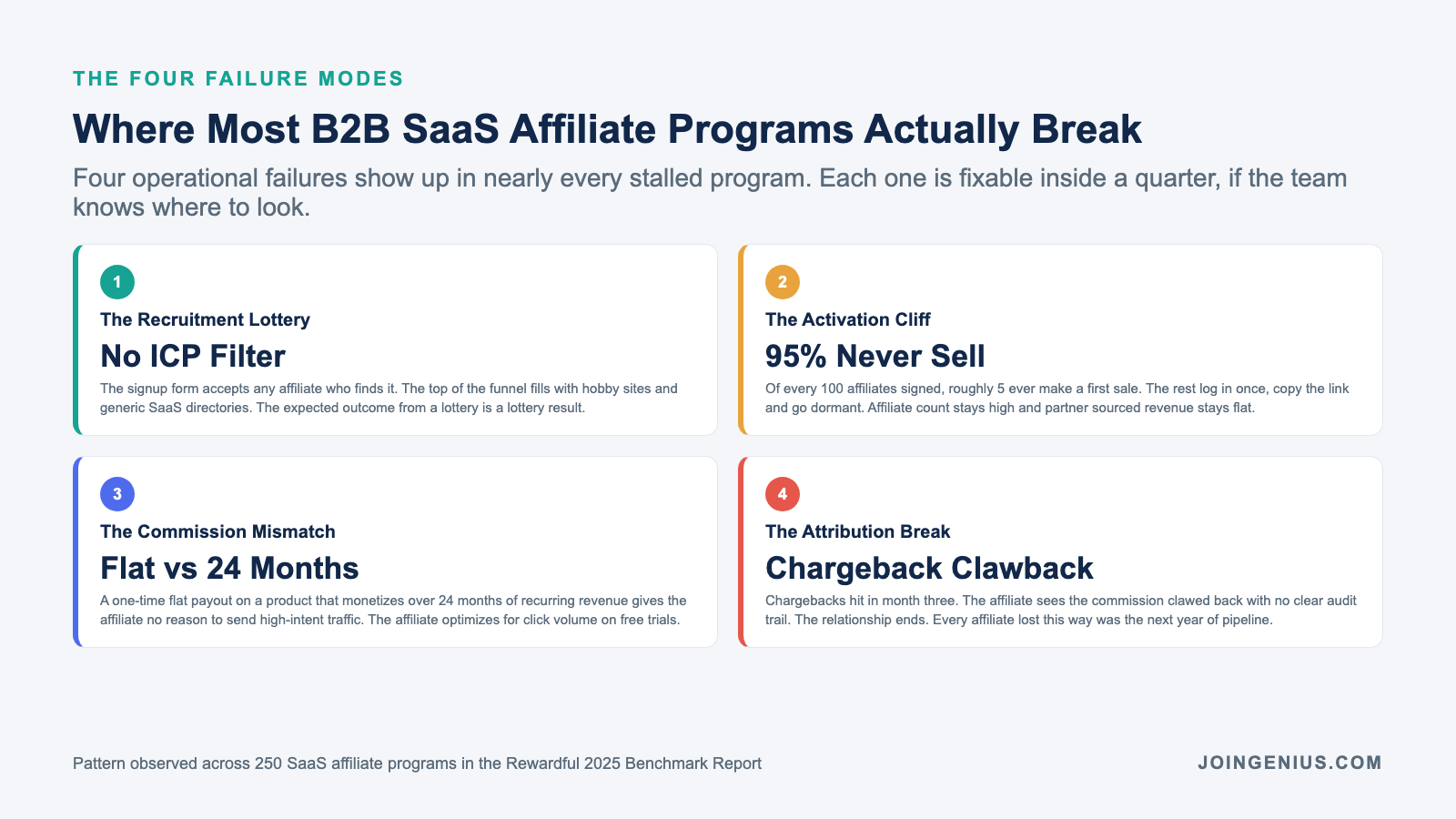
Failure one is the recruitment lottery. The program accepts any affiliate who finds the signup form without a check on audience fit or past B2B conversion history. The top of the funnel fills with hobby sites and generic SaaS directories. The expected outcome from a lottery is a lottery result.
Failure two is the activation cliff. Of every 100 affiliates who sign up, roughly 5 ever make a first sale. The rest log in once, copy the link and paste it into a dormant blog that never gets updated. The program looks healthy on affiliate count and looks starved on partner sourced revenue, because the two numbers measure different things.
Failure three is the commission model mismatch. A one time flat commission on a product that monetizes over 24 months of recurring revenue gives the affiliate no reason to send high intent traffic. The affiliate optimizes for click volume on free trials. The customer that converts is low intent. The LTV math does not work.
Failure four is the attribution and payout trust break. Chargebacks hit the SaaS at month three. The affiliate sees the commission clawed back with no clear audit trail. The relationship ends. Every affiliate the program lost this way was a partner the next year of pipeline needed.
Why The Partner Dashboard Looks Fine But ARR Does Not Move
The pattern is visible in the primary benchmark data. Rewardful’s 2025 SaaS Affiliate Program Benchmarks, drawn from 250 SaaS programs on its platform generating $68.4 million in combined revenue over the prior twelve months, shows the top 6 percent of programs account for $21.8 million of that total. The bottom 40.8 percent of programs together generate only $6.7 million.
Four out of ten B2B SaaS affiliate programs are stuck under $100,000 in annual partner sourced revenue. That is not a channel problem. It is a program design problem that compounds in the same direction every quarter until someone touches it.
The surface metric that hides this is affiliate count. A program with 400 signed affiliates and 12 of them active is reported to the leadership team the same way as a program with 80 signed affiliates and 40 of them active. The first program is failing. The second is working. The partner dashboard does not show the difference until someone asks for active affiliate rate by cohort.
The commission rate inside the bottom tier is 22.1 percent average against the top tier average of 24.5 percent, so the gap is not a pay problem either. The gap is who is being recruited and how activated they get in the first 60 days.
The Affiliate Network Layer Where Recruitment Actually Breaks
The quiet place where the loss lives is recruitment. The program lives or dies on who signs up in the first place, and most SaaS teams have no way to tell the audience fit of an incoming affiliate until six months of dead traffic says the fit was wrong.
The same Rewardful benchmark report puts the gap in sharp numbers. Programs in the top 6 percent average over 57,000 referred leads and 9,000 conversions per year. Programs in the middle 44 percent average more than 5,000 leads and 1,000 conversions. The 9x gap in conversions is a function of which affiliates the program attracted in the first year, not how the program paid them.
Running an affiliate program on a SaaS affiliate network like Reditus, which matches programs to a vetted network of 28,000+ B2B SaaS affiliates by ICP and keyword overlap before a partner ever reaches the signup form, closes the recruitment gap that otherwise shows up as a 90 percent dead affiliate list and no partner sourced pipeline.
Fixing the recruitment layer is the single highest return move a B2B SaaS team can make on its affiliate program in 2026. It does not require a new commission model or a bigger team. It requires one program manager who treats the first 60 days of every new affiliate as an activation problem, not a self serve one.
The economics on this are direct. A program that lifts active affiliate rate from 5 percent to 25 percent on the same signed affiliate base lifts partner sourced pipeline by roughly 5x inside two quarters at the same acquisition cost. The B2B/enterprise segment takes 18 to 24 months to reach meaningful partner sourced revenue, so the earlier the recruitment layer is fixed, the earlier the compounding starts.
Day 180 Before And After The Program Rebuild
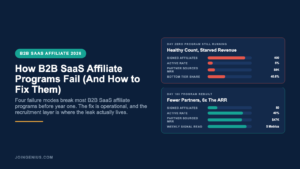
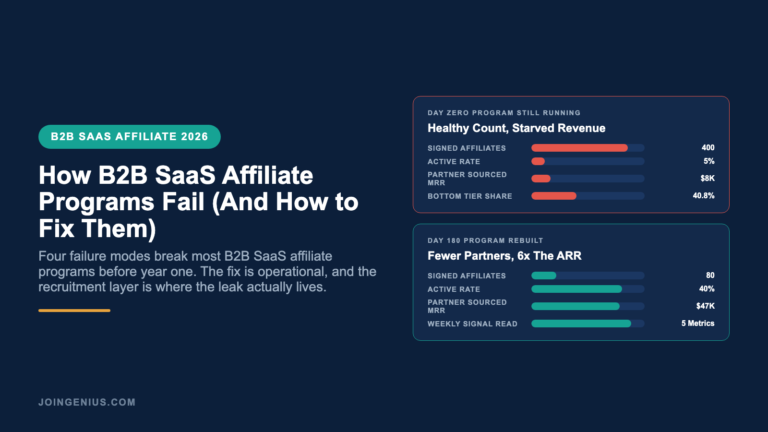
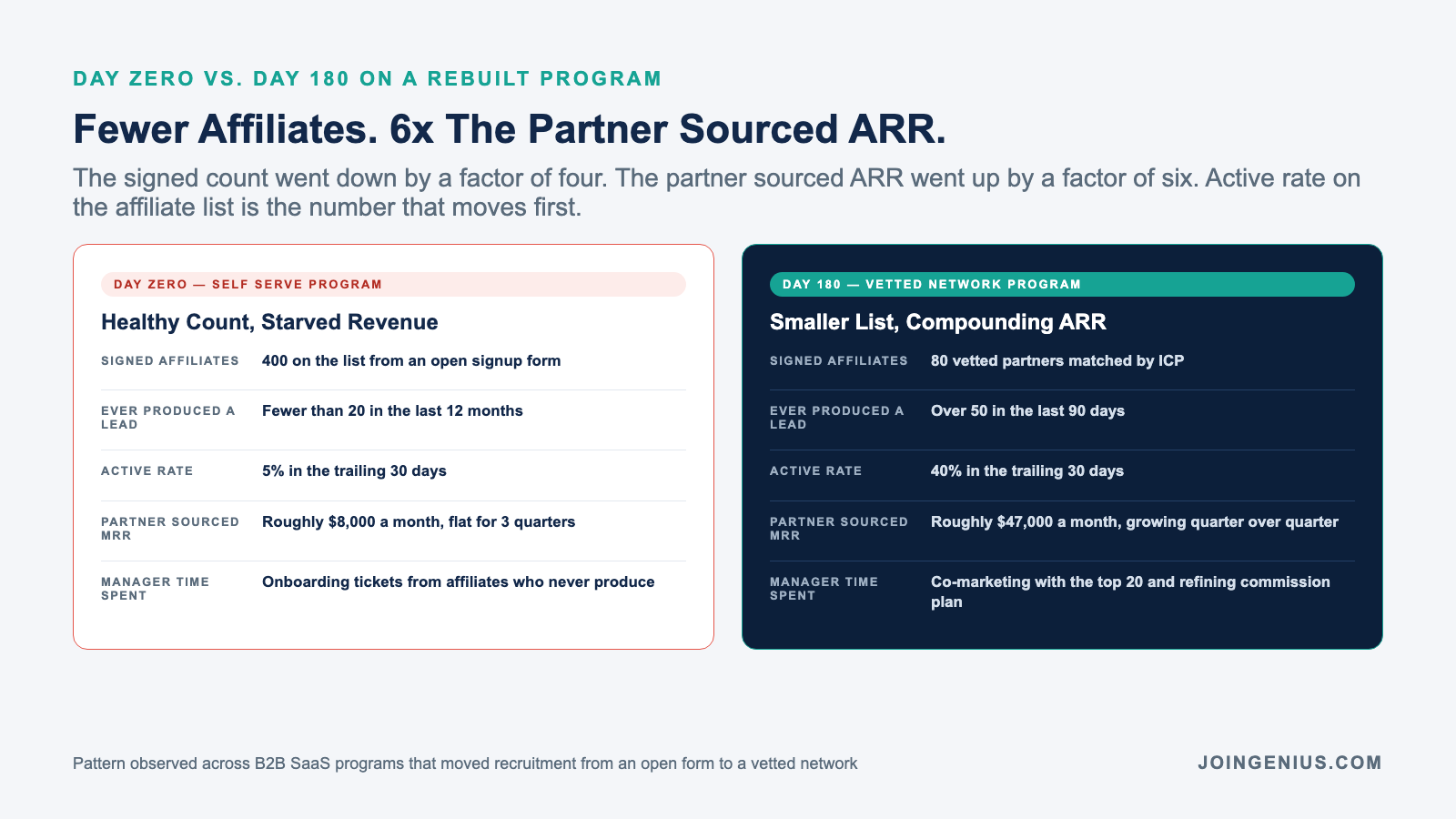
The before picture is the one most SaaS founders describe. The program has 300 to 500 signed affiliates. Fewer than 20 of them have ever produced a referred lead. Partner sourced ARR runs at roughly $8,000 a month. The program manager, if the company has one, spends most of the week answering onboarding tickets from affiliates who will never produce.
The after picture at day 180 looks different on every metric. The program has 80 vetted affiliates matched by ICP. Of those, 32 produce recurring referrals every quarter. Partner sourced ARR runs at roughly $47,000 a month. The program manager spends most of the week working with the top 20 affiliates on co marketed content and the commission plan.
The signed affiliate count went down by a factor of four. The partner sourced ARR went up by a factor of six. The team got that result by cutting affiliate recruitment off the generic signup form and routing it through a B2B SaaS network that filtered on audience fit before approval.
The number that changed first was active affiliate rate. It moved from 5 percent to 40 percent inside 90 days. Every downstream number moved on the lag of that one.
The Four Move Playbook For Fixing A Stalled Program
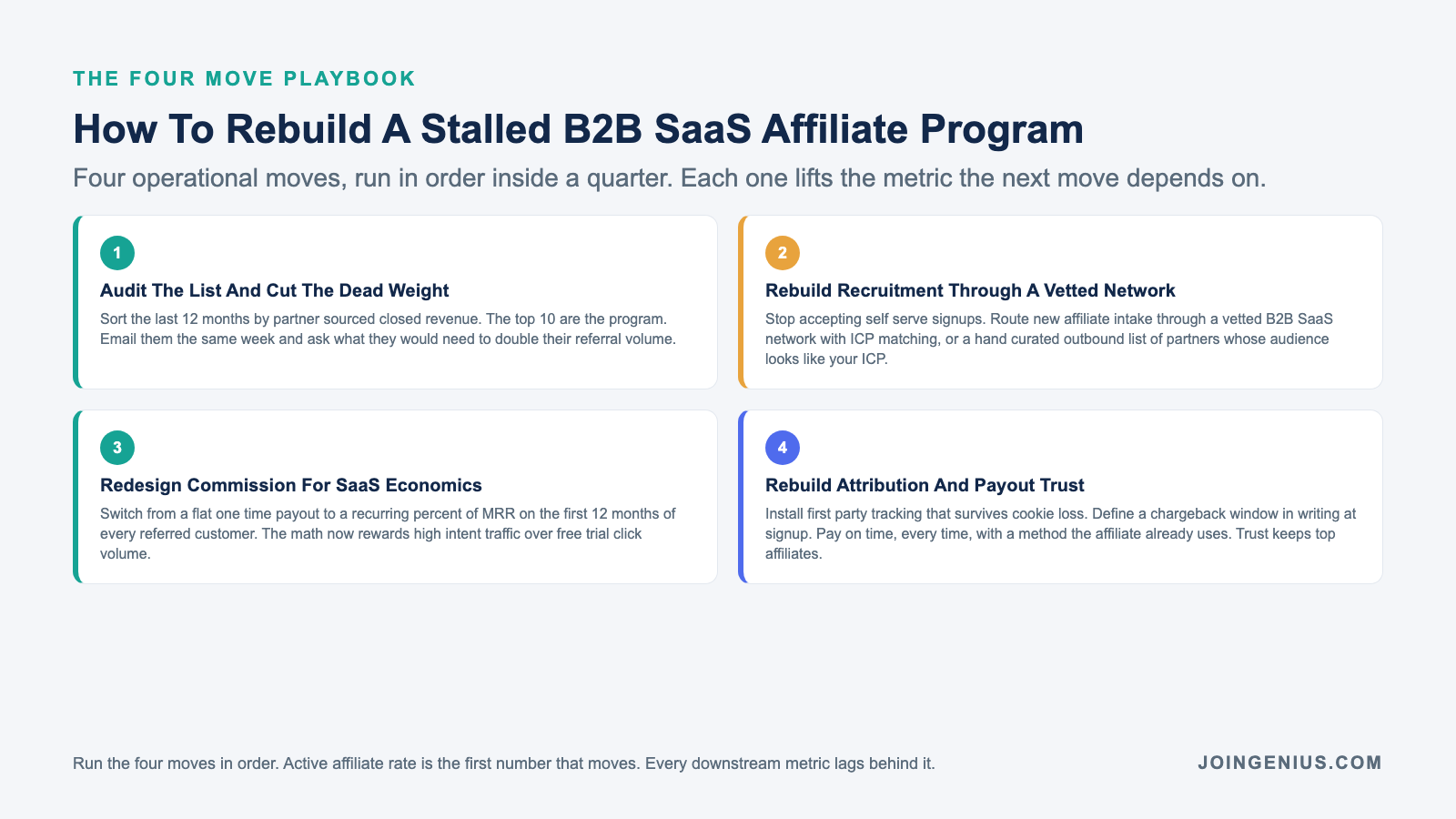
Move one is the audit. Pull the last 12 months of affiliate data and sort by partner sourced closed revenue. The top 10 affiliates are the program. The rest are a mailing list. Cut the list. Email the top 10 the same week and ask them what they would need to double their referral volume.
Move two is the recruitment rebuild. Stop accepting self serve signups from anyone with a Gmail address. Route new affiliate intake through a vetted B2B SaaS network with audience fit filtering or a hand curated outbound list of partners whose audience already looks like your ICP. Expect to approve fewer affiliates per month and get more revenue from each one.
Move three is the commission redesign. Switch from a flat one time payout to a recurring percent of MRR for the first 12 months of every referred customer. The affiliate math now rewards high intent traffic over click volume. A top affiliate who refers a $2,000 per month enterprise deal earns more than they would from 30 free trial clicks.
Move four is the attribution and payout rebuild. Install first party tracking that survives cookie loss. Define a chargeback window and communicate it in writing to every affiliate at signup. Pay on time, every time, with a payment method the affiliate already uses. Trust on the payout side is what keeps a top affiliate working with you when a competitor offers a higher commission.
A One Page Weekly Check On The Program
The replacement for the partner dashboard most B2B SaaS teams run is a weekly five metric read owned by the program manager. The point is to make the real signal visible without the leadership team asking.
Metric one is active affiliate rate in the trailing 30 days, measured as the percent of signed affiliates who produced at least one referred lead. Metric two is partner sourced MQL to SQL conversion rate against the company average. Metric three is partner sourced new ARR as a percent of total new ARR.
Metric four is time to first commission on affiliates who signed in the last 60 days. Metric five is the chargeback adjusted commission pipeline for the next 90 days, so the team is not surprised when a payout month lands lower than the dashboard suggested.
Scan these five every Monday, flag the two biggest week over week moves, and walk the team through the hypothesis before the leadership review. The conversation changes from “how many affiliates do we have” to “which cohort is actually converting this quarter,” which is the only conversation that moves partner sourced ARR.
Pair the weekly five with a quarterly cohort view on affiliate LTV. An affiliate program that only optimizes to the first referred sale is the affiliate program that cannot keep partners long enough to earn the recruitment cost back. The weekly and quarterly reads together are what the program manager actually owns. Build this expectation into your interview rubric for the program manager role.
Hire Program Managers Who Can Rebuild The Partner Channel
The teams that compound partner sourced ARR in 2026 are the ones that stopped hiring affiliate coordinators and started hiring program managers who treat the channel as a product. They are the ones that moved the recruitment surface off the generic signup form and onto a B2B SaaS network. They are the ones with a program manager who owns the first 60 days of every new affiliate.
The hiring window is tight. The US Bureau of Labor Statistics counts 952,700 market research analyst and marketing specialist jobs in 2025, with a 7 percent growth projection through 2035 and a median wage of $78,760. That is a seller’s market for the analytical program manager archetype you need to hire against.
Genius hires top one percent partner marketing and program management talent from the Philippines and LATAM at roughly 80 percent less than local comp. There are no monthly fees and the placement comes with a six month replacement guarantee.
We screen on the four program manager tests described on this page before any candidate reaches a hiring manager, so your sourcing funnel brings you people who will rebuild the recruitment layer on day one, not people who will present another partner deck on day thirty.