The new website launched on a Tuesday. The team shared it on LinkedIn and the founder sent it to a few customers. Everyone agreed it looked far better than the old one. Ninety days later the sales report looks the same as it did before. In some months it looks worse.
This is the most common outcome of a website redesign, and it is rarely the designer’s fault. A redesign is usually briefed as a visual project. The brief says modern and clean, and on brand. It almost never names the number the new site is supposed to move, so nobody designs for it.
This post covers the three reasons a redesign leaves sales flat and why the launch report hides the problem. It also covers the four checks to put in the brief before the first mockup.
The Three Reasons A Redesign Leaves Sales Flat
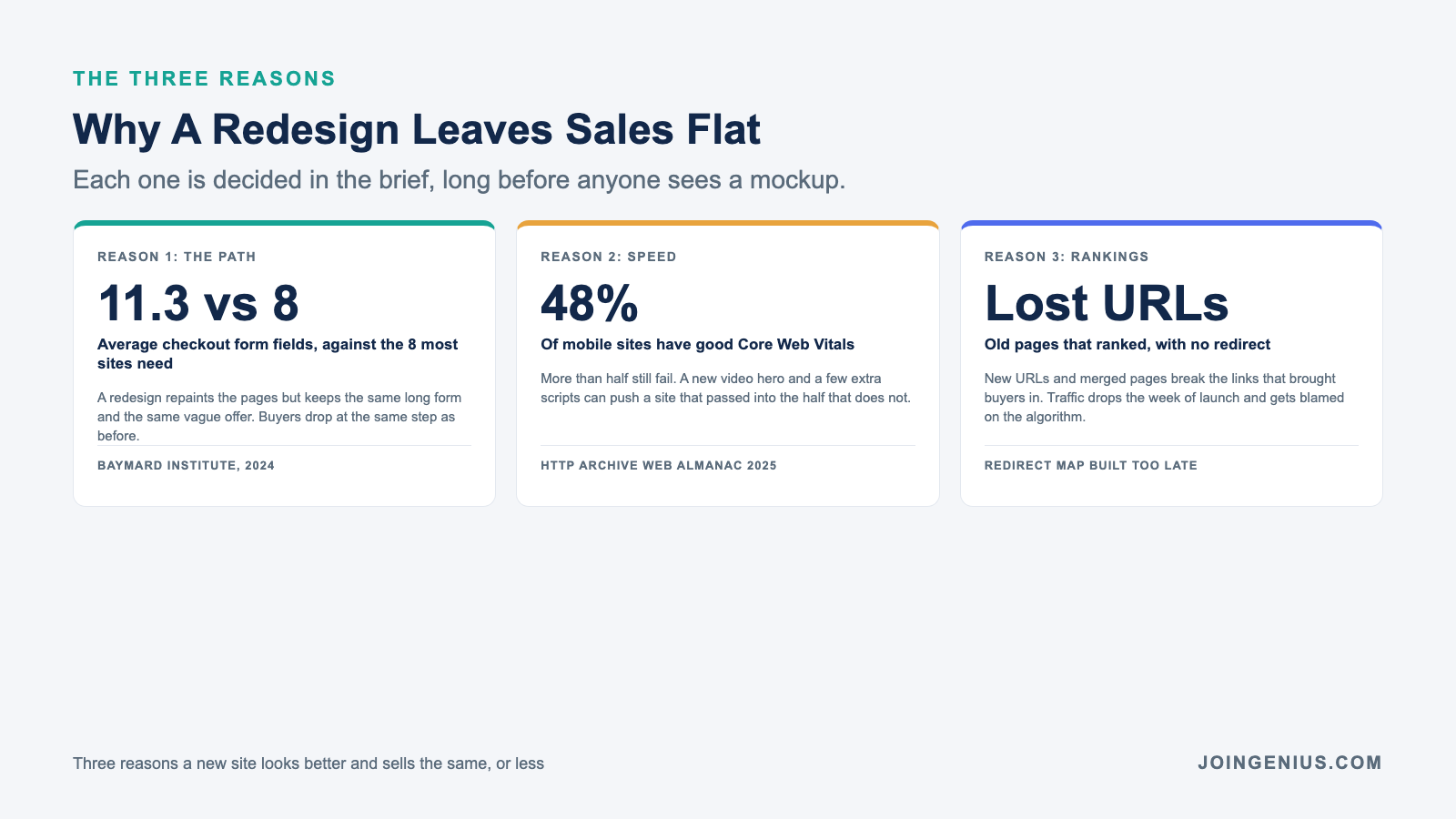
Reason one is that the path to buy did not change. The pages got a new look, but the offer is still vague and the enquiry form still asks for nine fields. Buyers drop at the same step they always did. Baymard Institute’s checkout research shows how common this is. Its 2024 analysis found the average checkout had 11.3 form fields, while most sites need only eight. That research covers ecommerce checkouts, and Baymard sells UX research, but the lesson carries over to any enquiry form. Every extra field is another reason to leave.
Reason two is speed. New sites tend to arrive with a video hero and heavier images, plus a few more tracking scripts. The HTTP Archive’s 2025 Web Almanac found that only 48 percent of mobile websites have good Core Web Vitals, up from 36 percent in 2023. More than half of mobile sites still fail. A redesign that adds weight can move a site that passed into the half that does not.
Reason three is lost rankings. A redesign often changes URLs and merges pages. It also rewrites the copy that was ranking. If the old URLs are not redirected one to one, the links and search positions that brought buyers in disappear the week the new site goes live. The traffic drop gets blamed on a Google update, and the redesign gets credit for nothing.
Why The Launch Report Says The Redesign Worked
The report that hides a failed redesign is the one built around engagement. Time on page is up because the new pages are longer. Bounce rate is down because a cookie banner now counts as an interaction. Everyone likes the design, so the project is marked a success.
None of those numbers are sales. The redesign was paid for to bring in more enquiries or orders, and the engagement report can look healthy while enquiries fall. The two numbers that matter are enquiries or sales per month and the conversion rate of the pages that bring them in.
Most teams cannot compare those numbers before and after, because nobody recorded the baseline before the old site came down. That is the first thing to fix on the next redesign.
The Conversion Layer A Redesign Should Be Scoped Around
A redesign that drives sales starts with the conversion layer, not the visual layer. That means the offer on the top pages and the enquiry form. It also means the speed of the pages that carry the most traffic. It also means a redirect plan for every URL that ranks today.
That work sits across design and SEO, which is why it often falls between two suppliers. A web design studio like Vudu Digital runs SEO and copywriting alongside design. That lets it scope the redesign around the conversion path and protect rankings during the move. The visual design then serves the path instead of replacing it.
The owner still has a job. Someone inside the business has to own the baseline number and say what a good result looks like at 90 days. Without that owner, even a well-scoped redesign gets judged on how it looks.
A Looks-First Redesign Versus A Conversion-First One
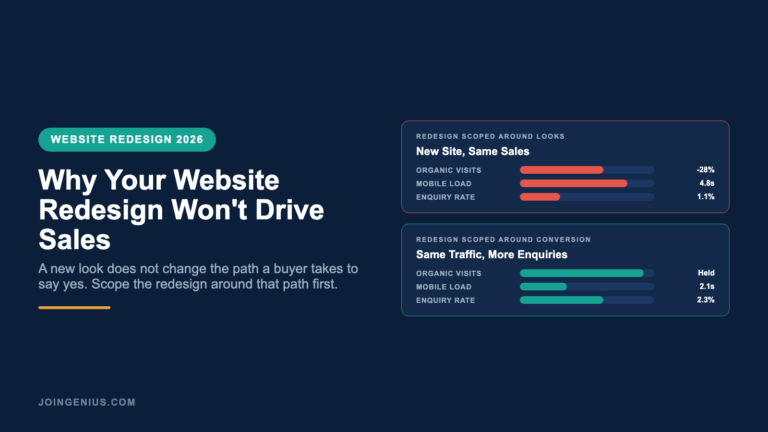
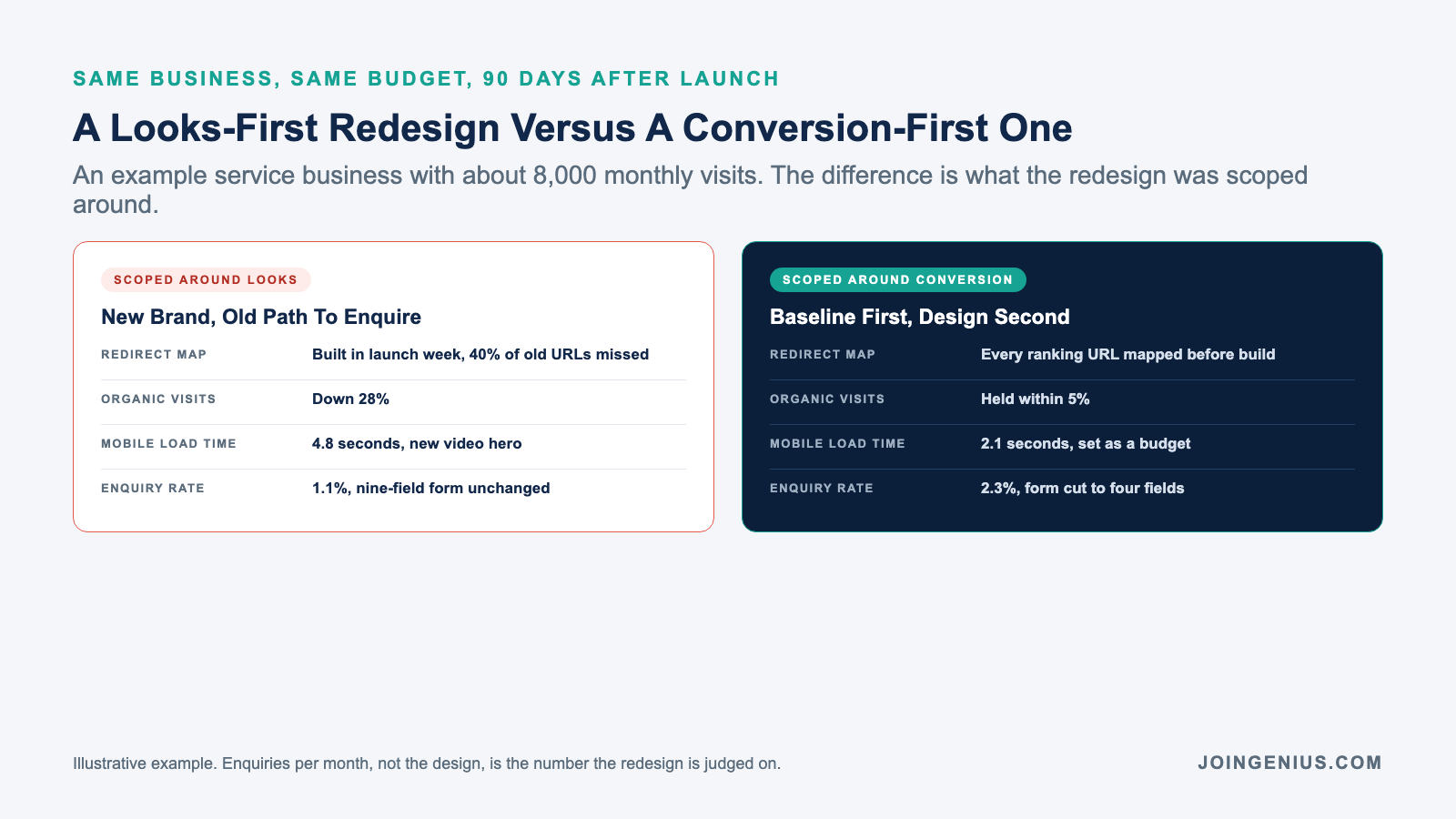
Here is an illustrative example. A service business gets about 8,000 visits a month. In the looks-first version, the redirect map is built in launch week and misses 40 percent of the old URLs. Organic visits fall 28 percent. A new video hero pushes mobile load time to 4.8 seconds. The nine-field enquiry form is unchanged, and the enquiry rate sits at 1.1 percent.
In the conversion-first version, the same business records its baseline first. Every ranking URL is mapped before the build starts. Organic visits hold within 5 percent. The brief sets a mobile load budget, and the site loads in 2.1 seconds. The enquiry form is cut to four fields, and the enquiry rate reaches 2.3 percent.
Same traffic, same budget, roughly double the enquiries. The only difference was what the redesign was scoped around.
The Four Checks To Put In The Brief
Check one is the conversion baseline. Record enquiries or sales per month and the conversion rate of the top ten pages. That is the number the redesign has to beat.
Check two is the redirect map. Every URL that ranks or earns links gets a one-to-one redirect. Build and test it before launch day, not during it.
Check three is the speed budget. Set a mobile load target in the brief. Any new video or script that breaks it has to earn its place. Check four is the form and offer audit. Cut the enquiry form to the fields sales actually uses, and rewrite the offer on the top pages before a designer touches them.
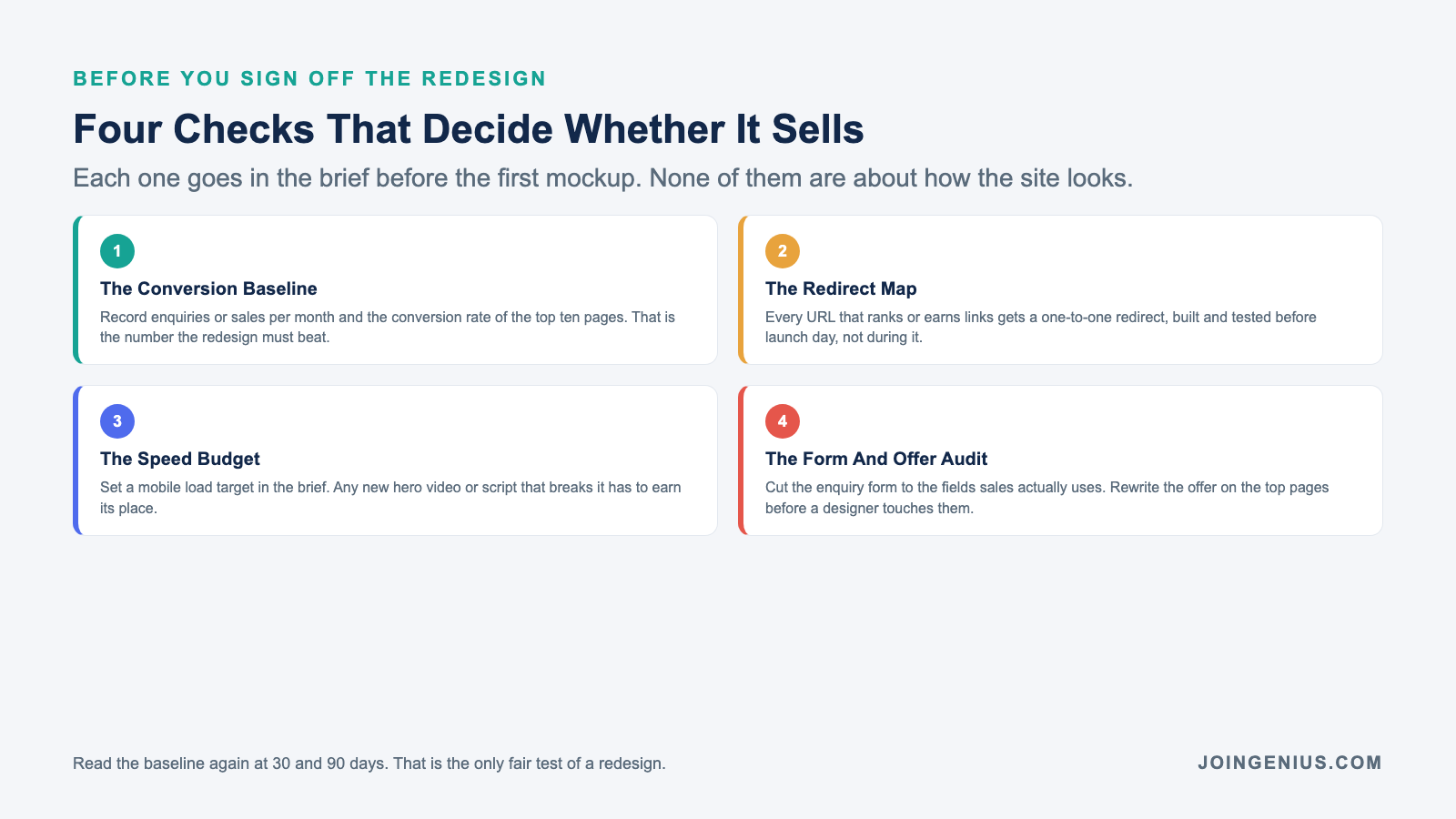
Read the baseline again at 30 and 90 days after launch. That is the only fair test of a redesign. If you are hiring someone to own the website, build these four checks into your interview rubric for the role.
Hire The People Who Own Conversion
The redesigns that drive sales are the ones with an owner who watches the number after launch. That owner might be a web developer who keeps the site fast, or a designer who tests the enquiry path. Either way, the job does not end when the new site goes live.
Those people are in demand. The US Bureau of Labor Statistics counts 220,100 web developer and digital designer jobs in 2025, with 5 percent growth projected through 2035. The median wage for web developers was $92,650 in May 2025.
Genius hires top one percent web development and design talent from the Philippines and LATAM at roughly 80 percent less than local comp. There are no monthly fees, and every placement comes with a six month replacement guarantee.
We screen candidates on the conversion work described on this page before they reach you. That means you meet people who will ask for your baseline in week one, rather than people who judge the new site on how it looks.