eCommerce operations staff spend their week moving between carrier dashboards, returns queues, inventory snapshots, and a help desk that never clears. The same person then answers a customer, re-labels a parcel, and explains a backorder before lunch whenever a return wave or carrier delay hits.
Below, we cover what makes the role different, the five drivers behind the burn rate in 2026, the signals a lead should spot before a resignation, the fixes that actually hold, and the team shape that keeps ops in seat past twelve months. Start with the customer service tenure data that already predicts who stays.
What Makes eCommerce Operations Staff Different From Other Teams
eCommerce operations staff are not a back-office function in the way the title suggests. Every decision they make touches a customer the same day, and every error compounds through carrier systems, finance ledgers, and the inbox before anyone writes a post-mortem. The job is customer service, logistics, and finance wearing one hat.
Why The Work Never Hits A Natural Pause
A software team ships. A marketing team closes a campaign. A finance team closes a month. An ops team never closes anything. Each day opens with the carry-over from the day before, which means no natural recovery point and no moment to say the week was good enough.
Why Errors Show Up Faster Than In Other Roles
A wrong label or a wrong SKU will be on a doorstep within 48 hours and in a one-star review by the weekend. That compressed loop between decision and customer impact pushes the stress curve higher than in a role where mistakes take a quarter to become visible.
The Five Drivers Behind eCommerce Ops Burnout In 2026
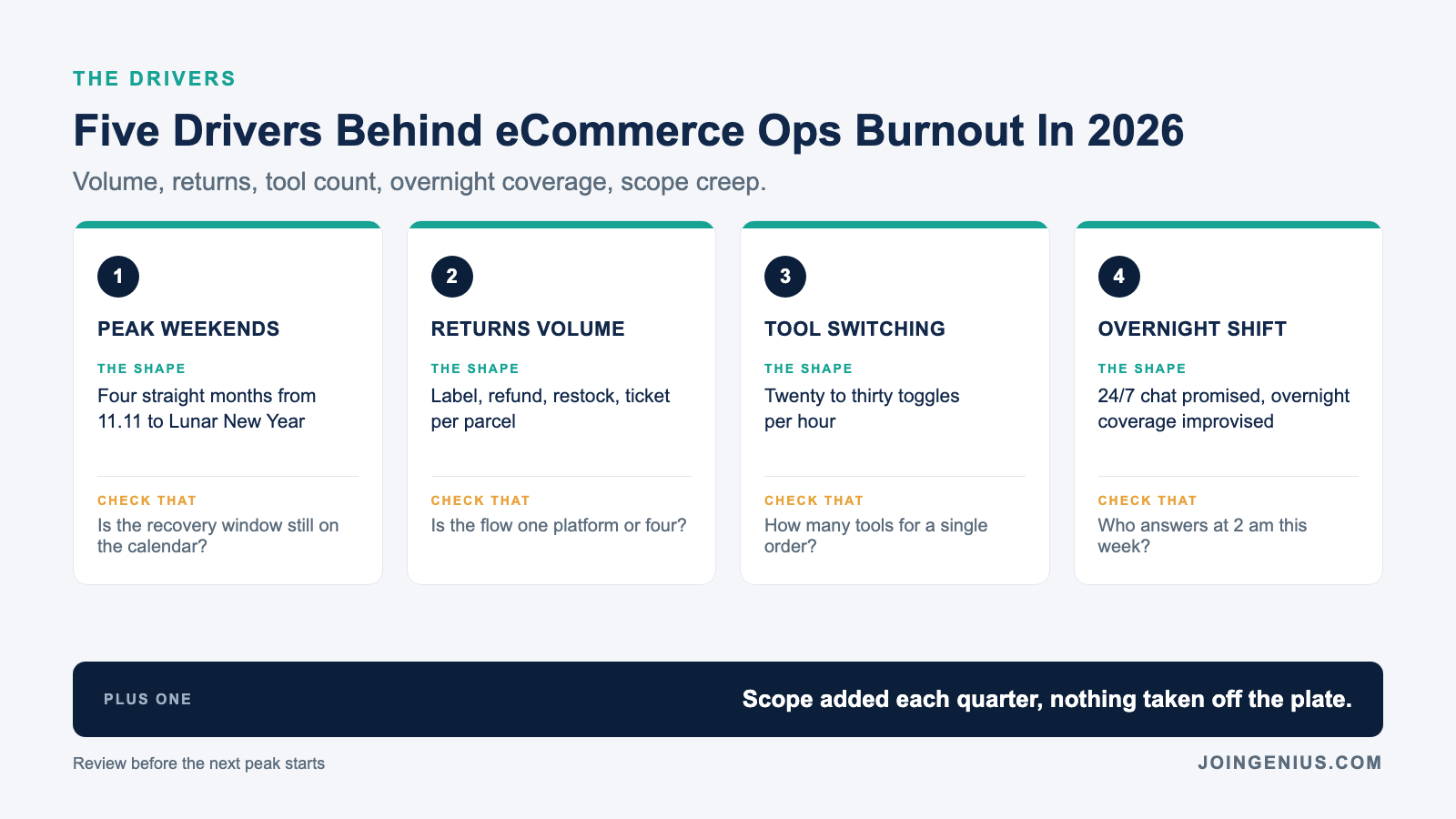
Most ops burnout is not about pay. It is about the shape of the work in a given month and whether the system compounds a mistake or absorbs it. The five drivers below are what we find on every team losing eCommerce operations staff faster than benchmark.
Peak Weekends That Last Four Months
Peak used to mean Black Friday through December. It now starts with October 11.11 waves, runs through Cyber Monday, Boxing Day, Lunar New Year, and a Valentine’s return cycle. Four straight months of weekend shifts on top of weekdays, with the recovery window gone.
Returns Volume Is The Fastest Path To Ops Burnout
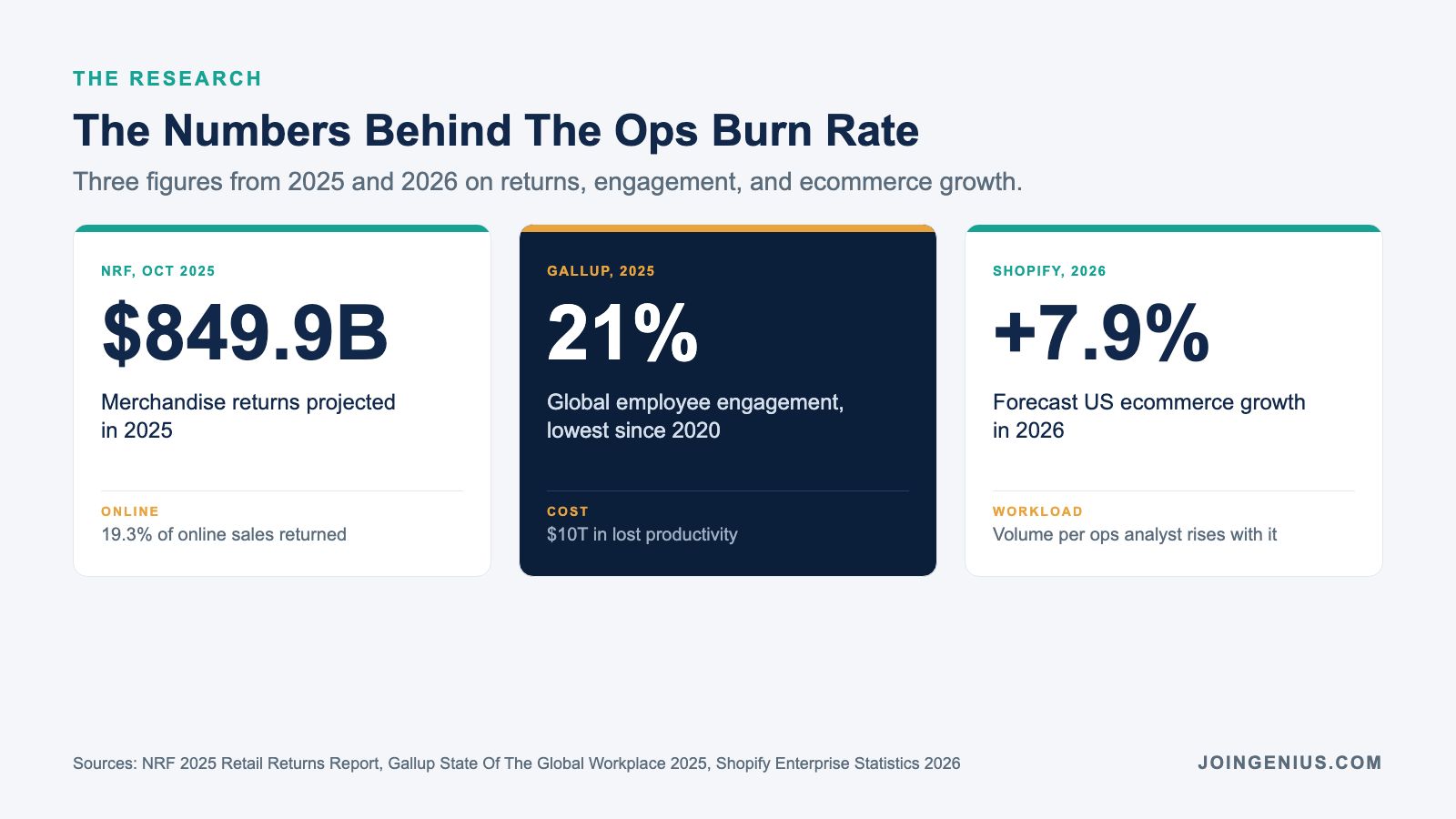
The NRF projects $849.9 billion in merchandise returns in 2025 at a 15.8% return rate, with online return rates at 19.3%, per the NRF 2025 retail returns report. Each return is a label, a refund, a restock, and a ticket.
A platform that collapses the label, the refund, and the restock into one flow, like Outvio’s returns management software, gives the ops team back the hours they currently lose to the ticket queue after every sale weekend.
Tool Switching Costs That Add Up By Hour
The average ops analyst toggles between the help desk, the shipping dashboard, the ERP, and the 3PL portal twenty to thirty times an hour. A tool count above six for a single order is the biggest predictor that hours per order will keep drifting up, as our breakdown of engineering tool fragmentation shows.
Shift Fatigue From Follow-The-Sun Service
Brands that promised 24/7 chat without properly staffing overnight pass the pain to the ops lead, who ends up covering 2 am tickets by hand. Even one night a week of this kills day-two productivity. The right pattern is regional coverage, not one team on call across every timezone of the calendar.
- Match peak days against total ops headcount, not against monthly average revenue.
- Count the tools each analyst logs into before the first ticket of the shift.
- Audit the overnight queue once a quarter and reassign it to a regional partner.
- Measure returns per order, not returns per revenue, because labor is the number that scales.
How To Spot The Drop Before A Resignation
Ops leads who lose people without warning are usually looking at the wrong signals. Attendance and raw ticket volume are lagging indicators. The leading indicators are how someone writes, who they escalate to, and how they answer a Monday standup. All three change weeks before a notice.
Four Signals That Precede An Ops Resignation
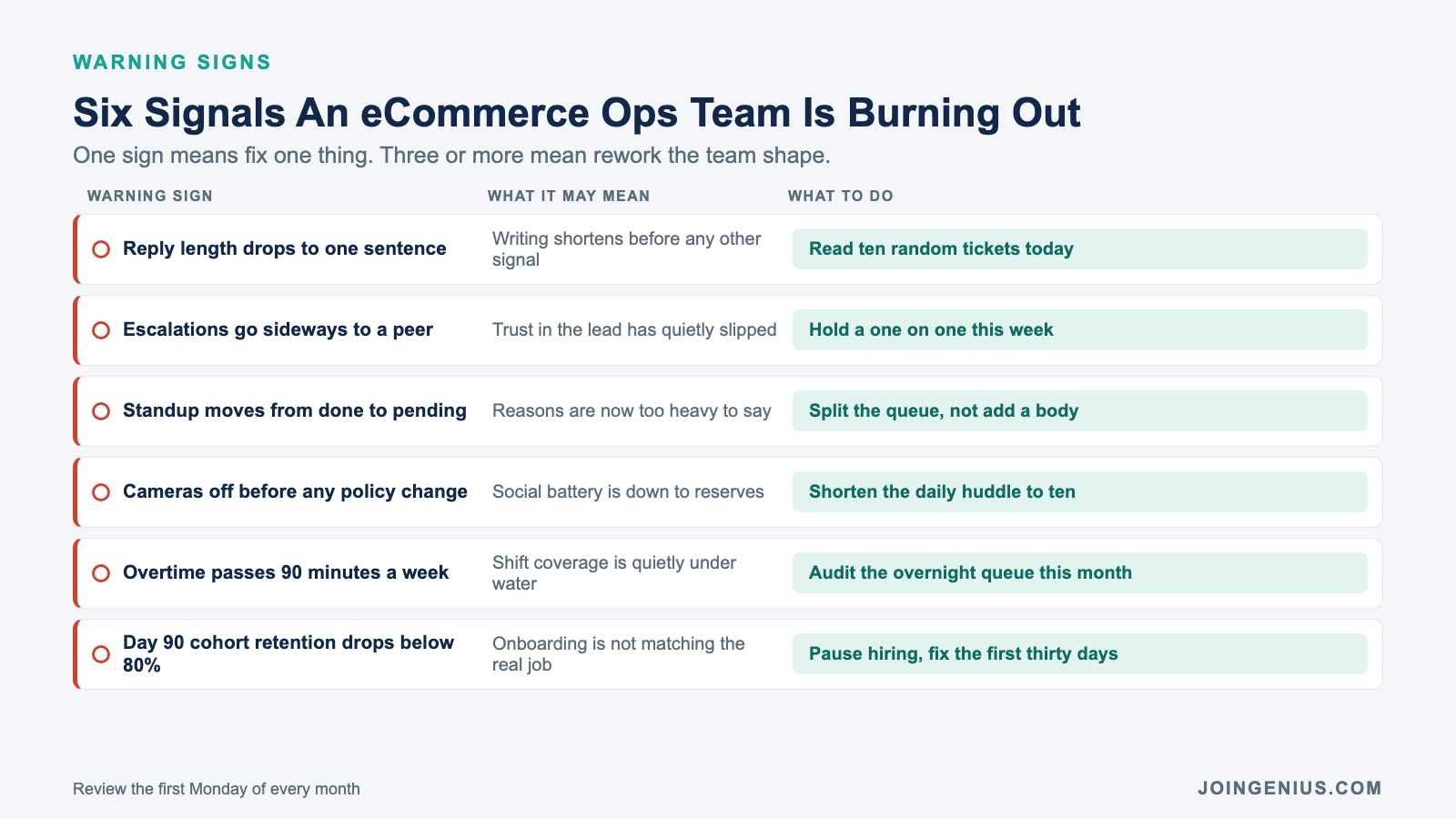
Burnout shows up in writing first. The shortest tickets, the ones where a reply used to be three sentences and is now one, usually mark the first visible dip. The others follow within two or three weeks, often in the same order on every team we have audited.
- Ticket replies lose their closing line and shrink to a single sentence inside the same week.
- Escalations stop flowing to the lead and start going to a peer the person trusts privately.
- The standup update moves from what shipped to what is pending without a reason attached.
- Camera-off participation in the daily huddle begins before any formal policy change.
What The Monthly Audit Should Check
Once a month, read a random sample of each analyst’s tickets, not just the escalated ones. Look for whether the tone, the length, and the resolution style match last month. Pair that reading with a cohort retention chart like the one in our customer success tenure data piece.
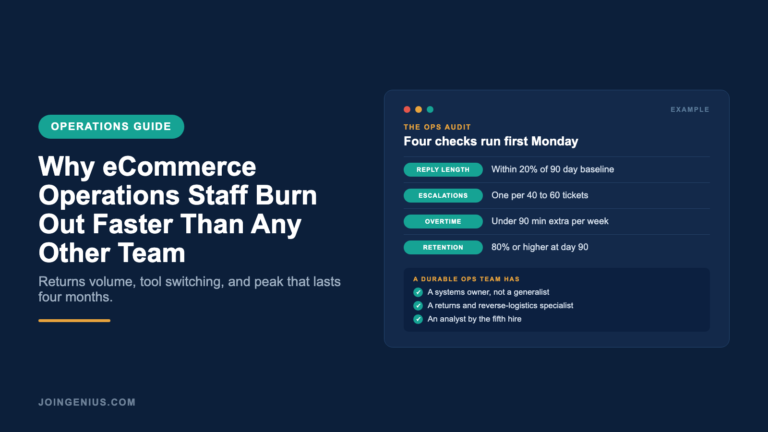
The audit matrix below is what a good ops lead runs on the first Monday of every month. Four signals, four checks, four healthy patterns, and the response to run the same day if a signal trips. Treat it as a system, not a performance review.
| Warning Signal | What To Check | What A Healthy Pattern Looks Like | What To Do If It Trips |
|---|---|---|---|
| Reply length collapses | Average tokens per response this week | Within 20% of the analyst’s 90 day baseline | One on one before the next shift block |
| Escalations stop flowing | Count of flagged tickets to the lead | One per 40 to 60 tickets on average | Pull a random ten for review the same day |
| Overtime creeps up | Hours logged outside the shift window | Under 90 minutes extra per week | Split the queue, do not add another body |
| Retention cohort dips | 90 day survival of the last three cohorts | 80% or higher at day 90 | Pause new hires, audit onboarding first |
The audit is not about judging an analyst in a bad week. It is about seeing the pattern three weeks before the person sees it, because that is when it is still fixable without a resignation on the way.
Fixes That Actually Lower The Burn Rate
Most burnout fixes written for office roles do not apply to ecommerce operations. A nap room does nothing on a Black Friday Monday. The fixes that actually hold are structural, and they are made before peak, not during it. Install them in a quiet month or do not install them at all.
Automations To Install Before The Next Hiring Round
Hiring is the most expensive answer to any ops bottleneck. Automations are the one that keeps paying. Any step the team repeats more than forty times a week belongs to a workflow, not to a human. The first three to install are the queue that grows fastest after each sale weekend.
- Auto-triage incoming tickets by order status before any human reads them.
- Auto-generate return labels at the request step, not after a CS back and forth.
- Auto-resolve WISMO tickets with a tracking page that pings before the customer asks.
- Auto-route exceptions to a single buffered queue so the team sees the shape of the problem.
Shifts, Cross Training, And Role Ladders
A team of six who all know only the help desk burns out faster than a team of four who each own two systems. Cross-training is the cheapest insurance an ops lead can buy, and it is the one most consistently cut when peak hits. Reverse the order.
Who To Hire And Where To Hire Them For Ops Longevity
The hiring mistake that costs the most is bringing on another junior ticket handler to absorb volume. The team needs a different shape by the time ticket volume doubles. Shape matters more than headcount by that stage.
According to Gallup’s State of the Global Workplace 2025 report, global employee engagement dropped to 21% in 2025, costing an estimated $10 trillion in lost productivity worldwide, and customer-facing roles sit at the sharp end of the drop.
The Shape Of A Durable Ops Team
A durable team has one lead, one systems owner who manages integrations and automations, one returns and reverse-logistics specialist, and a pool of generalists who handle the ticket queue. The fifth hire is almost always an analyst, not another generalist, and it is the one the team feels within the first month.
Where Offshore And Nearshore Hiring Fits
Ops workloads bend around timezones, which makes them one of the clearest fits for offshore and nearshore hires. Shopify’s ecommerce statistics report forecasts US ecommerce sales growing 7.9% in 2026, and hiring domestic generalists alone will not scale with that curve past peak.
Conclusion
eCommerce operations staff burn out faster than almost any adjacent team because every error reaches a customer in 48 hours and every month opens with last month’s carry-over. The fix is a structural audit of returns flow, tool count, shift coverage, and the signals that show up in a reply before a resignation email.
Genius staffs the team shape above. We place top 1% ops leads, returns specialists, systems owners, and senior analysts from the Philippines and LATAM at 80% less than a comparable US hire, no monthly fees, every hire backed by a 6 month guarantee. If your next peak needs a team that holds the floor, hire with Genius.