Lab safety audit gaps are the quiet reason an incident makes the news a quarter after a clean inspection. The checklist passed, the binder was in order, the inspector signed off. Then a chemical handoff went wrong on a Friday night and the audit had nothing on it that pointed to the real risk.
Below, we cover why most audits still clear a lab that is not ready, the five gaps teams keep missing in 2026, how to measure the audit itself, the fixes that close each gap, and the team shape that keeps a program honest. Start with the compliance hiring context.
Why Most Lab Safety Audits Pass And Still Miss The Biggest Risk
A compliance audit answers a different question than a readiness audit. One asks whether the written program matches the regulation. The other asks whether the lab, on a bad day, would actually hold. Most programs run the first every year and never schedule the second.
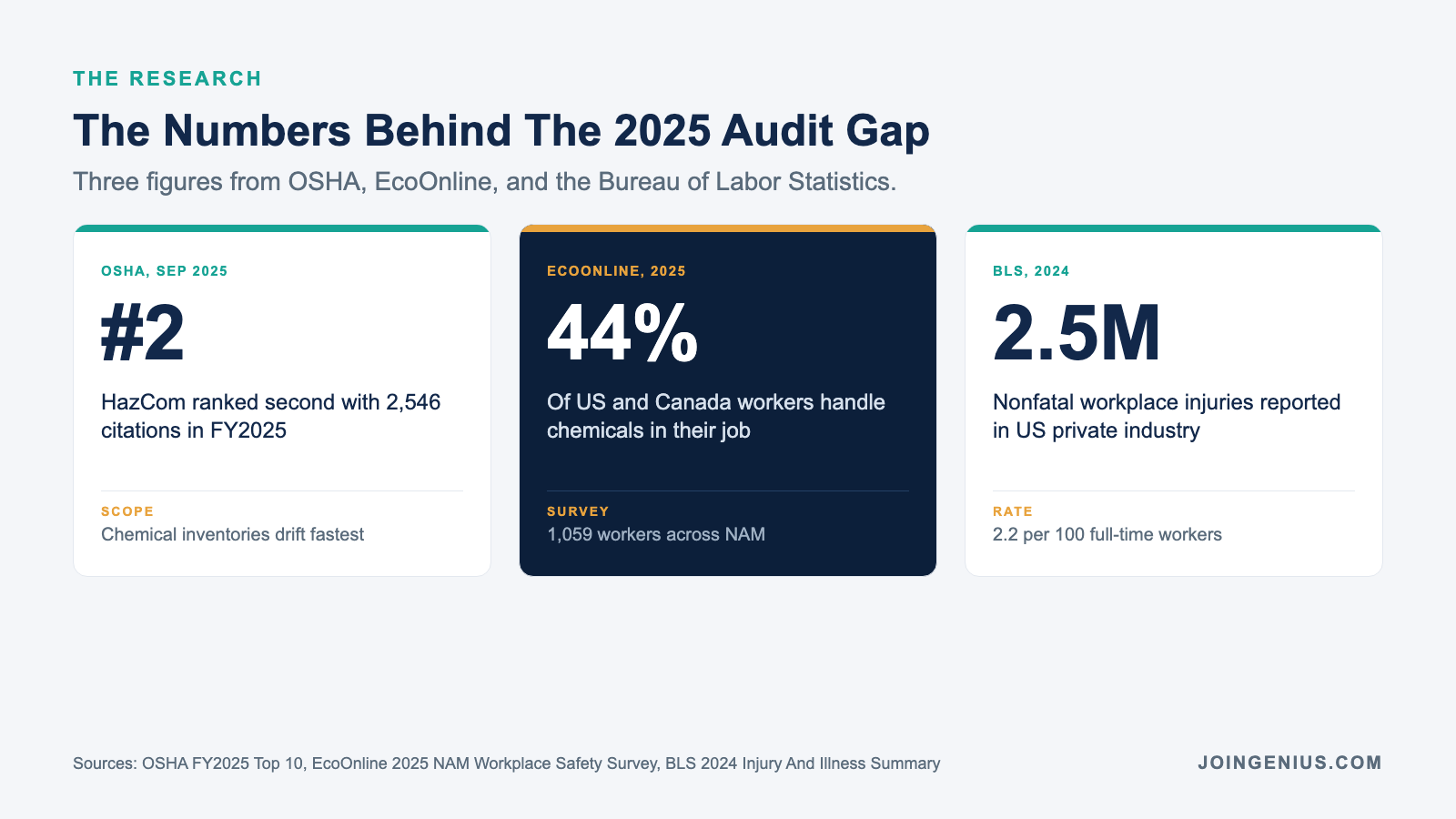
US Bureau of Labor Statistics data put 2024 nonfatal workplace injuries at 2.5 million, a rate of 2.2 per 100 full-time workers, per the BLS 2024 injury and illness summary. Lab incidents are a small share of that total and an outsized share of the headlines.
The Difference Between A Compliance Check And A Readiness Test
Compliance checks a document. Readiness checks a person. A written respirator policy will pass an inspection. A technician who cannot name which cartridge to swap at midnight will not pass a real incident. Audits that only read paper will keep missing the gap between the two.
The Audit Scope That Never Changes While The Lab Changes Monthly
Labs add instruments, swap reagents, and onboard new staff every month. The audit scope updates every three years. By the time the next cycle runs, half the real risks on the bench are invisible to the audit, because the audit is still looking at last decade’s workflow.
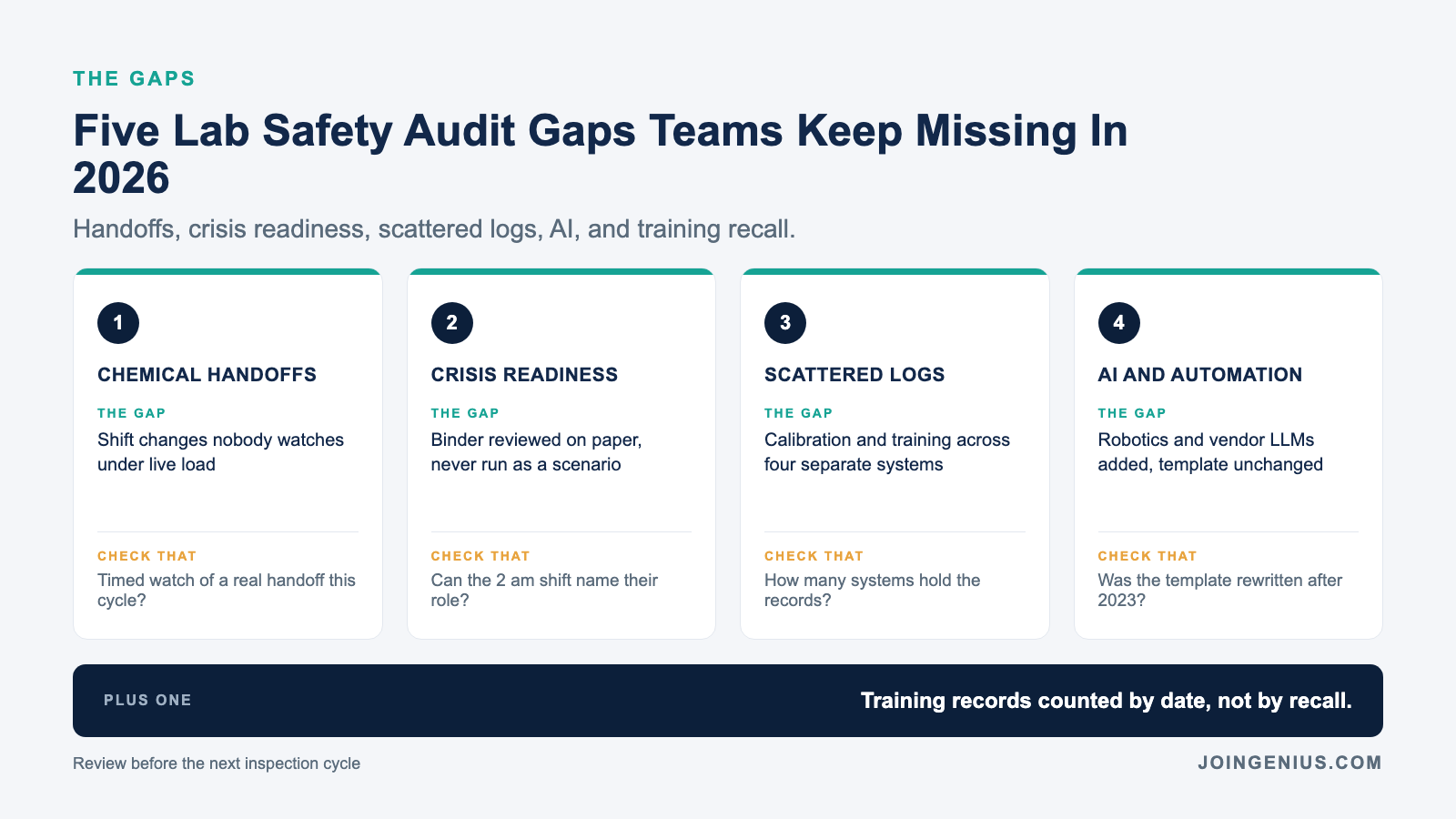
The Five Lab Safety Audit Gaps Most Teams Keep Missing In 2026
The five gaps below are what we keep finding when we rebuild a program after an incident the previous audit cleared. Each one is a specific pattern, not a general call for better culture. Fixing any three closes the majority of what a serious inspection would otherwise find next quarter.
The OSHA 2025 preliminary top 10 most cited standards put hazard communication at number two with 2,546 citations. Labs are overrepresented in that category because chemical inventories drift faster than any other document on the audit list.
Chemical Handoff Procedures Nobody Tests Under Load
The riskiest minutes in a lab are shift changes and sample handoffs. A procedure that reads clean on paper can fail the first time two technicians try it under pressure. If the audit never watches a real handoff at the actual time it happens, it is not measuring the risk.
Crisis Response Readiness As The Biggest Audit Blind Spot
Most audits review the emergency binder once a year and tick a box. Real readiness is whether the three people on shift at 2 am know their role, call tree, and decision authority. A scenario-based audit that scores people instead of paperwork reveals what the binder review always misses.
Instrument Logs That Nobody Reads Before The Next Inspection
Calibration logs, maintenance tickets, and training records live in four different systems on an average team. The audit opens each one once a year, looks for a date, and moves on. Our breakdown of tool fragmentation covers the same pattern in engineering, where fragmented logs mean the real pattern is never seen.
AI And Automation Added To Workflows But Not The Audit Scope
Labs now run robotic handling, automated pipettors, and vendor LLMs for triage. Each was added to speed the workflow and quietly added to the risk profile. Lab Manager’s recent note on AI safety boundaries names what an audit should score here, and templates written before 2023 have none of it.
- Watch a real shift change once per audit cycle, timed, with no advance notice to the bench.
- Count the systems that hold calibration and training records and cut that list by half this quarter.
- Add a line to the template for every automation or AI tool added to a workflow since the last audit.
- Score the crisis binder on whether the people on shift can run it, not whether the binder exists.
How To Measure Whether The Audit Is Actually Working
Most audit reports grade themselves on completion. The better question is whether the audit changed anything. If last year’s report named the same three gaps as this year’s, the audit is a ritual, not a risk control. Treat the audit itself as a system that needs its own measurement.
The EcoOnline 2025 North American workplace safety survey, drawn from 1,059 workers across the US and Canada, found 44% handle chemicals as part of daily work and nearly 40% of those say their employer is not actively substituting the hazardous ones. The gap between what the audit records and what the bench does keeps widening.
Four Numbers To Report Quarterly, Not Annually
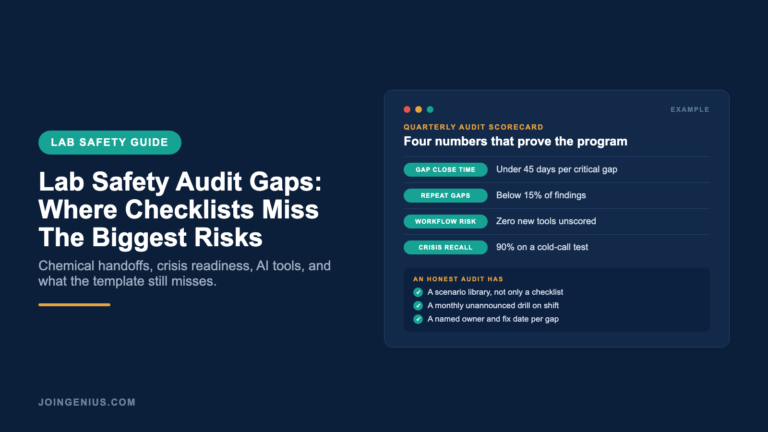
Average gap close time, percentage of gaps repeated from the prior cycle, number of new risks added by workflow changes, and percentage of staff who can name their crisis role in a cold-call test. These four describe whether the audit is a decision document or a filing exercise.
The Monthly Drill That Finds A Silent Gap
Pick one scenario a month, run it unannounced on a shift team, and score four things: time to the right person, correctness of the first action, completeness of the handoff, and accuracy of the log that gets written after. A monthly drill usually finds the gap the annual audit missed.
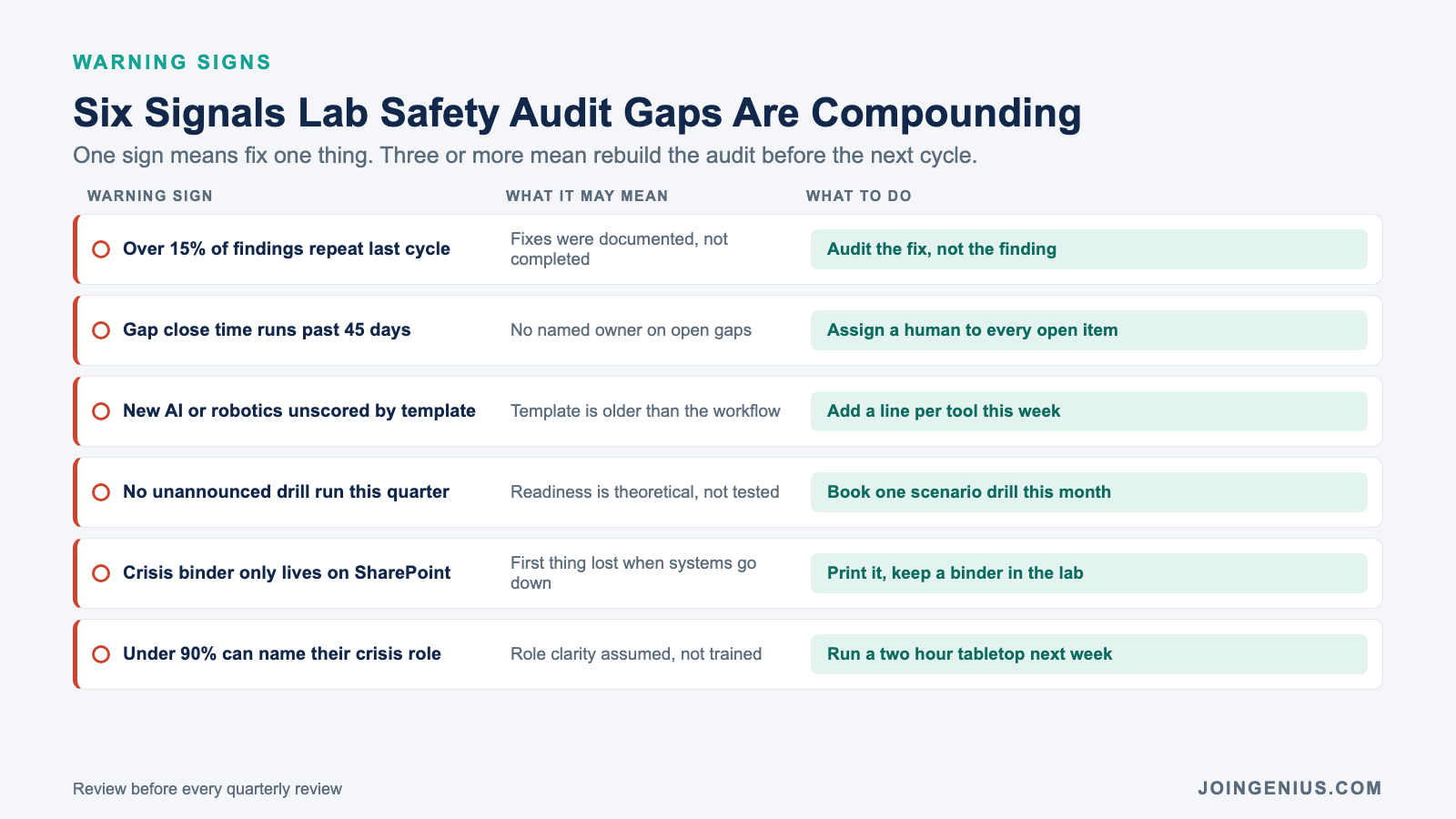
| Signal To Watch | What To Measure | Healthy Range For 2026 | What To Do If It Trips |
|---|---|---|---|
| Gap close time slips | Days from gap found to gap fixed | Under 45 days per critical gap | Reassign owner, do not re-queue |
| Repeat gaps appear | % of gaps carried over from last cycle | Below 15% in a healthy program | Audit the fix, not the finding |
| Workflow risk drifts | New tools added since last audit | Zero unscored, checked monthly | Add each one to the template this week |
| Crisis role recall drops | Staff who name their role unprompted | At least 90% on cold call | Run a two hour tabletop next week |
Any one of these slipping is a signal to fix. Three or more at once is a signal the audit program itself is overdue for a rebuild, not a schedule tweak. Report the four numbers quarterly to the same group that reads the financials, because safety gaps have the same compounding behavior.
The Operational Fixes That Close Each Audit Gap
Most audits identify gaps and never fix them because no one owns the work after the report ships. The fixes below are what we keep seeing on programs that stop repeating the same findings. Each one is a process change, not a budget ask, and our breakdown of why transformation roadmaps fail covers the same pattern.
Rewrite The Checklist Into Scenarios Before The Next Cycle
A scenario-based audit asks whether a team can perform under a specific hypothetical, not whether a document exists. Replace each line on the checklist that reads “written procedure exists” with one that reads “team completed scenario X in under Y minutes without an error.” That single edit closes the biggest gap.
Name The Owner And The Fix Window For Every Gap
Every finding has to list a named human, a fix date, and a verification step. A gap owned by a team is owned by nobody. A gap with a 90 day window and no owner is already open for another year. The audit is only as good as the accountability table attached to it.
Who Should Own The Audit And When To Bring In Help
Ownership of lab safety audits almost always goes to the wrong person on the org chart. It is handed to an operations manager who already runs the schedule and the budget. The audit becomes the eighth priority on a desk of seven, and the gaps stay open another year.
The Shape Of A Durable Lab Safety Team
One safety lead who owns the program, one process engineer who owns the scenario library, one records specialist who owns the log consolidation, and a quarterly sponsor from the lab director’s office. The fifth hire is a drill coordinator, not another inspector or compliance analyst.
When An External Auditor Adds Value And When It Does Not
An external auditor adds value when the in-house team cannot staff a true scenario drill or has not rewritten the template in three cycles. They add less value when the program is mature and only needs discipline. A partner that cannot show a reference restart from an incident is not the right partner.
Conclusion
Lab safety audit gaps are structural. They do not close because a program runs the same template year after year while the lab keeps changing. The fix is a scenario-based audit, four measurable numbers reported quarterly, and a drill cadence that keeps the program honest between cycles. Everything else is a binder.
Genius staffs the team shape above. We place top 1% lab safety leads, process engineers, and records specialists from the Philippines and LATAM at 80% less than a comparable US hire, no monthly fees, every hire backed by a 6 month guarantee. If your next audit needs a team that runs a real scenario, hire with Genius.