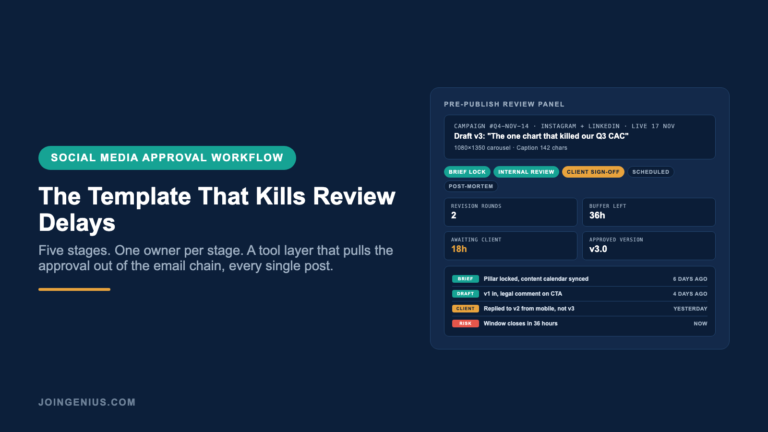
Social media approval delays are a template problem, not a talent problem. Teams miss launch windows because the review path lives in an email thread, not in a system. Drafts get lost in replies. Revisions get confused across versions. Client sign-off arrives after the window closes. The deadline gets bumped and the campaign loses its best slot of the week. The fix is not a bigger team or a faster designer. The fix is a workflow template with five stages and clear owners for each one. This piece walks through the template that kills review delays, and the tool layer that keeps the template running.
Why Email Still Runs The Approval Chain
Most social media approval still runs on email. A copywriter drafts a post and attaches a sentence of context. The creative lead replies with a note. The social manager forwards the revision to the client. The client replies to the wrong thread or to the previous version.
The post goes live late or with yesterday’s caption. Sometimes it does not go live at all. The deadline moves and the campaign moves and the retainer eventually moves too.
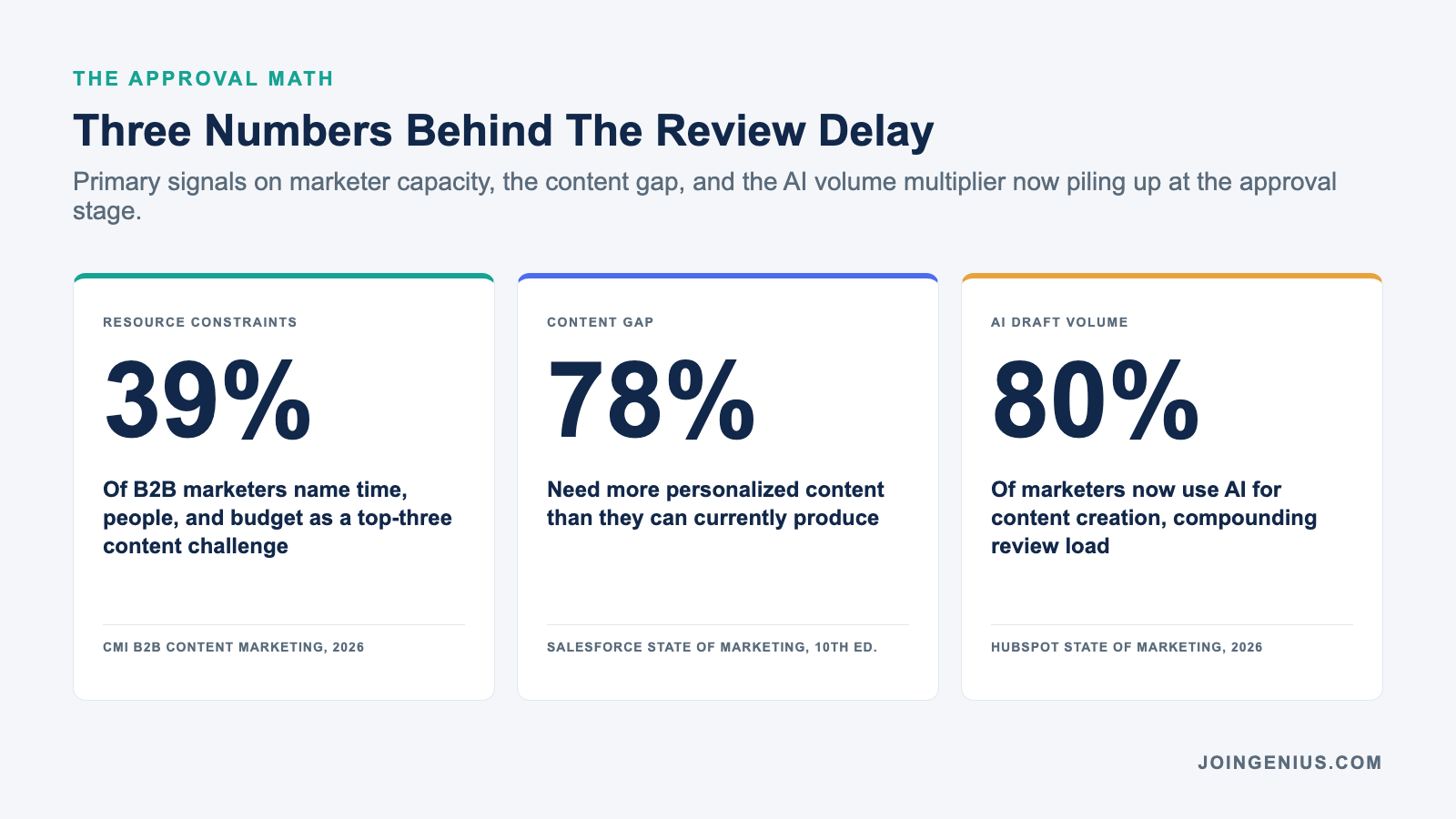
The production pressure behind this is not small. The Content Marketing Institute 2026 B2B Content Marketing research surveyed 1,015 B2B marketers, and 39% named resource constraints around time and people and budget among their top three content marketing challenges, which puts throughput ahead of strategy as the actual breakpoint.
The output demand is climbing in parallel. Salesforce’s Tenth State of Marketing report, based on 4,450 marketing professionals surveyed between October and November of 2025, found that 78% of marketers say they need more personalized content than they can currently produce. The gap gets wider on the social side, where every channel wants a native asset.
And the volume multiplier is already in the stack. The HubSpot 2026 State of Marketing report found 80% of marketers now use AI for content creation, which shifts the question away from draft speed and toward review speed. Draft speed went up. Review cycles did not.
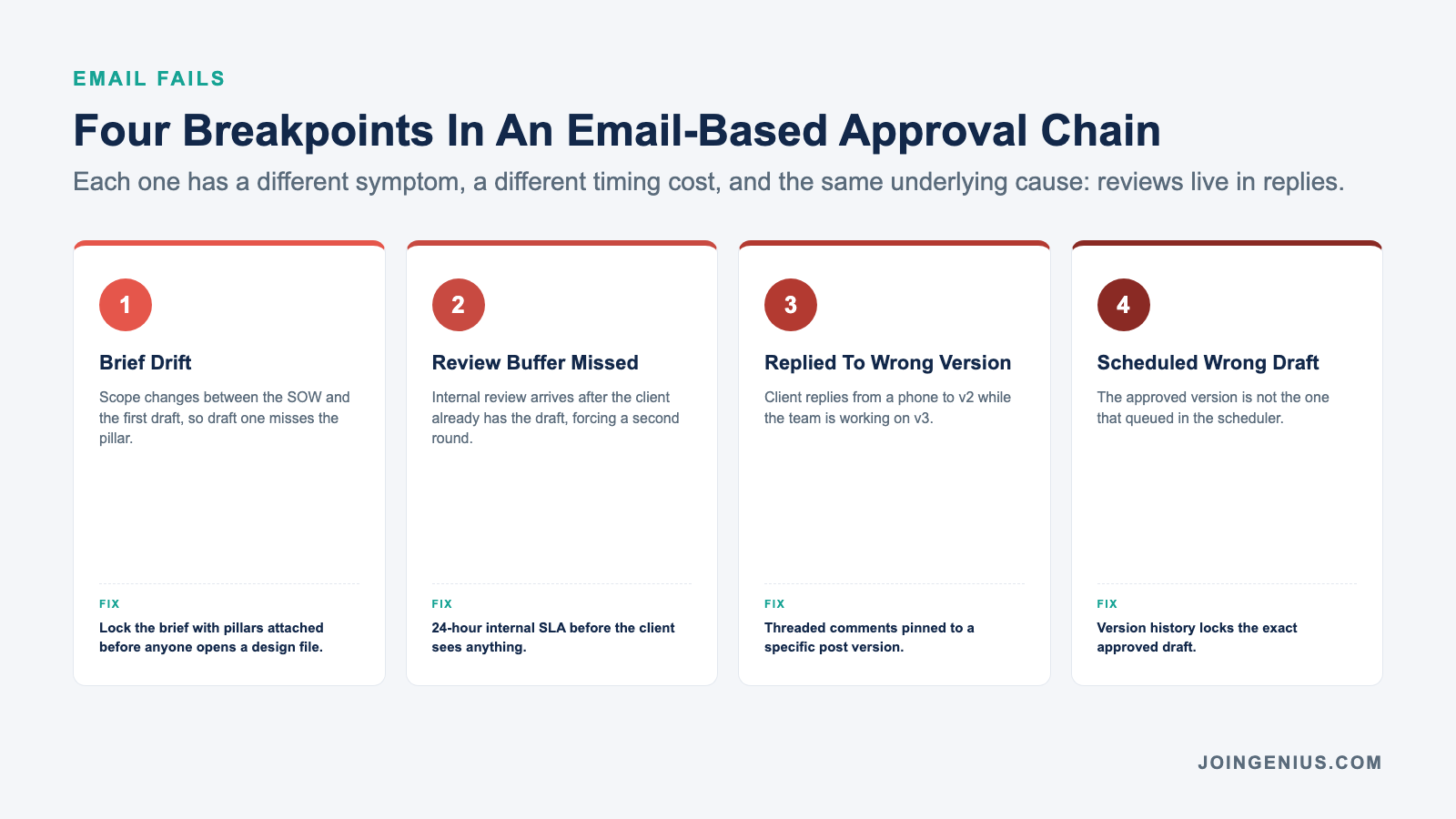
The bottleneck is the approval chain, and the thread the approval chain lives on is email. Here is what breaks at each stage when approval lives in replies:
| Approval Stage | What Breaks In Email | What A Workflow Fixes |
|---|---|---|
| Brief Lock | Scope drifts between the SOW and the first draft | Signed-off brief with pillars attached to the asset |
| Internal Review | Senior review arrives after the draft is already sent to the client | 24-hour SLA that catches issues before the client sees anything |
| Client Sign-Off | Revisions land in a reply thread, not on the asset itself | Threaded comments tied to a specific post version |
| Scheduled Publish | The approved version is the wrong version | Version history locks the exact approved draft |
| Post-Mortem | Nothing from the result feeds back into the next brief | Performance notes attached to the pillar and the next brief |
The Template That Kills Review Delays
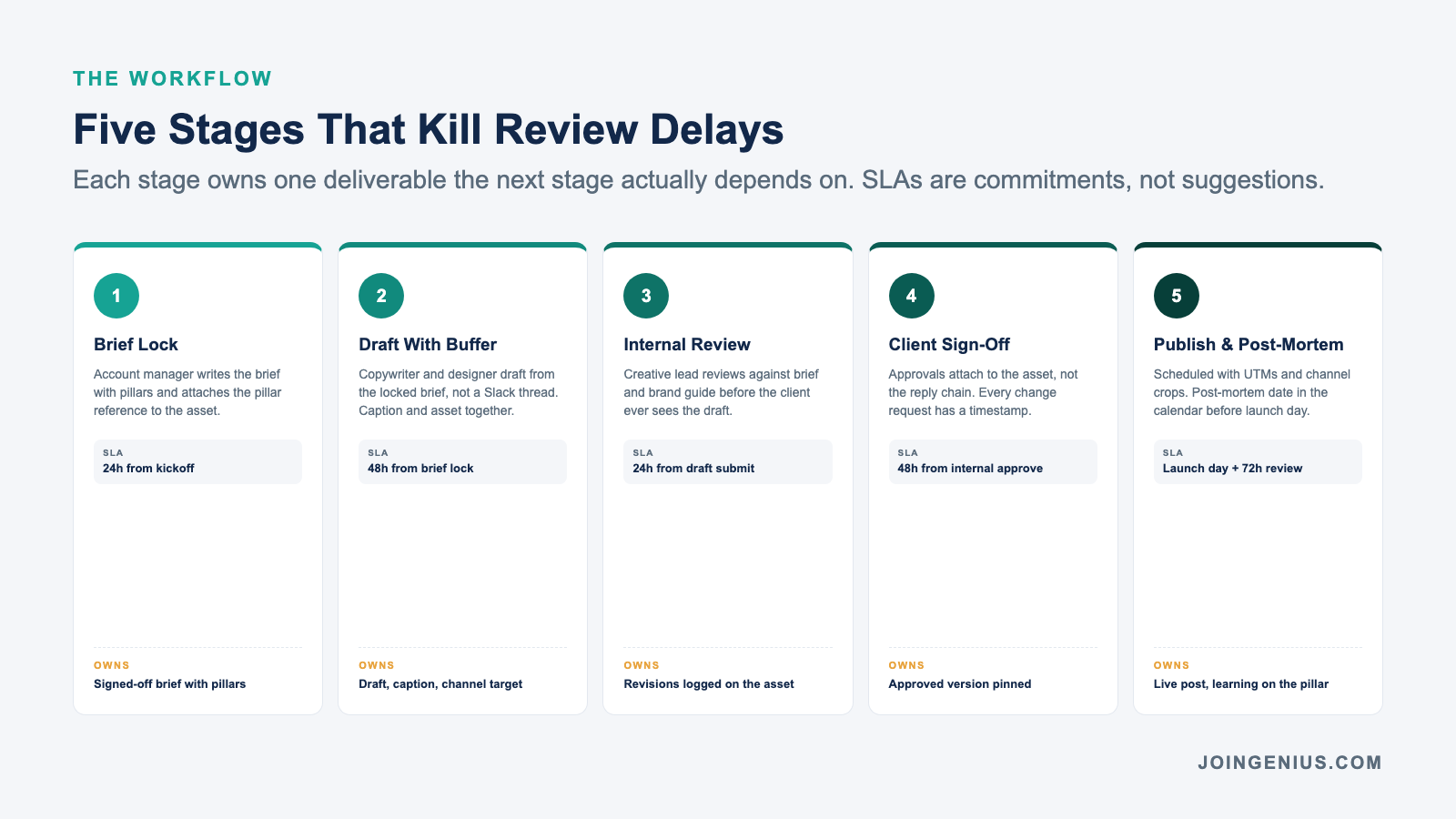
The template is simple. It has five named stages and one owner per stage. Each stage has a target SLA and a deliverable that moves to the next stage. The tool layer behind it holds version history and threaded comments so that revisions attach to the asset instead of a reply chain.
The template lives alongside the production calendar, not inside an email folder. Every social post inherits the same five stages. The social manager owns the handoff between stages and the creative lead owns internal review and the account manager owns client sign-off. When a stage misses its SLA, the dashboard flags it before the launch date arrives.
The reason this works for marketing managers running multi-client retainers is that every post looks the same from the inside. No matter how urgent the brief is, the stages do not change and the owners do not swap. The workflow holds under load.
The Five Stages Of A Social Media Approval Workflow That Holds
Each stage below has a name, an owner, a target SLA, and one deliverable that unblocks the next stage. When any one stage runs long, the one after it compresses, which is why the SLA numbers matter as much as the deliverables. Treat the target times as commitments, not as suggestions.
Stage 1. Brief Lock With Content Pillars
Stage one locks the brief before any drafting work starts. The account manager writes the brief with the client, or pulls it from the quarterly content pillars, then attaches the pillar reference to the asset. Owner is the account manager. Target SLA is 24 hours from the kickoff call. Deliverable is a signed-off brief with pillars attached.
The brief lock is the piece most teams skip, which is why draft one usually misses the pillar. Lock it before anyone opens a design file.
Stage 2. Draft With A Deadline Buffer
Stage two produces the first draft inside a deadline buffer. The copywriter and designer work from the locked brief, not from a Slack thread. Owner is the social manager running the production calendar. Target SLA is 48 hours from brief lock. Deliverable is a draft with caption and asset and target channel attached.
The deadline buffer matters. A post that hits the queue on the publish date has zero review time. Build 48 hours of buffer for internal review and another 48 hours for client sign-off, which pushes the actual draft deadline four days ahead of the live date.
Stage 3. Internal Review Before The Client Sees It
Stage three catches problems before the client reads the draft. The creative lead and the account manager review the asset against the brief and against brand guidelines. Owner is the creative lead. Target SLA is 24 hours from draft submission. Deliverable is a revision set logged on the asset, not emailed around.
The internal review is the reason senior social media managers send cleaner work to clients. Catching a copy slip or an off-brand color inside the agency is a conversation. Catching it inside a client reply thread is a credibility hit.
Stage 4. Client Sign-Off With Tracked Decisions
Stage four is where the client approves the final version. Approvals attach to the asset, not to the reply chain. Every change request has a timestamp and a decision owner on the client side. Owner is the client stakeholder. Target SLA is 48 hours from internal sign-off. Deliverable is an approval with tracked comments and an approved version pinned.
The piece that breaks in email is right here. Clients reply to the wrong version or they reply from a phone without seeing the asset or they CC a legal reviewer who was never in the loop. Tracked decisions on a single version close that gap.
This is the stage where operations managers actually earn their seat on the account. The right stage owner on the client side is named at kickoff, not discovered during the first approval cycle. If the client has not named their sign-off owner by Stage 4, the whole workflow falls back into email.
Stage 5. Scheduled Publish Plus A Post-Mortem
Stage five is the publish and the review loop. Approved posts queue in the scheduler with UTM tags and channel-specific crops attached. Owner is the social manager. Target SLA is same-day on the agreed launch date. Deliverable is a queued post with tracking parameters and a post-mortem date on the calendar.
The post-mortem matters more than most teams give it credit for. Three days after launch, the content writers running the account pull the performance snapshot and attach a one-line learning to the pillar. That learning is the piece that feeds the next brief, which is how the five stages become a loop instead of a line.
The Tool Layer That Replaces The Email Chain
The five stages work on a whiteboard. They do not work in a reply thread. At some point the workflow needs a tool layer that holds version history and threaded comments and channel-specific previews on the same asset.
The tool does three things email cannot. It pins the approved version so no one publishes the wrong draft. It attaches comments to the asset so revisions stay on the post instead of in a thread. It gives the client a mobile sign-off path so approvals do not wait on a laptop.
A dedicated review space with threaded comments and version history and one-click client sign-off, like Kontentino’s approval tool, removes the email chain that most agencies still treat as an approval system.
The honest caveat is that no tool fixes a workflow nobody owns. The template still needs the stages and the owners and the SLAs. The tool holds the template. It does not replace it.
The Approval Workflow Is The Deliverable
The approval workflow is the deliverable, not just the thing that moves the deliverable through. Clients who stay the longest are the ones whose agency has fewer revision rounds and faster sign-off, both of which fall out of a workflow that lives in a system instead of in email.
The five stages hold because each one has an owner and an SLA. The template kills review delays because every stage has a next step before it starts. The tool layer removes the reply chain where most of the delay was hiding.
The teams that build this run leaner and ship on the day they planned, which is where Genius comes in for teams that need to hire the owners this template needs.