Why AI literacy gaps cost enterprises more than skills is a question most executives answer with another training budget line. The answer the budget misses: a skills gap can be closed with a new hire or a short course, but a literacy gap turns into bad decisions made by many people at once, and the cost compounds every quarter.
Below we cover the distinction most enterprises miss, the 2025 and 2026 numbers that quantify the cost, where the gap shows up before the quarterly review, the ownership that actually closes it, and the measurement that keeps it closed. Start with the enterprise transformation roadmaps that fail pattern.
The Difference Between An AI Skills Gap And An AI Literacy Gap
Most enterprise AI programs still write their budget against a skills gap. A certification here, a bootcamp there, a hiring plan for prompt engineers. The deeper problem is literacy, and it costs more because it does not show up in a resume column; it shows up in how employees interpret model output.
Skills Are What People Can Do, Literacy Is What They Should Trust
A skills gap is measurable: can the analyst query the database, can the engineer deploy the model, can the marketer brief the copilot. A literacy gap is softer and more dangerous: knowing when the model is probably wrong, when to ask for a second check, and when a confident-looking answer is covering a stale source.
Why This Distinction Matters For Enterprise Spend
The cost of an unfilled skills gap is a position staying open or a project running late. The cost of an unaddressed literacy gap is quieter and larger.
A sales team using a model to score leads with the wrong confidence interval loses deals at the margin. A legal team pasting regulated text into a chat without knowing what gets logged exposes the enterprise to a different quarter’s problem.
The distinction matters because the teams that treat the two as the same problem keep solving the easier one. Hiring a prompt engineer is faster than teaching a product manager to question a model, so the first thing gets done and the second thing gets added to next year’s plan, forever.
The 2026 Cost Of An AI Literacy Gap
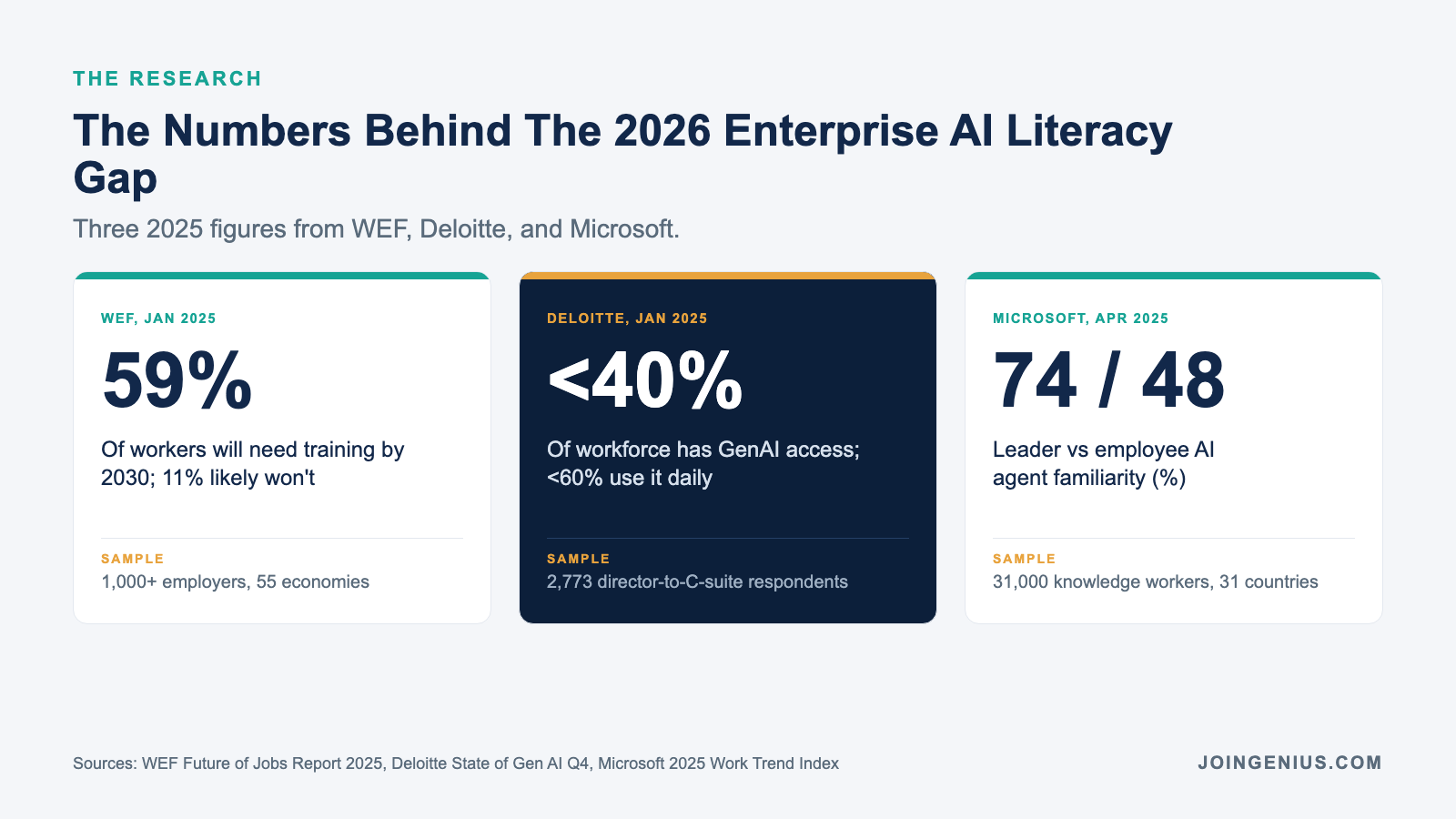
Three 2025 reports converged on the same finding. The gap is wide, it is unevenly distributed, and it will widen before it closes. Each stat below points at a different piece of the same bill: the training backlog, the access gap, and the familiarity split between leaders and the workers using what the leaders bought.
WEF: Most Of The Workforce Needs AI Training By 2030
The WEF Future of Jobs Report 2025, drawn from more than 1,000 employers across 55 economies covering 14 million workers, found that out of every 100 workers, 59 will need training by 2030, and 11 will likely not receive the training they need.
The implicit training backlog is the enterprise cost most CFOs still do not have on a budget line.
Deloitte: 40% Access, 60% Not Using It Daily
Deloitte’s State of Generative AI in the Enterprise Q4, a January 2025 report from 2,773 director-to-C-suite respondents across six industries, found access to generative AI is still limited to less than 40% of the workforce, and fewer than 60% of workers with access use it daily.
The gap between license spend and actual usage is the literacy problem in dollar form.
Microsoft: Leaders Already Know More Than Their Teams
Microsoft’s 2025 Work Trend Index, based on an Edelman survey of 31,000 knowledge workers across 31 countries, found 74% of APAC leaders report being highly familiar with AI agents versus only 48% of employees. The gap between the boardroom and the desk is where enterprise AI programs quietly die.
Where Literacy Gaps Show Up Before The Dashboard
The literacy gap is visible in the work three quarters before it shows on a KPI dashboard. The problem is that nobody owns the pattern, so the signs below get filed as individual complaints. Together they are the same gap.
Dashboards Nobody Trusts
The sales dashboard that produces a sensible number but gets ignored. The ops dashboard everyone opens once a month, confirms what they already knew, and closes. Dashboards are not failing because the data is wrong. They are failing because the users are not confident reading what the model did to produce the number.
Models Nobody Can Explain
A credit model that one analyst wrote six months ago and nobody else can defend in a meeting. A lead scoring model whose author left the company. These are not model problems. They are documentation and literacy problems, and they are concentrated in the roles that supposedly do not need AI training.
Rollouts That Fizzle
Three weeks of all-hands enthusiasm, a pilot signed off by three departments, and six months later the tool is gone from the quarterly plan. Rollouts fail at the second meeting after the demo, when nobody in the room can explain what the model is supposed to be doing differently.
Tool sprawl compounds it. See our breakdown of AI tool sprawl before renewal for the same pattern across the license portfolio.
The table below is the quick triage. Each symptom traces back to a specific literacy gap and a specific fix. Any single row is a conversation. Three or more is a redesign of the program.
| Symptom | What It Signals | Where To Start |
|---|---|---|
| Dashboards no one opens | Users cannot defend the inputs | 60-minute readback session per quarter |
| Models nobody can explain | Documentation and context gap | One-page model card, owner named, next review date |
| Pilots that fizzle at month 4 | Rollout had no literacy plan | Role-based training before the tool, not after |
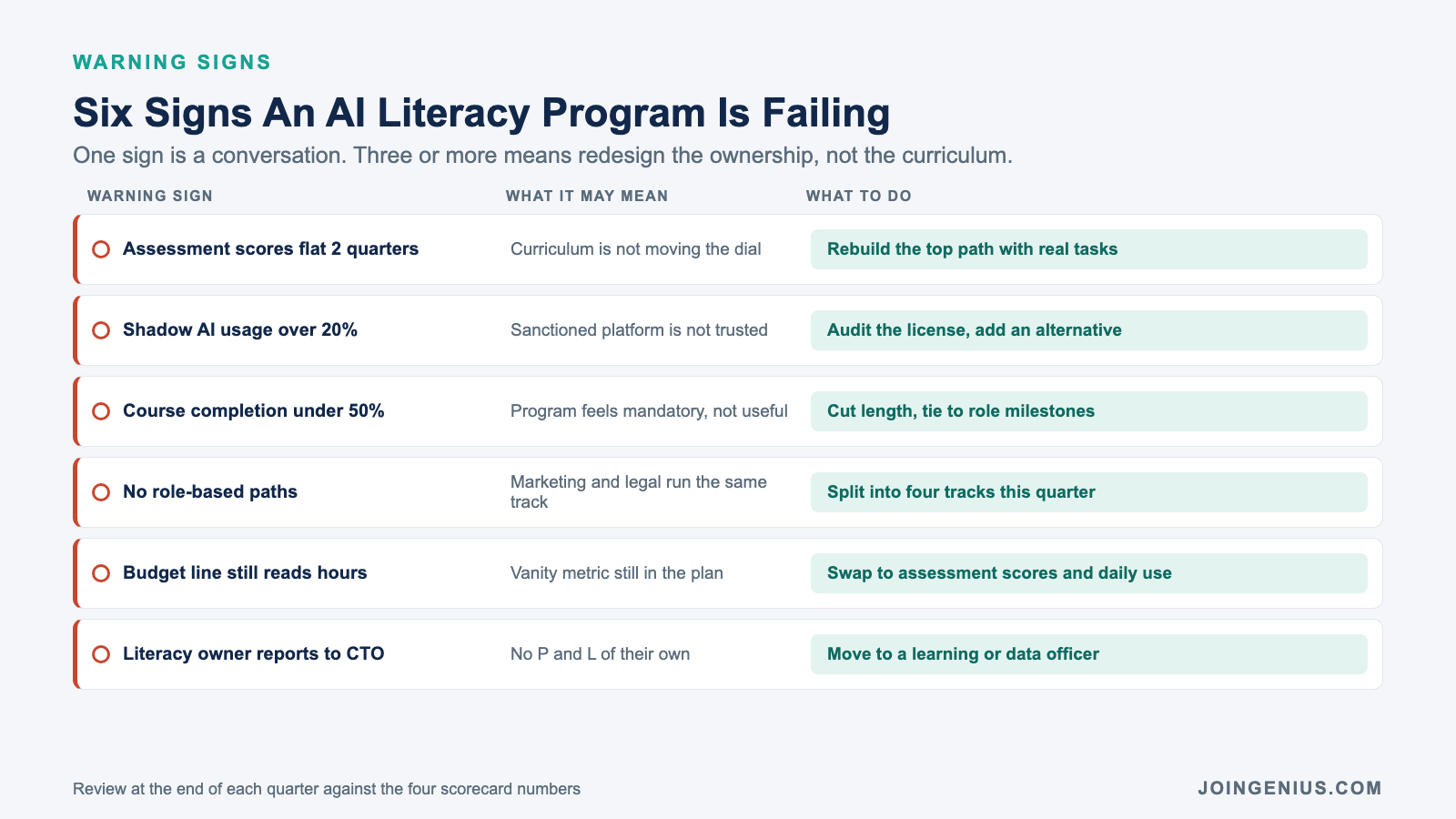
| Shadow AI tool usage | Employees do not trust the sanctioned tool | A clear what-and-why on the enterprise license |
| Repeated prompt failures | Users treat the model as a search engine | A one-hour team session on how the model is wrong |
Closing The Gap: What Enterprises Actually Have To Build
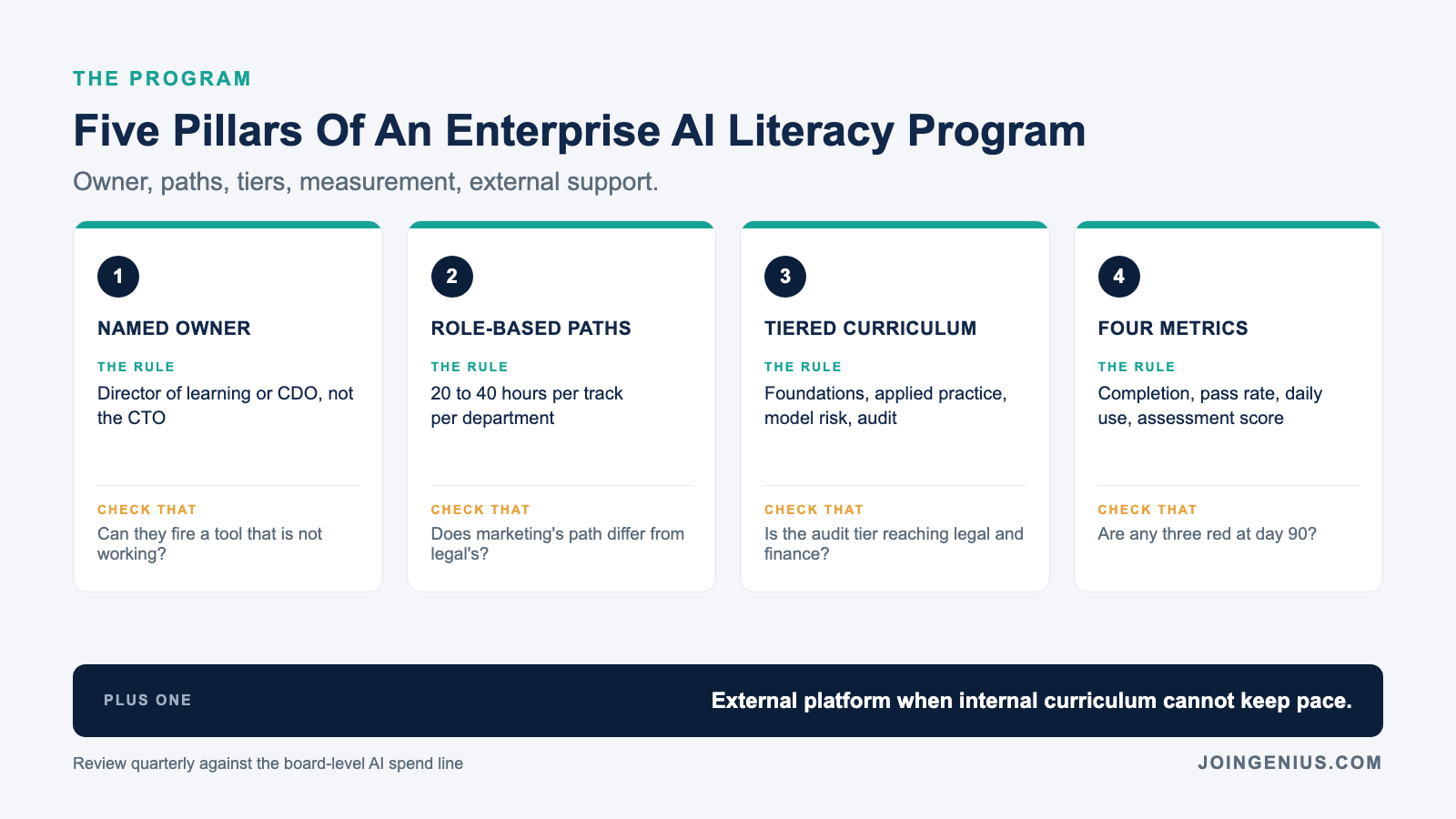
AI literacy is not a training program. It is a shape of ownership, a learning path, and a measurement system. Most enterprises buy the first part, skip the second, and never get to the third. The sequence below is what works.
An Internal Owner Who Is Not The CTO
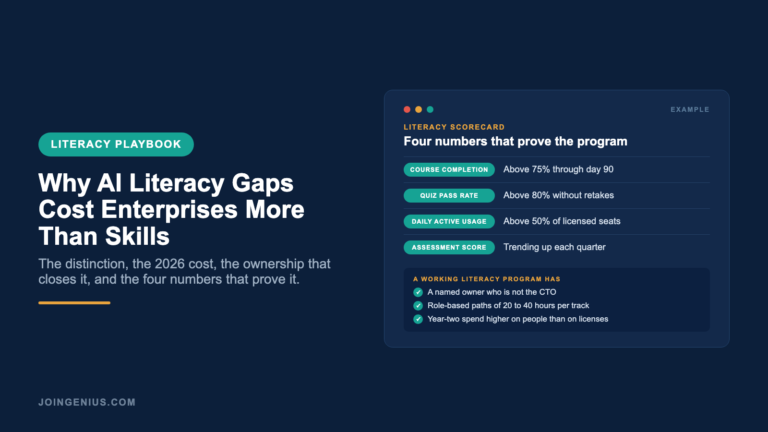
The best enterprise AI literacy programs give the role to a named leader at the level of a director of learning or a chief data officer, not the CTO. The CTO is building the systems. The literacy owner is building the people who use them. The two roles need different incentives and different reporting lines.
Role-Based Learning Paths, Not Blanket Workshops
Everyone-does-the-same-thing training is where enterprise AI literacy programs quietly waste their budget. Marketing needs prompt literacy. Finance needs model risk literacy. Legal needs audit literacy. Engineering needs deployment literacy. A role-based path with 20 to 40 hours per track beats a one-day workshop every time.
Hiring for the shape is covered in hiring for AI-first agencies where the same role-first thinking applies to the recruiter brief.
When An External Literacy Platform Fits
Some enterprises do not have the internal curriculum team at the scale needed to build and maintain a tiered literacy program across every department. An external partner fits when the work is faster to buy than to build.
QuantHub’s data literacy training is one of the longer-running options for corporate teams that want measurable skills gains tied to role-based assessments rather than one-off workshops.
Measuring AI Literacy, Not Just Training Hours
Training hours are the vanity metric. A workforce can log 10,000 hours of AI training and still be functionally illiterate at month twelve. The four numbers below are what actually move. Report them to the same board that reads the AI spend.
Leading Indicators Through The First 90 Days
Course completion rate above 75%, quiz pass rate above 80% without retakes, daily active usage above 50% of licensed seats, and a quarterly skills assessment score moving up. If any three are red at day 90, the program is already failing and no amount of extended enrollment will fix it.
Lagging Indicators Through The First 12 Months
Reduction in shadow AI tool usage, reduction in model incidents logged by legal or compliance, improvement in model-related decision quality on sampled audits, and reduction in help desk ticket volume on AI tools. These are the long signals that the program worked, not that training was attended.
Metrics Worth Tracking Past Year One
Past year one, the right numbers to watch are percentage of AI-touched decisions reviewed in audit, retention of trained employees in AI-adjacent roles, and share of AI budget shifted from tools to training. A mature program at year two spends more on people than on licenses.
Warning Signs The Program Is Broken
If the metrics above have been flat for two quarters, the warning signs below are showing up at the same time. One is a conversation with the owner. Three or more means redesigning the program, usually starting with the ownership decision rather than the curriculum.
Conclusion
AI literacy gaps cost enterprises more than skills because the failure mode is distributed. A thousand small decisions made with low-trust model output does more damage than one open requisition. A named owner, role-based paths, and four measured numbers turn literacy from a slogan into an operating metric.
For more on building a modern enterprise capability, see our full engineering and leadership guides.