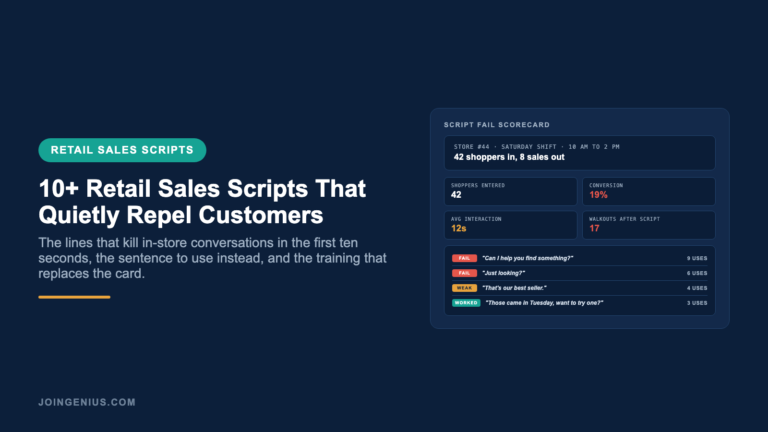
Most retail sales floors are quietly bleeding conversations with the exact scripts associates were trained to use. The greeting that was supposed to feel friendly. The mid-visit pitch that was supposed to sound expert. The closing line that was supposed to cover the exit. Each script was written with good intentions and tested in front of a trainer who was not actually shopping. In front of a real customer, those scripts land as robotic and pushy and scripted. This piece walks through ten retail sales scripts that quietly repel customers and the sentence to use instead and the training layer that replaces reading from a card.
Why Retail Scripts Repel Customers In 2026
The problem is not that the associate is unfriendly. The script lives in a store, and the customer came in carrying a real intent.
The customer wants to know whether this product fits their specific problem. The script answers a generic version of a question the customer did not ask. The conversation ends before it starts.
The scripted interaction also costs more than it used to. The in-store conversation is competing with the phone in the customer’s hand and with the ecommerce tab still open at home.
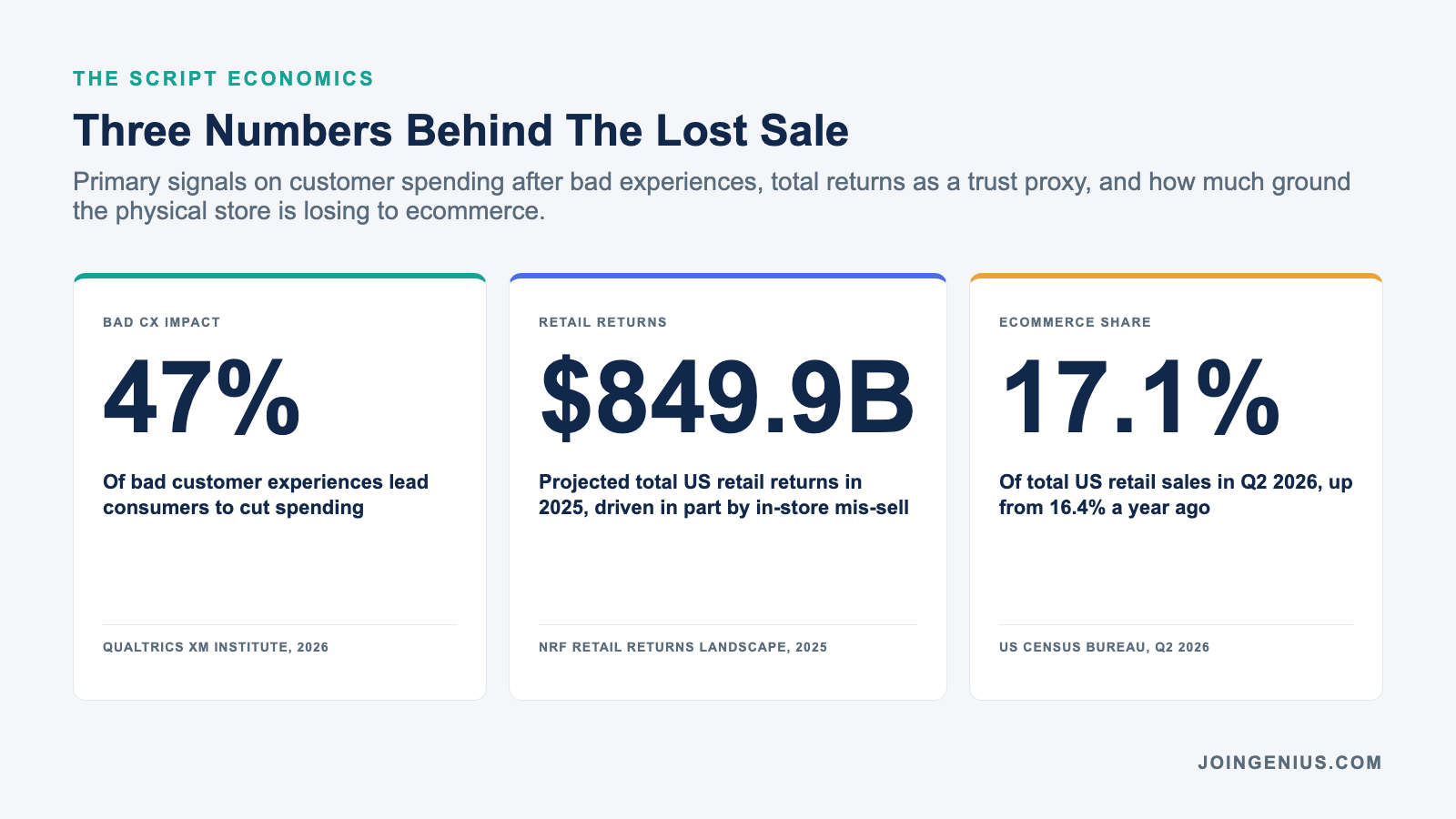
The customer cost shows up in spending data. The Qualtrics XM Institute 2026 research, based on over 20,000 global consumers with fieldwork in Q3 2025, found that 47% of bad experiences lead consumers to cut spending. A clumsy greeting is a bad experience with a measurable price tag.
The downstream cost shows up in returns. The NRF 2025 Retail Returns Landscape, co-produced with Happy Returns and published in October of 2025, projected total US retail returns of $849.9 billion for 2025.
Not all of that is sales-floor friction, but a meaningful share is customers who bought the wrong product because the associate pushed a script instead of asking a question.
And the competitive floor is narrower every quarter. The US Census Bureau reported ecommerce at 17.1% of total US retail sales in Q2 2026. The physical store is losing share, which means every in-store conversation has to be worth the visit.
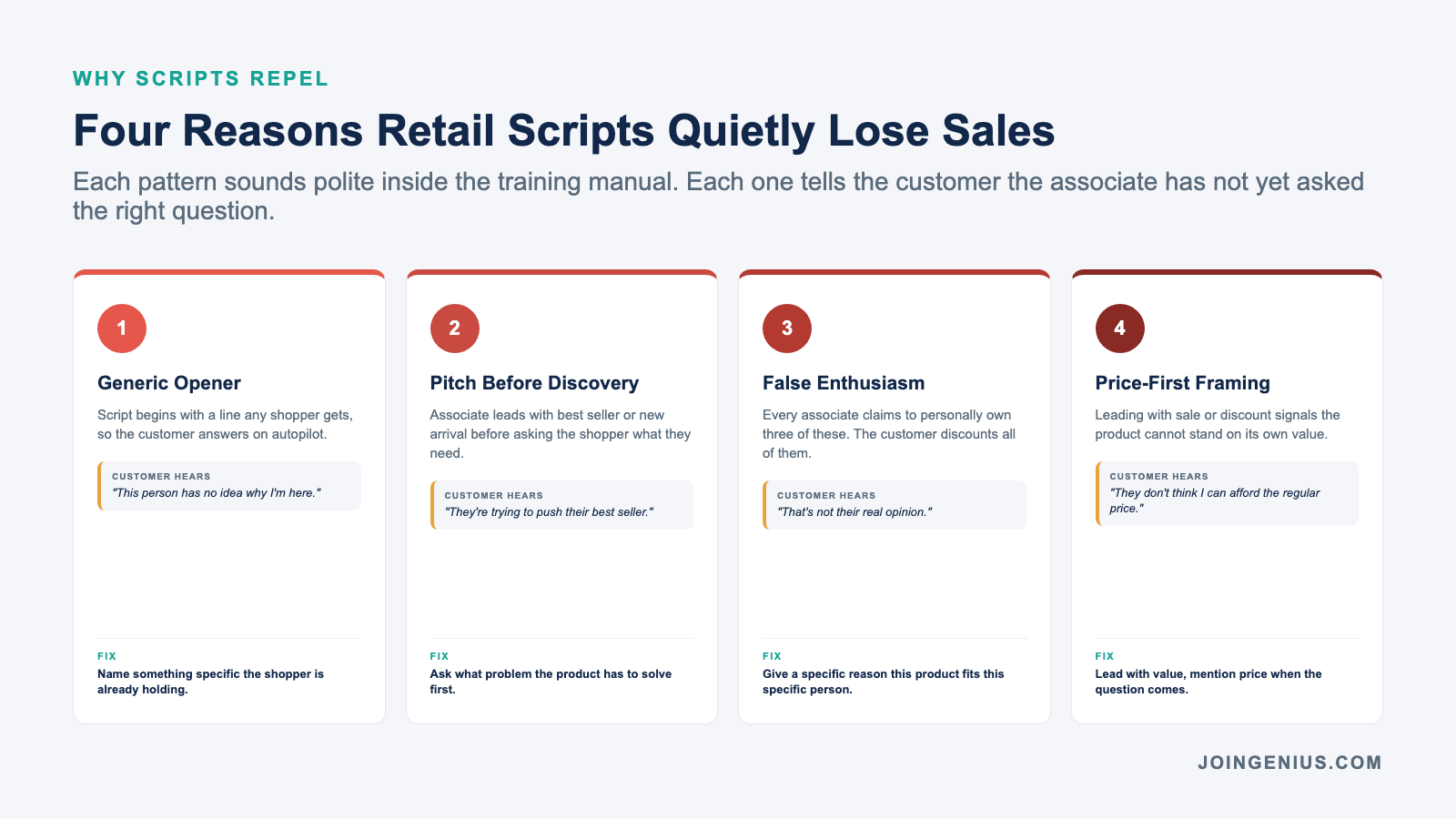
The scripts that repel customers repeat across stores. The sales representatives running the floor know exactly which lines fall flat because they hear them every shift. The table below names the four reasons the same lines keep killing conversations.
| Script Pattern | What The Customer Hears | What To Say Instead |
|---|---|---|
| Generic opener | “This person has no idea why I’m here.” | A specific observation about what they’re already looking at. |
| Pitch before discovery | “They’re trying to push their best seller.” | A question about the problem the product has to solve. |
| False enthusiasm | “That’s not their real opinion.” | A reason this specific product fits this specific person. |
| Price-first framing | “They don’t think I can afford the regular price.” | Lead with value, mention price when the question comes. |
Opening Scripts That Lose The Customer In Ten Seconds
The opening lines kill the most sales because they end the conversation before discovery starts. Each one has a reflex answer the customer gives without thinking.
1. “Can I Help You Find Something?”
The classic lose-the-greeting script. The customer answers “just looking” because the question gave them an escape hatch. The conversation never starts.
Replace it with a specific observation about what they are already holding. “Those are the new release, they came in Tuesday.” That earns a real response.
2. “Just Looking?”
Even worse than asking, confirming. This script gives the customer permission to refuse engagement before they have even decided whether to engage. Associates use it as a polite check-in and do not notice it trains the customer to say no.
Try naming where the customer is instead. “You’re in our new arrivals section.” That places the customer in the store without asking a yes-or-no question.
3. “Welcome To The Store, Let Me Know If You Need Anything”
This one sounds polite and is fatal. The customer hears “I am not going to approach you again.” The opener and the goodbye happen in the same breath. The customer service representatives reading this script feel they did their job. The job was to start a conversation.
Trade the two-sentence greeting for one sentence that invites a follow-up. “Hey, let me know when you’re ready to try the new collection.” That assumes engagement instead of handing the customer the exit.
Mid-Visit Scripts That Break Trust
Mid-visit scripts kill conversations the opener already started. These are the lines that make customers quietly decide they are done being sold to while still in the store.
4. “That’s Our Best Seller”
The best-seller script tells the customer the associate has not asked them a single question about what they need. Best-seller is a signal to the retailer, not the shopper. The marketing managers who own merchandising rank best sellers for restocking logic. Customers rank them against their own problem.
Trade it for a reason this specific item fits this specific person. “The reason this one fits what you described is that the strap is adjustable to 36 inches.” That is a sentence a customer can actually respond to.
5. “I’d Personally Pick This One”
The fake personal opinion is the script customers see through fastest. Every associate on the floor claims to personally own three of these. The customer counts the claims and discounts them all.
Replace it with a specific scenario. “This one gets most of our returns if someone wants it for hiking, because the insole flattens under a pack.” Honest and specific.
6. “It’s On Sale Today”
Leading with price frames the product as something the customer could not otherwise afford. The customer reads the sale pitch as a signal the product does not stand on its own. Price is a trust-killer when it comes before value.
Save the sale mention for when the customer asks about price. “This one is what I would use for a daily commute.” When the price question comes, the discount is a bonus and not the opener.
7. “We Don’t Have That In Your Size, But…”
The “but” is the problem. Everything before it was a dismissal. Everything after is a substitution the customer did not ask for.
Try “We don’t have that size on the floor. Let me check the back and the other store.” Full stop. If the item is coming in, give a date. If not, suggest an alternative once the customer is still in the conversation.
Closing Scripts That Kill The Sale
Closing scripts lose sales already won. These lines kill the deal between the customer saying “yes” and the credit card actually coming out.
8. “Let Me Know If You Have Any Questions”
Said right after discovery, this closes the sale before it opens. The customer hears “I am leaving you alone now.” The associate leaves the aisle. The customer walks out.
Replace it with a specific next step. “I’ll grab the matching one in black and meet you at the fitting rooms.” That keeps the associate present through the decision point.
9. “I’ll Have To Check With My Manager”
When the customer asks about a return or a price match or a custom option, the manager-check script signals powerlessness. It also signals the sale is going on pause, and every pause is a chance for the customer to decide the trip is not worth finishing.
Try “I can confirm that in 30 seconds.” Then do it. If the answer genuinely needs a manager, name them. “Priya is on the floor, I’ll flag her now.” Specific is active, not powerless.
10. “Would You Like To Join Our Rewards Program?”
Asked at the register, this is the script that turns a successful sale into an awkward delay. The customer has their card out. The rewards pitch adds 45 seconds of friction to a win.
Save the rewards pitch for the pre-register moment. “If you buy this one every six weeks, the rewards card pays for it the fourth time.” That is a reason, not a script.
The Training Layer That Replaces Script Reading
The ten scripts above have one thing in common. They come from training programs that handed associates a card to read instead of a conversation to run. A card gets the words right and loses the sale. A conversation adjusts to the person in front of the associate.
A dedicated retail sales training program that teaches associates how to open and how to discover and how to close, like SalesRX Online Training from The Retail Doctor, replaces script reading with conversation skills associates can use on the floor.
The honest caveat is that no training program fixes a store that does not reinforce it. Managers who hire for warmth and then schedule like warehouse pickers will undo it in a week. The training layer gives the words. The floor manager keeps them in use.
The three features that matter most are role-play that mirrors real shoppers and quick daily refreshers instead of a one-day seminar and manager scorecards that measure conversation quality.
Scripts Are A Symptom, The Conversation Is The Fix
The scripts above are not the actual problem. The problem is the belief that retail sales is a performance to recite, when the shopper is a person with a specific question the associate has not yet asked.
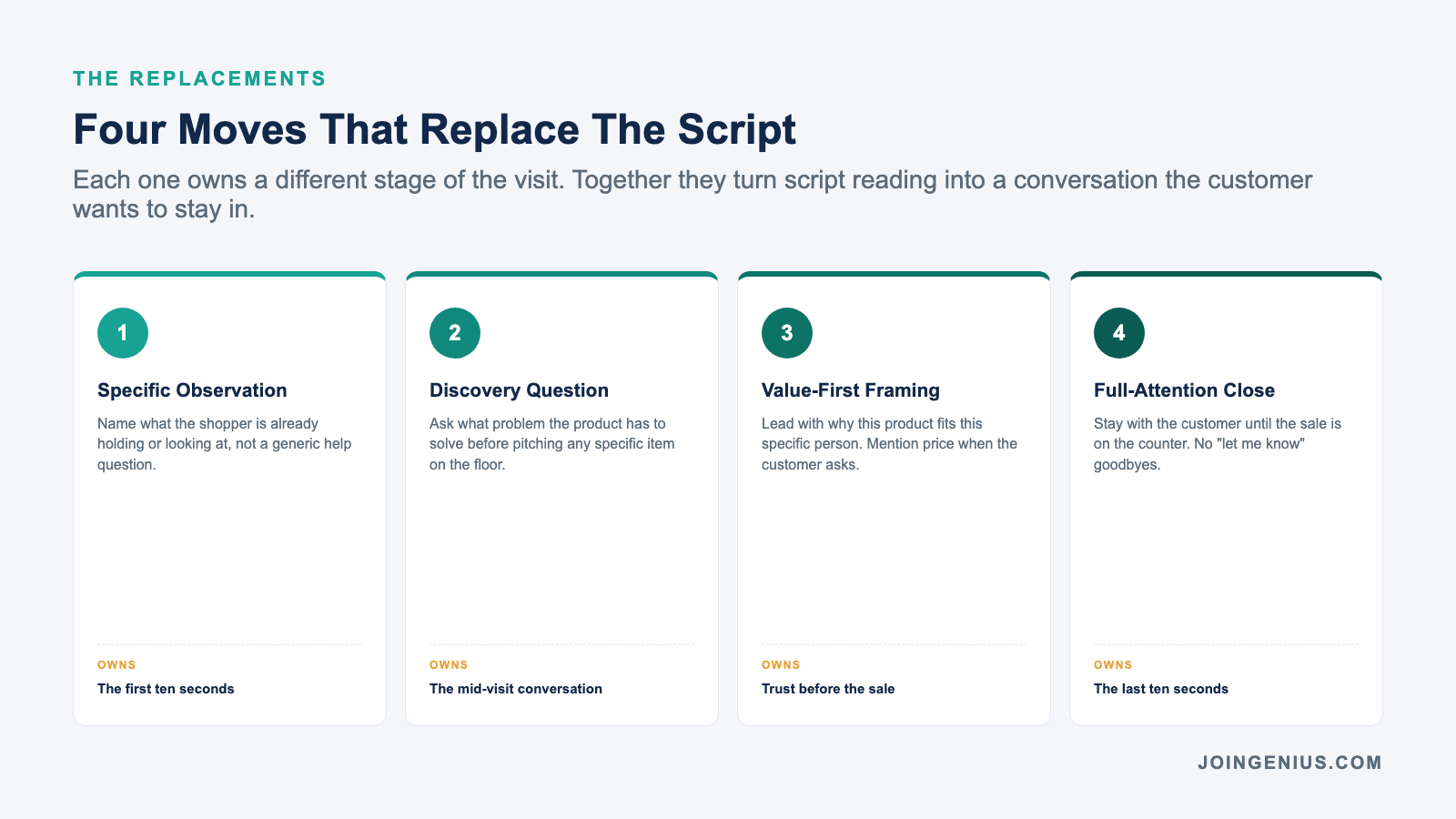
The ten scripts repel customers because they answer a generic version of a question the customer did not ask. The replacements all share one trait. They name something specific about the customer or the product in front of them.
The training layer handles the scaling problem so independent retailers get the conversation skills without rebuilding training from scratch. Genius helps staff the floors where those conversations actually happen.