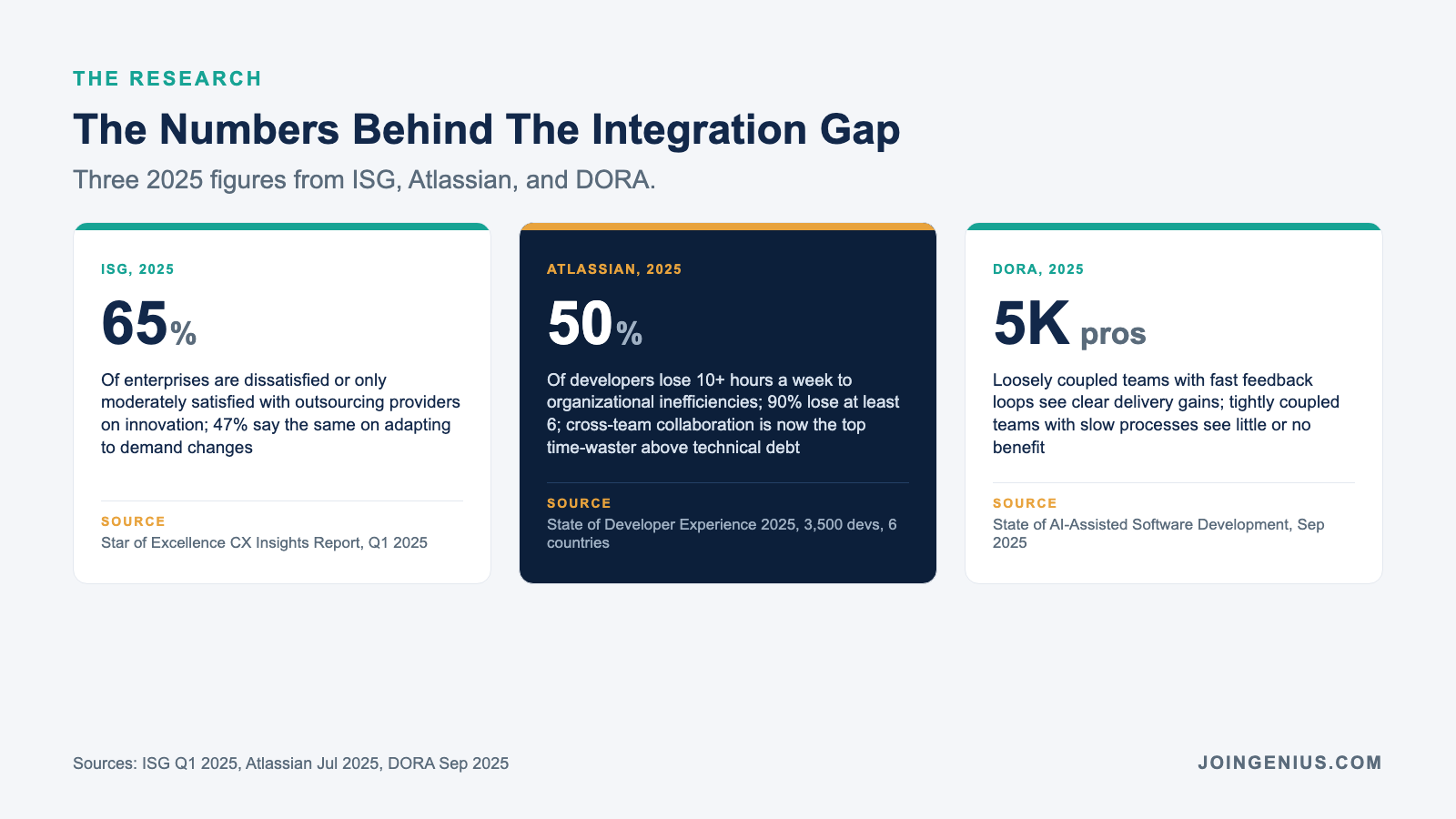
ISG’s Q1 2025 Star of Excellence research found 65% of enterprises are dissatisfied or only moderately satisfied with outsourcing providers on innovation. The gap shows up inside six weeks of signing the contract.
Atlassian’s July 2025 State of Developer Experience survey of 3,500 developers found 50% lose 10+ hours a week to organizational inefficiencies, with cross-team collaboration now the top time-waster. DORA’s 2025 report on nearly 5,000 tech professionals confirmed loosely coupled teams with fast feedback loops see delivery gains, while tightly coupled ones see almost none.
Outsourced teams fail at the integration layer, not the hiring one. These are the 5 integration mistakes that break them, and the fix.

Research Shows Why Outsourced Teams Underdeliver
Three 2025 reports from different research houses point at the same thing. Outsourced dev teams do not fail because the people are wrong. They fail because the integration layer is left to chance.
ISG: 65% Of Enterprises Dissatisfied On Innovation
ISG’s Q1 2025 Star of Excellence CX Insights Report found roughly 65% of enterprises are dissatisfied or only moderately satisfied with outsourcing providers on innovation. About 47% say the same for the provider’s ability to adapt to demand changes.
That is a two-thirds miss on the thing enterprises hired the provider to deliver, and the 2025 trend line is flat against 2024.
Atlassian: 50% Of Developers Lose 10+ Hours A Week
Atlassian’s July 2025 State of Developer Experience survey of 3,500 developers found 50% lose 10+ hours a week to organizational inefficiencies, and 90% lose at least six. Cross-team collaboration moved to the top of the time-waster list above technical debt.
A six-week-per-quarter tax on each developer is the integration cost nobody writes into the outsourcing SOW. A disciplined onboarding plan pulls it back first.
DORA: Tightly Coupled Teams See Almost No Delivery Gain
DORA’s September 2025 State of AI-Assisted Software Development report, based on nearly 5,000 tech professionals, found loosely coupled teams with fast feedback loops see clear delivery gains. Tightly coupled ones see little or no benefit from the same investments.
Outsourced teams default to tight coupling because they live as a separate org-chart branch with a separate backlog, the anti-pattern DORA’s cluster analysis flags.
The 5 Integration Mistakes That Sink Outsourced Dev Teams
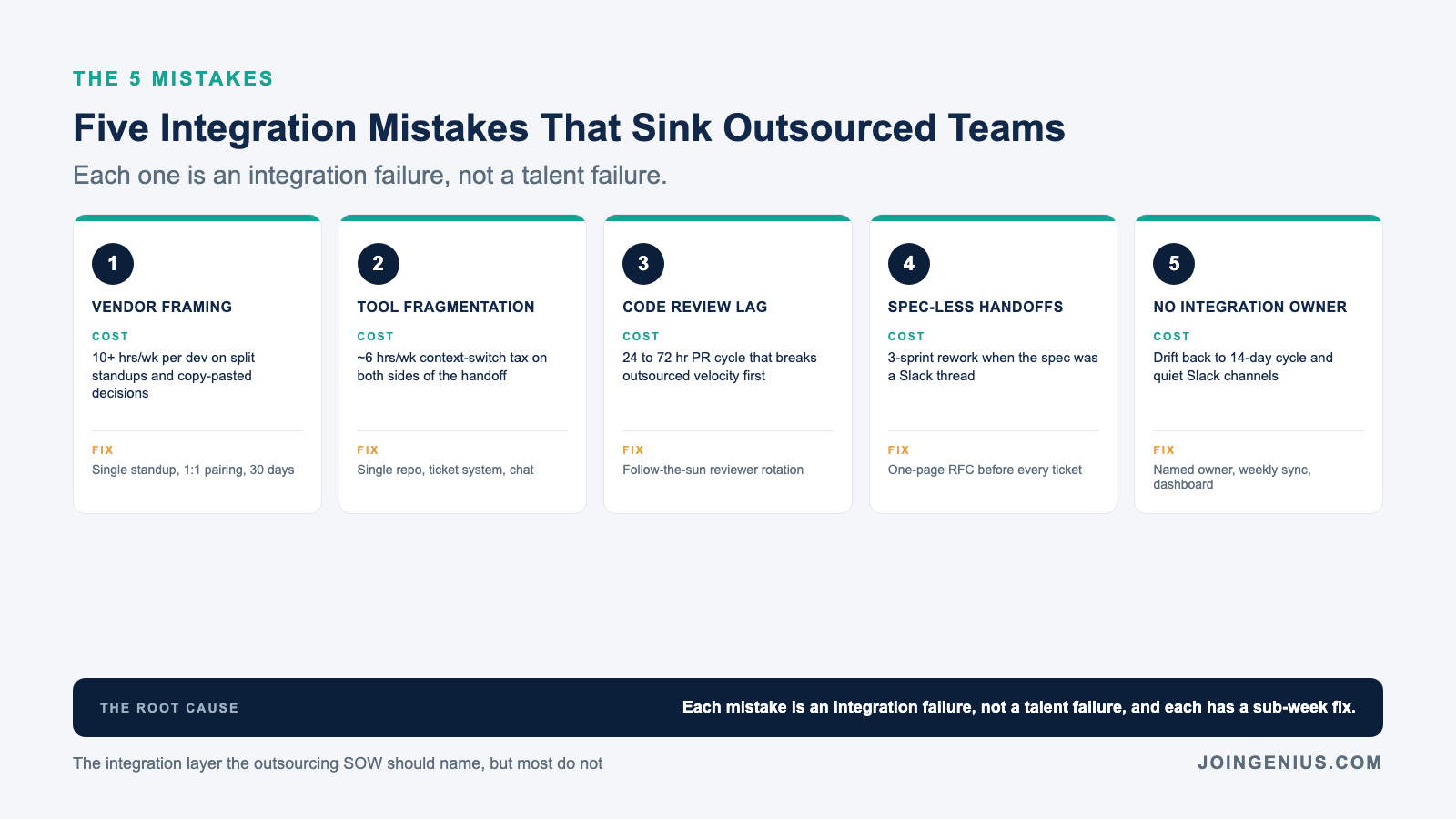
Each mistake below shows up in a real post-mortem on an outsourced team that underdelivered. Each one is an integration failure, not a talent failure. Each has a measurable cost and a fix that does not require a new vendor.
Mistake 1: Treating Them As A Vendor, Not A Team Member
The outsourced team gets a separate standup, a separate backlog, and a separate Slack channel on day one. Three weeks in, the staff engineers are copy-pasting decisions between the two channels and the outsourced team is guessing at priority.
The fix is a single standup, a single backlog, and a 1:1 pairing between every outsourced engineer and a staff engineer for the first 30 days of onboarding. Velocity climbs by the second sprint.
Mistake 2: Tool Fragmentation Between The Two Teams
The in-house team runs GitHub, Linear, and Slack. The outsourced team runs GitLab, Jira, and Microsoft Teams. Every handoff requires a human translator, and the context-switch tax hits both sides.
The fix is a single source of truth for code, tickets, and chat on day one. Research on engineering tool fragmentation puts the switching cost at roughly six hours per developer per week.
Mistake 3: Code Review Lag Across Time Zones
A PR submitted by the outsourced team at 6pm their time waits until the following afternoon for a review. A 24-to-72-hour cycle is the slowest part of the delivery pipeline and breaks outsourced velocity first.
The fix is a follow-the-sun rotation: one reviewer per time zone owns PRs during their window. AI code review covers the first pass, not the judgment call.
Mistake 4: Handoffs Without A Design Document
A ticket handed off without a one-page design doc or RFC is a ticket with a three-sprint rework attached. The outsourced team ships what the spec said, and the spec was a Slack thread.
The fix is a one-page RFC before any ticket crosses the handoff line. It takes 30 minutes to write and halves the rework rate on cross-team tickets.
Mistake 5: No Named Owner For The Integration
The integration is a shared responsibility, which means nobody owns it. Response time drifts, the Slack channel goes quiet, and the outsourced team starts shipping against the Slack thread from three weeks ago.
The fix is one named Integration Owner with a weekly sync and a dashboard tracking the metrics below. One hour a week beats five hours of fire drill.
The Integration Playbook That Saves The Relationship
The five mistakes above share one root: the integration layer was never designed. The playbook below is the 3-week setup that fixes it, with a specialist partner where in-house bandwidth runs out.
The 3-Week Setup That Closes Each Mistake
Week 1 is the merge: single standup, single backlog, single chat. Week 2 is the tooling: one repo, one ticket system, one review rotation. Week 3 is the ownership: Integration Owner named, weekly sync scheduled, dashboard live.
That is the integration layer the outsourcing SOW should name explicitly, and most SOWs do not. The three weeks pay back inside the next quarter.
Where Aalpha Fits
Aalpha is an offshore outsourcing partner with six engagement models, including dedicated teams and offshore development centers that integrate into the in-house standup and work in synchronized time zones.
For teams that need to extend engineering capacity without adding the 10 hours a week Atlassian’s 2025 survey flagged as the collaboration tax, the engagement-model page covers the setup that avoids each of the five mistakes above.
The table below is the single-page audit for an engineering manager running an outsourced team. Each mistake is paired with the hidden cost, the fix, and the role that owns it for the first 90 days.
| Mistake | Hidden Cost | The Fix | Owner |
|---|---|---|---|
| 1. Vendor framing | 10+ hrs/wk per dev | Single standup, 1:1 pairing for 30 days | Eng manager |
| 2. Tool fragmentation | 6 hrs/wk context switch | Single repo, ticket system, chat | Platform lead |
| 3. Code review lag | 24-72 hr PR cycle | Follow-the-sun review rotation | Tech lead |
| 4. Spec-less handoffs | 3-sprint rework average | One-page RFC before every ticket | Product lead |
| 5. No integration owner | Drift to 14-day cycle | Named owner, weekly sync, dashboard | Eng VP |
A 15-minute weekly review against this table keeps the integration from drifting, and the first owner is the engineering manager who signed the contractor onboarding plan.
The Metrics To Log After Integrating An Outsourced Team
The integration is only as real as the metrics it moves. The H3s below are the baseline numbers logged weekly, telling the engineering manager whether the integration is working or drifting back to the two-org shape.
PR Cycle Time Across Teams
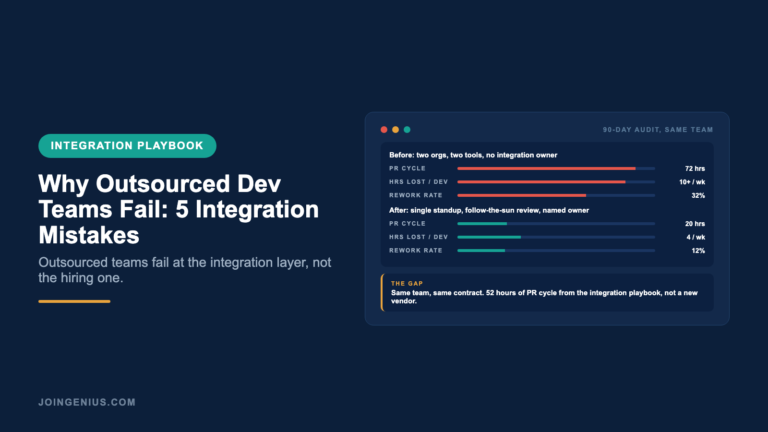
Median time from PR open to PR merge, logged separately for in-house and outsourced authors. The target floor is 24 hours. A 48-hour cycle is the first integration drift signal, and a 72-hour cycle is the one that tanks velocity on a cross-team sprint.
Follow-the-sun review rotations hold the 24-hour target. Review assignment by team instead of individual holds it when a reviewer is on vacation, and a backup reviewer named per time zone closes the last gap.
Hours Lost Per Developer Per Week
Atlassian’s 2025 survey put 50% of developers at 10+ hours lost per week to organizational inefficiencies. A monthly pulse question in the sprint retro keeps the number visible, and the target is under six hours per developer per week.
Under-six is where the outsourced team starts to feel like one team instead of two. It is also the metric the Integration Owner reports to the VP each month.
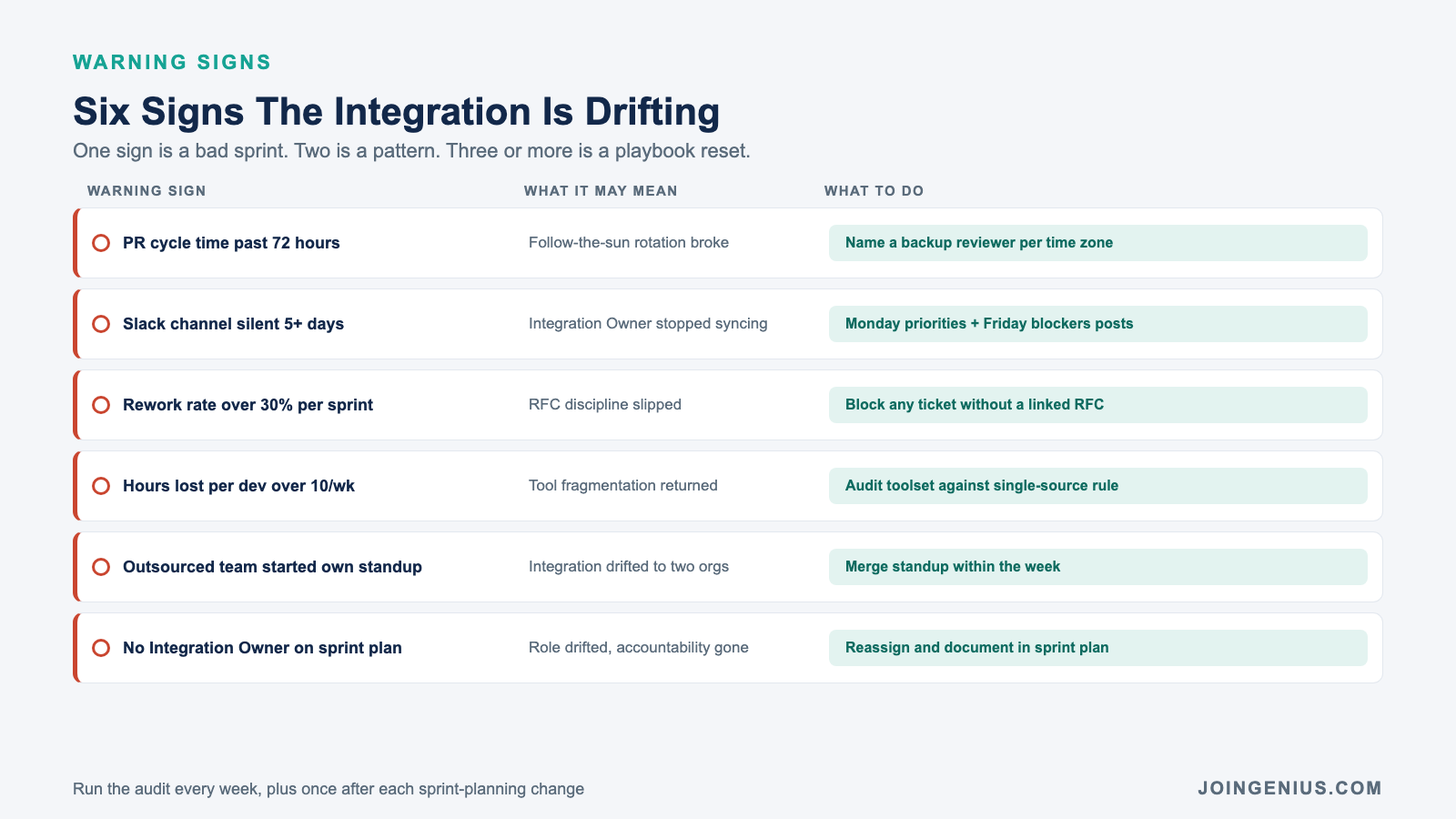
Warning Signs The Integration Is Drifting
The playbook is not finished when the first integrated sprint ships. Integration drifts under normal pressure. Three signs track to a 30-day velocity drop if ignored, each with a sub-day fix.
PR Cycle Time Past 72 Hours
A 72-hour median PR cycle is the first drift signal, and it usually means the follow-the-sun rotation broke because a reviewer went on vacation without a backup. The fix is to name a backup reviewer per time zone and test the rotation monthly.
72 hours is also the point where the outsourced team starts to self-review PRs that should have gone through the in-house reviewer, which is where undocumented decisions quietly accumulate.
Slack Channel Goes Quiet For A Week
A silent cross-team Slack channel for 5 or more working days signals the outsourced team is operating off the old thread and the Integration Owner has stopped syncing. Response time drifts from hours to days.
The fix is a Monday standup post from the Integration Owner with the week’s priorities, and a Friday retro post with the week’s blockers. 30 minutes a week, two posts, no exceptions.
Rework Rate Climbs Over 30%
Rework on cross-team tickets over 30% in a sprint usually means the one-page RFC discipline slipped and tickets started shipping against Slack threads. The fix is to block any ticket without a linked RFC.
Rework over 30% also means the velocity gain from the three-week playbook is being clawed back by a Mistake 4 regression, which is why the RFC is the first discipline to protect.
Conclusion: Build The Integration Layer Before The Next Vendor Change
Every data point above is operational, not theoretical. The playbook is: merge the standup, collapse the tooling, rotate the code review, write the one-page RFC, name the Integration Owner, and log two metrics every week.
Each step is a one-week change, and together they move a 72-hour PR cycle to 24 hours and pull the collaboration tax under six hours per developer.
The research is pointing one way. ISG’s 2025 study says outsourcing disappoints on innovation, Atlassian’s 2025 survey says collaboration is the top time-waster, and DORA’s 2025 report says tightly coupled teams gain nothing from new investment.
The lane is open for the engineering manager who designs the integration layer before the next vendor change, not after the next failed sprint.
For more on outsourced team integration, developer velocity, and the economics behind the engineering-manager decision, the full library is at joingenius.com.