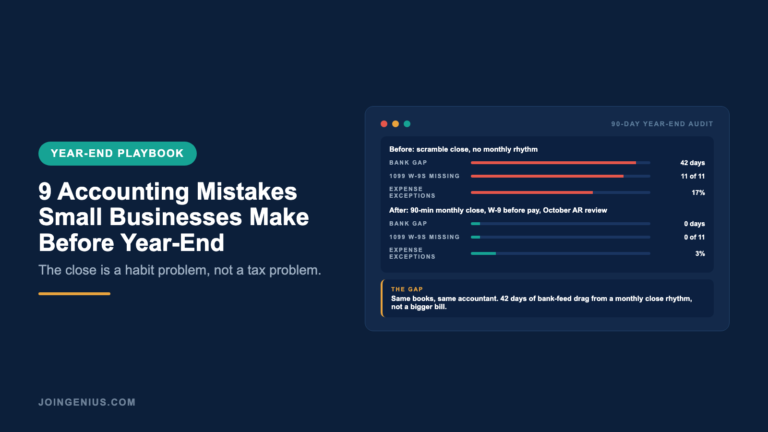

Year-end is where sloppy bookkeeping meets a hard deadline. By December 31, every missed expense, unreconciled account, and unfiled 1099 either gets fixed or rolls into the next year as a tax bill, a penalty, or a quiet cash leak. Most small businesses do not have a controller watching this. The owner has three hats, the bookkeeper is part-time, and the accountant shows up in January with questions nobody can answer anymore. This guide covers nine specific accounting mistakes that cost small businesses money before year-end, with a fix for each and a short playbook for the final six weeks of the fiscal year.
The Real Cost Of A Year-End Scramble
The reason small businesses miss things at year-end is not laziness. It is that the three forces working against a clean close, unpaid invoices, federal tax paperwork, and thinner sales margins, all peak in Q4. Three 2025 and 2026 figures make the picture concrete.
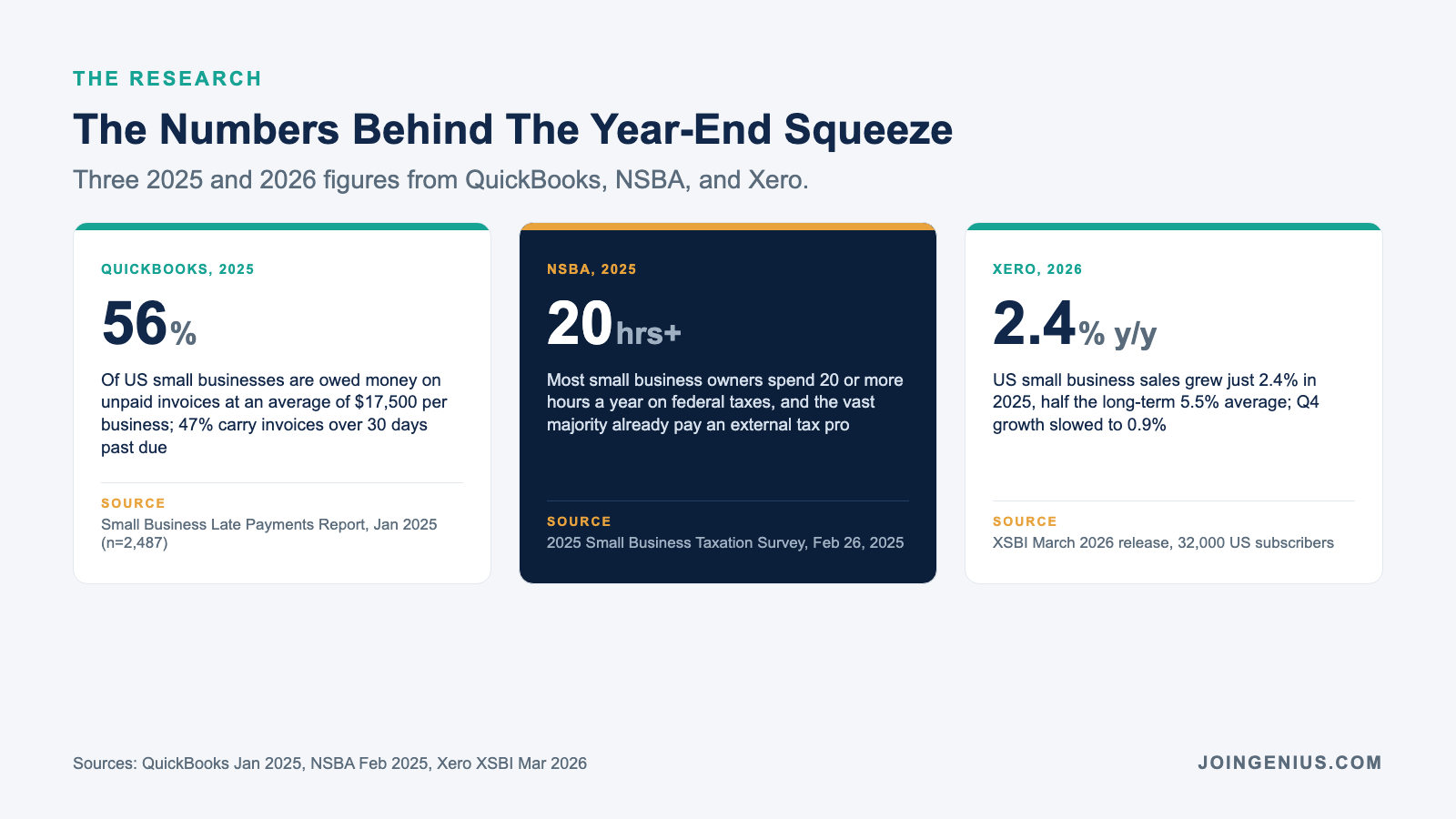
Fifty-Six Percent Of Small Businesses Are Owed Money
Intuit’s 2025 QuickBooks Small Business Late Payments Report, a January 2025 survey of 2,487 US small businesses with up to 100 employees, found that 56% of respondents were owed money on unpaid invoices, averaging $17,500 per business.
Half reported cash flow issues, and 47% carried invoices overdue by more than 30 days. Those stale receivables distort year-end revenue, inflate the tax picture, and hide a cash gap the owner finds in February.
Twenty Hours Vanish Into Federal Tax Paperwork
The NSBA 2025 Small Business Taxation Survey, released February 26, 2025, found that most small business owners spend more than 20 hours a year on federal taxes, even though the vast majority pay an external tax professional.
The survey calls administration and complexity, not the money itself, the single biggest tax burden. That time cost explains why so many owners start the close in late December rather than October.
Sales Growth Is Running Half Its Long-Term Pace
Xero’s March 2026 XSBI release, drawn from 32,000 US small business subscribers, reported that US small business sales grew just 2.4% year-over-year in 2025, about half the long-term 5.5% average, with Q4 growth slowing to 0.9%.
Thinner top-line growth leaves less cushion when a bookkeeping error becomes a tax or penalty hit, so the cost of each year-end mistake is larger than it was two years ago.
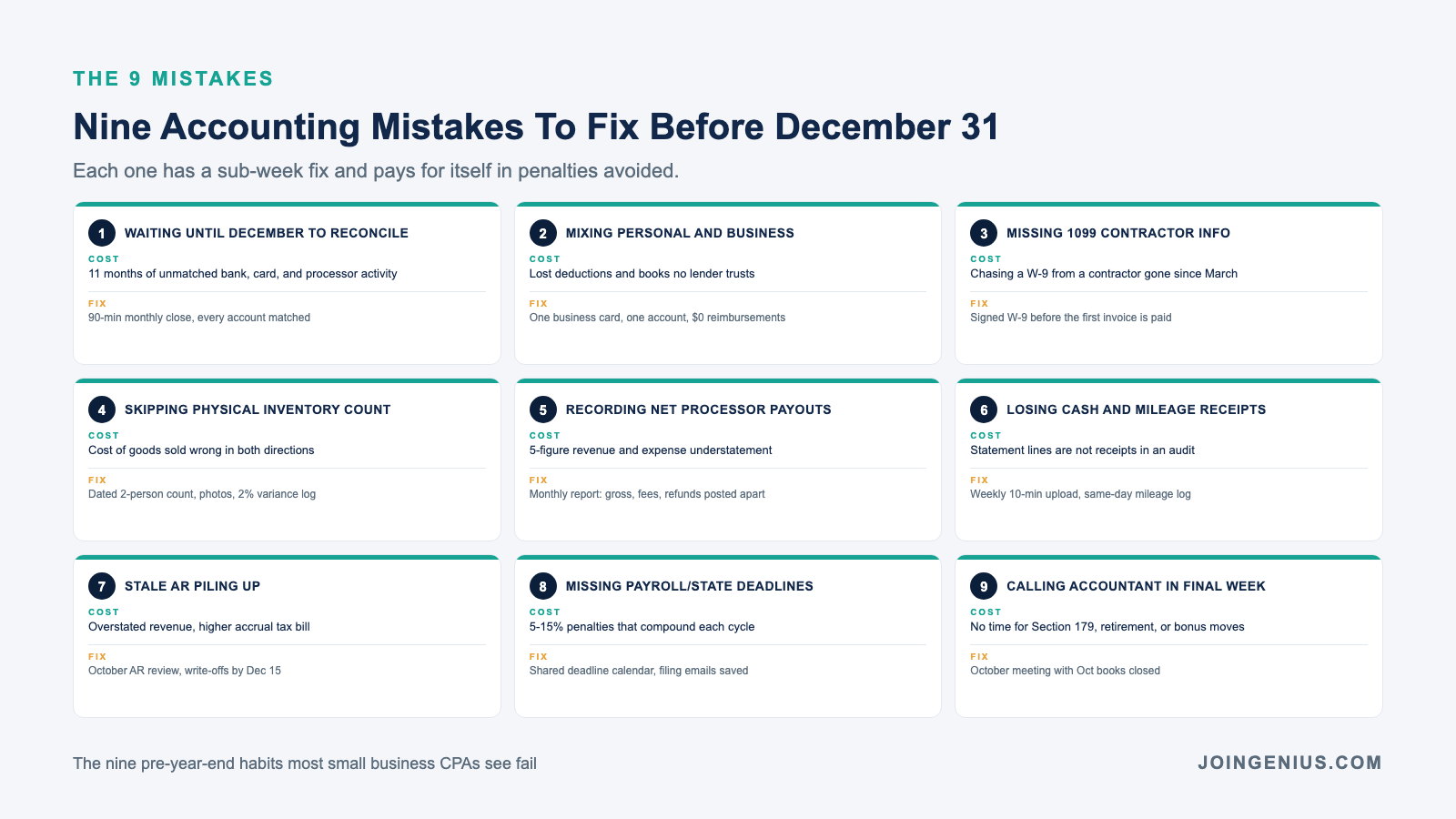
Nine Accounting Mistakes To Fix Before December 31
Each of these nine mistakes is common enough that most small business accountants have a story about every one. Each has a fix that takes less than a week and costs less than a late filing penalty.
1. Waiting Until December To Reconcile
Monthly reconciliation is the one habit that keeps every other year-end task small. Skip it and you arrive at December with eleven months of bank, card, and processor activity that has not been matched to the books.
The fix is a 90-minute monthly close block that reconciles every account, posts adjusting entries, and flags any transaction over $250 with no category. Owners who improve their accounts payable process early see the biggest gains.
2. Mixing Personal And Business Expenses
The most common year-end cleanup job at any CPA firm is sorting personal Amazon orders out of the business account, or the reverse. Mixed accounts cost legitimate deductions, lower S-corp distributions, and credibility with any lender.
The fix is one business card, one business bank account, and a $0 reimbursement policy for anything the owner buys on a personal card.
3. Missing 1099 Contractor Information
If the business paid any US contractor $600 or more during the year, a 1099-NEC is due by January 31. The mistake is not filing late. It is getting to January and not having a W-9 on file.
Chasing a contractor who finished a project in March and has moved on is a familiar year-end pain. The fix is a contractor onboarding step that requires a signed W-9 before the first invoice is paid.
4. Skipping The Physical Inventory Count
For any business that holds inventory, the December 31 count is what the tax return is built on. Skipping it, or counting from a stale spreadsheet, leaves cost of goods sold wrong in both directions.
The fix is a dated count on the last business day of the year, two people, one counting and one recording, with a photo of the storage location and a reconciliation note for every variance over 2%.
5. Recording Only Net Payment Processor Payouts
Stripe, Square, and Shopify Payments all send a net deposit to the bank, the gross sale minus their fees, refunds, and chargebacks. Posting only the deposit understates both revenue and expense by the same amount.
Over a year that is a five-figure distortion for most retailers. The fix is a monthly processor report, split into gross revenue, processor fees, and refunds, with each piece posted to its own account.
6. Losing Receipts On Cash And Mileage
The IRS does not require a receipt for every expense under $75, but a card statement line is not a receipt. For meals, travel, and mileage, the owner needs the date, the business purpose, and the attendees.
The fix is one receipt app (Expensify, Dext, or a dedicated folder in the accounting software) and a weekly 10-minute block to upload the week’s receipts, with a mileage log that records trips the same day.
7. Letting Stale Accounts Receivable Pile Up
A customer who has not paid an invoice in 120 days is unlikely to pay it without a conversation. Leaving those invoices on the books overstates revenue and makes the accrual-basis tax bill worse.
The fix is an October AR review, a written collection step for every invoice over 90 days by October 31, and a formal write-off decision by December 15. Pair it with a bookkeeping outsourcing partner if nobody internal owns AR.
8. Missing Payroll And State Filing Deadlines
Payroll tax penalties are among the most expensive, because they compound. Form 941 is quarterly, state withholding filings vary, and the W-2 and W-3 are due by January 31. An owner who runs payroll in-house is one missed deadline from a 5% to 15% penalty.
The fix is a single shared calendar with every payroll and state deadline, owner assigned, with a filing confirmation email saved to the same folder as the return.
9. Calling The Accountant In The Last Week
A CPA cannot run a tax projection on a set of books that has not been closed through November. The owner who shows up on December 28 asking about Section 179, a retirement contribution, or a bonus has already missed most of the planning window.
The fix is an October meeting with the accountant, with October’s books closed, so the owner has 60 days to act on advice instead of 72 hours.
The Playbook That Saves The Close
Every mistake above traces back to one habit, the monthly close. The business that closes its books by the fifteenth of the following month finds mistakes in week two, not in December week fifty-two. Two moves make that habit stick.
Where ProfitBooks Fits
ProfitBooks is small business accounting software that handles double-entry bookkeeping, automated bank reconciliation, and more than 45 financial reports including Balance Sheet, Profit and Loss, Cash Flow, and Trial Balance, with a read-only invite for the accountant or auditor so the year-end review does not block the owner’s access to the books.
The Monthly Close Muscle
A monthly close is not a tool choice, it is a rhythm. Block the same 90 minutes on the fifteenth of every month. Reconcile all bank, card, and processor accounts. Post adjusting entries for depreciation and accruals.
Run a three-report pack (P&L, Balance Sheet, Cash Flow) and compare it to the prior month. Send a one-paragraph summary to the accountant with any flag over $1,000. By October, the books are 10 months closed and the year-end question is small.
Metrics To Watch In The Final Quarter
Four numbers tell the owner whether the books are close-ready before December 31. Run them every Friday from October onward. Any single number outside its target range is a signal to open the books, not to wait.
Four Numbers Every Owner Should Know
Two of these are about the transactions themselves, and two are about the system around them. Treat the target column as a floor, not a ceiling, and investigate anything outside the target for more than two consecutive weeks.
| Metric | Target | Owner | Audit Cadence |
|---|---|---|---|
| Days since last bank reconciliation | Under 15 | Bookkeeper | Weekly |
| Uncategorized transactions over $250 | Zero | Bookkeeper | Weekly |
| Invoices over 60 days past due | Under 5% of AR | Owner | Weekly |
| Signed W-9s for every paid contractor | 100% | Operations | Monthly |
| Payroll filing confirmations on file | 100% | Payroll owner | Monthly |
| Expense receipts attached to card transactions | Over 95% | Owner | Weekly |
The column that moves first is almost always expense receipts, so that is the leading indicator to watch. When receipt attachment drops below 85%, the rest of the close falls apart two to four weeks later.
Warning Signs Your Close Is Slipping
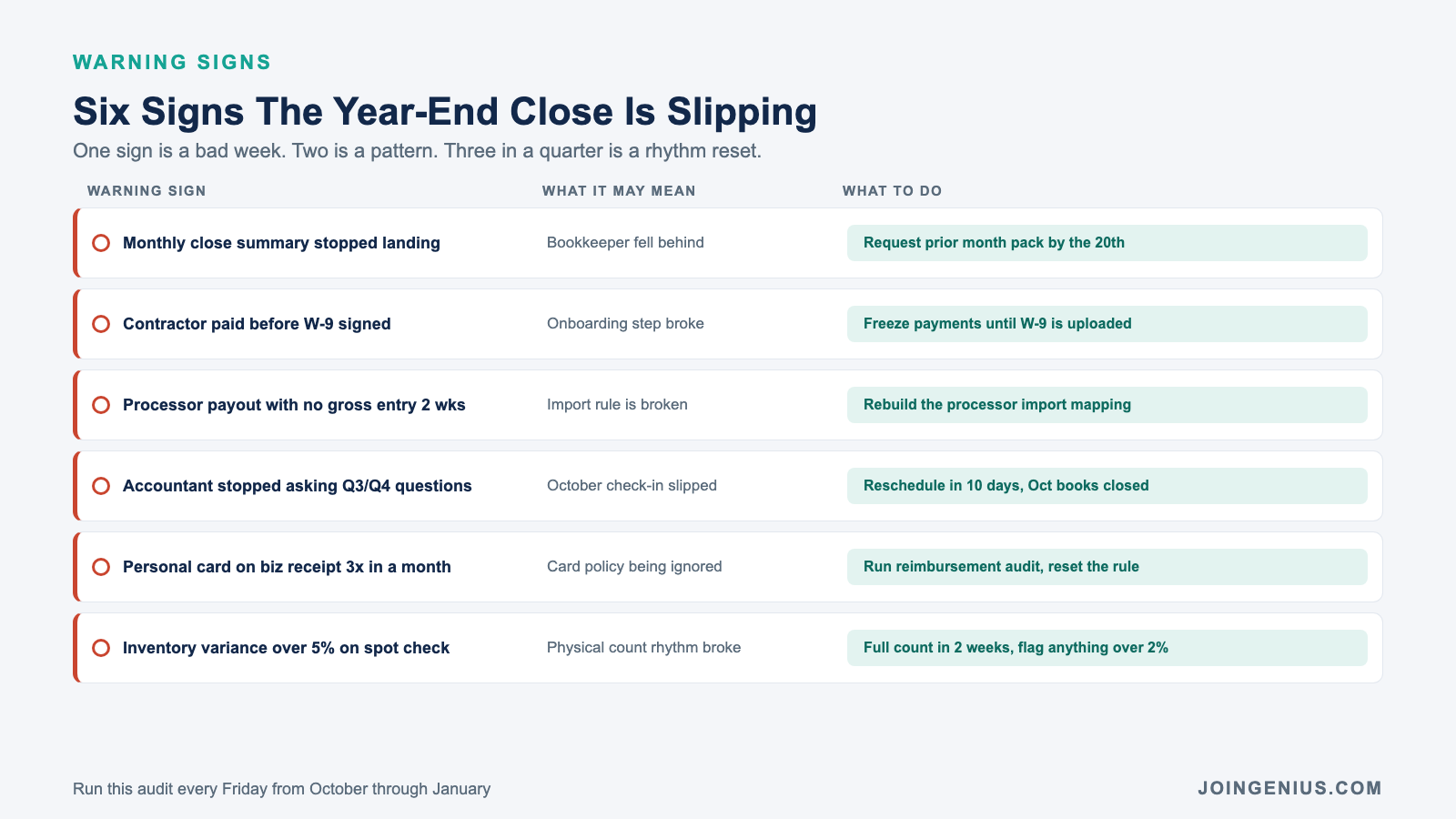
Owners who miss the year-end close rarely miss it in December. They miss it in September or October, when a small habit slipped and nobody raised a hand. These patterns are the early signals that the close is drifting, and each has a one-week fix.
The bookkeeper stops sending a monthly close summary. A new contractor is paid before a W-9 is signed. The processor payout line in the bank feed has no matching gross-revenue entry for two weeks running.
The accountant stops asking quarterly questions. The owner’s personal card shows up on a business receipt for the third time in a month. One of these is a bad week, two is a pattern, three in one quarter is a sign to rebuild the close rhythm before November 1.
Conclusion
Year-end accounting mistakes are not a tax problem, they are a habit problem. The owner who reconciles monthly, requires a W-9 before paying a contractor, splits processor deposits into gross, fees, and refunds, and meets the accountant in October will spend the last week of December on the business, not on the books.
The nine mistakes above all have a one-week fix, and each one pays for itself in avoided penalties, recovered deductions, or a cleaner set of books for the lender or buyer who will ask next year. For more small business playbooks, see joingenius.com.