Why WordPress Staging Environments Matter More Than You Think

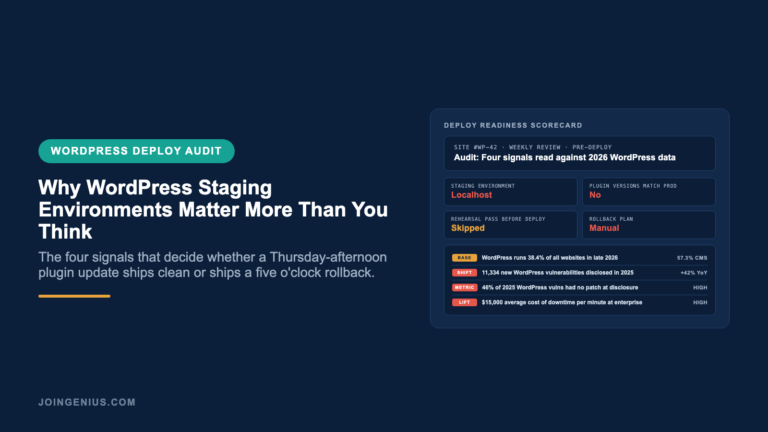
Genius cover for Why WordPress Staging Environments Matter More Than You Think showing a Deploy Readiness Scorecard for a fictional Site number WP-42 in the weekly pre-deploy review read against four signals a WordPress developer should be checking before every Thursday-afternoon push and scored as Staging Environment Localhost slip because Local or MAMP is not the same stack as production, Plugin Versions Match Prod No slip because the developer is about to run the one-click update on live without rehearsing it on a current clone, Rehearsal Pass Before Deploy Skipped amber because the rehearsal that would catch the plugin conflict never ran, and Rollback Plan Manual slip because no second environment is standing by to roll back to if the push breaks the checkout, with the four grounding figures underneath being WordPress still running 38.4 percent of all websites with a 57.3 percent share of the CMS market per W3Techs' November 2026 measurement, 11,334 new WordPress vulnerabilities disclosed in 2025 a 42 percent year-over-year jump per Patchstack's State of WordPress Security in 2026 whitepaper, 46 percent of those 2025 vulnerabilities having no developer patch available at the moment of public disclosure per the same Patchstack report making untested plugin updates as likely to open a hole as to close one, and 15,000 US dollars average cost of downtime per minute at Global 2000 scale per Splunk's May 2026 Hidden Costs of Downtime report run by Oxford Economics against 2,000 executives which is the kind of bill that lands when a bad deploy hits during a traffic window.
Table of Contents
Table of Contents

A WordPress editor who pushes a plugin update to a live site on a Thursday afternoon is running a bet. The bet is that the plugin change does not conflict with the theme or the cache. It does not break the billing plugin. And it does not shift the Elementor layout on the pricing page. The odds on that bet have moved the wrong way in 2026. More plugins. More vulnerabilities disclosed before a fix ships. And a cost-of-downtime bar that gets higher every quarter. This guide walks a wordpress developer through why a staging environment is the one piece of the workflow that pays off in a single quarter.

cover

Why “I’ll Just Push It To Live” Is A Bigger Bet Than It Was A Year Ago

WordPress still runs most of the internet’s frontend in 2026. The scale of the install base is what makes “I’ll just push it” such a widespread bet, not a developer edge case.

W3Techs’ latest measurement, dated November 2026, shows WordPress running 38.4 percent of all websites on the open web and holding a 57.3 percent share of the content management system market.

That means the plugin update the editor is about to run is going to run on a site that has company. Across more than a third of the internet. The “it works on my machine” defense ages badly at that scale.

The practical implication is that staging stopped being an agency luxury in 2026. It is the one piece of the WordPress workflow that pays for itself inside a single quarter, because the deploy it saves pays for the year of hosting.

What Actually Breaks When You Skip Staging

The thing most editors learn the hard way is that WordPress is not one thing. It is the server plus the application plus the database plus a stack of plugins the editor did not write. A plugin update is a code change pushed into four other systems at once.

Patchstack’s State of WordPress Security in 2026 report counted 11,334 new WordPress vulnerabilities disclosed in 2025, a 42 percent jump over the year before. Nearly half of those, 46 percent, had no developer patch available at the moment of public disclosure.

The practical read is that the plugin update you push to production is as likely to open a security hole as to close one. A staging environment is where you find that out before the attacker does.

The rehearsal also catches the fatal error. A fatal error on a live WordPress site is a “this site is experiencing technical difficulties” message for every visitor the editor was supposed to be serving. The rehearsal catches it on a page nobody is visiting yet.
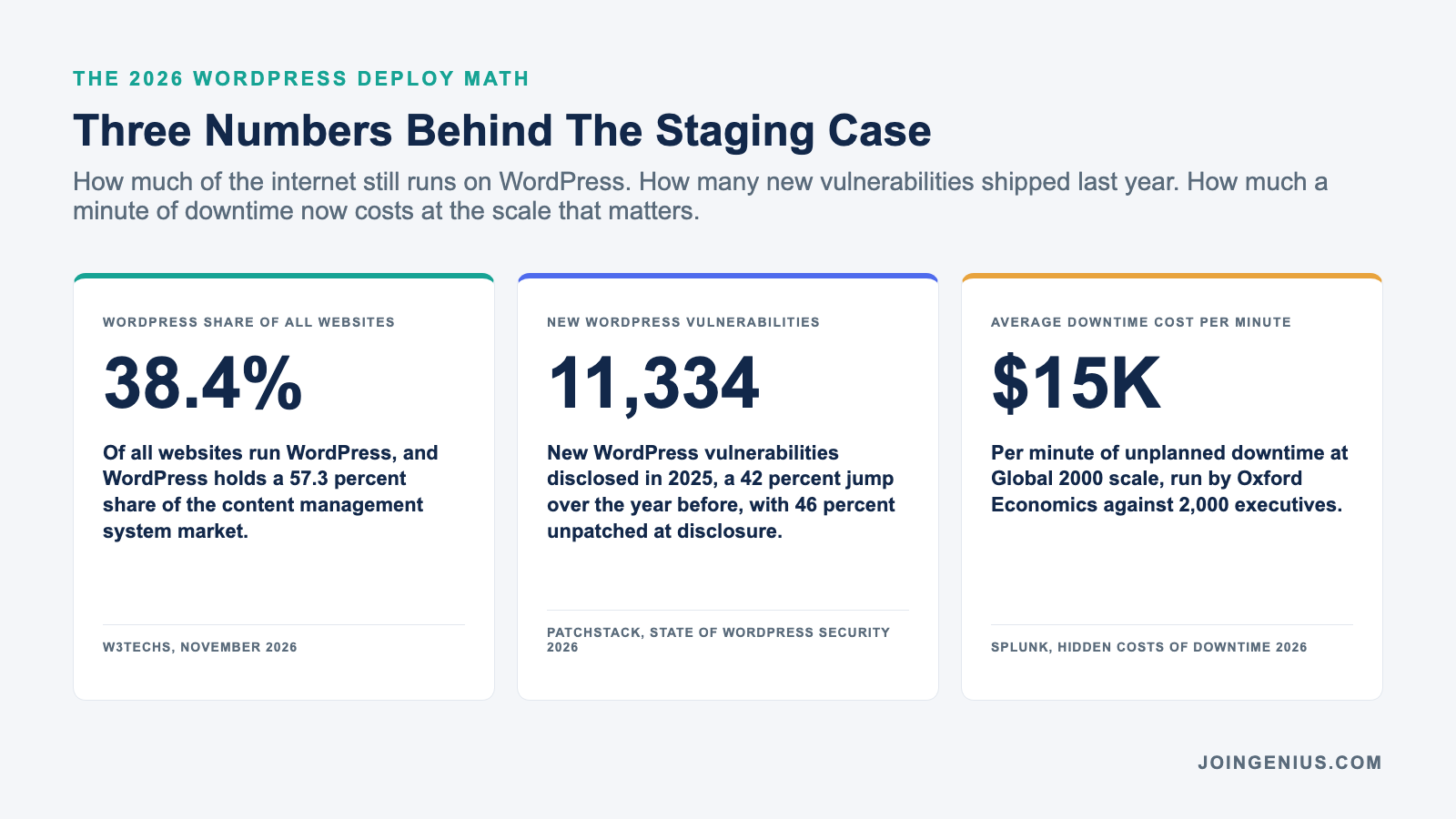
Three primary source numbers behind the 2026 case that WordPress staging environments have moved from an agency luxury to the one piece of the workflow that pays for itself inside a single quarter: WordPress running 38.4 percent of all websites with a 57.3 percent share of the content management system market per W3Techs' content management systems overview dated November 26 2026 which sets the scale at which a routine plugin update is a code change pushed into more than a third of the internet's frontend, 11,334 new WordPress vulnerabilities disclosed in 2025 a 42 percent year-over-year jump with 46 percent unpatched at the moment of public disclosure per Patchstack's State of WordPress Security in 2026 whitepaper updated February 25 2026 which is why the untested plugin update is as likely to open a hole as to close one, and 15,000 US dollars average cost of downtime per minute at Global 2000 scale per Splunk's May 2026 Hidden Costs of Downtime report run by Oxford Economics against 2,000 executives and announced in the Cisco newsroom release The 600 Billion Wake-up Call on May 19 2026 which is the enterprise bill behind the per-minute cost that lands on a mid-market WordPress site at a smaller number not a zero when a Thursday-afternoon deploy goes wrong, read together as the three pressures that make staging the one WordPress workflow move that pays itself off inside a quarter in 2026.

The Hidden Cost Of A Botched Deploy

The downtime an editor is trying to avoid is not “the site is down for the afternoon.” It is “the site is down during the hour the ad spend was pacing.” The cost per minute is not a developer’s time.

In Splunk’s May 2026 Hidden Costs of Downtime report, run by Oxford Economics against 2,000 Global 2000 executives, the average cost of downtime was 15,000 US dollars per minute at the enterprise scale. A WordPress site below that scale carries a smaller number per minute, not a zero.

The cost is also not just lost sessions. A broken deploy during a traffic window is the one place the organic ranking can slip in a week it took six months to climb. A seo specialist tracking that climb is the one who sees the bill first.

The cost side of a bad deploy also includes the time the agency spends explaining it. An hour of client call for every minute of downtime is an hour the team is not shipping the next thing. The rehearsal that would have caught it costs ten minutes.

Why “Staging” On Localhost Isn’t The Same As Staging On Prod

The editor who thinks they already have staging because they run the site in Local or MAMP is testing against a reality that is not the live site. The PHP version is different. The web server is different. The caching layer does not exist. The CDN is not involved. The database content is a stale snapshot.

A real staging environment lives on the same hosting stack as production. The database is a current copy. The PHP build and the caching layer match. A devops engineer will have language for the difference.

The hours editors waste on “it ran on localhost” are the hours that get billed to the client as cleanup after the deploy. The difference is the environment.

The Plugin And Theme Upgrade Workflow Staging Is Actually For

The workflow staging is actually for is not “preview the page before publishing.” It is “rehearse the risky change on a clone of the live site before letting it touch production.” The risky change is almost always a plugin update. Sometimes a theme change. Sometimes a PHP version bump. Sometimes a core WordPress upgrade.

The rehearsal is where the regressions get caught. A plugin that worked at version 3.1 with the current WooCommerce build does not work at version 3.2. The staging site is where that finding lives, not the live checkout.

The editor who runs the rehearsal is the one who ships a Thursday-afternoon update at four without the five o’clock rollback.

The reason the rehearsal matters is that the version numbers do not tell you what you need to know. A plugin at version 3.2.1 can have shipped a breaking change that version 3.2.0 did not have. The changelog is a short file. The site is a long one.
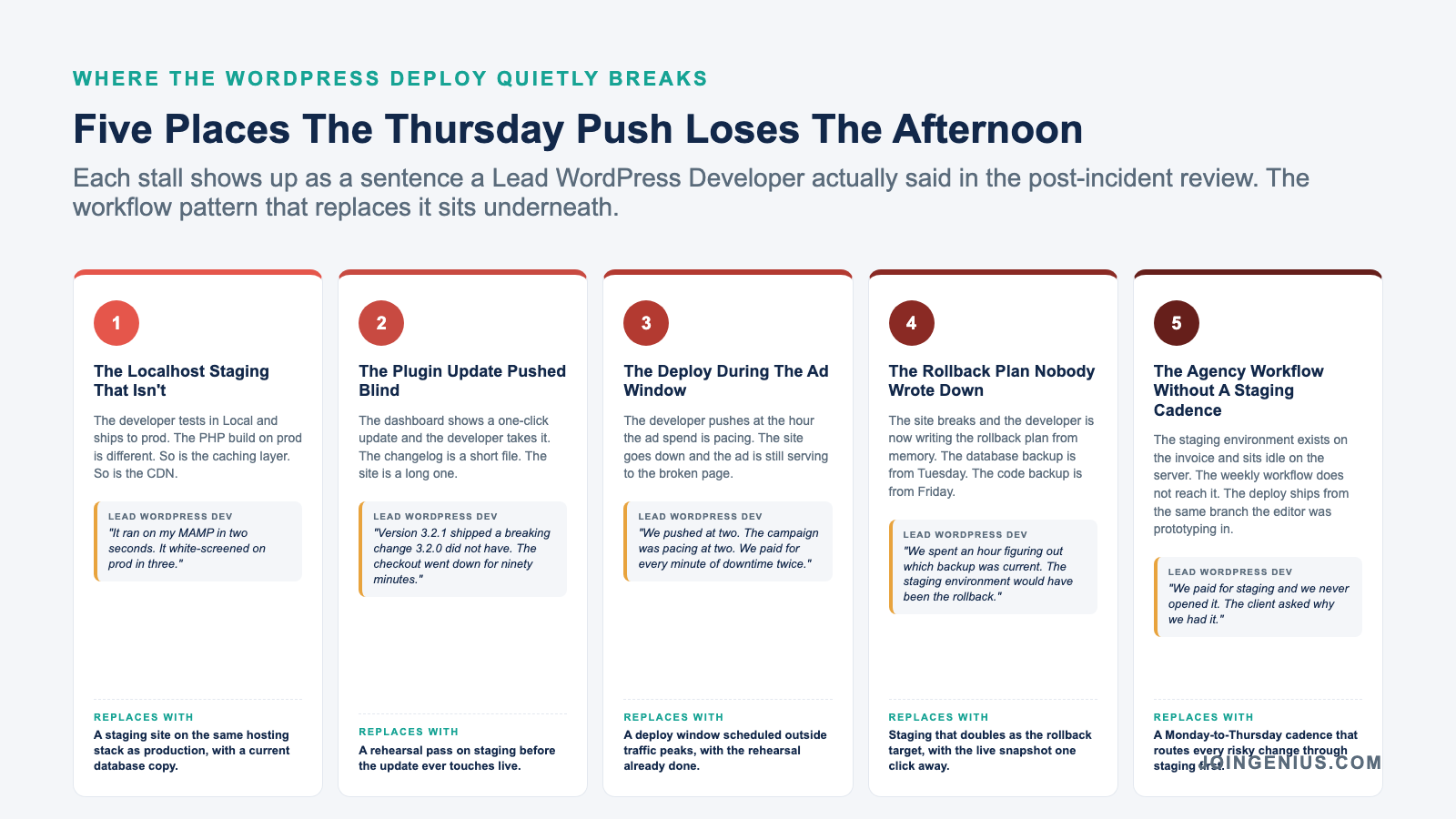
Five places a WordPress deploy quietly breaks against the 2026 plugin and downtime baseline, each shown through a sentence a Lead WordPress Developer actually said in the post-incident review, and the workflow pattern that replaces it: The Localhost Staging That Isn't where the developer tests in Local or MAMP and ships to prod and the PHP build on prod is different and so is the caching layer and so is the CDN and the Lead WordPress Developer says it ran on my MAMP in two seconds and it white-screened on prod in three and the pattern that unblocks it stands up a staging site on the same hosting stack as production with a current database copy, The Plugin Update Pushed Blind where the dashboard shows a one-click update and the developer takes it and the changelog is a short file and the site is a long one and the Lead WordPress Developer says version 3.2.1 shipped a breaking change 3.2.0 did not have and the checkout went down for ninety minutes and the pattern that unblocks it runs a rehearsal pass on staging before the update ever touches live, The Deploy During The Ad Window where the developer pushes at the hour the ad spend is pacing and the site goes down and the ad is still serving to the broken page and the Lead WordPress Developer says we pushed at two and the campaign was pacing at two and we paid for every minute of downtime twice and the pattern that unblocks it schedules the deploy outside traffic peaks with the rehearsal already done, The Rollback Plan Nobody Wrote Down where the site breaks and the developer is writing the rollback plan from memory with the database backup from Tuesday and the code backup from Friday and the Lead WordPress Developer says we spent an hour figuring out which backup was current and the staging environment would have been the rollback and the pattern that unblocks it keeps staging as the rollback target with the live snapshot one click away, and The Agency Workflow Without A Staging Cadence where the staging environment exists on the invoice and sits idle on the server with the weekly workflow not reaching it and the deploy shipping from the same branch the editor was prototyping in and the Lead WordPress Developer says we paid for staging and we never opened it and the client asked why we had it and the pattern that unblocks it runs a Monday-to-Thursday cadence that routes every risky change through staging first.

Shrinking The Time Between “Spin Up A Clone” And “Push Live”

The reason editors skip staging is not that they do not believe in it. It is that spinning up a cloned environment used to cost an hour of hosting setup before the rehearsal could begin. An hour on each risky change is a workflow nobody runs on a Thursday afternoon.

The 2026 shift is that the clone can now be stood up in under a minute from a live backup, on a server that matches production, with a push-back-to-live button that moves only the changes that passed.

Where InstaWP Fits

Setups like InstaWP spin up a cloned staging environment from a live WordPress site in about ten seconds. The risky change gets rehearsed in isolation. Only the changes that passed get pushed back to production with one click.

The staffing effect is not that the product replaces the developer. It is that the developer’s Thursday no longer starts with “first, set up staging.” The rehearsal is the work. The push is a button.

How To Rehearse A Risky Change Without A Second Production

The rehearsal has three checkpoints that matter. The first is a current clone of the database, because a stale copy will not catch a WooCommerce order flow regression. The second is the plugin version and the theme version matching production exactly.

The third checkpoint is that the test runs on a browser the live visitor actually uses. A staging site tested only in Chrome DevTools misses the Safari issue that will show up on half the traffic on Friday.

A system administrator owning the server side of the staging workflow keeps the rehearsal honest. The editor does not have to guess at whether the PHP build matches. The staging site inherits it.

The rehearsal pass is where the editor finds the plugin conflict that would have surfaced on live at eleven at night. The time it takes is the time the rehearsal paid back.

How To Build Staging Into The Weekly Agency Workflow

A staging environment sitting idle because nobody opens it is a budget line that does not earn. The weekly workflow the agency runs on a client’s WordPress site is where staging has to live, not the calendar invite for “next quarter.”

Monday runs the clone and the backup. Tuesday runs the risky updates on staging. Wednesday runs the rehearsal pass with the client. Thursday pushes only the changes that passed. Friday is a buffer for the rollback that did not have to happen.

A web developer running the agency’s staging workflow against a shared template across clients is the one who makes the cadence stick. The template saves the hour that the manual setup used to cost.

The agency that runs this cadence stops being the one that bills for Thursday-night rollbacks. The client that sees the cadence stops being the one that shops for a new agency the week after a bad deploy.
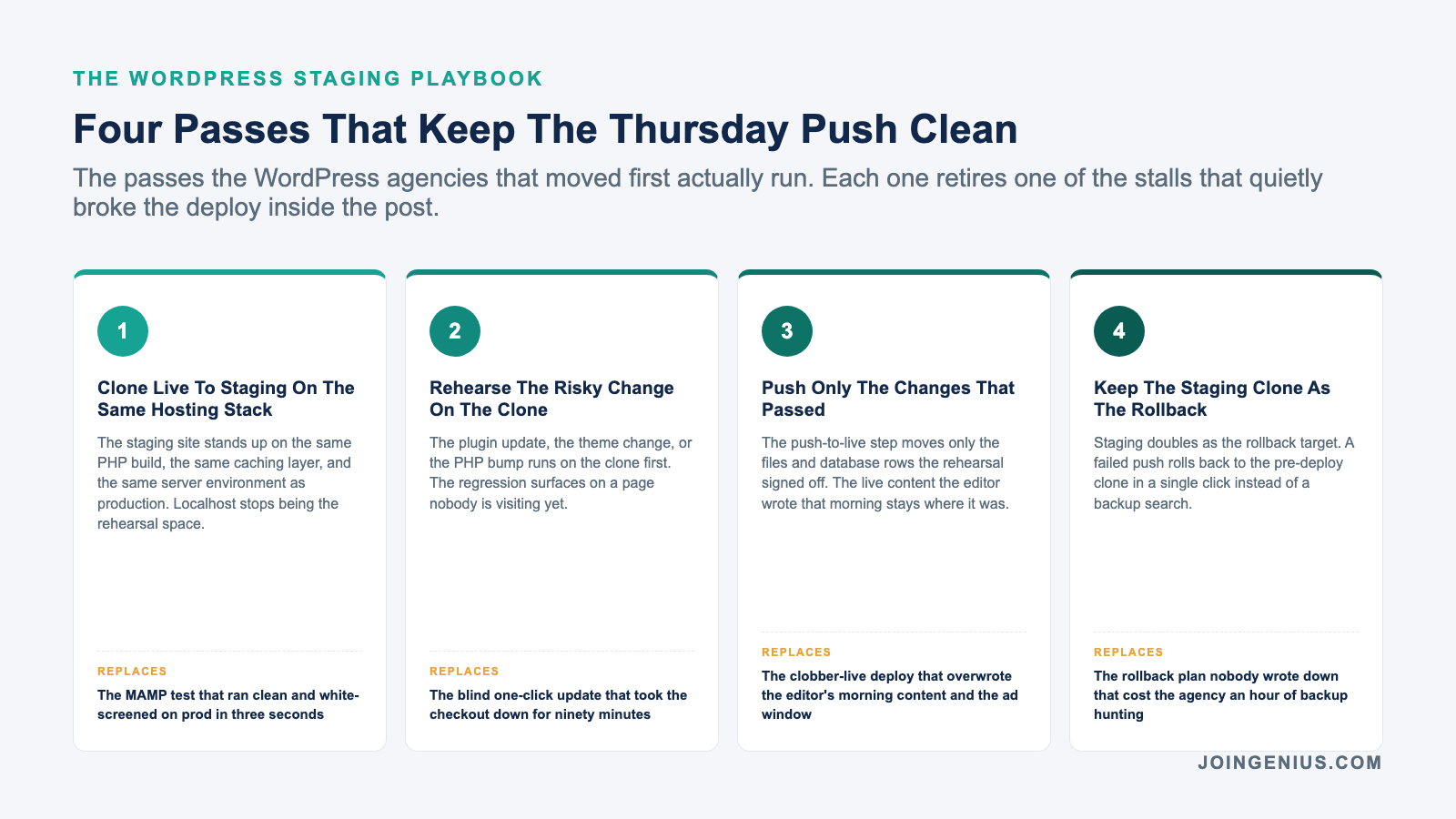
Four passes that keep a Thursday-afternoon WordPress push clean against the 2026 deploy baseline, each one retiring at least one of the stalls that quietly broke the deploy inside the post: Clone Live To Staging On The Same Hosting Stack where the staging site stands up on the same PHP build and the same caching layer and the same server environment as production so Localhost stops being the rehearsal space which replaces the MAMP test that ran clean and white-screened on prod in three seconds, Rehearse The Risky Change On The Clone where the plugin update or theme change or PHP bump runs on the clone first so the regression surfaces on a page nobody is visiting yet which replaces the blind one-click update that took the checkout down for ninety minutes, Push Only The Changes That Passed where the push-to-live step moves only the files and database rows the rehearsal signed off and the live content the editor wrote that morning stays where it was which replaces the clobber-live deploy that overwrote the editor's morning content and the ad window, and Keep The Staging Clone As The Rollback where staging doubles as the rollback target and a failed push rolls back to the pre-deploy clone in a single click instead of a backup search which replaces the rollback plan nobody wrote down that cost the agency an hour of backup hunting.

Conclusion

The reason WordPress staging environments matter more than most editors think in 2026 is not that staging is a new idea. It is that the cost of skipping it has moved.

The vulnerabilities get disclosed before a patch ships. The downtime cost per minute lands on the ad window. The agency loses the client after the one deploy that should not have gone to live.

The editor who treats the clone and the rehearsal as the Thursday-afternoon workflow instead of the Monday-morning stretch goal gets the deploy back. Genius has written the hiring side of that workflow with the WordPress agencies that moved first.

Get an unfair advantage by hiring the top 1% of overseas talent for your sales & marketing, IT, data & engineering, finance & accounting, and VA & customer support needs.

  • We find you high-performing remote workers for 80% less
  • Enjoy our 6-month Perfect Hire Guarantee
  • And $0 monthly middleman fees

Get your personalized list of pre-vetted candidates and see exactly what caliber of talent you can access at 80% less than US rates.

IG Rosales
Genius' Head of Content, shaping HR narratives for 10+ years. Her secret weapons? A keen eye for talent (hired through Genius, of course) and a relentless quest for the perfect coffee.

Related Articles and Topics

Leave a Reply

Your email address will not be published. Required fields are marked *

Comment policy: We love comments and appreciate the time that readers spend to share ideas and give feedback. However, all comments are manually moderated and those deemed to be spam or solely promotional will be deleted.

By submitting this form: You agree to the processing of the submitted personal data in accordance with Genius Privacy Policy, including the transfer of data to the United States.

Get Elite Talent and Cut Hiring Costs by 80%

Get your personalized list of pre-vetted candidates and see exactly what caliber of talent you can access at 80% less than US rates.

Download a PDF version.

By submitting this form: You agree to the processing of the submitted personal data in accordance with Genius' Privacy Policy, including the transfer of data to the United States.

By submitting this form, you agree to receive information from Genius related to our services, events, and promotions. You may unsubscribe at any time by following the instructions in those communications.

Browse A-Player employees that cost 80% less than US equivalents