How to Audit Your HR Software Stack and Cut Redundant Tools In 2026

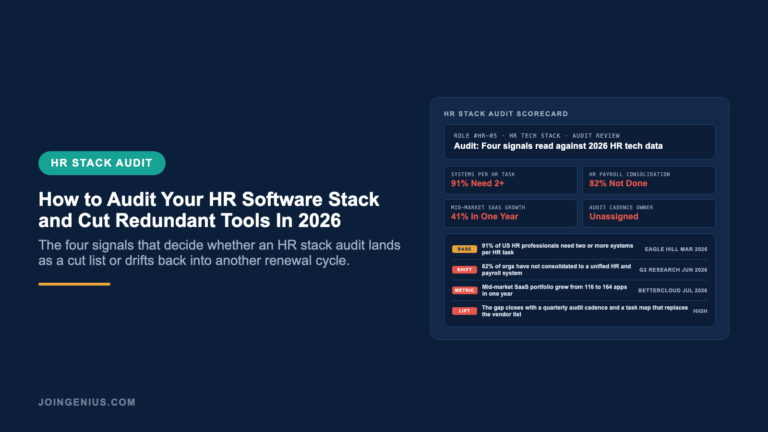
Genius cover for How to Audit Your HR Software Stack and Cut Redundant Tools In 2026 showing an HR Stack Audit Scorecard for a fictional Role number HR-05 HR tech stack audit review read against the four signals an HR manager and HRIS analyst should be checking before the next renewal cycle locks the stack in for another year, scored as Systems Per HR Task 91 percent Need Two Plus slip because nine in ten HR professionals say they need two or more systems to finish a single HR task which is the clearest tell that the inventory on the procurement team's vendor list is not the inventory the HR team actually runs the work on, HR Payroll Consolidation 82 percent Not Done slip because the overwhelming majority of HR and payroll organizations have not yet consolidated to a unified HR payroll system and most of them still run fragmented multi-system setups that require manual reconciliation every pay cycle, Mid-Market SaaS Portfolio 41 percent One Year Growth slip because the average mid-market organization ran 164 SaaS applications in 2026 up from 116 the year before which is the broader stack sprawl the HR layer sits inside and inherits the price inflation of, and Audit Cadence Unassigned slip because most HR teams still run the stack audit as a one-off compliance event when the CFO calls for SaaS cuts rather than as a quarterly design practice that keeps the stack size roughly where the previous audit left it, with the four grounding figures underneath being Eagle Hill Consulting's March 2026 study fielded by Ipsos among 200 US HR professionals at companies with 100 million dollars or more in annual revenue showing 91 percent need two or more systems per HR task and 43 percent need three or more, G2 Research's June 2026 study of 211 HR and payroll decision-makers across SMB and enterprise organizations showing 82 percent of organizations have not consolidated to a unified HR payroll system and 69 percent still run fragmented multi-system setups, BetterCloud's 2026 State of SaaS Report based on a July 2026 survey of 525 IT and security professionals showing the average mid-market organization now runs 164 SaaS applications up from 116 the year before, and the composite reading that the HR stack audit lands by replacing the vendor list with a full stack inventory and a task map and then running the exercise on a quarterly cadence rather than treating it as a one-off compliance event.
Table of Contents
Table of Contents

The HR software stack is a graveyard of good intentions. The ATS got procured when hiring surged. The LMS came in when compliance training moved online. The engagement tool was a late-2024 experiment that stuck around. The screening tool came in the next fiscal year. Two years on, the stack has eleven tools. Seven of them overlap. Nobody can tell which one holds the source of truth for who got hired last quarter. This guide walks an HR manager through eight passes that turn an HR stack audit into a decision the finance team actually approves and the payroll run does not break on.

Starting The Audit With A Full Stack Inventory, Not A Vendor List

Most HR stack audits start with the vendor list procurement already has. The vendor list is incomplete. It shows the tools finance signed a PO for. It does not show the single-seat subscription a recruiter expensed in April or the free tier a benefits admin signed up for on a payroll run that was already three days late.
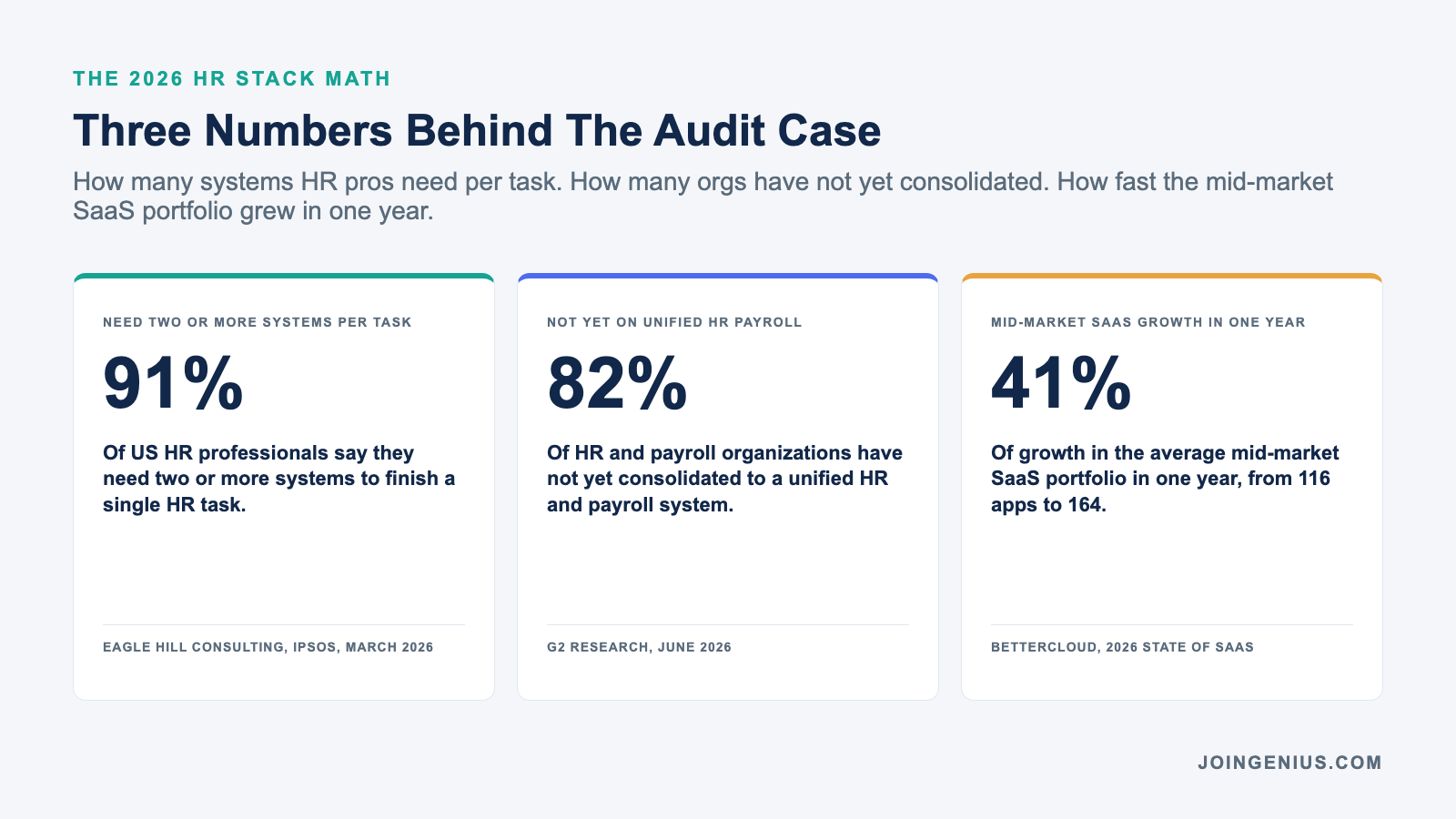
Three primary source numbers behind the 2026 case that most HR software stacks have grown past the point where the vendor list the procurement team maintains reflects the tools the HR team actually runs the work on and the overlap between HRIS and payroll and ATS and LMS and engagement tools quietly inflates both the SaaS bill and the number of places the source of truth could possibly live: 91 percent of US HR professionals saying they need two or more systems to finish a single HR task per Eagle Hill Consulting's March 2026 study fielded by Ipsos among 200 HR professionals at companies with 100 million dollars or more in annual revenue which is the stack-sprawl signal that tells HR managers the inventory on the procurement team's vendor list cannot be the inventory the HR team actually operates against, 82 percent of HR and payroll organizations not having consolidated to a unified HR and payroll system per G2 Research's June 2026 study of 211 HR and payroll decision-makers across SMB and enterprise organizations which is the consolidation-gap signal that tells HRIS analysts the industry-wide move to one system of record has not happened at most of their peers either so the migration cost is still the real blocker rather than the price of the all-in-one, and 41 percent one-year growth in the average mid-market SaaS application portfolio per BetterCloud's 2026 State of SaaS Report based on a July 2026 survey of 525 IT and security professionals showing the mid-market app count jumped from 116 to 164 in a single year which is the price-inflation signal that tells learning and development managers and payroll specialists the 2023 contract price is no longer the benchmark against which the renewal should be measured, read together as the three pressures that explain why the HR stack audit in 2026 will not be closed by procuring one more HR tool but by replacing the vendor list with a full stack inventory and a task map and then running the exercise on a quarterly cadence rather than as a one-off compliance event when the CFO calls for SaaS cuts.

An Eagle Hill Consulting study fielded by Ipsos in March 2026, surveying 200 US HR professionals at companies with 100 million dollars or more in annual revenue, found that 91% of HR professionals need two or more systems to finish a single HR task and 43% need three or more.

The audit starts with a full stack inventory, not a vendor list. An HRIS analyst pulls the SSO log and the expense report line items tagged software. The browser extension survey the IT team is already running adds the shadow tools. The spreadsheet that falls out of those sources is the real stack with every shadow seat included.

Mapping Each Tool To The Task It Actually Owns

The inventory names the tools. The map names the tasks. A task is a concrete HR action with a start and an end. Onboarding a new hire is one task. Running payroll for a country is another. Sending the quarterly engagement survey is a third. Each task gets exactly one tool assigned as its system of record.

The mapping exercise surfaces the overlaps instantly. Two tools claiming to be the system of record for the same task is a redundant tool somewhere. Three tools doing it means the real question is which tool actually gets used on the Thursday afternoon when the onboarding has to ship.

The output of the mapping is a two-column spreadsheet. Column A is the task. Column B is the single tool that owns it. Every tool not in Column B is a candidate for the cut list. The candidate list goes to the finance partner with a reason next to each line rather than a vendor name.

The Consolidation Gap That Most HR Teams Have Not Closed

The audit tells you which tools overlap. The consolidation question is which ones to keep. The two obvious moves are to collapse to the HRIS the business is already paying for or to pick the specialist tool the HR team actually uses on Thursday afternoon. Most HR teams in 2026 have not made either call yet.

G2 Research’s June 2026 study of 211 HR and payroll decision-makers across SMB and enterprise organizations found that 82% of organizations have not yet consolidated to a unified HR and payroll system. Sixty-nine percent are still running fragmented multi-system setups that require manual reconciliation every pay cycle.

The reason the consolidation did not happen is not the price of the all-in-one. It is the migration cost. Moving payroll off a tool the finance team trusts is a three-month project with a risk nobody gets a bonus for owning. The audit has to size that cost honestly or the consolidation argument stays on the slide deck.

The Replacement Shortlist That Follows The Audit

The cut list from the mapping exercise is the set of tools the audit retired. The replacement shortlist is the set of tools the audit still needs. Most HR teams write the second list the way they wrote the first one, ending up on a sales call at list price the audit was supposed to avoid.

A replacement shortlist that follows an audit has a different shape than a net-new purchase. The business already knows the task the tool has to own. The audit already named the budget the cut list freed up. The shortlist has to find a tool that matches the task at a price the freed budget can carry.

Where SaaSPirate Fits

Teams that finish the HR stack audit and need to swap a redundant tool for something cheaper or more fit-for-purpose now source the replacement shortlist from a curated SaaS deals marketplace like SaaSPirate rather than paying list price on the first vendor the HR team met at a conference.

Shopping the replacement in a deals marketplace changes two things at once. The first is the price. The second is the shape of the procurement. The HR team walks in with a known use case and a known budget. The deal page carries the trial route already, which is the part that tends to fall out of the sales-call version.

Pricing The Redundant Tool Against What The Market Charges

The cut list sometimes includes a tool the HR team wants to keep. The question is whether the price is right. The audit answers it by pricing the tool against what the market actually charges for the same task in 2026, not against what procurement signed off on when the tool was first bought in 2023.

BetterCloud’s 2026 State of SaaS Report, based on a July 2026 survey of 525 IT and security professionals, found that the average mid-market organization now runs 164 SaaS applications, up from 116 the year before. The SaaS stack grew 41% in one year, and the HR layer grew with it.

A learning and development manager looking at the LMS spend in 2026 is pricing a market that has doubled in the last two years. The 2023 contract is not the benchmark. The 2026 market rate is. The audit records both and lets the finance partner see the delta.

The Payroll Overlap Nobody Wants To Own

Payroll is the HR layer where overlap hurts the most. One tool runs the actual payroll. A second owns benefits elections. A third owns tax filing. The three tools share employee records. None of them owns the version of truth the IRS sees, because each one keeps its own copy and syncs on a schedule the audit never mapped.
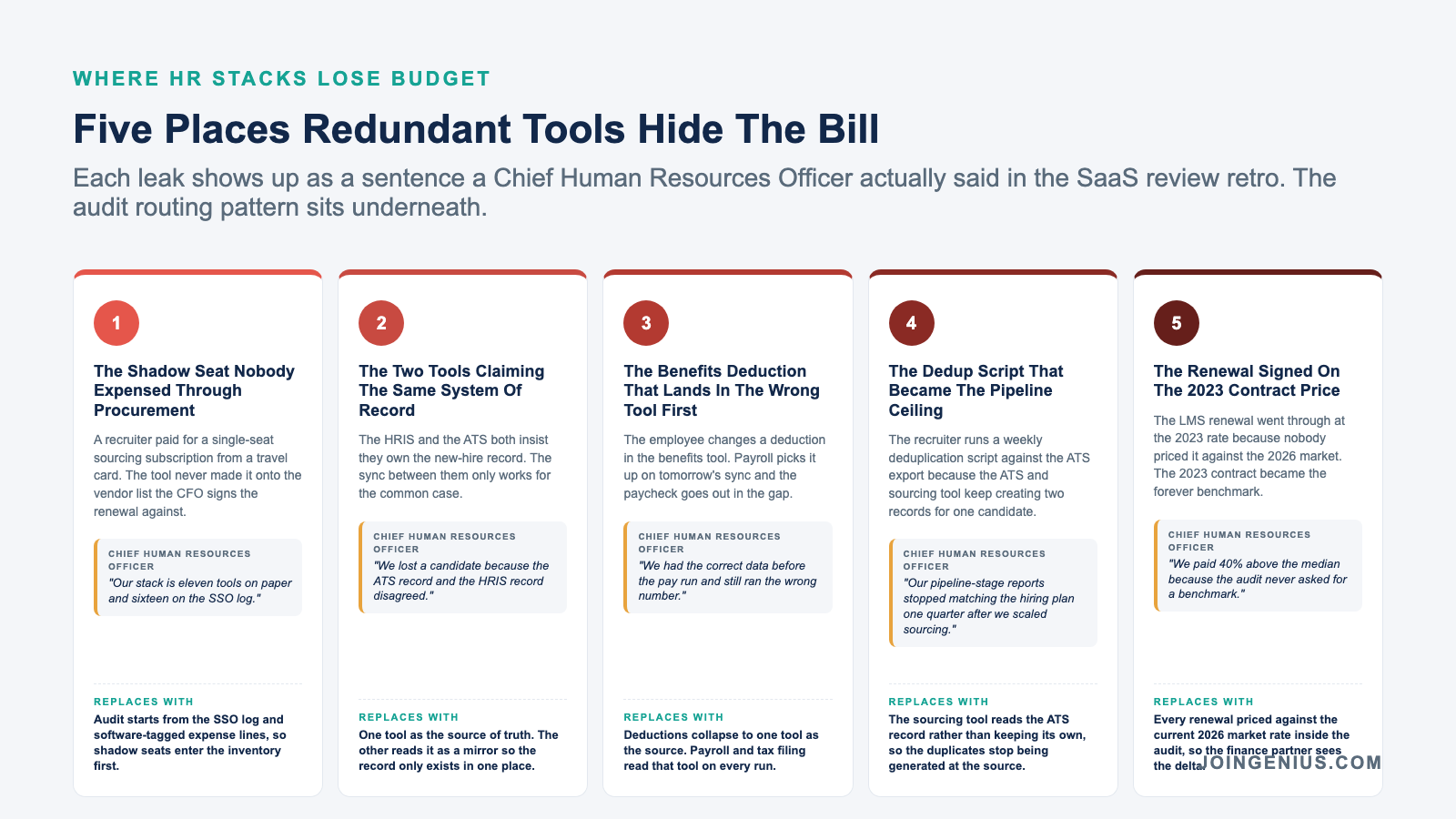
Five places HR stacks quietly lose budget to redundant tools against the 2026 audit baseline, each shown through a sentence a Chief Human Resources Officer actually said in the SaaS review retro, and the audit routing pattern that replaces it: The Shadow Seat Nobody Expensed Through Procurement where a recruiter paid for a single-seat sourcing subscription out of a travel card and the tool never showed up on the vendor list the CFO signs the renewal bill against and the CHRO says our stack is eleven tools on paper and sixteen on the SSO log and the pattern that unblocks it starts the audit from the SSO log and the expense line items tagged software so the shadow seats enter the inventory before the vendor list does, The Two Tools Claiming The Same System Of Record where the HRIS and the ATS both insist they own the new-hire record and the engineering team integrated them with a sync that only works for the common case and the CHRO says we lost a candidate because the ATS record said one thing and the HRIS record said another when the hiring manager pulled the file and the pattern that unblocks it picks one tool as the source of truth and makes the other a read-only mirror so the record only exists in one place, The Benefits Deduction That Lands In The Wrong Tool First where the employee changes a deduction in the benefits tool and payroll picks it up on tomorrow's sync and the paycheck goes out in the gap and the CHRO says we had the correct data in the system before the pay run and still ran the wrong number because the sync was a day behind the reality and the pattern that unblocks it collapses the deductions path to one tool as the source of truth and reads it out to the payroll and tax-filing tools on every run, The Dedup Script That Became The Pipeline Ceiling where the recruiter runs a weekly deduplication script against the ATS export because the ATS and the sourcing tool keep creating two records for the same candidate and the script works until the volume doubles and the CHRO says our pipeline-stage reports stopped matching the hiring plan one quarter after we scaled sourcing and the pattern that unblocks it has the sourcing tool read the ATS record rather than keep its own so the duplicates stop being generated at the source, and The Renewal Signed On The 2023 Contract Price where the LMS renewal went through at the 2023 rate because nobody priced it against the 2026 market and the CHRO says we paid 40 percent above the median because the audit never asked for a benchmark and the pattern that unblocks it prices every tool against the current market rate inside the audit so the finance partner sees the delta before the renewal signature.

The overlap shows up when an employee changes a deduction and the change lands in the benefits tool first. Payroll picks it up on the next sync, which is tomorrow. Tax filing picks it up on the sync after that. The paycheck goes out in the gap and the employee sees the wrong number before lunch.

A payroll specialist owning the audit of this layer picks one tool as the source of truth and drops the other two to read-only mirrors. The deductions change in one place. Every other tool reads it. The gap closes. The paychecks tie out on the first run.

The ATS Sitting Next To The Sourcing Tool Doing The Same Job

The ATS runs the open requisitions and the pipeline stages. The sourcing tool runs the outbound outreach. The two tools share a candidate record that is supposed to sync. The sync works for the common case. The sync breaks on the candidate who got sourced twice by two different recruiters, which is the candidate the audit will find.

The usual workaround is a weekly deduplication script a recruiter runs from the ATS export. The script works until the volume doubles, at which point the duplicates sit in the funnel and the pipeline-stage reports stop matching the hiring plan. The workaround became the ceiling two quarters ago.

A talent acquisition specialist auditing this layer decides which tool holds the candidate record and makes the other one a surface. The sourcing tool reads the ATS record rather than keeping its own. The duplicates stop showing up because there is only one record for them to collide against.

Running The Audit On A Quarterly Cycle, Not A Compliance Event

The last mistake is the one that undoes the rest. Teams run the HR stack audit once, in the quarter the CFO asked for SaaS cuts, and then let the stack grow back. The next fiscal year the eleven tools are twelve. The overlap is back. The audit happens again from scratch with the same spreadsheet.
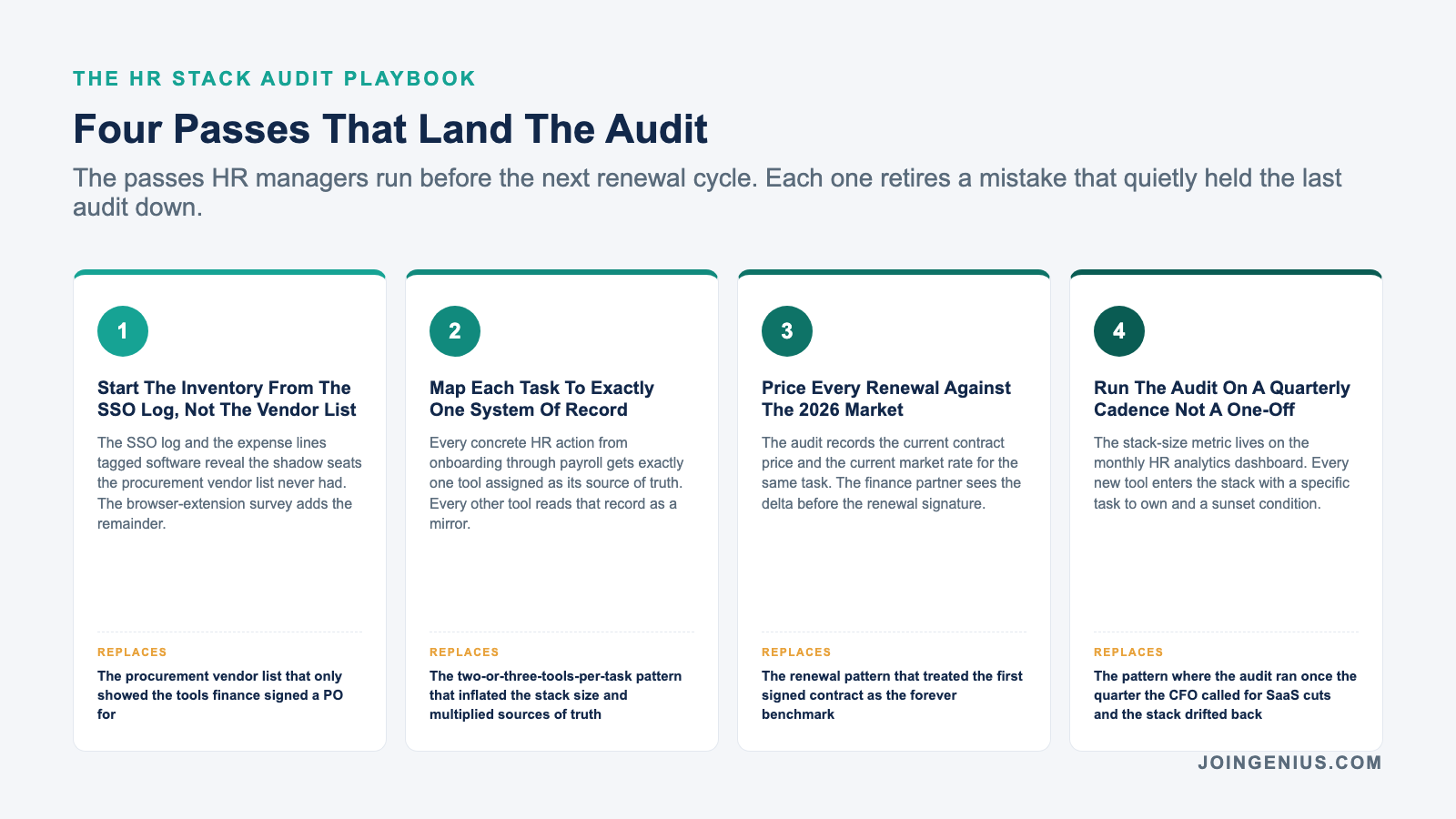
Four passes that close the HR stack sprawl in 2026, each one retiring one of the mistakes that quietly held the last audit cycle down inside the post: Start The Inventory From The SSO Log And The Expense Lines Not The Vendor List where the SSO log and the expense report lines tagged software reveal the shadow seats a recruiter and a benefits admin paid for on their own cards and the browser-extension survey the IT team already runs adds the remaining tools which replaces the procurement vendor list that only shows the tools finance signed a PO for, Map Each Task To Exactly One System Of Record where every concrete HR action from onboarding through payroll through the engagement survey gets exactly one tool assigned as its source of truth and every other tool reads that record as a mirror which replaces the two-or-three-tools-per-task pattern that quietly inflated both the stack size and the number of places the source of truth could possibly live, Price Every Renewal Against The 2026 Market Not The Original Contract where the audit records both the current contract price and the current market rate for the same task so the finance partner sees the delta before the renewal signature and the LMS or ATS or HRIS does not keep clearing at the 2023 price when the 2026 median is lower which replaces the renewal pattern that treated the first signed contract as the forever benchmark, and Run The Audit On A Quarterly Cadence Not A One-Off Event where the stack-size metric lives on the monthly HR analytics dashboard and procurement checks the task map before signing the next tool in and every new tool enters with a specific task and a sunset condition which replaces the pattern where the audit ran once the quarter the CFO asked for SaaS cuts and then let the stack drift back to the number the audit was called to fix.

Running the audit on a quarterly cycle keeps the stack size roughly where the previous audit left it. The HR analytics team adds a stack-size metric to the monthly dashboard. The procurement team asks about the task map before signing the next renewal. The new tool enters the stack with a specific task and a sunset condition.

The quarterly cadence also turns the audit from a compliance event into a design practice. The question stops being whether the stack has redundant tools, because it always will between audits. The question becomes how fast the stack catches the redundancy and how cleanly it retires the loser.

Conclusion

The eight passes add up to a single pattern. The HR stack grew through good intentions. The audit shrinks it through better ones. A full inventory and a task map replace the vendor list. A quarterly cadence replaces the one-off compliance event.

Genius helps HR managers and people operations leaders staff the audit with the analysts and administrators that keep the stack honest between review cycles.

Get an unfair advantage by hiring the top 1% of overseas talent for your sales & marketing, IT, data & engineering, finance & accounting, and VA & customer support needs.

  • We find you high-performing remote workers for 80% less
  • Enjoy our 6-month Perfect Hire Guarantee
  • And $0 monthly middleman fees

Get your personalized list of pre-vetted candidates and see exactly what caliber of talent you can access at 80% less than US rates.

IG Rosales
Genius' Head of Content, shaping HR narratives for 10+ years. Her secret weapons? A keen eye for talent (hired through Genius, of course) and a relentless quest for the perfect coffee.

Related Articles and Topics

Leave a Reply

Your email address will not be published. Required fields are marked *

Comment policy: We love comments and appreciate the time that readers spend to share ideas and give feedback. However, all comments are manually moderated and those deemed to be spam or solely promotional will be deleted.

By submitting this form: You agree to the processing of the submitted personal data in accordance with Genius Privacy Policy, including the transfer of data to the United States.

Get Elite Talent and Cut Hiring Costs by 80%

Get your personalized list of pre-vetted candidates and see exactly what caliber of talent you can access at 80% less than US rates.

Download a PDF version.

By submitting this form: You agree to the processing of the submitted personal data in accordance with Genius' Privacy Policy, including the transfer of data to the United States.

By submitting this form, you agree to receive information from Genius related to our services, events, and promotions. You may unsubscribe at any time by following the instructions in those communications.

Browse A-Player employees that cost 80% less than US equivalents