Most course creators know the feeling of launch morning. The course took four months to record. The email goes out at 9 a.m. By lunch there are three sales and a support ticket about a login link. There is also a refund request from someone who expected something else.
The launch was not decided that morning. It was decided in the six weeks before it, by a handful of checks that either happened or did not. Nearly every quiet launch skips the same ones, and none of them require a bigger audience or a bigger ad budget.
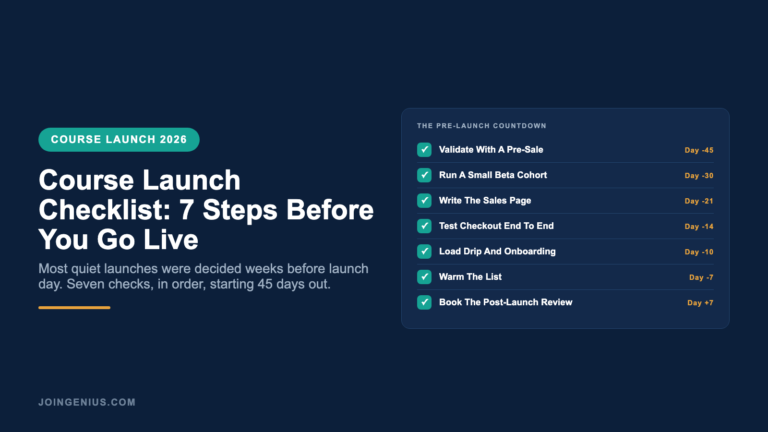
This post walks through the three gaps behind most quiet launches and the seven-step checklist that closes them. It ends with the four numbers to read one week after you go live.
Why Most Course Launches Go Quiet On Day One
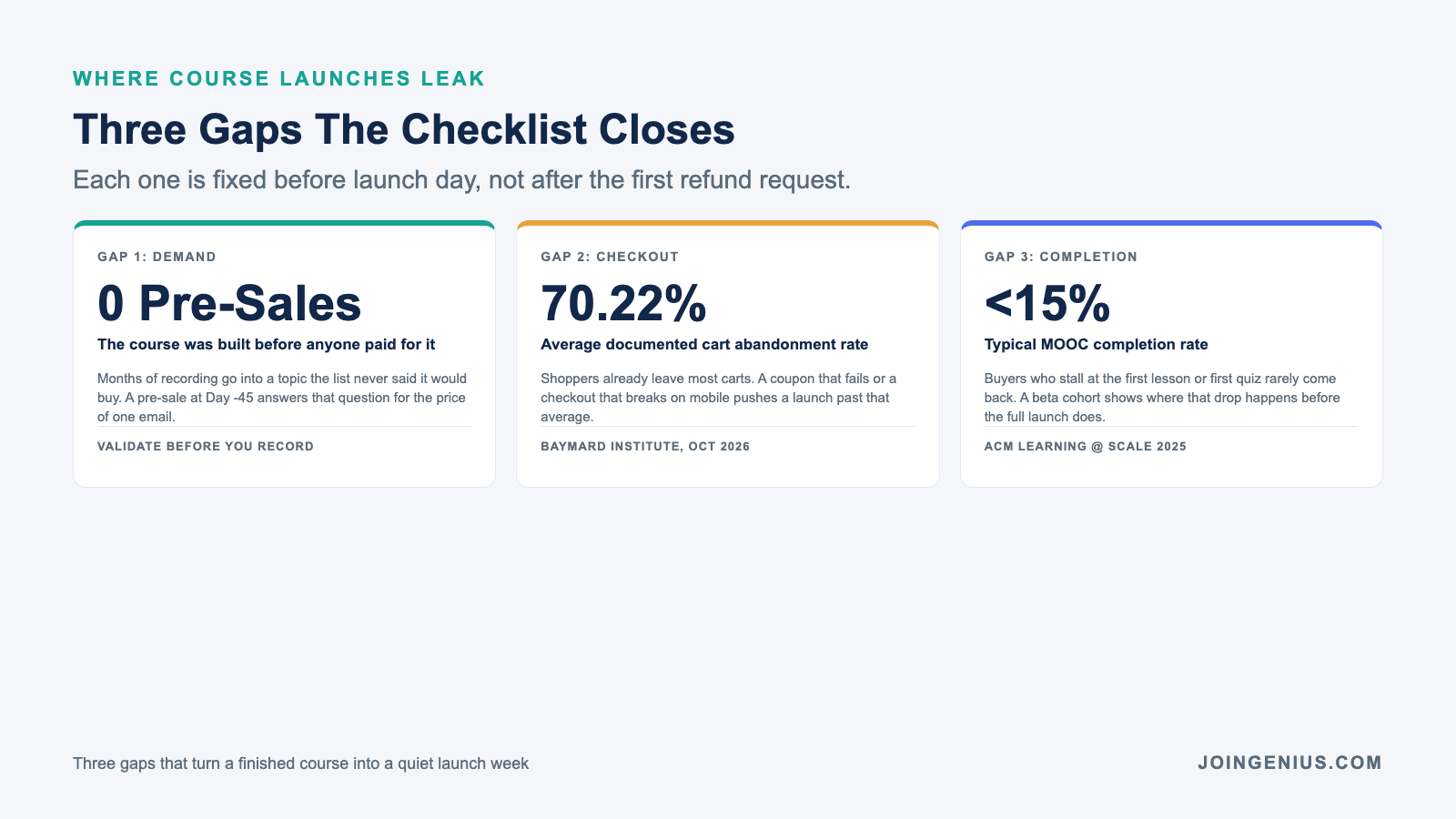
Gap one is demand that was never tested. The creator picked a topic, built the whole course, and then asked the list to buy it. If the list was never asked whether it would pay for that outcome at that price, the launch email is the first test. That is an expensive place to find out the answer is no.
Gap two is the checkout. A buyer who has decided to pay can still be lost on the payment page. The Baymard Institute’s cart abandonment research, updated in October 2026, puts the average documented cart abandonment rate at 70.22 percent across 50 studies. Those are ecommerce studies rather than course sales, and Baymard sells UX research, so read the figure with that in mind. The point holds for a course checkout too. A coupon code that fails or a payment form that breaks on a phone pushes a launch well past that average.
Gap three is what happens after the sale. Research published at ACM Learning @ Scale 2025 by researchers at the University of Pennsylvania and Haverford College notes that MOOC completion rates are often below 15 percent. Across 90 Coursera courses with more than 5.3 million enrollments, the authors found that drop-off was highest at the first graded assessment. Buyers who stall early become refund requests and quiet reviews, and that hurts the next launch.
Step 1: Validate Demand With A Pre-Sale At Day -45
Before recording more than the first module, send the list a short offer. Describe the outcome the course delivers and the price, and give a launch date. Ask people to pay now at a founding rate, with a full refund if the course does not ship.
The pre-sale count is the most honest number you will get. Twenty people who paid tell you more than two hundred who clicked a survey. If almost nobody buys, change the promise or the price before you build the rest, not after.
Step 2: Run A Small Beta Cohort At Day -30
Give the first module to 10 to 20 of the pre-sale buyers and watch what they do. Where do they stop? Which lesson creates the most questions? Does anyone fail the first quiz?
The first graded assessment is where the Learning @ Scale research saw the biggest drop, so look hard at your first quiz or assignment. A beta cohort also gives you the testimonials the sales page needs, written by people who actually took the course.
Step 3: Write The Sales Page Around One Outcome At Day -21
The sales page should answer one question for one reader. What will I be able to do when I finish, and how long will it take? Lead with that outcome. Put the beta testimonials right under it, and the curriculum after that.
Cut anything that promises a second outcome. Refund requests that say “not what I expected” usually trace back to a sales page that promised two things and delivered one.
Step 4: Test Checkout End To End At Day -14
Buy your own course. Do it on a phone and on a laptop. Apply the launch coupon, then try an expired one. Use a card that will be declined and check what the buyer sees. Then confirm the welcome email arrives and the login works on the first try.
This is the step where the platform choice matters most, because every handoff between separate tools is a place for the launch to break. An online course platform like FreshLearn keeps the sales page and checkout in the same place as the course and its drip schedule. That leaves fewer connections to test, and fewer to fail at 9 a.m. on launch day.
Step 5: Load The Drip Schedule And Onboarding Emails At Day -10
Decide whether lessons unlock all at once or on a schedule. A weekly drip keeps a cohort moving together. Full access suits buyers who want to binge.
Then write the first three onboarding emails. The first one sends the login and says exactly which lesson to start with. The second goes out 48 hours later to anyone who has not opened lesson one. The third points to the first quiz and says why it matters.
Step 6: Warm The List With A Launch Sequence At Day -7
A list that has not heard from you in two months will not buy on one email. Send a short sequence in the week before launch. Open with the problem the course solves. Follow with a beta student’s result. Close with the open date and the founding price deadline.
Tell the pre-sale buyers first. They already paid, and a launch-day email that thanks them by name turns them into the first people sharing the link.
Step 7: Book The Post-Launch Review For Day +7
Put a one-hour review on the calendar before launch day, so it happens whatever the numbers look like. The review is where the next launch gets better. Revenue alone will not tell you why the launch went the way it did.
A Rushed Launch Versus A Checklist Launch
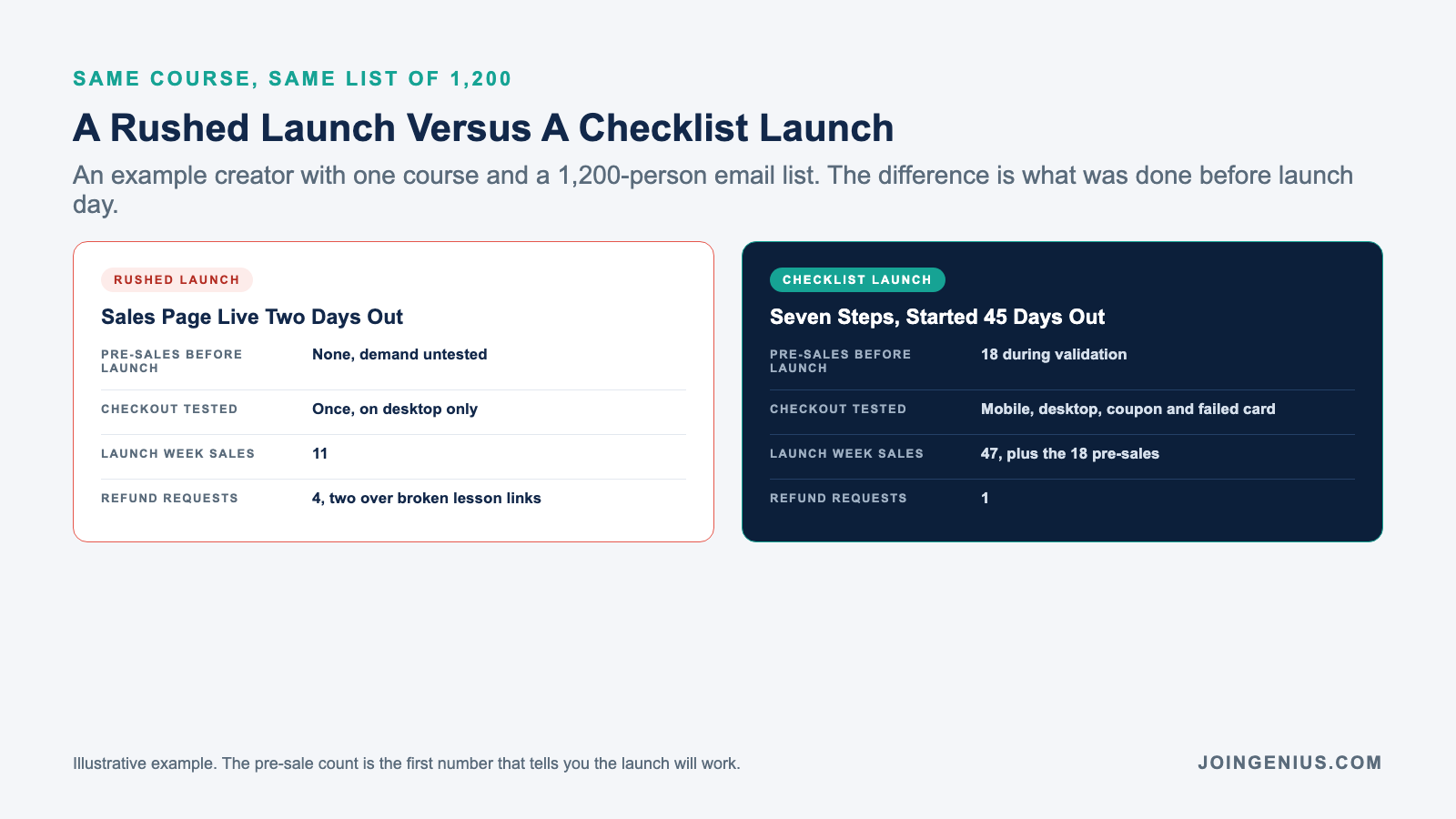
Here is an illustrative example. A creator has one course and an email list of 1,200 people. In the rushed version, the sales page goes live two days before launch. Nobody has pre-paid, and checkout was tested once on a desktop. Launch week brings 11 sales and four refund requests, two of them over broken lesson links.
In the checklist version, the same creator ran a pre-sale at Day -45 and got 18 founding buyers. A beta cohort fixed the first quiz. Checkout was tested on mobile and desktop, with a coupon and a declined card. Launch week brings 47 sales on top of the 18 pre-sales, and one refund request.
The number that told the creator the launch would work came first. It was the pre-sale count, six weeks before anyone saw the sales page.
The Four Numbers To Read One Week After Launch
Number one is the sales page to checkout rate. It counts visitors who clicked buy as a share of sales page visitors. A low rate points at the promise or the price, not the traffic.
Number two is the checkout completion rate. It counts orders completed as a share of checkouts started. A drop here is almost always a payment or coupon problem, and it is the fastest one to fix.
Number three is the first lesson start rate. It counts buyers who opened lesson one within 48 hours. Number four is refund requests, each one tagged by reason. Broken links and access issues are setup problems, and “not what I expected” is a sales page problem.
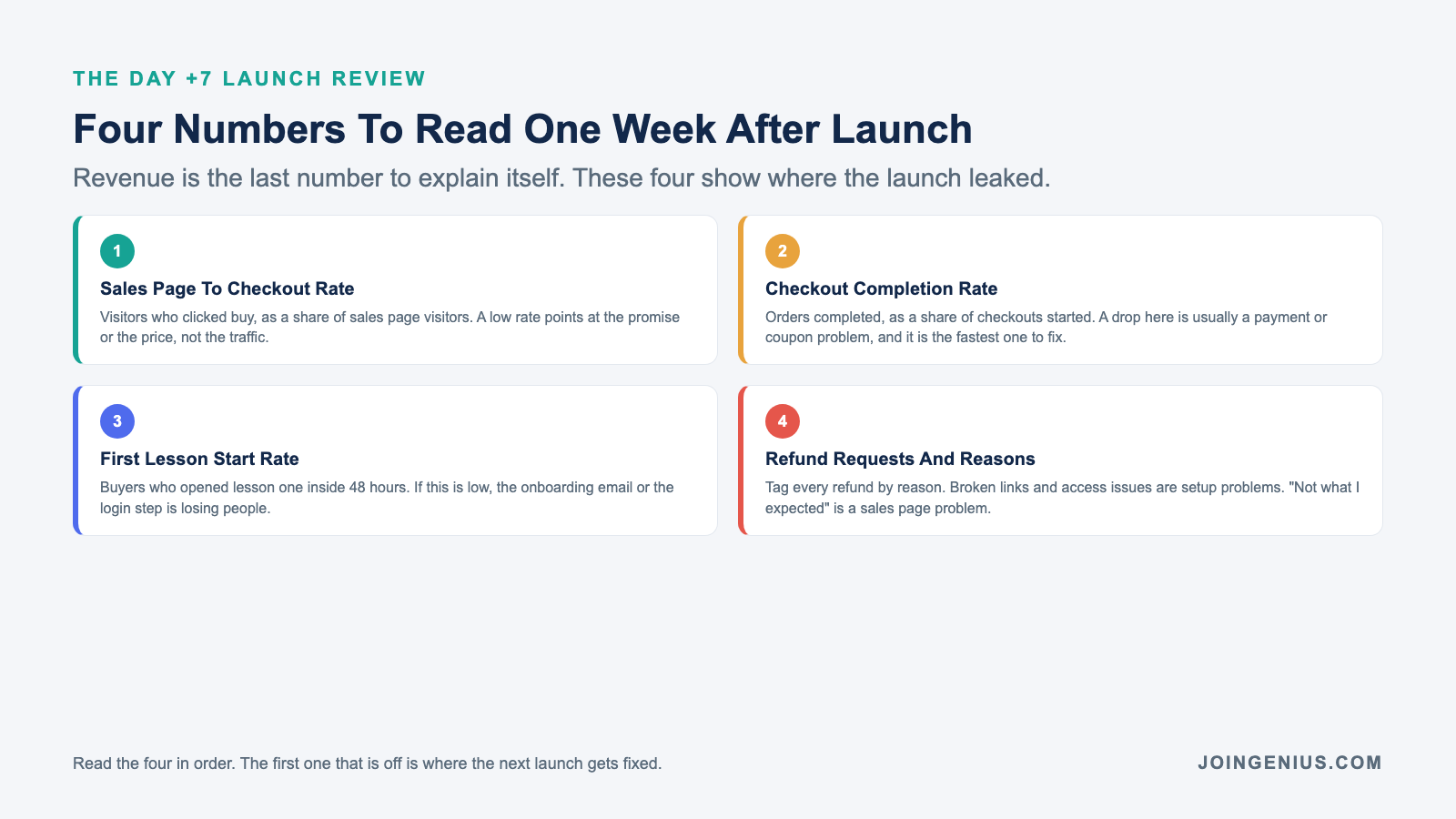
Read the four in order. The first one that is off is where the next launch gets fixed. If you are hiring someone to run launches for you, build these four numbers into your interview rubric for the role.
Hire The Team That Runs Your Next Launch
The creators who launch well are rarely doing all seven steps alone. Someone designs the course flow and the first assessment. Someone else writes the sales page and runs the email sequence. A third person tests checkout and answers the first support tickets.
The people who build learning programs are in demand. The US Bureau of Labor Statistics counts about 472,500 training and development specialist jobs in 2025, with 11 percent growth projected through 2035. The median wage was $69,280 in May 2025.
Genius hires top one percent instructional design and marketing talent from the Philippines and LATAM at roughly 80 percent less than local comp. There are no monthly fees, and every placement comes with a six month replacement guarantee.
We screen candidates on the launch work described on this page before they reach you. That means you meet people who will ask about the pre-sale count in week one, rather than discovering a broken checkout on launch day.