Long-form video on YouTube has quietly become television. The script is what decides whether a thirty-minute video gets watched or scrubbed through. Most of the long-form playbooks that ship with a “write a strong hook” line were built for a 2022 audience that would give the first ninety seconds the benefit of the doubt. The 2026 audience will not. The retention math has moved, and the format itself has shifted from a written page to modular blocks the creator assembles on a timeline. This guide walks a content writer through the script-writing passes that actually make a thirty-minute video hold to the end.

Why Long-Form Scripts Carry More Weight In 2026 Than They Did A Year Ago
The long-form script is a sharper lever in 2026 because the retention baseline on the platform has moved under it. The viewer who stayed for the first three minutes last year is not staying this year, and the script has to earn every minute it gets.
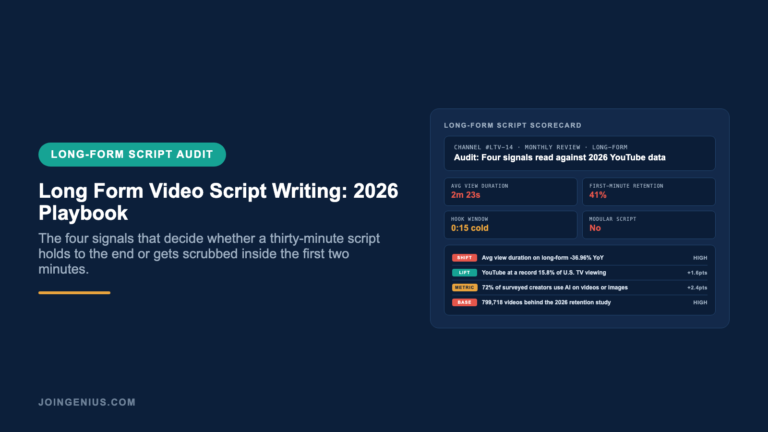
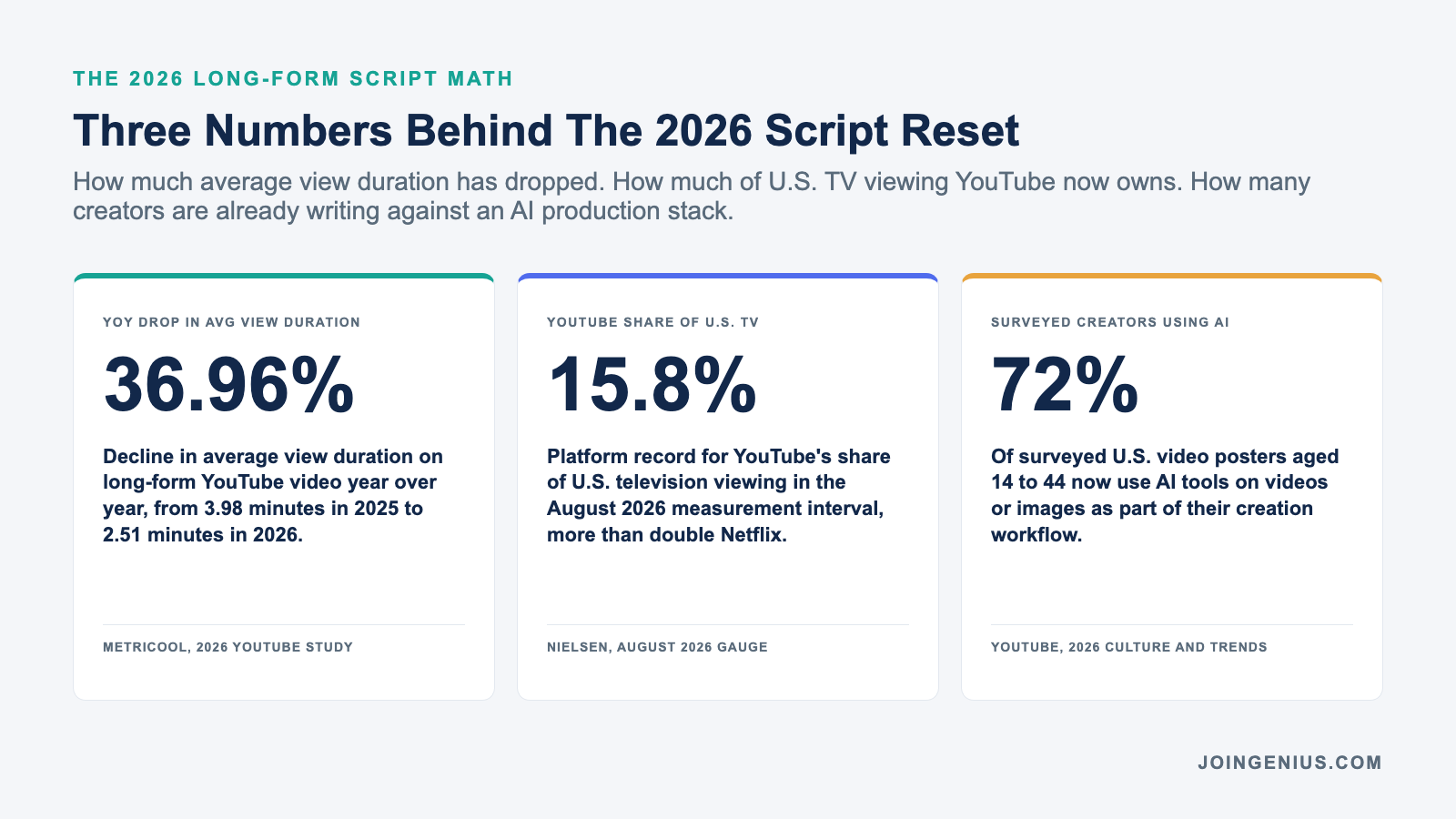
According to Metricool’s 2026 YouTube study of 799,718 videos across 71,177 accounts, average view duration on long-form video fell to 2.51 minutes, down 36.96 percent year over year. Views still climbed 76 percent in the same period, so the audience is watching more videos but staying inside each one for less time.
The long-form writer who ignores that split writes the same twelve-minute script the same way the same year. Views do not land. The edit the script needs is upstream of the edit the editor makes.
The Hook Window That Decides If The Script Gets Watched
The hook is not the first ninety seconds anymore. It is the first thirty, and most long-form scripts start writing the hook about fifteen seconds in.
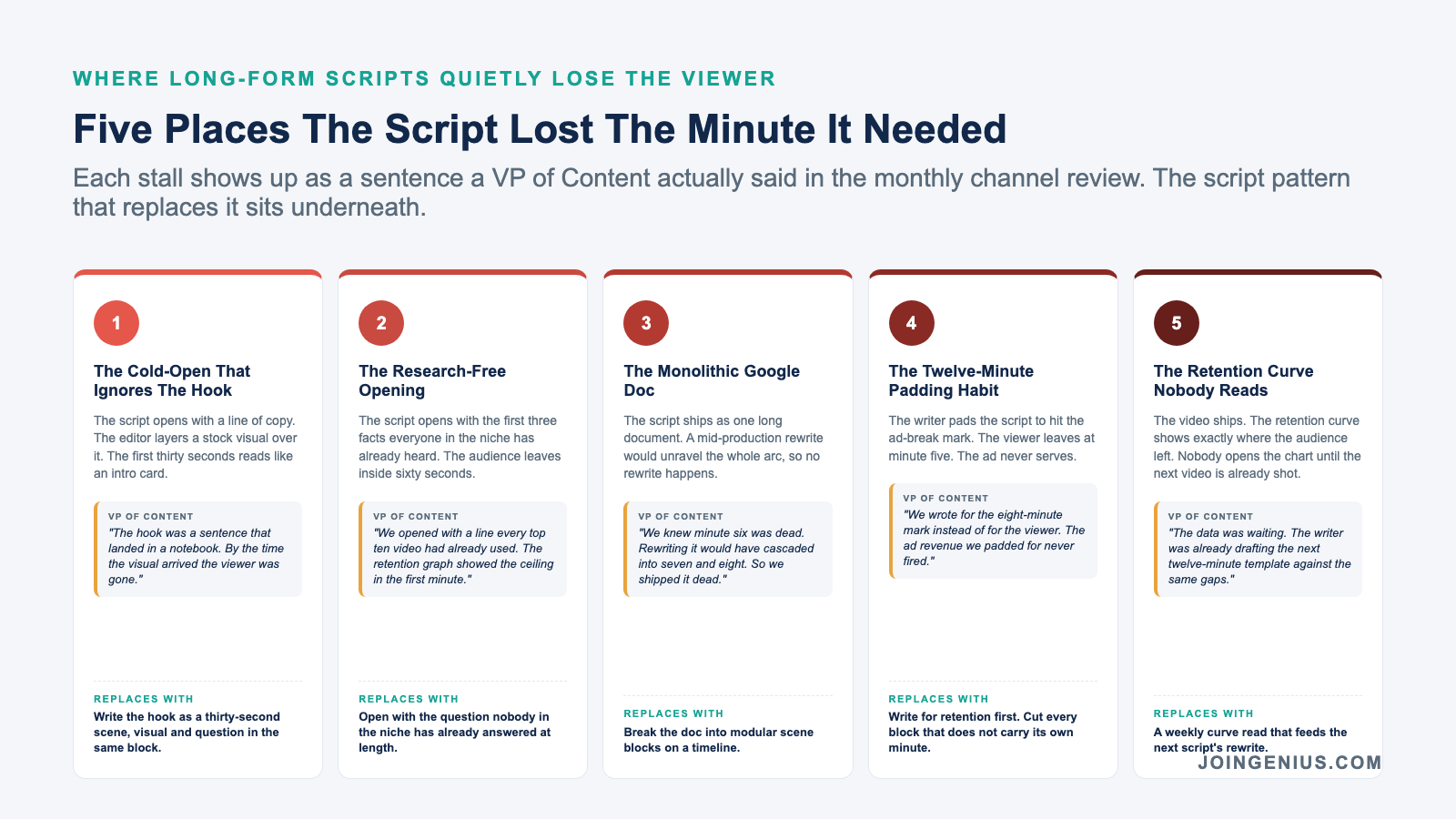
The script problem is that the writer treats the hook as a line of copy, so a copywriter writes it as if it were the headline on a landing page. The hook is a thirty-second scene instead.
It has to open with a visual the viewer can read at a glance and a question the viewer already has in their own head, with a promise that the next twenty-nine seconds will answer the question.
The writer scripts all three in the same thirty-second block, rather than scripting a cold-open line and letting the editor layer the visual on top later.
A scene test on the hook is a thirty-second cut read by a second pair of eyes against the channel’s retention pattern, not a sentence read aloud at a desk. The test takes about ten minutes. The script writers who run it are the ones whose first-minute retention has stayed above the channel’s baseline through the retention reset of 2026.
Scripts that treat the hook as a scene test twice before shipping. Scripts that treat it as copy ship once and bleed on the retention graph in the first minute.
What Long-Form Scripts Are Now Competing Against
The long-form script of 2026 is not competing with other YouTube long-form. It is competing with television production.
In Nielsen’s August 2026 Gauge report, YouTube reached a record 15.8 percent of U.S. television viewing in the measured month, up from 14.2 percent in July and more than double Netflix at 7.7 percent.
The practical implication for a script is that the viewer watching it on a living-room TV is reading it against a different grammar than a laptop viewer did in 2022.
The pacing has to feel like television. The information density has to feel like an essay. The script that meets both is the one that compounds on the channel’s long-term watch time, because the viewer chose to turn the TV on and chose this video to fill it.
The Research Layer That Separates Watchable Scripts From Padded Ones
The script-writing problem most long-form creators under-index on is research. The video that opens with the same three facts everyone in the niche has already heard is the one that gets scrubbed inside sixty seconds.
YouTube’s 2026 Culture and Trends report, which surveyed 694 U.S. video posters aged fourteen to forty-four, found that seventy-two percent of surveyed posters now use AI tools on videos or images as part of their creation workflow. Sixty-one percent said they are interested in using AI to insert themselves into content.
The implication for a scripter is that research can now move faster than production. An SEO specialist pulling the long-tail topic cluster for the niche and the top-performing titles against it can hand a writer a research brief in an afternoon that would have taken a week in 2022.
That is where the padded script turns into the researched one. The script that opens with the question nobody in the niche has already answered at length is the one that holds past minute two.
Why Written Pages Are Shifting To Modular Blocks
The long-form script of 2022 was a Google Doc with headings. The long-form script of 2026 is a set of modular scene blocks on a timeline, each with its own voice track and visual direction, with B-roll notes attached.
The shift matters because the writer and the video editor stop being two roles separated by a hand-off. The writer scripts the block. The editor assembles the block. The two now work against the same timeline, not across a document.
The modular script is also the one that survives a mid-production rewrite. A block that is not working can be rewritten without rebreaking the whole arc, which is the lever most twelve-minute scripts lose when they ship as one long document.
The modular layout is also what makes a thirty-minute script feasible for a creator team of one. Each block is a self-contained unit of work that can be written and voiced in one sitting, with the rendering handled before the next block begins, so the project never sits unfinished at the ninety-percent mark.
From Written Script To Published Video
The written script is one half of a long-form video. The other half is the published asset. The gap between the two is where most long-form projects stall, because the writer finishes a document and the production stack has to translate it into visuals and voice, with music and thumbnail work still to come.
The old workflow handed that gap to a production team that charged by the minute of finished video. The new workflow treats the gap as a software problem, because the pipeline from script to video has itself been rewritten by generative AI tools.
Where Crreo AI Fits
Crreo AI turns a finished long-form script into a complete video up to 30 minutes for YouTube creators, educators, and storytellers, closing the gap between a written outline and a published video.
What that does for the scripter is reshape the final draft. The script is no longer a document a production team will interpret. It is a brief a generative stack will render against, which means every scene block in the modular script becomes a render target with a measurable output.
The writer now writes for the renderer as well as for the viewer. The block that renders well has a clear visual verb and a line of narration under fifteen seconds, with a scene-specific prompt the renderer can act on without ambiguity.
The block that renders poorly reads like a paragraph of exposition that assumes a production team will figure out the visuals in post. Nothing figures them out. The scene renders as the line sounds.
The Retention-Curve Edit Pass Nobody Teaches
After the script is written and the video is rendered, the retention curve shows up. Most long-form writers never run the edit pass that uses it.
A data analyst looking at the retention curve for the last six videos can hand the writer three specific moments inside the script where the audience left, and the writer then rewrites those three moments into the next script before the next one is shot.
That feedback loop is the piece that compounds. One cycle of it is a minor rewrite. Six cycles of it is a script writer whose channel has quietly doubled its average view duration on long-form while everyone else is still shipping the same twelve-minute template.
The Playbook For Writing A Thirty-Minute Script That Holds
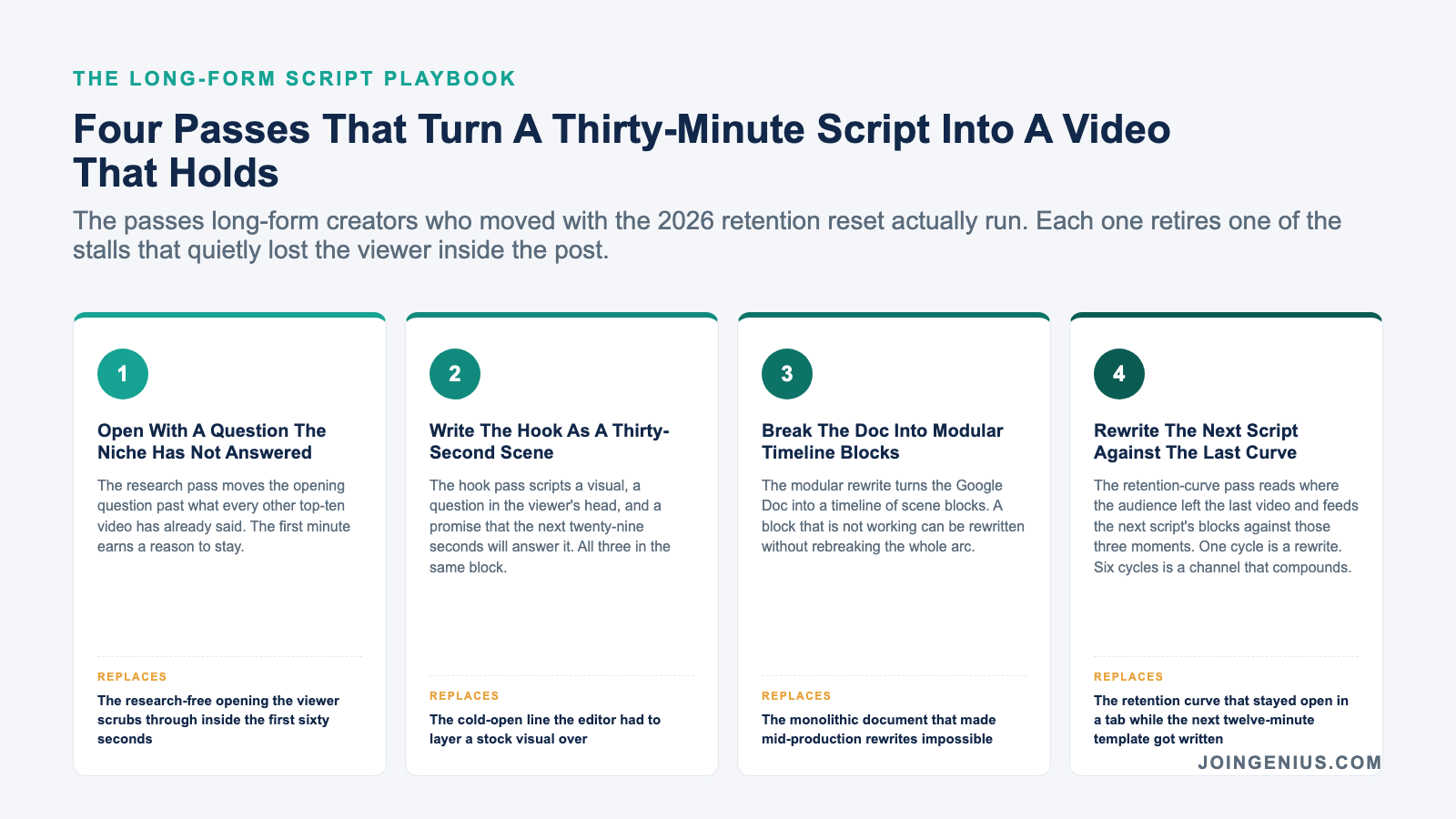
The four passes that produce a thirty-minute script that actually holds stack in a specific order.
The first is the research pass that moves the opening question past what the niche has already heard. The second is the hook pass that treats the first thirty seconds as a scene, not a line.
The third is the modular rewrite that turns the Google Doc into a timeline of blocks. The fourth is the retention-curve edit pass that feeds the next script against the last video’s drop-offs.
Each pass by itself produces a marginally better script. Stacked, they produce a long-form video that lands inside the top decile of the channel’s retention graph, because the script treats the first thirty seconds and the middle three minutes as distinct problems, with the last five minutes handled by its own pass.
Conclusion
The long-form script of 2026 is not harder to write than the one of 2022. It is written against a different set of constraints. The retention baseline has moved. The competition has become television. And the production stack now renders against the script rather than interpreting a document.
The scripter who moves with those constraints is the one whose channel compounds through 2026 and into 2027. That shelf of talent, the long-form writer who scripts against the retention curve, is the one Genius operators are hiring into this year.