An app marketer spends week one after launch watching a dashboard and the next three explaining why installs cost more than the plan said. App advertising best practices are not a list of channels and bid types. They are a short set of decisions made before the first dollar goes live.
Below, we cover why the first 30 days decide the growth curve, the four rules of app ad creative, how to pick targets after the audience options got smaller, what to trust after ATT, and the team shape that keeps the program working. We finish with the campaign metrics that matter most to track from week one.
Why The First 30 Days Decide The App’s Entire Growth Curve
App advertising budgets rarely fail at the end. They fail in the first month, when assumptions from the pitch deck collide with what the live auctions actually cost. Most of the decisions that will matter later are made or missed in that window.
The Three Numbers A Team Should Lock Before Day One
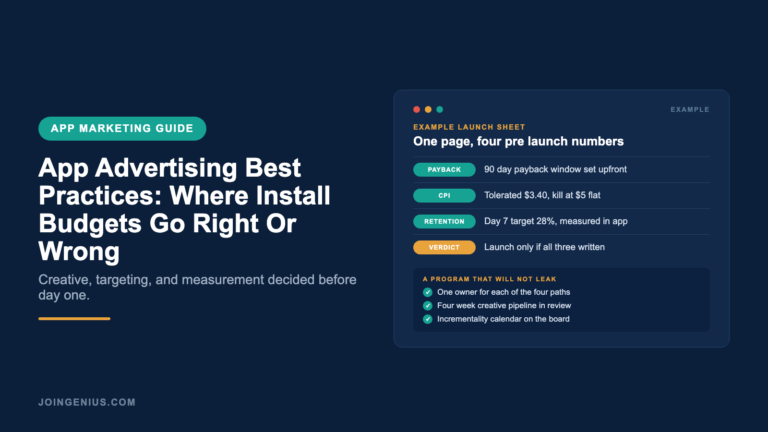
A payback window, a tolerated cost per install, and a cohort retention target. All three have to be written down in a single document before the campaign launches. If any of the three is a feeling, the campaign is a budget test, not an advertising program.
The payback window is usually 60 to 120 days for a subscription app and up to 180 days for a utility. The CPI ceiling is a kill switch, not a target. The retention number is a cohort number, not a daily average, because daily average retention hides which install source is actually sticking.
Why The Auction Will Teach You Something Your Research Did Not
No pre-launch competitor study survives first contact with the real auction. The winning creative in week one is almost never the one the agency recommended. Treat the first 72 hours of live spend as paid research, and give the team permission to kill ideas that the auction is not confirming.
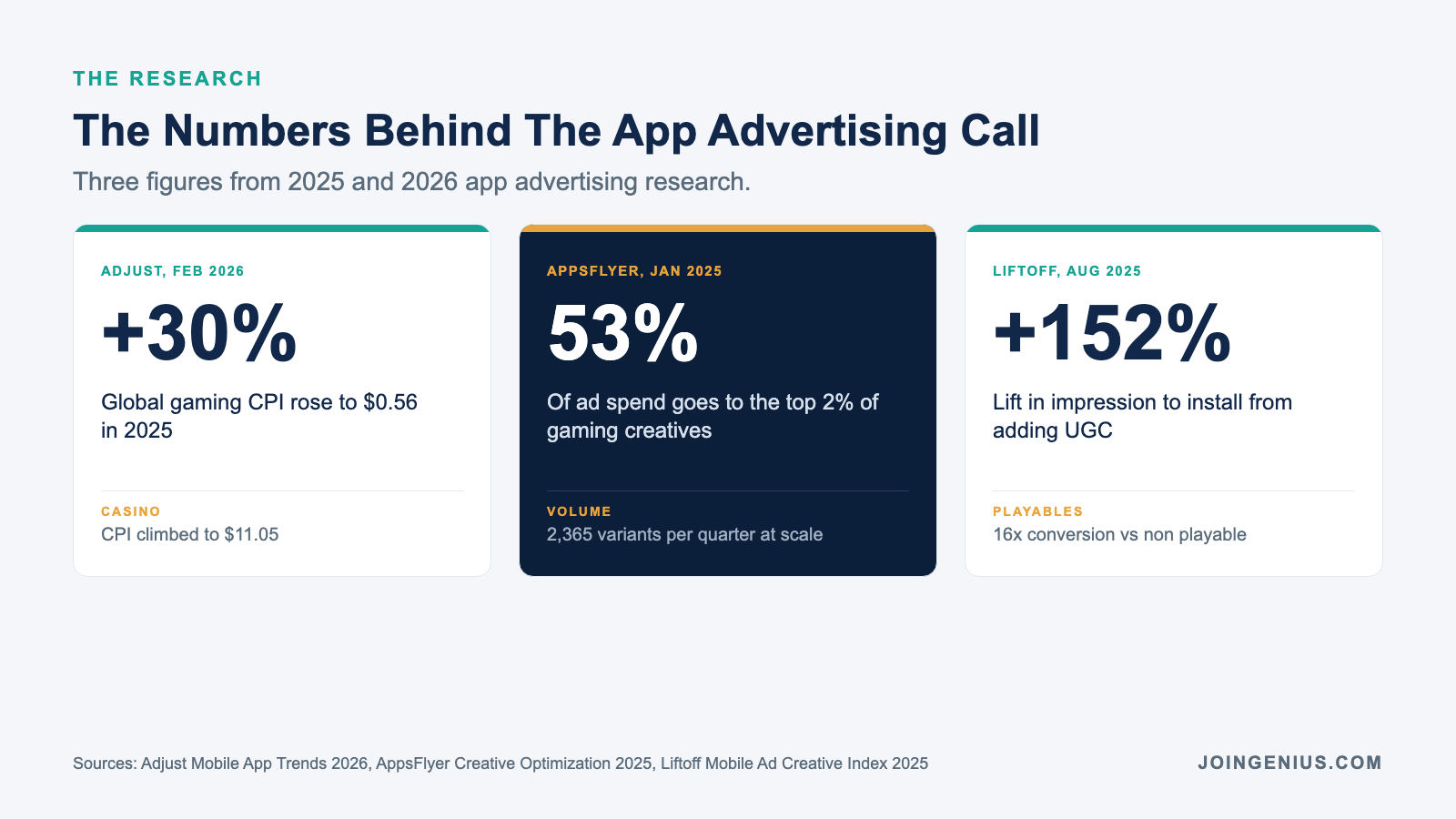
A February 2026 Adjust Mobile App Trends report put the global gaming cost per install at $0.56 in 2025, up 30% year over year, with casino at $11.05. A live campaign now costs more in its first 30 days than the one before it did in its final 30.
The Four Rules Of App Ad Creative That Hold In 2026
Creative is where app advertising best practices change fastest, and where more budget gets wasted than in any other decision. The four rules below are what the top performers follow even when a platform rep suggests a shortcut.
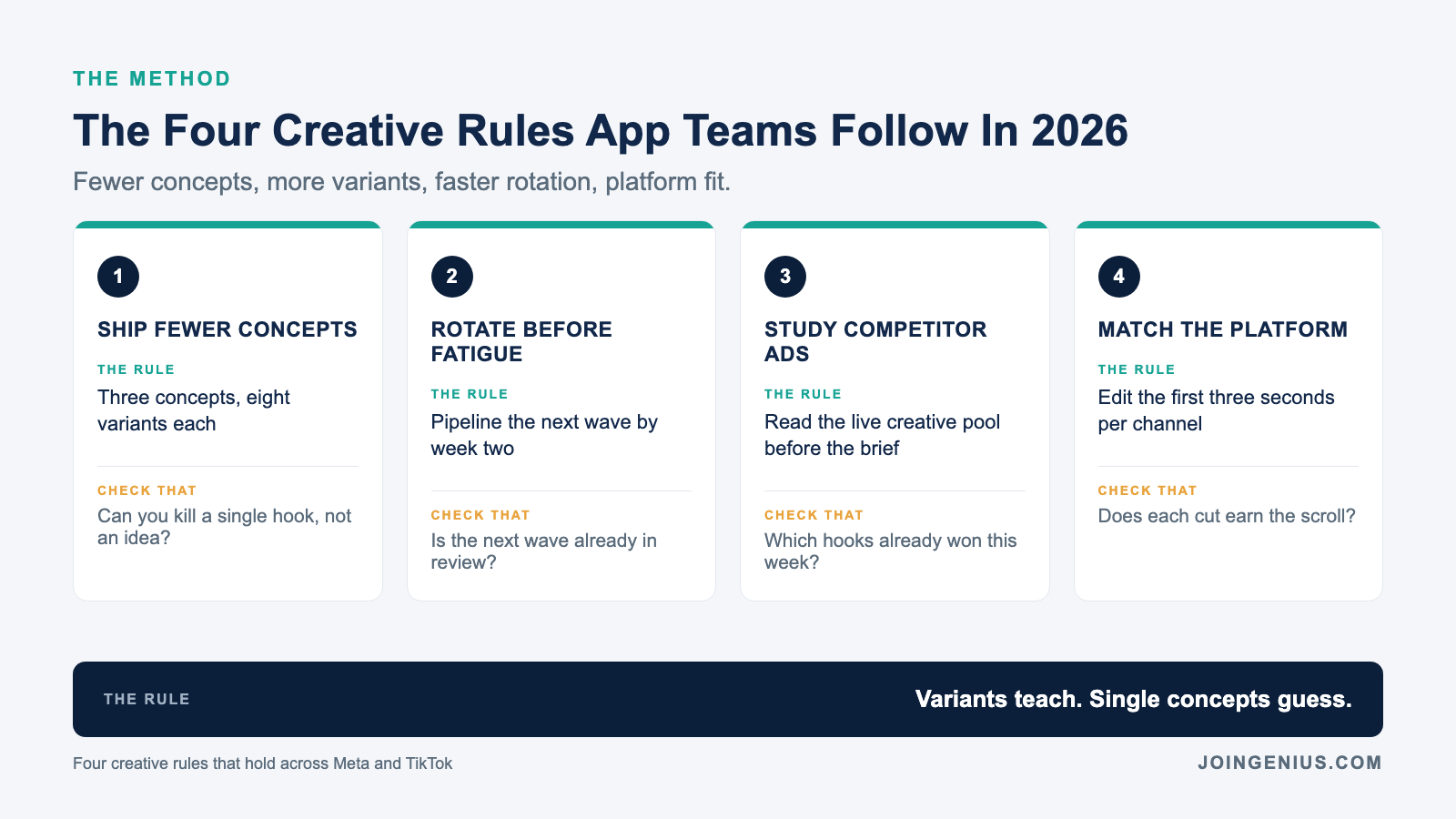
Ship Fewer Concepts, Test More Variants Of Each
Three concepts with eight variants each beats twelve concepts with one variant each. Variants teach a team which hook is working inside a winning concept. A single-variant concept that dies tells the team nothing about why.
Rotate Before Fatigue, Not After It
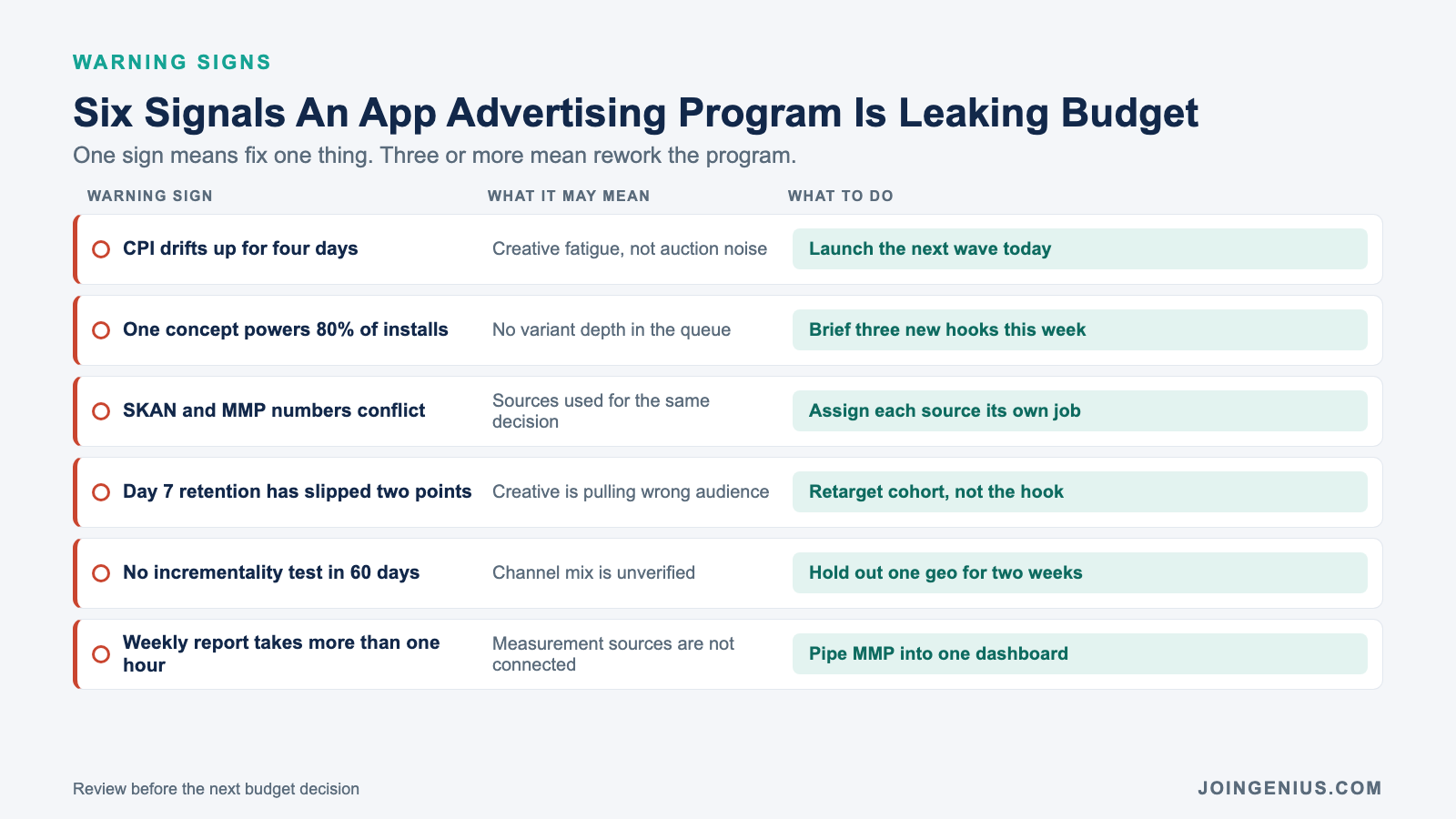
A winning creative on Meta or TikTok decays within two weeks even at moderate spend. The rotation calendar has to be set before the first creative goes live, not after cost per install starts drifting. Teams that only react to fatigue always pay for it.
- Build a four week creative pipeline so the next wave is already in review when the current one peaks.
- Reserve 20% of creative spend for genuinely new concepts, not fresh takes on the current top performer.
- Keep the hook variable, not the whole ad; most decay is in the first three seconds.
- Kill a concept the day its CPI crosses 1.5 times the account median, not the day finance notices.
Use Ad Intelligence Before Any New Creative Brief
The best creative teams study what competitors are already running before they write a new brief. SocialPeta’s ad creative intelligence is built for that step, so a team can see which hooks, formats, and selling points are working in their category before the brief goes to production, not after it fails in auction.
Match The Creative To The Platform, Not The Other Way Around
A TikTok ad that is a Meta ad with a hashtag will underperform both. The same team that writes the brief should know which three seconds of each ad are load bearing on each platform, because TikTok analysts who read data are the ones who catch the pattern first.
Who To Target When The Audience Options Got Smaller
After the 2021 privacy changes, the targeting toolkit that app advertisers grew up on was replaced by a smaller one. The teams that scaled anyway are the ones that stopped targeting by signals the platform no longer provides and started targeting by cohorts the app itself can describe.
Cohorts To Describe Before The First Campaign Group
Which behavior in the app signals a profitable user. Which event, inside the first session, best predicts day 30 retention. Which three creatives speak to the top 20% of value users. These three answers decide who the auction should optimize for, and they come from the app’s own data, not from the ad platform.
The AppsFlyer 2025 Creative Optimization report, drawn from 1.1 million video variations across 1,300 apps, found the top 2% of gaming creatives captured 53% of total spend, and non-gaming advertisers spending over $7 million a quarter now average 2,365 variations per quarter. Audience shrank. Creative volume matters more.
Measurement After ATT: What To Trust And What To Ignore
Measurement is the part of app advertising best practices that most teams quietly stopped doing well in 2021 and never restarted. The table below is a short reference for what each attribution path actually tells you now.
Four Attribution Paths And What Each One Really Reports
Mixing SKAN reports with MMP reports as if they measured the same thing is the single most common reason budget decisions go wrong. Each source has a job, and the team should name them before any report goes to the CFO.
| Attribution Path | What It Reports | Trust It For | Do Not Use It For |
|---|---|---|---|
| SKAdNetwork 4 postbacks | Deterministic iOS installs, delayed | Platform level install allocation | Fast creative iteration or day one bids |
| MMP probabilistic model | Modeled installs across sources | Cross channel direction, not exact counts | Finalized CAC numbers at the SKU level |
| Incrementality tests | Lift above organic baseline | Deciding to keep or cut a channel | Daily pacing decisions on live spend |
| In app analytics on cohorts | Behavior and revenue post install | Judging creative quality and LTV | Attribution to a specific ad group |
Teams that run performance marketing without losing conversions treat these four paths as four different jobs, not four opinions on the same number.
Liftoff’s 2025 Mobile Ad Creative Index, based on 4.7 trillion impressions and 1.1 billion installs, found that advertisers who added user generated content to a campaign raised impression to install conversion by 152%, and playable ads converted 16 times better than non playable ads for all but the largest spenders.
Who Should Run The App Advertising Program And When
App advertising best practices only compound when the team that runs them stays long enough to learn the account. The most common structural mistake is hiring for channel execution before hiring for data and creative.
The Three Roles The Program Cannot Run Without
A media buyer who owns the auctions day to day. A creative strategist who briefs and reviews every variant. An analyst who owns the dashboard and the incrementality calendar. Any gap in these three is the gap the next 60 day spend will leak through.
- Pick a media buyer with two full cycles of SKAN postback experience on iOS, not channel certifications.
- Pick a creative strategist who can read a video edit and a cohort retention chart in the same meeting.
- Pick an analyst who has published a lift test writeup, not only a weekly dashboard.
- Rotate none of the three in the first six months; the learnings are what you paid the first budget for.
When Each Role Should Be In House Versus Agency
In house works when the brand plans to spend for at least 18 months. Agency works when the team needs channels the brand cannot staff yet. A fractional creative strategist usually beats a full time one until paid install spend hits six figures a month. A good creative review process keeps either shape moving.
Conclusion
Before any new app campaign goes live, write a single sheet: payback window, tolerated CPI, the two cohorts the auction should learn, and the four measurement paths you will not confuse. If that sheet does not exist, the program is a budget test. App advertising best practices start by treating the first 30 days as paid learning.
Genius staffs either side of this. We place top 1% media buyers, creative strategists, and performance analysts from the Philippines and LATAM at 80% less than a comparable US hire. No monthly fees, every hire backed by a 6 month guarantee. If your next app launch needs a team that reads SKAN postbacks by week two, hire with Genius.