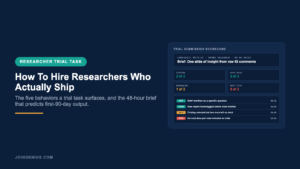
Hiring researchers is where most brand teams quietly lose the next quarter. The resume reads like fifty other resumes. The interview covers frameworks everyone has read the same thinkpiece about. And the candidate lands on day one with no obvious way to prove they can turn noisy consumer data into something a VP will act on. Six weeks later the team is still waiting for the first slide. This post covers why the resume signals fail and which five behaviors a good trial task surfaces and the specific 48-hour brief that separates the researchers who ship from the researchers who read.
Why Resumes Fail For Researcher Roles
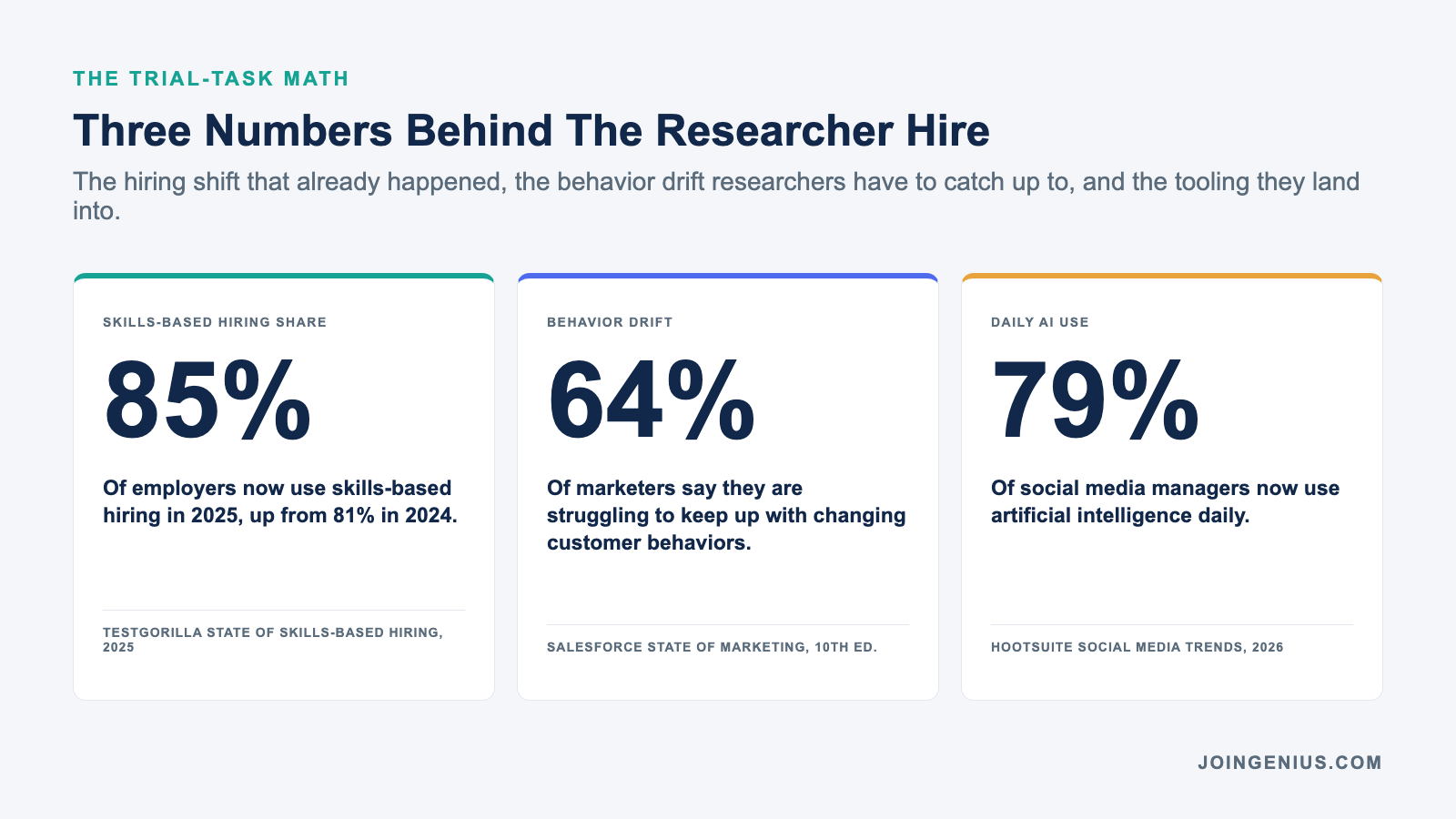
The hiring market already moved past resume-only filtering. TestGorilla’s State of Skills-Based Hiring 2025 report, based on 1,084 hiring decision-makers and 1,076 job seekers across the UK and US surveyed in April 2025, found that 85% of employers now use skills-based hiring, up from 81% in 2024.
The research role is where that shift hits hardest, because the job is defined by output no resume can preview.
A researcher’s resume can tell you where they went to school and which agencies they worked at and which brands they studied. It cannot tell you whether they will spot the pattern in a messy export on a Tuesday afternoon.
The failure mode is specific. Teams hire someone who talks beautifully about segmentation at the final-round and then produces nothing a stakeholder can act on for the first two months.
The data analysts who make it on brand teams are the ones who can stand up a view of a messy export in an afternoon, not the ones who can recite the right framework.
Researchers are measured on the same instinct, applied to qualitative data instead of tabular data. The trial task is where that instinct becomes visible, because every candidate performs it on the same inputs and the output either exists or it does not.
Five Behaviors A Good Trial Task Surfaces
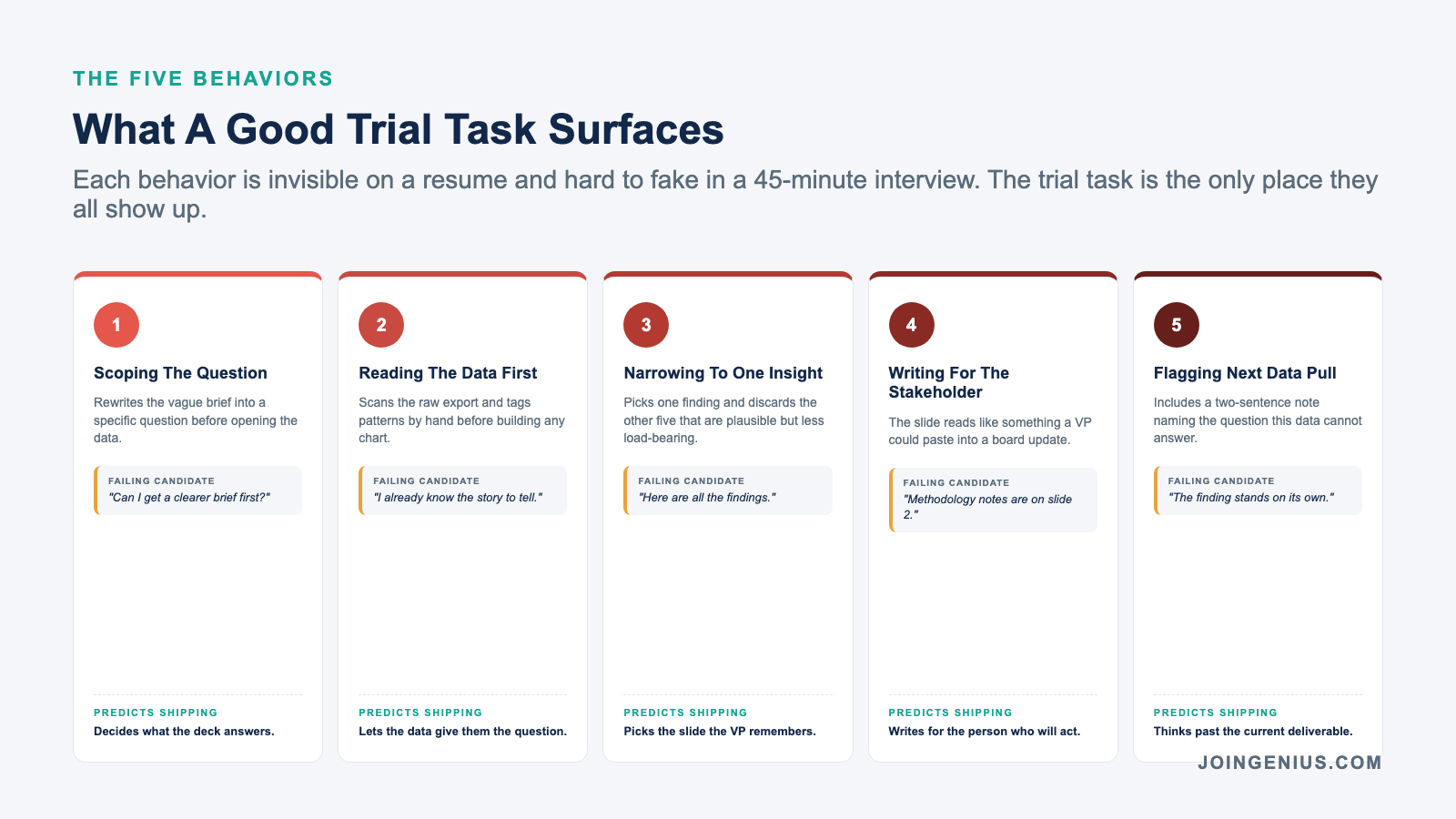
Each behavior below is invisible on a resume and hard to fake in a 45-minute interview. A good trial task surfaces each one on the same deliverable from the same inputs, which is the only way to compare candidates on the dimensions that predict first-90-day output.
| Behavior | What It Looks Like In The Trial | Why It Predicts Shipping |
|---|---|---|
| Scoping The Question | The candidate rewrites the vague brief into a specific question before opening the data and does not ask for more inputs. | The researcher decides what the deck answers instead of waiting for a stakeholder to clarify what they actually want. |
| Reading The Data First | The candidate spends the first third of their time scanning the raw export and tagging patterns by hand before building any chart. | The researcher trusts the data to give them the question instead of pushing a prior hypothesis onto it. |
| Narrowing To One Insight | The candidate picks one finding and discards the other five that are plausible but less load-bearing. | The researcher knows a slide the stakeholder will remember beats a slide that covers everything. |
| Writing For The Stakeholder | The candidate’s slide reads like something a VP could paste into a board update, not a methodology document. | The researcher writes for the person who will act, not for the person who hired them. |
| Flagging What They Would Do Next | The candidate includes a two-sentence “next data pull” note that names the specific question the current data cannot answer. | The researcher thinks past the current deliverable, which is the behavior that compounds in the first 90 days. |
Each of the five behaviors maps to a mistake a stakeholder sees in the first month.
A researcher who skips scoping delivers a deck that answers the wrong question. A researcher who skips the data read delivers a deck that confirms what the team already believed. A researcher who refuses to narrow delivers a deck the VP never gets past the agenda slide.
The Insight Gap A Trial Task Is Really Measuring
The reason the trial task matters is that the gap between raw data and a shipped insight widened in the last two years.
The Salesforce Tenth Edition State of Marketing report, based on 4,450 marketing decision-makers surveyed across 26 countries from October 8 through November 17 2025, found that 64% of marketers say they are struggling to keep up with changing customer behaviors.
Behavior drift outruns the research function when the function hires on credentials and ships on vibes. The marketing managers feeling that pain are not asking for better methodologies. They are asking for the research hire who can turn an Instagram comment thread or a customer support ticket into a decision by Friday.
The second half of the gap is that the tools have changed. Hootsuite’s Social Media Trends 2026 analysis reports that 79% of social media managers now use artificial intelligence daily, which means a researcher who still frames the job as collecting data is a researcher who will arrive after the team already has the data and still needs the synthesis.
The trial task tests the synthesis side of the role, which is the side the AI tooling has not automated. Any candidate who leans on the AI to do the thinking will produce a deck that reads like a dozen other decks and will get filtered inside the first scoring pass.
The Trial Task That Predicts First-90-Day Output
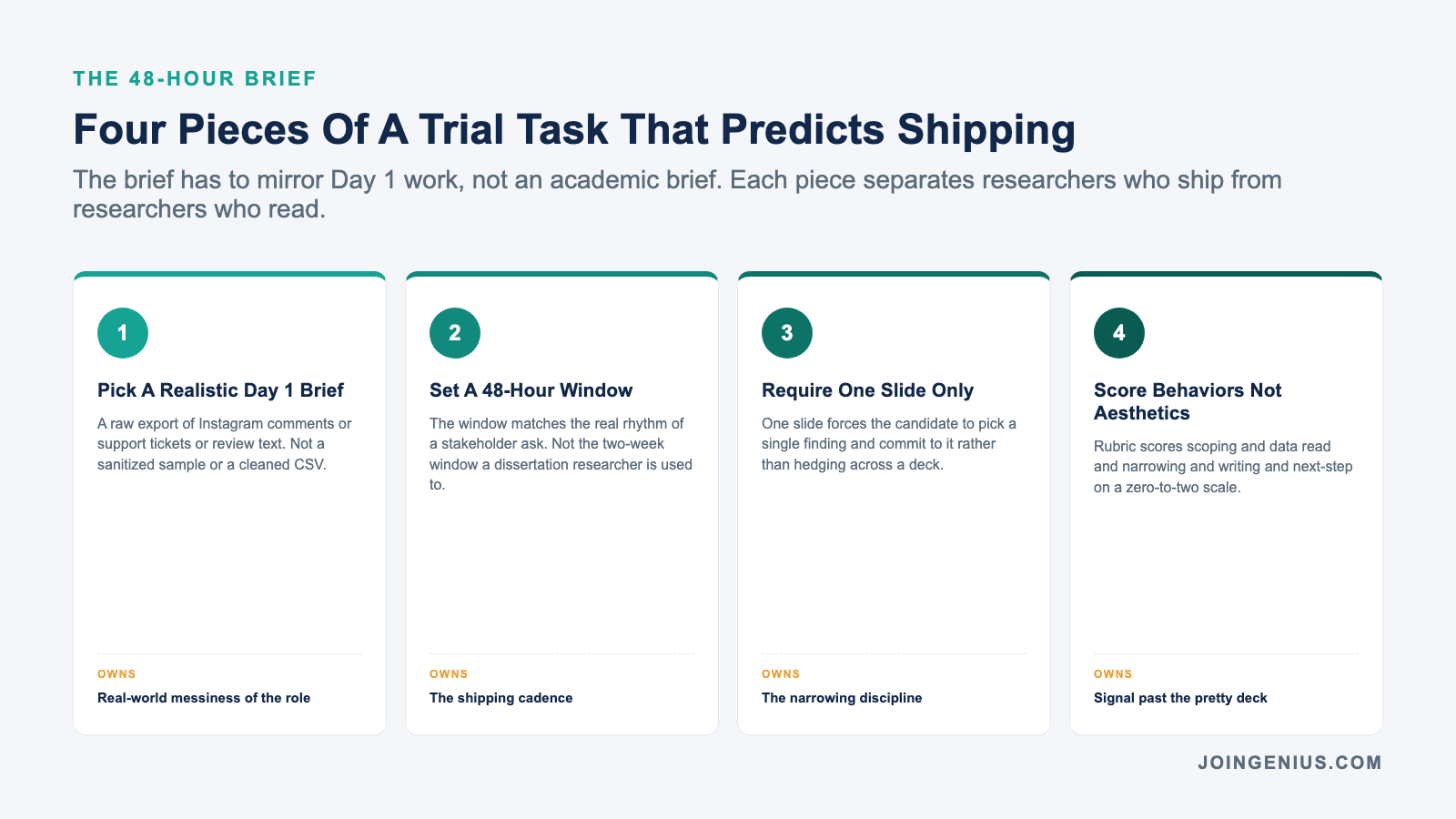
The trial task that predicts first-90-day output is specific and cheap to run and honest about what you are measuring. The trick is picking a brief that mirrors the actual Day 1 work and not a brief designed to make the candidate feel tested.
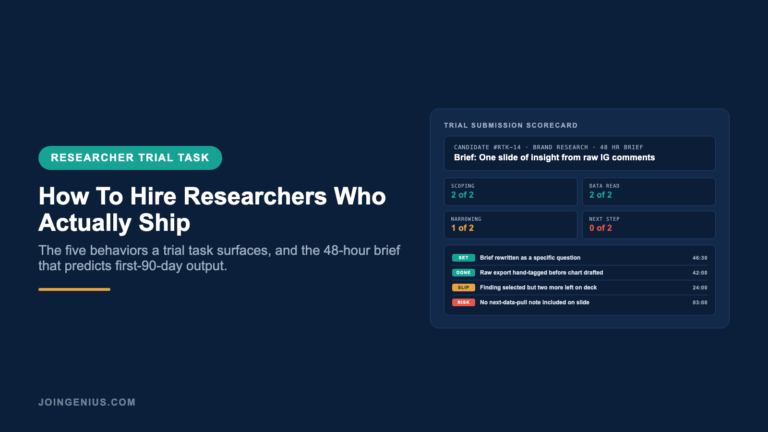
Hand candidates a raw export of Instagram comments and ask for one slide of insight in 48 hours, and the top 10 percent will find a pattern the brand team did not already know.
Three things make this brief predictive.
The raw export contains thousands of real-world strings rather than a sanitized sample, so the candidate has to decide what to ignore.
The 48-hour window matches the actual rhythm of a stakeholder ask on a real team, not the two-week window a dissertation researcher is used to.
And one slide forces the candidate to pick a single finding and commit to it, which is the hardest part of the job and the part no interview question covers.
The 48-hour window is the compression function. It filters researchers who treat every brief as a publishable thesis from researchers who treat every brief as an operating decision. The operating-decision mode is the one every brand team actually needs, because the decision was already made by Friday whether the researcher shipped or not.
Provide the export with no pre-processing. No cleaned columns and no sentiment labels and no sampled subsets. The point is to see whether the candidate can impose structure on raw material, which is what the job asks every week.
The social media managers who run the resulting insights already have cleaned data from the tools. The researcher’s value is in the step that comes before the dashboard, not the step that comes after.
How To Score The Trial Without Falling For The Pretty Deck
Scoring the trial is where most hiring teams quietly undo the work the trial did. The deck that scores best in a casual review is almost always the deck with the cleanest visual design and the shakiest finding.
The deck that predicts shipping is almost always the deck with one clear number and one blunt recommendation and visual design that looks like something a working analyst makes on a Thursday afternoon.
The fix is a scoring rubric written before the first submission lands. The rubric scores each of the five behaviors from the table above on a 0-2 scale, with 2 reserved for behaviors the candidate executed in a way the hiring team had not seen before. Every reviewer scores independently. Scores get compared only after every reviewer has filed theirs.
The recruiters who run this process well never give the hiring manager the sum. They give the five sub-scores so the manager can see which behavior the candidate missed.
A candidate who scored a 2 on scoping and a 0 on narrowing is different from a candidate who scored a 1 on all five, and the difference matters to whether the hire ships in the first 90 days.
The false positive to watch is the candidate who finds a pattern that is real but obvious. The brand team already knew engaged users leave positive comments.
The deck that calls that out is a failing deck in disguise. The deck that notices that negative comments cluster around a specific product sub-feature mentioned nowhere else in the data is the one that passes.
Shipping Is The Skill, Not The Credential
The researcher who ships in the first 90 days is not always the one with the most impressive resume. The resume is a lagging indicator of jobs that already existed. Shipping is a forward indicator of jobs that need doing now.
The 48-hour trial separates the two on the dimensions that predict output, and no other filter in the hiring process even tries.
A hire who ships in week two changes what the next six months look like for the brand team, because every other decision moves faster when the insight turnaround drops below a quarter.
Genius builds the brand research and analyst talent who can turn a raw comment export into a decision by Friday, which is the only version of the researcher role that actually earns its headcount.