The App Store and Google Play do not rank apps the way most ASO reports imply. The pretty keyword table that lists search volume and current position hides the signal your app actually competes on. A store algorithm reads the keyword and scores the app against metadata placement and download velocity and retention and review sentiment before it publishes a rank. Treating the list as the lever is why a senior SEO specialist often inherits an ASO stack that has been chasing phantom gains for six months. Fix the signal model first, and the keyword rank tends to follow within one release cycle.
The Signals That Actually Decide A Keyword Rank
The App Store ranks a keyword query against every app indexed for that term, and it reads six signals in parallel before returning a list. Four of the six belong to metadata the app controls directly, and two belong to behavior the user controls after install.
On Apple, the metadata signals are the title and the subtitle and the 100-character keyword field and the in-app purchase names. On Google Play, the signals are the title and the short description and the long description. The two behavior signals are install conversion rate on the product page and 30-day retention of the installed cohort.
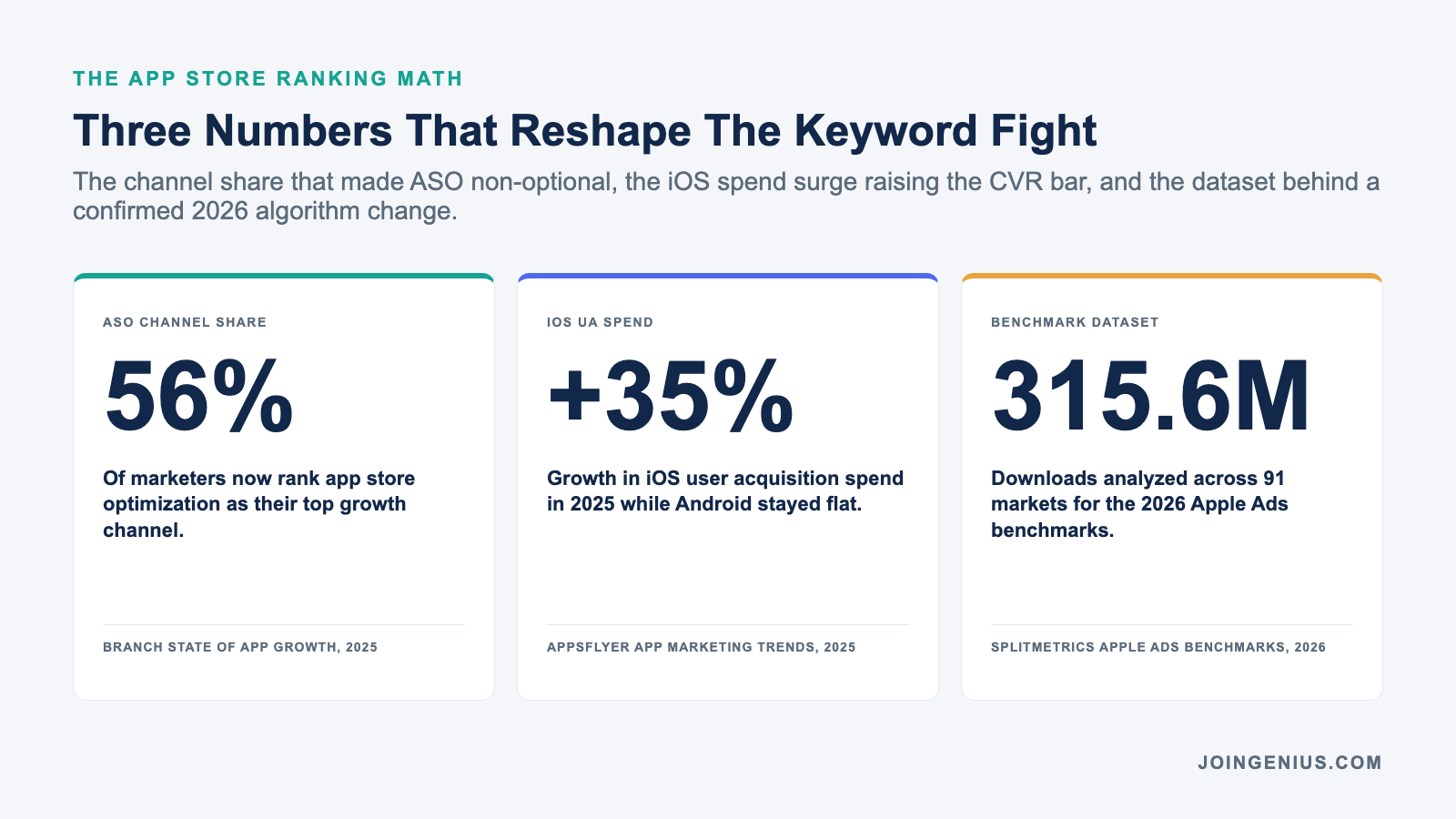
Branch’s 2025 State of App Growth found that 56% of marketers now rank ASO as their top growth channel, ahead of paid search at 50% and paid social at 44%, which is why algorithm fluency has stopped being a nice-to-have. The algorithm scores every app against the same inputs and ranks what is left.
The pretty rank report reads the output. The algorithm reads the inputs.
Title And Subtitle Carry Most Of The Metadata Weight
Among the four Apple metadata fields, the title and subtitle carry roughly 70% of the keyword weight in Apple’s ranking logic. The keyword field carries most of the remaining weight, and the IAP names carry very little unless the app is in a crowded category.
That weighting is why renaming a two-word title into a keyword-dense phrase is often the single highest-lift ASO change a mobile developer can ship in a release cycle. It also explains why so many apps that rank for their brand term rank for nothing else.
On Google Play, the title and the short description carry the heaviest keyword weight. The long description still matters, but Play tokenizes it the way a search engine tokenizes a web page, so repetition past five instances per keyword degrades the signal, it does not amplify it.
The practical rule is one primary keyword in the title and one secondary keyword in the subtitle or short description. Everything else goes in the keyword field on Apple and in the long description on Play.
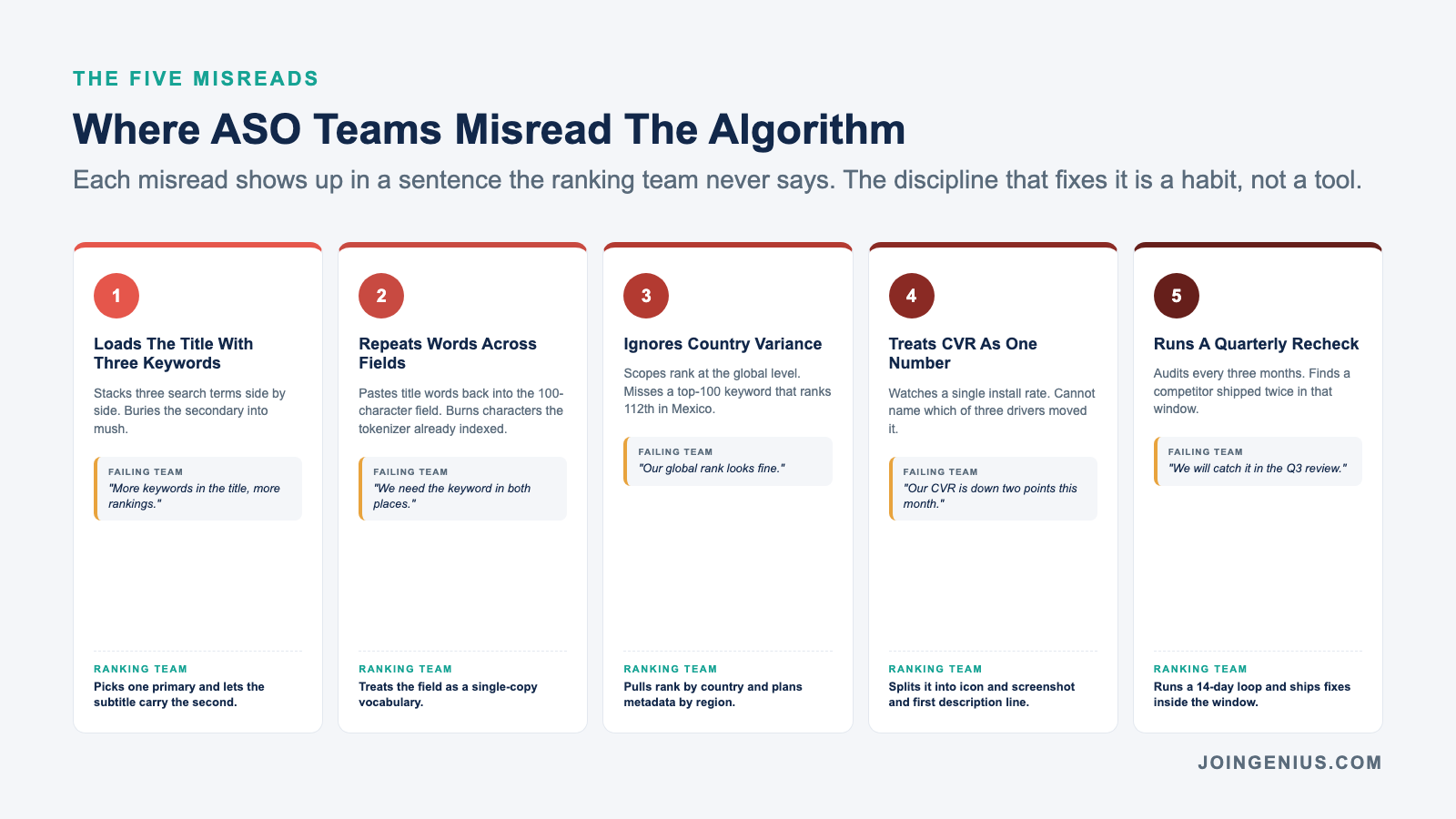
Loading the title with three keywords is the most common cause of a mid-ranking app that never breaks into the top ten for any of them.
Treat The Keyword Field Like A Vocabulary
The iOS keyword field is 100 characters, comma-separated, and it is the most misused field in ASO. Teams load it like a URL query string, with repeats and plurals and brand words, and watch half of those characters get ignored.
Apple’s tokenizer already inherits singular from plural and the reverse, and it already indexes every word in the title and subtitle. Repeating a title word in the keyword field burns characters the algorithm throws away.
The right iOS developer treats the field like a single-copy vocabulary where every token appears exactly once across title and subtitle and the keyword field combined.
A typical audit on a mid-size app recovers 30 to 50 characters of wasted space the first time this rule is enforced. Those characters absorb long-tail terms the app used to rank 40th for and now has room to rank 15th for.
Separator discipline matters too. Commas cost one character and nothing else, so the old trick of dropping spaces after commas remains correct in 2026.
Conversion Rate Is The Dark Signal
Apple and Google both watch install conversion rate on the product page, and they feed it back into the ranking model within a few days. Two apps with identical metadata will rank differently if one converts at 12% and the other at 28% from the same search impression.
Conversion rate itself is a composite of icon recognition and screenshot clarity and the first-line hook of the description, which is why the behavior signal is often the hardest ASO lift to brief. The teams that treat it as a single metric miss three of its drivers.
AppsFlyer’s late-2025 trend data showed global UA spend rose 13% to $78B with iOS user acquisition spend growing 35% while Android remained flat. More apps are now buying their way onto the same search terms, which raises the CVR bar that keeps you ranking there.
The practical fix is a monthly product-page split test through Apple’s Custom Product Pages feature, plus a weekly check on the review star average, since both move the CVR.
What App Keyword Intelligence Data Actually Replaces
Most ASO workflows break at the same point: pulling rank history across 15 to 20 countries weekly into a spreadsheet, while the algorithm has already moved. By the time the pivot table loads, half the data is three days stale.
The gap the spreadsheet cannot close is the one between the keyword’s ranking position and the competitor’s metadata that just changed and the country-level search volume that shifted after a major ad-spend quarter. All three need to land in the same view on the same day.
Pulling rank history by hand across 20 countries weekly is where most ASO programs stall, which is why a mature app keyword intelligence data layer is often the first spend an app marketing team approves after the first paid push. It consolidates the rank and the competitor delta and the volume shift before the algorithm has moved again.
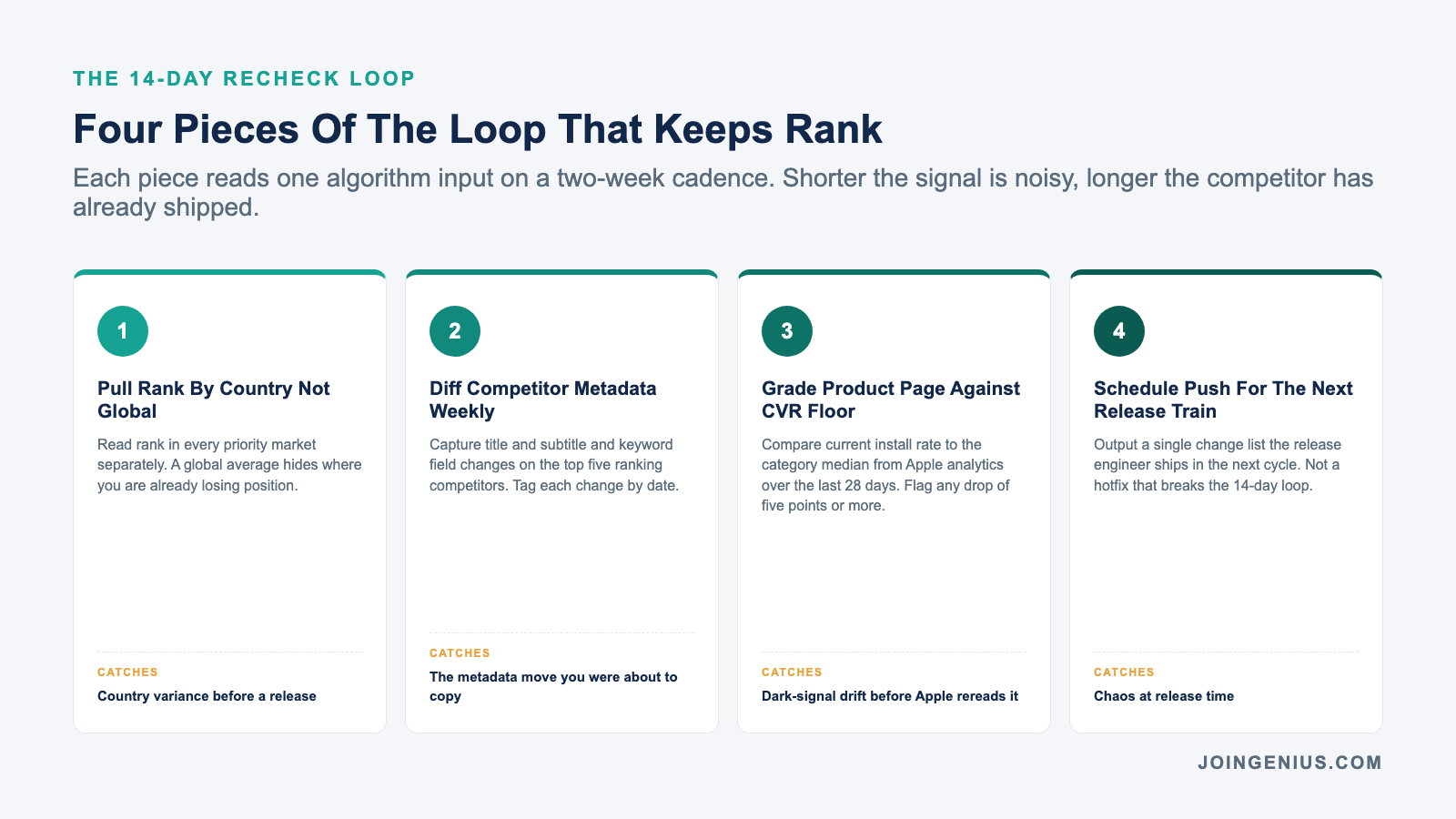
The signal most teams underweight is country variance. A keyword that ranks 8th in the US can rank 112th in Mexico for identical metadata because the competitor set is entirely different. A keyword intelligence feed that scopes correctly by country turns that variance into a prioritization backlog instead of a surprise on next week’s rank report.
The Audit That Mirrors The Algorithm Cycle
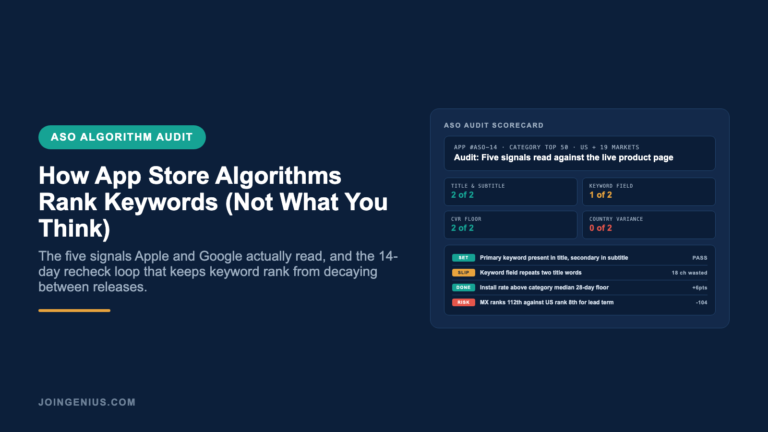
Treating the audit as five discrete checks that match the five inputs the algorithm reads makes the output comparable across apps and countries and release cycles. Each row below reads one signal and grades it against the current product page before deciding whether to change metadata or change the product-page assets or wait for the next release.
| Audit Step | Input Read | Pass Threshold |
|---|---|---|
| Metadata Audit | Title and subtitle keyword coverage | Primary keyword in the title and secondary keyword in the subtitle and every token present exactly once |
| Keyword Field Check | iOS 100-character field | No repeats and no brand terms and no title words and no plurals of a singular already present |
| Conversion Rate Floor | Product-page install rate | Above the category median from Apple analytics over the prior 28 days |
| Country Variance Map | Rank by country | No country ranks more than 30 positions below the lead country without a documented reason |
| Competitor Delta Log | Metadata changes on the top five ranking apps for the primary keyword | Reviewed weekly with a decision to match or differentiate or hold |
Running this audit on a monthly cadence catches most metadata drift before it compounds. The row that fails most often in practice is the country variance map, because it is the one teams rarely scope correctly in the first place.
The 14-Day Recheck That Keeps You Ranking
Keyword rank is not a set-and-forget output. Apple and Google both retune their ranking logic on an opaque cadence, and the apps that hold position are the ones running a 14-day recheck loop built into the ASO calendar. The loop catches drift before a competitor catches it.
SplitMetrics’ 2026 Apple Ads benchmarks confirm a new search-results ad placement launching in March 2026, with two ad placements inside the search results page instead of one. That doubles the pressure on organic rank because the organic top position now sits below two paid units, so CVR on the organic row falls unless the metadata improves.
An Android developer running a Play-side recheck will see a similar pressure from Google’s ongoing AI-driven ranking updates, which reward long-description relevance more than the old keyword density tricks. The recheck window catches both before the next release ships with stale copy.
Two weeks is the usable floor. Shorter and the signal is noisy. Longer and the competitor has already shipped the metadata change you were about to copy.
Conclusion
The ASO stack that outperforms in 2026 will not be the one with the longest keyword list. It will be the one that audits the five algorithm inputs and treats the keyword field as a vocabulary and defends CVR on a two-week cadence.
Fix the model, not the output, and the rank follows within a release cycle rather than a quarter.
For teams staffing that stack, Genius sources the senior marketer or developer who can run the audit end to end without a six-month ramp.