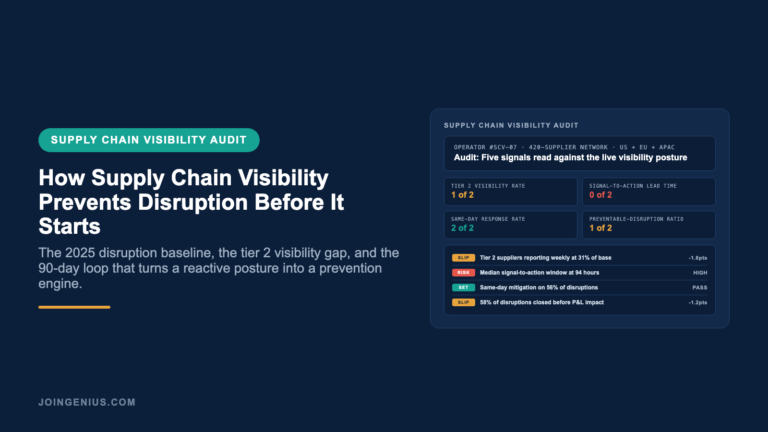
A supply chain disruption that lands on your P&L in 2026 did not start the day it hit. It started weeks earlier, inside a tier 2 supplier’s capacity ledger or a quality report nobody read in time. The operations manager who prevents the disruption is the one who read those signals first and acted on them. This guide covers the 2025 disruption baseline every scaling operator is grading against, the visibility gap that keeps most supply chains reactive after the fact, the collaboration layer that turns a weak signal into a same-week action, and the five-row scorecard for grading the posture against a resilient benchmark.

The 2025 Disruption Baseline Every Operator Is Grading Against
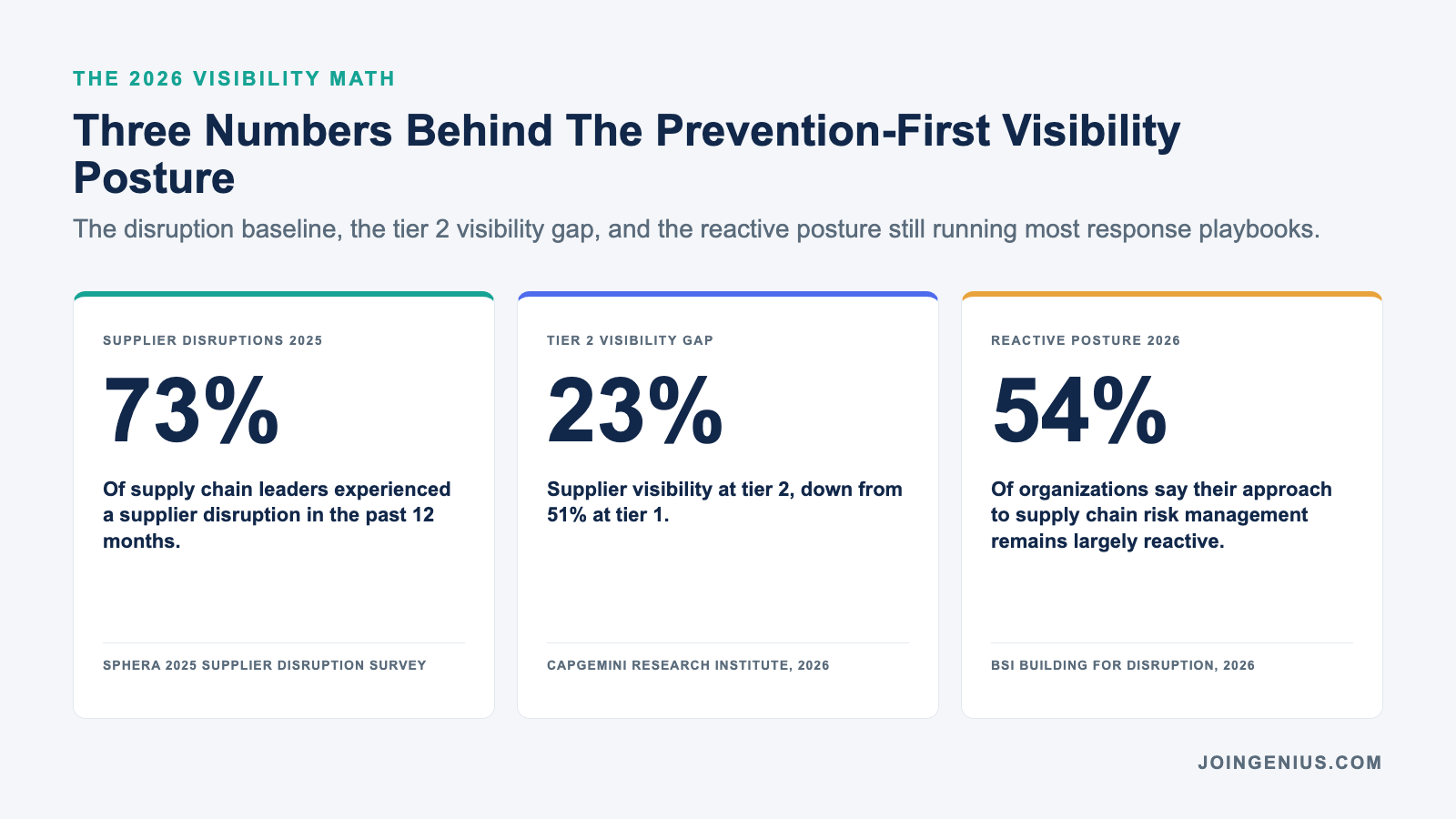
A supply chain disruption in 2025 is not a tail risk. It is the operating condition. The Sphera 2025 Supplier Disruption Survey, polling 200 senior procurement and supply chain executives at US and UK organizations in September 2025, found that 73 percent of supply chain leaders experienced a supplier disruption in the past 12 months.
Almost one in four (23 percent) of those leaders reported significant revenue or cost losses from the disruption. Another 50 percent reported minor losses. The baseline every scaling operator is grading against is not whether the disruption lands, but how fast the team sees it coming and how small they can keep the P&L hit.
The financial analyst building next quarter’s cost model is modeling against that same baseline. A supplier disruption that reaches the balance sheet after the window to prevent it closed is a line item the resilient operator has already learned to shrink, not accept.
The baseline also shifts the question procurement teams ask each quarter. The useful question is no longer whether the supplier base will produce disruptions, because the data says it will. The useful question is how many of those disruptions reach the P&L before the team catches them.
Why Tier 1 Visibility Alone Breaks Below The Surface
Most supply chain dashboards show a complete tier 1 picture and a half-empty one below. The Capgemini Research Institute’s Resilient By Design study, published November 2026, surveyed 1,000 executives at organizations above 1 billion dollars in annual revenue across 13 countries. It found supplier visibility drops from 51 percent at tier 1 to 23 percent at tier 2.
Tier 2 is where most disruption forms. A tier 1 supplier that reports a stable forecast might be sitting on a tier 2 capacity constraint it has not surfaced. By the time that constraint reaches the tier 1 production line, the preventable window has already closed.
The visibility that would have caught it in week two is reading it in week six, which is why resilient operators grade their visibility on how deep it reaches, not how pretty the tier 1 chart looks. Depth beats polish every time the next shock lands.
The depth problem has a second shape worth naming. A supplier that is tier 1 for one product can be tier 3 for another, inside the same operator’s network. The visibility posture that reads the supplier against one role misses the exposure sitting inside the other.
The Reactive Posture Still Running Most Response Playbooks
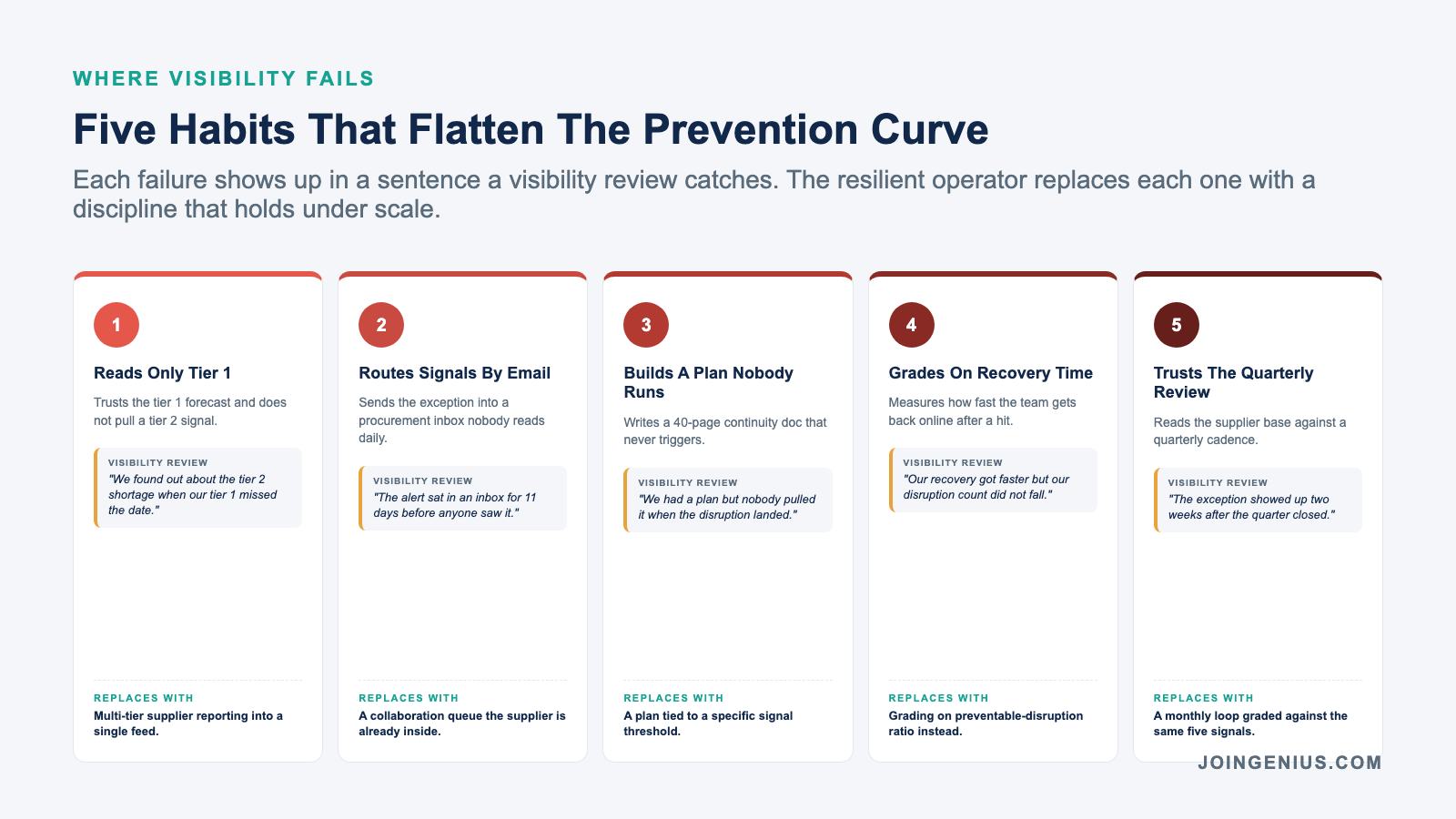
Even with the disruption baseline understood, most teams respond to the signal instead of acting on it. BSI’s Building For Disruption study, published October 2026 and surveying more than 1,400 managers in supply chain and procurement functions globally, found that 54 percent of organizations say their approach to supply chain risk management remains largely reactive.
Only 27 percent of those organizations can take action on the same day when disruption strikes. Another 37 percent did not follow a crisis plan during their most recent disruption, which means the plan existed but the trigger to run it never reached the operator in time.
The reactive posture is not a planning failure. It is a visibility failure dressed up as a planning one. The plan was ready, and the data arrived too late to run it. That gap between plan-ready and signal-ready is the gap the resilient operator spends every quarter closing.
The Signals That Reach The Operator Before The Supplier Misses The Date
A resilient supply chain is not graded on how fast it recovers. It is graded on how many disruptions it never enters recovery for. A recovery-focused posture defines success after the hit. A prevention-focused posture defines success before the window ever closes.
The signals that keep a supplier from missing a date are already flowing somewhere in the system, typically scattered across a forecast module and a production monitor that nobody reads together. The resilient operator reads them in the same pane, before the delivery date gets locked.
The data analyst who owns that pane is not reading dashboards. They are reading a signal stack. The stack catches the capacity gap in week one. It catches the port congestion before the vessel ETA slips, and the quality drift before the complaint volume rises.
The difference between a resilient supply chain and a reactive one is not a bigger team or a bigger budget. It is a signal stack that reaches the operator while there is still a lever to pull on the supplier side of the network.
The Collaboration Layer That Turns Visibility Into Prevention
A signal is only useful if the supplier on the other end of it can confirm or act on it the same week. The visibility that lives inside a buyer’s dashboard and never reaches the supplier is a reporting tool, not a prevention tool.
A collaboration network that connects the buyer and the supplier against the same data and the same alert queue is what turns a weak signal into a same-week fix. The alert travels one hop instead of three, and the action starts before the exception becomes a disruption.
A platform built around supply chain risk at the collaboration layer lets procurement teams flag an exposure against a tier 2 supplier before it travels up the chain. The exposure gets confirmed and mitigated by the supplier network, not by a buyer forwarding emails to a procurement inbox.
A business development manager building supplier relationships from a growth angle has the same collaboration layer available. The visibility that catches a disruption also surfaces the supplier scaling fastest, the one worth doubling down on before a competitor locks them in.
Five Signals A Resilient Supply Chain Grades Each Quarter
A visibility posture is only as resilient as the signals it grades against a benchmark. The table below pairs five signals with the behaviour each one catches and the pass threshold the resilient operator holds the team to every quarter.
| Grading Signal | Behaviour Caught | Pass Threshold |
|---|---|---|
| Tier 2 Visibility Rate | Supplier exposure below the tier 1 line | Above 60 percent of tier 2 suppliers reporting weekly |
| Signal-to-Action Lead Time | How fast a weak signal reaches the operator | Under 48 hours from first signal to routed action |
| Same-Day Response Rate | Share of disruptions with same-day mitigation | Above 50 percent within one business day |
| Crisis Plan Execution Rate | Share of disruptions where the plan actually ran | Above 75 percent of plans executed as written |
| Preventable-Disruption Ratio | Share of disruptions caught before P&L impact | Above 70 percent closed before cost hit |
The gap between a 23 percent tier 2 reporting rate and the 60 percent threshold is where the preventable disruption lives. The team closes it one supplier at a time, by routing the signal into the collaboration queue rather than the quarterly review deck.
The scorecard also tells the team which signal to fix first. A 94-hour signal-to-action lead time outranks a strong recovery rate every quarter, because the lead time controls how many disruptions ever reach the recovery column in the first place.
The 90-Day Loop That Compounds Visibility Into Resilience
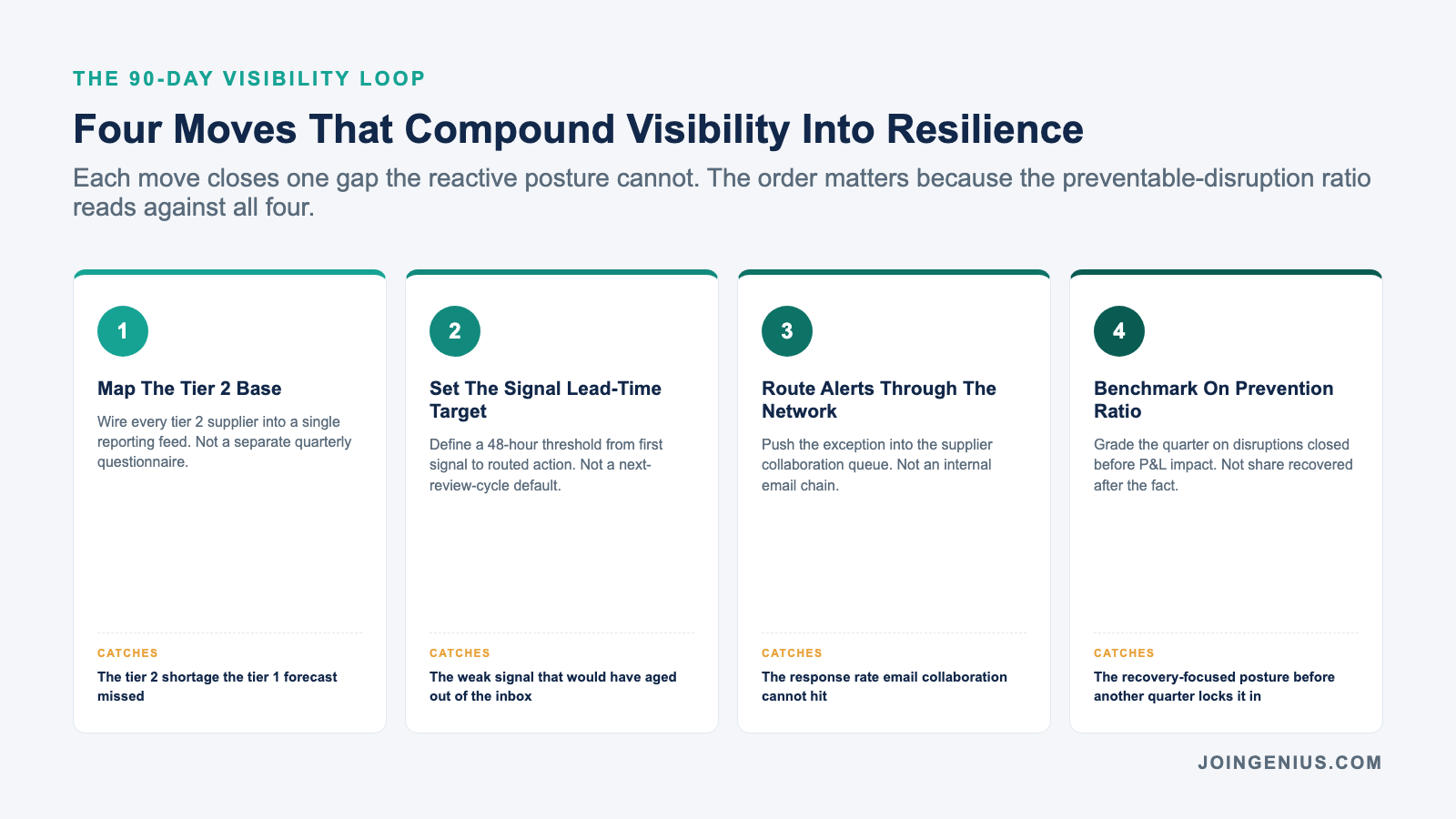
The visibility posture does not install in a quarter. It compounds over three quarters, and the first 90 days set whether it holds. The resilient operator runs the loop on a monthly cadence, grading the same five signals against the same thresholds.
Month one maps the tier 2 supplier base and wires each supplier into a single reporting feed. Month two sets the signal-to-action lead-time target and routes the first wave of alerts through the collaboration network. Month three benchmarks the response rate and the preventable-disruption ratio against the baseline.
By the fourth quarter, the loop runs itself. The team catching the disruption is the same team the growth plan depends on, because the fulfilment promise now matches the launch promise every time the market tests it.
Conclusion
A supply chain disruption in 2026 is not prevented in the war room. It is prevented in the tier 2 ledger and in the collaboration queue that connects the operator to the supplier before the window closes.
The team that treats visibility as a prevention engine, not a reporting layer, is the team that keeps the P&L intact while the market absorbs the next shock. That team is scaling on talent built for the role, which is where Genius comes in.