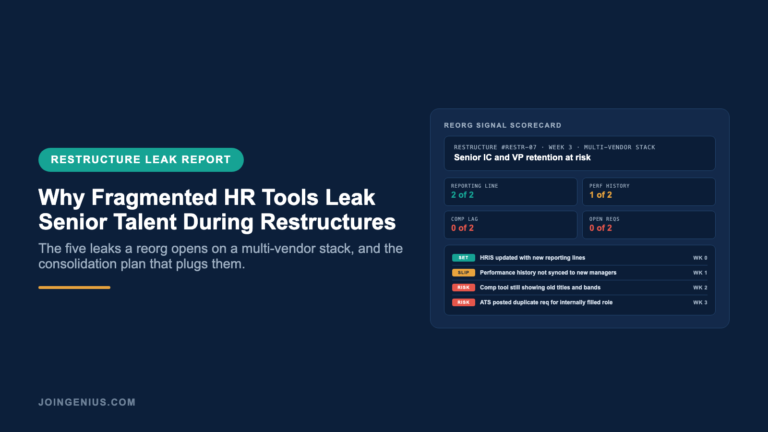
A restructure is supposed to make a company leaner. In practice it often does the opposite. Senior people, the ones with the deepest institutional knowledge and the longest tenure, are quietly the first to update their resumes the week an org chart leaks. The hiring manager who announces the change usually finds out months later, when a VP gives notice and takes three direct reports with them. Most HR managers know the pattern by heart. The root cause is rarely the restructure itself. It is the fragmented HR stack that makes the restructure visible to senior people before anyone in people operations has a plan to keep them.
The Window When Senior People Look First
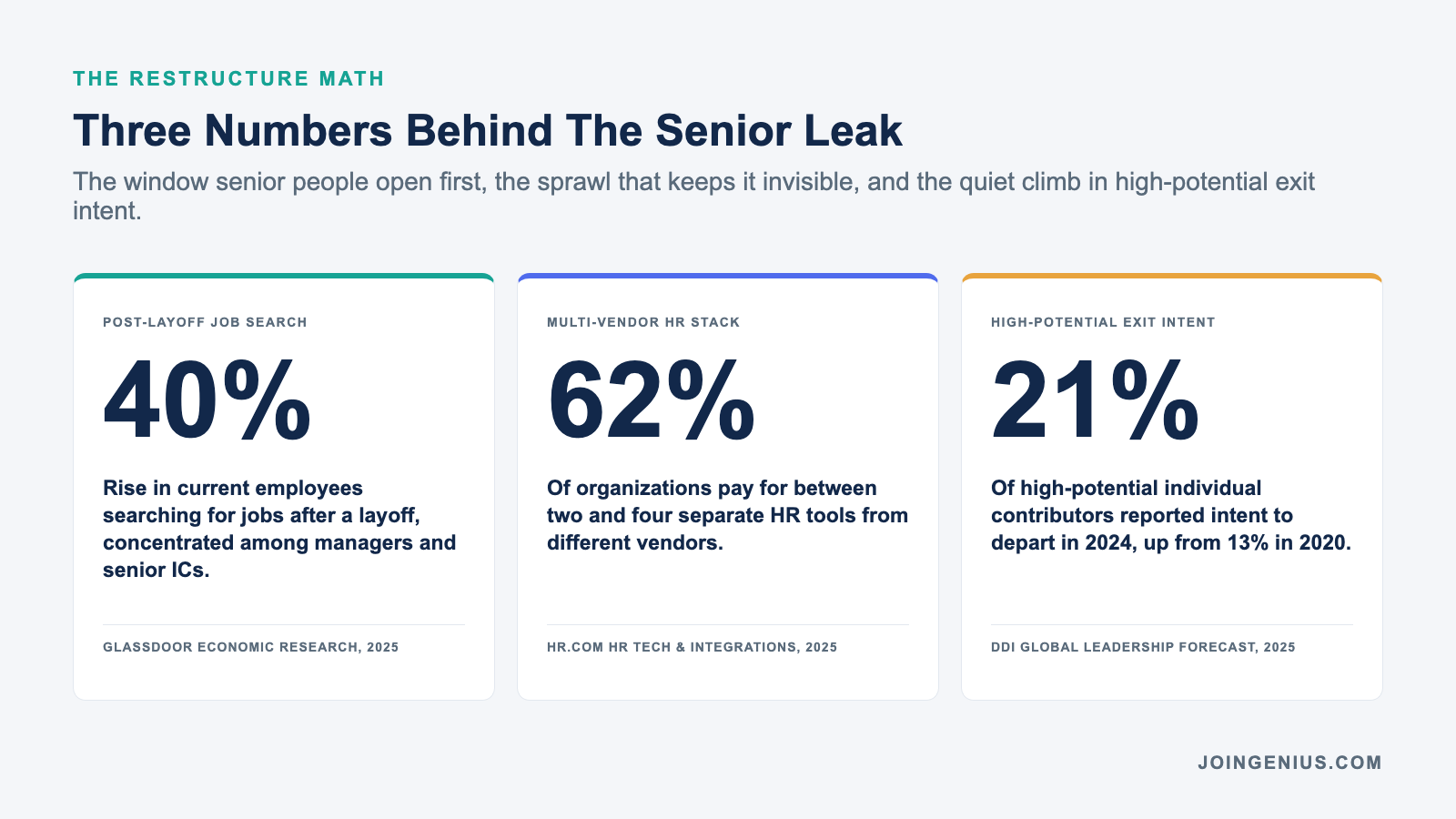
Glassdoor’s September 2025 “Layoffs Cast a Long Shadow” research tracked the behavior of employees at companies going through layoffs and reorgs from 2021 through 2025. The headline number was a 40% rise in the share of current employees searching for jobs after a layoff, concentrated among managers and senior individual contributors.
Two details matter more than the headline. The spike began the week the restructure was rumored, not the week it was announced. And it lasted for months, long after the public coverage had moved on.
The window is the real problem. It opens quietly. It stays open longer than the announcement cycle. The senior people who look first are the ones a company most wants to keep.
A fragmented HR stack keeps that window invisible to the people who could close it. The talent reviews live in one system. The engagement scores live in another. The applicant tracking system logs who is interviewing where, but no one wires it back to the retention plan until a senior resignation is already on the calendar.
By then the window has done its work. The regretted exits are already drafting their announcements, and the counter-offer that lands on the Friday of week three is almost always a week too late to matter.
Why Tool Sprawl Turns A Reorg Into An Exit Event
HR.com’s HR Research Institute surveyed 153 HR professionals late 2024 through February 2025 for its State of Today’s HR Technology and Integrations 2025 report. 62% of organizations pay for between two and four separate HR tools from different vendors.
Only 15% run everything on a single provider. And 81% of respondents whose integrations are poor say it keeps the organization from reaching its HR goals. That last number is the one the finance team never sees before approving the next point tool.
A reorg is the stress test that exposes every one of those integration gaps. On a normal week, a people operations team can paper over the handoffs between the four or five systems a mid-size HR team runs. On a restructure week, the gaps compound.
A manager who was just moved into a new reporting line cannot find her new report’s last performance review. The compensation tool still shows the old title. The engagement survey still routes to the old manager. The ATS does not know the reorg happened at all, so a passive-candidate pipeline opens for the same role the company just filled internally.
Chief people officers feel this most on day four, when the second and third senior resignations land in the same inbox. By then the stack has already written the story. The restructure read as chaos to the people it was supposed to retain.
The Five Fragmentation Leaks That Push Senior People Out
When a restructure lands on a fragmented stack, the leaks are not random. They repeat. HR generalists running the reconciliation can usually name all five by the second week.
| Leak | What Breaks During The Restructure | Why Senior People Notice First |
|---|---|---|
| Stale Reporting Line | HRIS updates. Engagement tool and 1:1 scheduler do not. The Q4 check-in routes to the old manager. | Senior people run team pulse checks weekly. The gap shows up on day two. |
| Lost Performance History | Performance system does not sync new managers in. The new manager cannot see the last three reviews. | Senior people lose the receipt for their last promotion case. |
| Compensation Lag | Comp tool still shows the old title. Band and bonus target move with it. | Senior people run their own comp math and flag the drift inside a week. |
| Duplicate Requisition | ATS does not know the reorg happened. A backfill gets posted for a role filled internally. | Senior people find their own role on LinkedIn and read it as a signal. |
| Blind Engagement Pulse | Survey tool routes by the old org. Scores roll up to the wrong team. | Senior people see their response disappear and stop answering the next round. |
The shape of the leaks explains why consolidation pays off. Each one is caused by data that exists in one system and is never asked for by another. A single platform never has to ask.
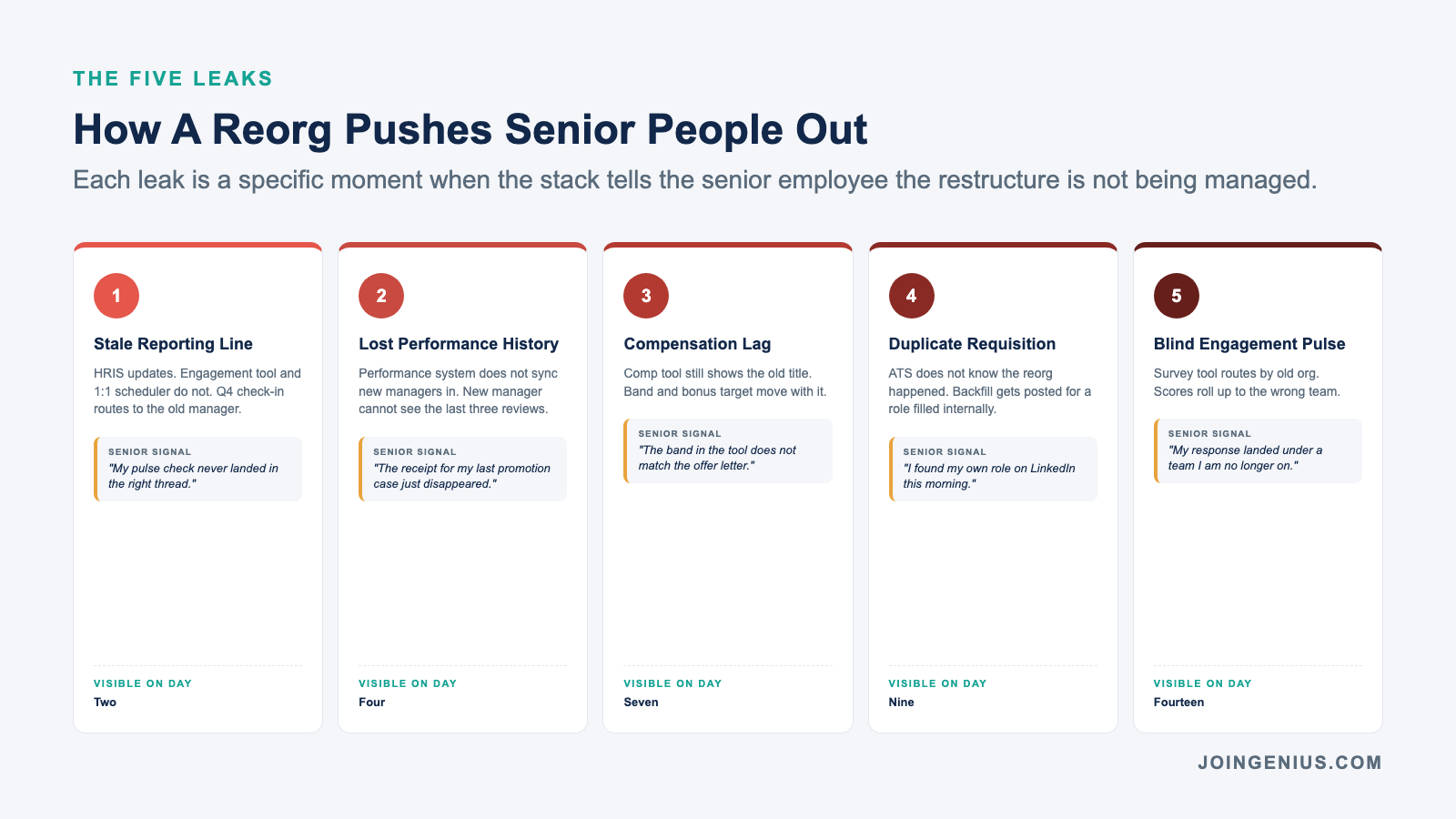
The common thread across the five leaks is timing. Each one becomes visible to the senior employee before it becomes visible to anyone on the people operations team. That lag, repeated across five systems, is the mechanism by which a restructure manufactures regretted attrition.
What Senior Attrition Actually Costs During A Restructure
The replacement math is bleaker than it looks on the surface. DDI’s Global Leadership Forecast 2025, based on surveys of 10,796 leaders and 2,185 HR professionals across more than 50 countries, found that the intent to depart among high-potential individual contributors climbed from 13% in 2020 to 21% in 2024.
Those are the people a restructure is quietly selecting out. The replacement cost for a senior individual contributor runs between 150 and 200 percent of annual salary. That number counts ramp time and the loss of institutional knowledge, and most finance teams only budget for the recruiter fee.
The hidden line item is the queue. Every regretted senior exit creates a req that pulls a recruiter off the planned hiring roadmap and into a backfill cycle. A restructure that was framed as a cost-cutting move inside the finance deck shows up in the next quarter as three unfilled senior roles and a flat engineering roadmap.
The cost that never hits the budget is the second-order one. When a senior engineer leaves, the pipeline for the next senior hire shortens. Candidates read Glassdoor before they open the recruiter’s email, and the pattern a restructure writes stays on the review page for months.
The Consolidated HR Stack That Plugs The Leaks
Consolidation is not a software purchase. It is a decision about where the record of truth lives. The best-in-class stack for a company heading into a restructure keeps employee data and performance history and compensation bands and engagement signals in one platform, so the restructure reads as a single org-chart change and not as five simultaneous migrations.
The all-in-one route is why open-source and modular options like the HRMS platform OrangeHRM runs get a second look during consolidation reviews. A people operations team that has lived through a reorg usually wants the people record and the performance history and the comp band and the engagement survey to update together, with one audit trail and one login.
The four pieces of a consolidation plan that actually hold through a restructure are specific and repeatable. They prevent each of the five leaks from the previous section before the leak becomes a resignation.
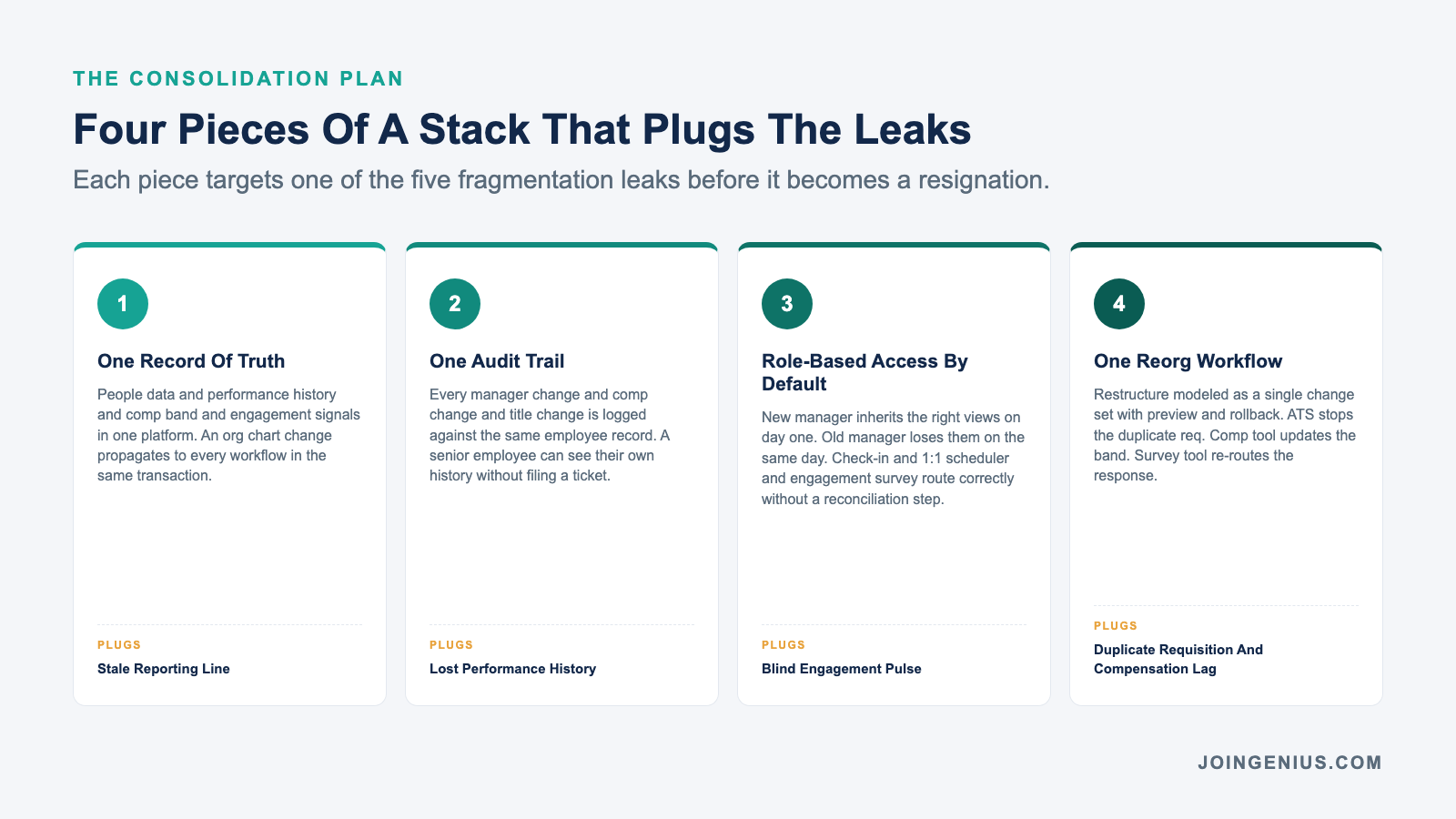
The point is not to ban best-of-breed tools. It is to put the record of truth in one place, so a restructure never writes two versions of it. The teams that come through a restructure with their senior people intact are the teams whose stack never let the restructure be a surprise.
What The Restructure Looked Like From The Senior Seat
Ask any VP who left in the three months after a reorg why they started looking, and the answer is almost never the reorg itself. It is the week of silence after.
The 1:1 that routed to the wrong manager. The review they could no longer open in the performance tool. The internal posting for a role they did not know had been filled.
Those are the signals a senior person reads as abandonment. Each one of them is a data-plumbing failure that a consolidated stack prevents by design.
The retention plan that works is the one the stack writes before the leak opens. The retention plan that fails is the one a people operations team writes by hand, after the fact, from five systems that disagree about what the new org chart says.
Conclusion
Senior attrition during a restructure is not a leadership problem wearing a data costume. It is a data problem wearing a leadership costume.
The window opens the week the restructure is rumored. The leaks are the same five every time. The cost shows up in the quarter after.
A stack that treats the people record as a single source makes the retention plan possible. A stack that treats it as a federation of integrations makes the retention plan a spreadsheet nobody owns.
Genius helps teams fill the roles the leaks created, and the posts here keep the stack honest for the restructures still to come.