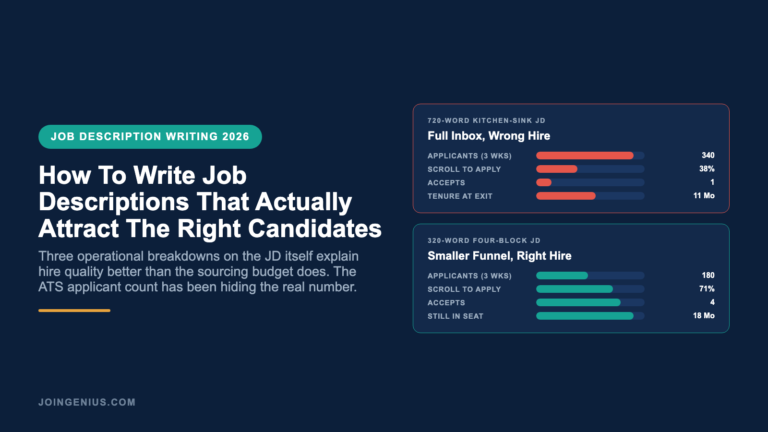
Every recruiter who opens their ATS on a Monday morning knows the same pattern. The senior engineer requisition posted three weeks ago has 340 applicants. The hiring manager has interviewed four of them. None of them are the person the team actually needed. The applicant count on the dashboard is up and to the right. The quality of the funnel is flat.
The reason is not the job board and not the sourcing budget. Three specific operational breakdowns show up in nearly every job description that fills the inbox without filling the seat, and each one is a writing decision that happened weeks before the first application landed.
This post walks through the three breakdowns, the layer where applicant quality actually breaks, and what to change on the JD before the next req opens.
The Three Breakdowns That Keep Job Descriptions From Attracting The Right Candidates
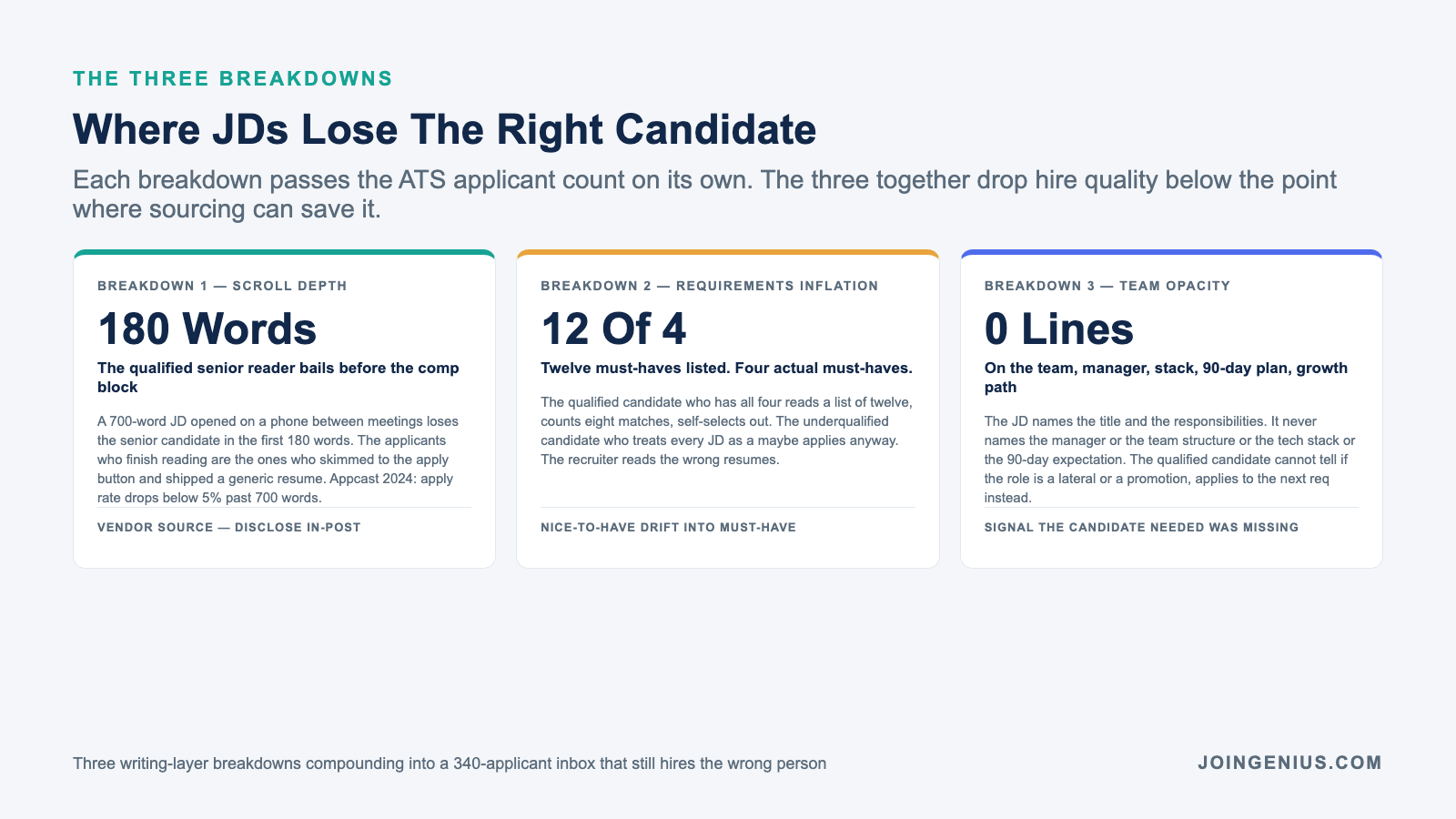
Breakdown one is the scroll-depth problem. The JD runs 700 words. The qualified senior candidate opens it on a phone between meetings. They read the first 180 words and realize the job sounds generic. The tab closes before they ever reach the compensation block or the stack. The applicants who do finish reading are the ones who skimmed to the apply button and shipped a generic resume.
Breakdown two is requirements inflation. The hiring manager wrote the JD with 12 must-haves because they wanted “the complete picture.” Nine of those requirements are nice-to-haves that drifted into the must-have column during the review. The qualified candidate who has four of the four actual must-haves reads the list and self-selects out because they only match 8 of 12. The underqualified candidate who treats every JD as a maybe applies anyway.
Breakdown three is team and stack opacity. The JD names the role title and the responsibilities. It never names the manager or the team structure or the tech stack or the 90-day expectation or the growth path. The qualified candidate reads it and cannot tell if the role is a lateral move or a promotion. They cannot tell if it is a greenfield build or legacy maintenance. They cannot tell if it is a two-person team or a 40-person org. They apply to the next req instead, where the team block is one short paragraph long.
The signal that the three breakdowns are already shipping on most reqs is in the apply-rate data at scale. Appcast’s 2025 Recruitment Marketing Benchmark Report, published February 11, 2025, puts the overall apply rate at 6.1 percent across 379 million job ad clicks and 30-plus million applications from 1,300 US employers in 2024. The same body of research places the apply-rate bell curve at 200 to 600 words of body copy. JDs over 700 words fall below a 5 percent apply rate on the same traffic. The data is produced by a programmatic job-advertising vendor and the figure should be read against that context. Even on the conservative read, every word past 600 is a tax on the qualified applicant the recruiter was writing the JD to attract.
Why The ATS Says The Req Is Filling But The Funnel Does Not Convert
The dashboard that hides the problem is the applicant-count view in the ATS. A req with 340 applicants and 22 interviews reads to the talent leader like a healthy funnel. The two numbers that actually matter are qualified-application rate and interview-to-offer conversion, and neither of them are on the default screen.
SHRM’s 2025 Recruiting Benchmarking Report, drawn from a survey of 2,371 active US SHRM members fielded January through March 2025, puts the median time-to-fill at 44 calendar days for non-executive roles and 45 days for executive roles, measured from requisition open to accepted offer. A bad JD lengthens every downstream step against that 44-day baseline. Each day the recruiter spends re-screening a slush pile is a day the first-best candidate is interviewing somewhere else.
The surface metric that hides this on a talent program is time-to-fill. A req that fills in 42 days with 340 applicants reads to leadership the same as a req that fills in 42 days with 110 applicants. The first req burned 60 recruiter hours screening generic resumes and hired the fifth-best candidate because the first-best bailed in week three. The second req ran four qualified interviews, made two offers, and closed the first-best candidate in week five.
The recruiter who knows this difference opens two reports before trusting the applicant count. The first is application-to-interview rate on the req, a direct read on whether the JD is sorting. The second is the scroll-depth on the JD page itself from the ATS or careers-site analytics, which tells them whether the qualified candidate even made it to the apply button.
Most reqs with a 340-applicant inbox and a struggling pipeline never run either report. The JD stays as written. The recruiter sources around it. The hiring manager interviews the wrong five people. The req closes in 60 days on a candidate everyone compromises on.
The JD Layer Where Applicant Quality Actually Breaks
The quiet place where the loss lives is the two-sided handoff between the JD a recruiter publishes and the resume a qualified candidate ships back. The JD goes live in the ATS. The candidate reads the JD, parses the keywords and must-haves, and tailors a resume to match before they apply. If the JD is clean, that match happens cleanly and the recruiter opens a funnel of resumes that already map to the role.
If the JD is a 700-word kitchen-sink document with 12 must-haves and no team block, the match on the candidate side is approximate at best. The qualified candidates with an ATS resume checker like MyCVCreator will still tailor a focused resume against whatever signal the JD gives them. The candidates who do not use one will ship whatever resume is on their desktop. The recruiter ends up reading 340 resumes that cluster around “person who applies to a lot of jobs” instead of “person who matched your actual requirements.”
Running the JD layer with the candidate-side ATS match in mind closes the gap that otherwise shows up as a 340-applicant inbox the recruiter spends 60 hours sorting. The JD is the signal the candidate matches against. The resume is the return value. If the signal is noisy, the return is noisy. If the signal is clean, the return is clean and the recruiter reads a funnel instead of a slush pile.
Fixing the JD layer is the single highest return move a talent program can make on hire quality. It does not require a bigger sourcing budget or a new ATS. It requires one recruiter who treats the JD as a four-part writing problem rather than a copy-paste from the last req.
Day Zero Versus Day 180 On A Rebuilt JD
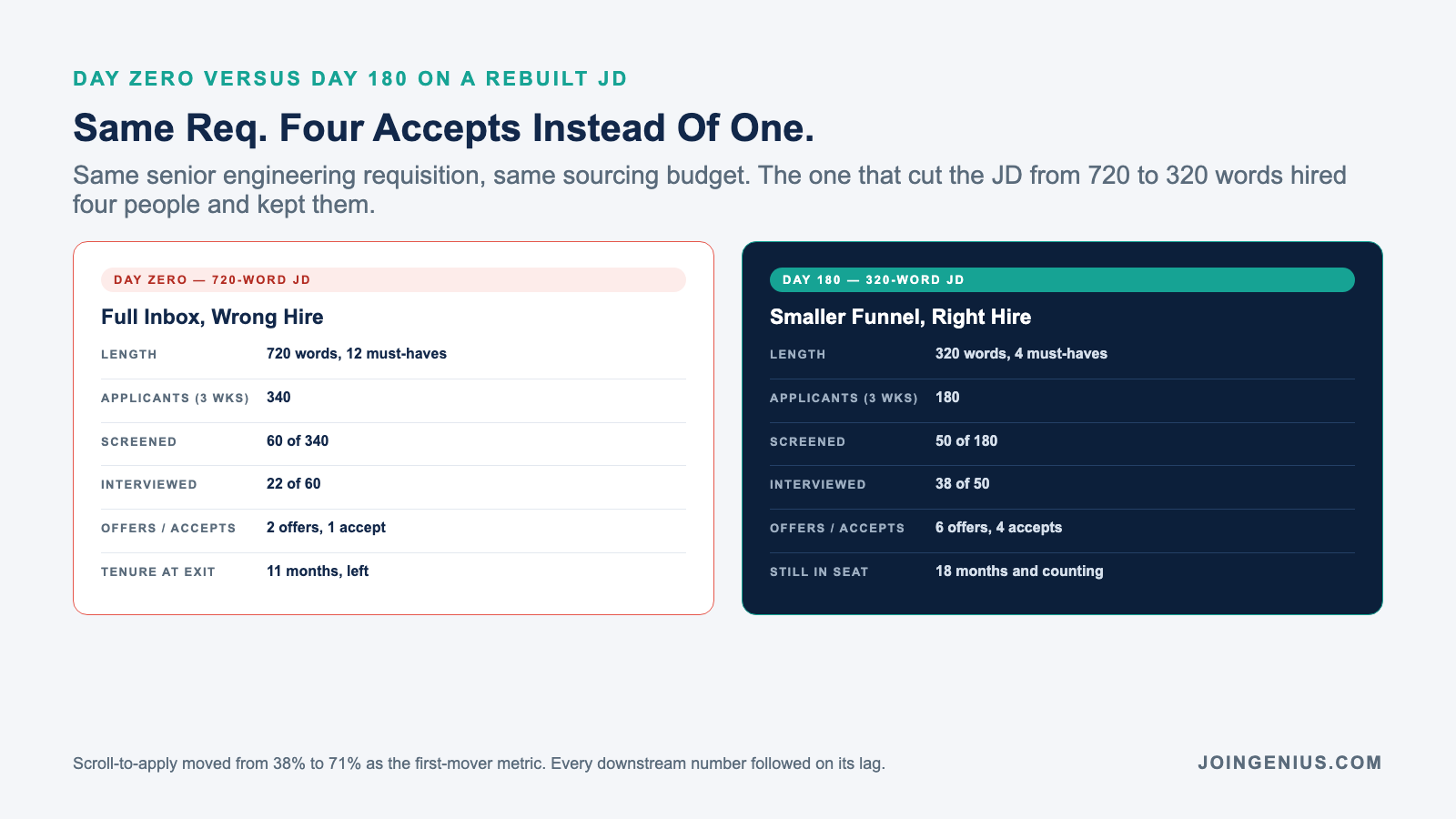
The before picture is the one most recruiters describe. The req is a senior engineering role. The JD runs 720 words with 12 must-haves. There is no manager name and no stack list and no 90-day expectation. The post generates 340 applicants in three weeks. The recruiter screens 60 of them. The hiring manager interviews 22. Four reach a final round. Two offers go out. One accepts. The candidate who accepts starts on a 42-day time-to-fill and leaves at the 11-month mark.
The after picture at day 180 looks different on every metric. The same req on the same budget. The JD is rewritten to 320 words with four must-haves. The team block names the manager and the stack and the 90-day expectation and the growth path to the next level. The post generates 180 applicants in three weeks. The recruiter screens 50 of them. The hiring manager interviews 38. Twelve reach a final round. Six offers go out. Four accept. The hire starts on a 38-day time-to-fill and is still in seat at the 18-month mark.
The signed-up applicant count at the top of the new funnel is roughly half of what the old JD would have pulled, and the hire rate is three times higher. The team got that result by moving the JD from a 700-word kitchen sink to a 320-word four-block document the qualified candidate could read in two minutes.
The number that changed first was JD scroll depth. It moved from 38 percent of visitors reaching the apply button to 71 percent on the same careers page. Every downstream metric moved on the lag of that one.
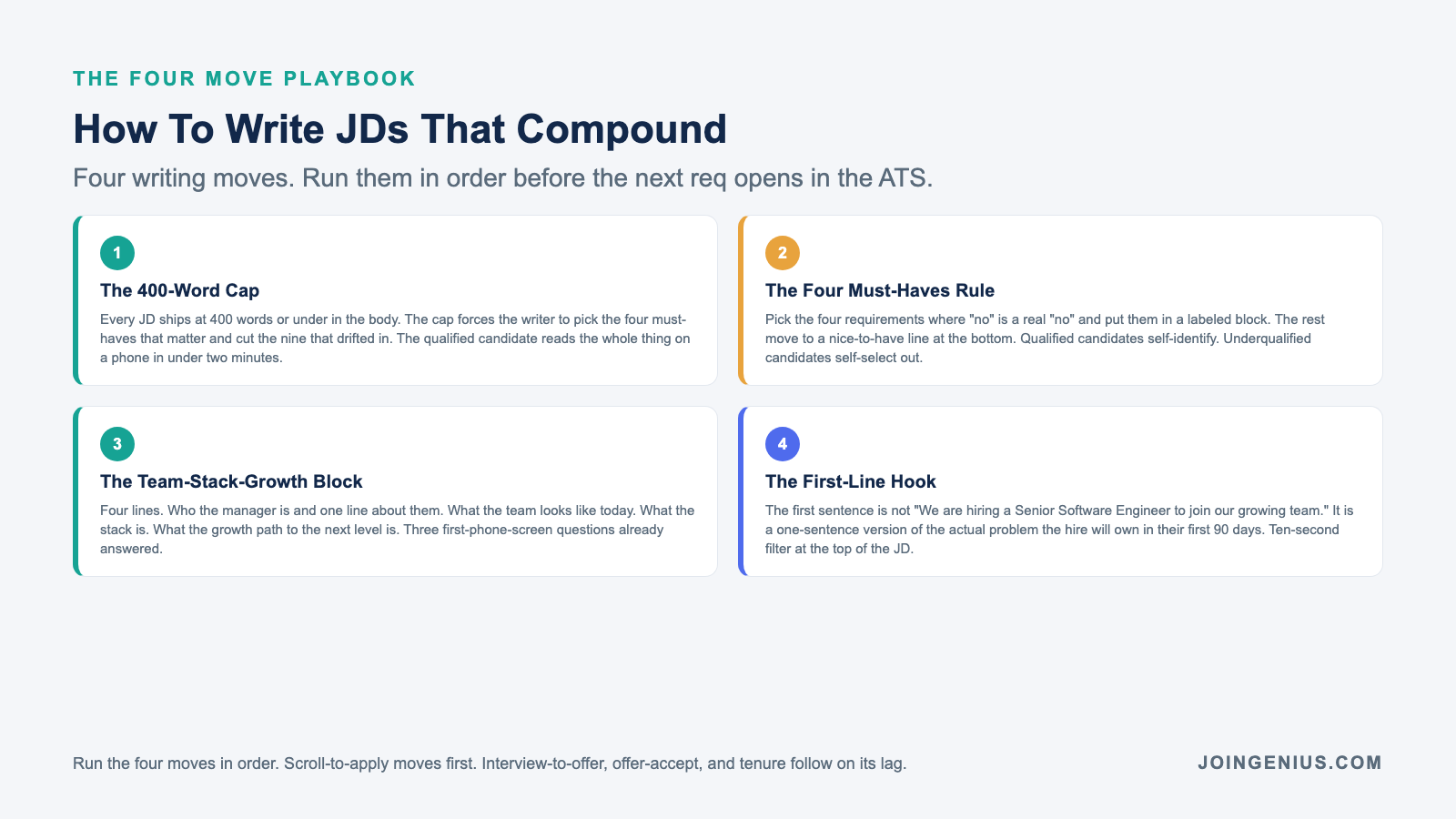
The Four Move Playbook For Writing JDs That Compound
Move one is the 400-word cap. Every JD ships at 400 words or under in the body. The cap forces the writer to pick the four must-haves that actually matter and cut the nine that were drifting into the list. The qualified candidate reads the whole thing on a phone screen and gets to the apply button in under two minutes.
Move two is the four must-haves rule. Pick the four requirements where “no” is a real “no” and put them under a labeled block. Move the rest to a “nice to have” line at the bottom. The qualified candidate with all four self-identifies as a fit. The underqualified candidate with two sees the gap and self-selects out without the recruiter having to filter them.
Move three is the team-stack-growth block. Four lines. Who the manager is and one line about them. What the team looks like today. What the stack is. What the growth path to the next level is. The qualified candidate gets the three questions they would have asked in the first phone screen already answered, which moves the self-selection into the top of the funnel.
Move four is the first-line hook. The first sentence of the JD is not “We are hiring a Senior Software Engineer to join our growing team.” It is a one-sentence version of the actual problem the hire will own in their first 90 days. The qualified candidate reads the first line and knows within 10 seconds whether the role matches the kind of problem they want to work on.
A One Page Weekly Check On The JD Program
The replacement for the applicant-count dashboard most talent programs run is a weekly five metric read owned by the recruiter. The point is to make the real JD signal visible before the hiring manager interviews four of the wrong people, not after.
Metric one is JD scroll depth on the careers page, scanned for the qualified-reader-reaches-apply-button signal. Metric two is application-to-interview rate on open reqs, scanned for whether the JD is pre-sorting the inbox. Metric three is interview-to-offer conversion, scanned for whether the JD was promising something the role is not actually delivering.
Metric four is offer-acceptance rate, scanned for whether the team-stack-growth block was aligned with what the hire actually walks into on day one. Metric five is days from JD post to first qualified application, scanned for whether the first-line hook is landing with the right reader on the first weekend after the post goes live.
Scan these five every Monday, flag the two biggest week over week moves, and walk the hiring manager through the hypothesis before the sourcing sync. The conversation changes from “how many applicants do we have” to “which one of the four moves is live on this req,” which is the only conversation that moves the hire-quality number. Build this into your interview rubric for the recruiter role.
Hire Recruiters Who Write JDs That Compound
The talent programs that compound in year two are the ones that stopped treating applicant count as the health metric and started treating the JD as the funnel-sorting layer. They are the ones that moved every req from a 700-word kitchen sink to a 400-word four-block document. They are the ones with a recruiter who owns the first-line hook, the four must-haves, and the team-stack-growth block as a writing problem before it is a sourcing problem.
The hiring window is tight. The US Bureau of Labor Statistics counts 939,700 human resources specialist jobs in 2025, with a 6 percent growth projection through 2035 and a median wage of $75,940 as of May 2025, last modified October 29, 2026. That is a seller’s market for the JD-literate recruiter archetype you need to hire against.
Genius hires top one percent recruiting and talent operations talent from the Philippines and LATAM at roughly 80 percent less than local comp. There are no monthly fees and the placement comes with a six month replacement guarantee.
We screen on the four JD moves described on this page before any candidate reaches a hiring manager, so your sourcing funnel brings you recruiters who will rewrite the JD in week one rather than sort through another slush pile in week three.