Every WordPress site that ships a second language inherits the same silent failure mode. The hreflang tags look fine in the page source. The SEO plugin reports a clean sitemap. The translator adds a new locale three months in. Six weeks later the US organic traffic is landing on the UK URL, the Spanish homepage is competing with the Mexican homepage for the same query, and nobody can point at a single commit that broke it.
The reason is not the translation quality. The reason is that hreflang on WordPress is a layer problem, not a tag problem. Three specific skill breakdowns show up in nearly every multilingual WordPress build that ships hreflang errors to production, and each one is a hiring decision before it is a configuration decision.
This post walks through the three breakdowns, the plugin layer that most teams misassign, and what to actually screen for in the person you hire to own the multilingual stack.
The Three Breakdowns That Keep Hreflang Hires Shipping Errors
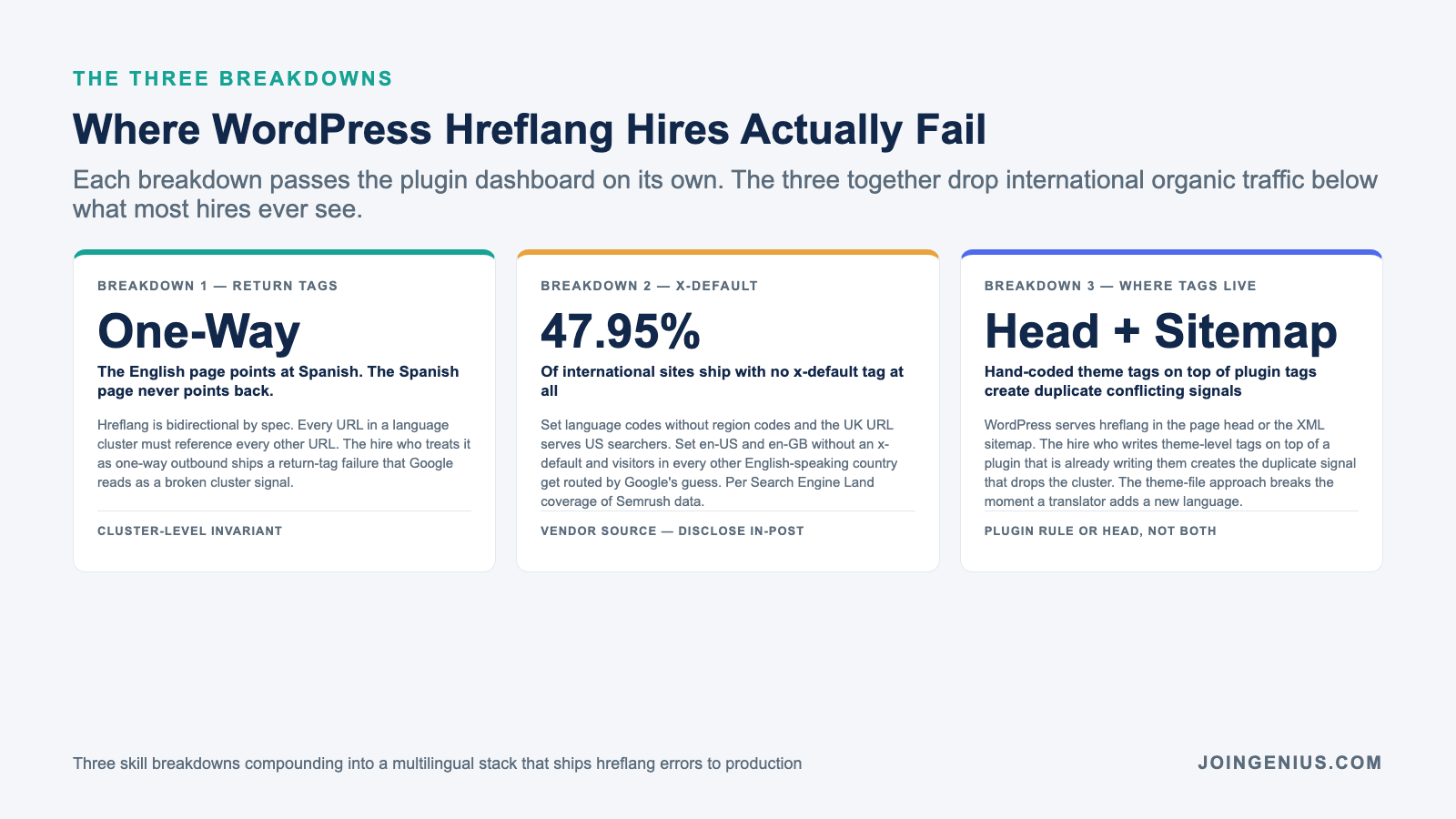
Breakdown one is return-tag symmetry. Hreflang is bidirectional by spec. Every URL in a language cluster has to reference every other URL in that cluster, including itself. The hire who treats hreflang as a one-way outbound tag ships a site where the English page points at the Spanish page but the Spanish page never points back. Google reads the missing return tag as a broken signal and drops the cluster. The audit report will show the English side clean. The failure is on the pages nobody opened.
Breakdown two is the x-default and language-region split. The hire who sets language codes without region codes serves the UK URL to US searchers because the fallback was never defined. The hire who sets en-US and en-GB without an x-default leaves visitors in every other English-speaking country routed by whatever Google guesses. The pages look right in isolation. The visitors land on the wrong one.
Breakdown three is where the tags actually live. WordPress serves hreflang in two possible places: the page head, or the XML sitemap. The hire who writes hand-coded hreflang into a theme file on top of a plugin that is already writing tags creates duplicate conflicting signals. Google sees the inconsistency and drops the cluster the same way it drops a broken return tag. The theme-file approach also breaks the first time a translator adds a new locale without touching the template.
The signal that the three breakdowns have already compounded is in the audit data for multilingual sites at scale. Search Engine Land’s coverage of the Semrush hreflang study puts 31.02 percent of international websites at conflicting hreflang directives. 16.04 percent are missing self-referencing hreflang. 47.95 percent do not use an x-default tag at all. The data is produced by SEO software vendor Semrush and the figures should be read against that context. Even on the conservative read, the three breakdowns are already shipping on roughly a third of the multilingual sites a new hire will inherit.
Why The SEO Dashboard Says Green While The Traffic Lands Wrong
The dashboard that hides the problem is the plugin’s own hreflang panel. Most WordPress SEO plugins and most audit tools scan the page head for hreflang tags. If the plugin wrote them there and the return-tag loop closes inside the head, the panel shows green. The sitemap-side configuration is a separate code path and the audit never opens it. The surface the audit is scanning is enormous. W3Techs on November 9, 2026 puts WordPress at 58.1 percent of the content management market and 39.4 percent of all websites, and a substantial share of that footprint runs more than one language. The configuration surface where the dashboard-reports-green failure mode lives is the one most of the SEO estate most teams build on.
The surface metric that hides this on a multilingual program is translated URL count. A site with 1,200 translated URLs and a clean plugin dashboard reads to the leadership team the same as a site with 1,200 translated URLs and a working hreflang cluster. The first site is losing US organic traffic to the UK URL every week. The second site is not. The dashboards for both sites say the same thing until somebody checks the search appearance report by country.
The hire who knows this difference opens two reports before trusting the plugin dashboard. The first is the Search Console country split on the top 50 translated URLs. The second is the sitemap file itself, read against the live page head to confirm the tags are in one place and not both.
Most multilingual WordPress builds ship with the tags in both places because one hire turned the plugin on and a second hire wrote theme-level code to “be safe.” The duplicate tags are what Google actually sees, and the audit dashboard never catches them.
The Plugin Layer That Actually Owns Hreflang
The quiet place where the loss lives is the handoff between the plugin that writes hreflang and the plugin that writes the XML sitemap. The practical hreflang implementation on WordPress at scale is through a WordPress multilingual plugin like WPML, which adds hreflang tags for every translated page plus an x-default tag for visitors whose language does not match any translation. Hand-coded tags in theme files break the moment a translator adds a new language variant without touching the template.
The handoff detail that catches most hires is where WPML writes the tags. When the site runs Yoast SEO or Rank Math and the XML sitemap is on, WPML puts the hreflang entries in the sitemap and turns off the duplicate tags in the page head. When the XML sitemap is off, the tags go in the head. The hire who enables the sitemap later and does not turn off the head tags ends up serving both, which is the duplicate-signal failure the audit dashboard will not flag.
Running the multilingual layer on a plugin that owns both ends of the hreflang path closes the return-tag, x-default, and head-versus-sitemap gaps that otherwise show up as a traffic report where the US visitor lands on the UK URL. The plugin is the layer that enforces the loop. The hire is the person who knows which setting to flip and which theme code to delete.
Fixing the plugin layer is the single highest return move a multilingual WordPress program can make on international organic traffic. It does not require a site rebuild or a new theme. It requires one specialist who treats hreflang as a cluster-level invariant rather than a per-page tag.
Day Zero Versus Day 180 On A Rebuilt Multilingual Stack
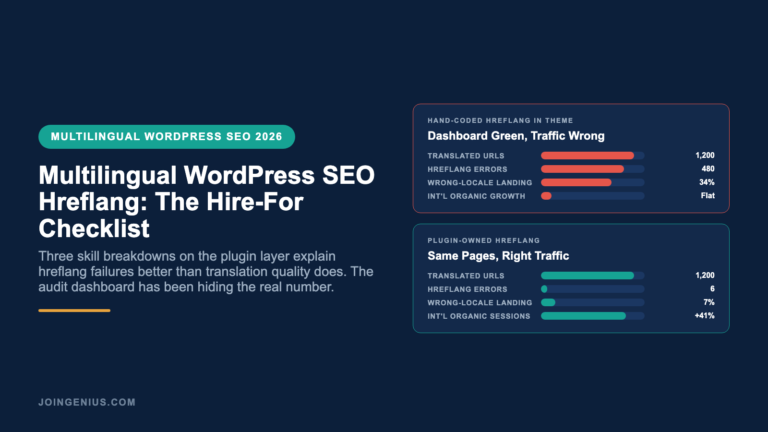
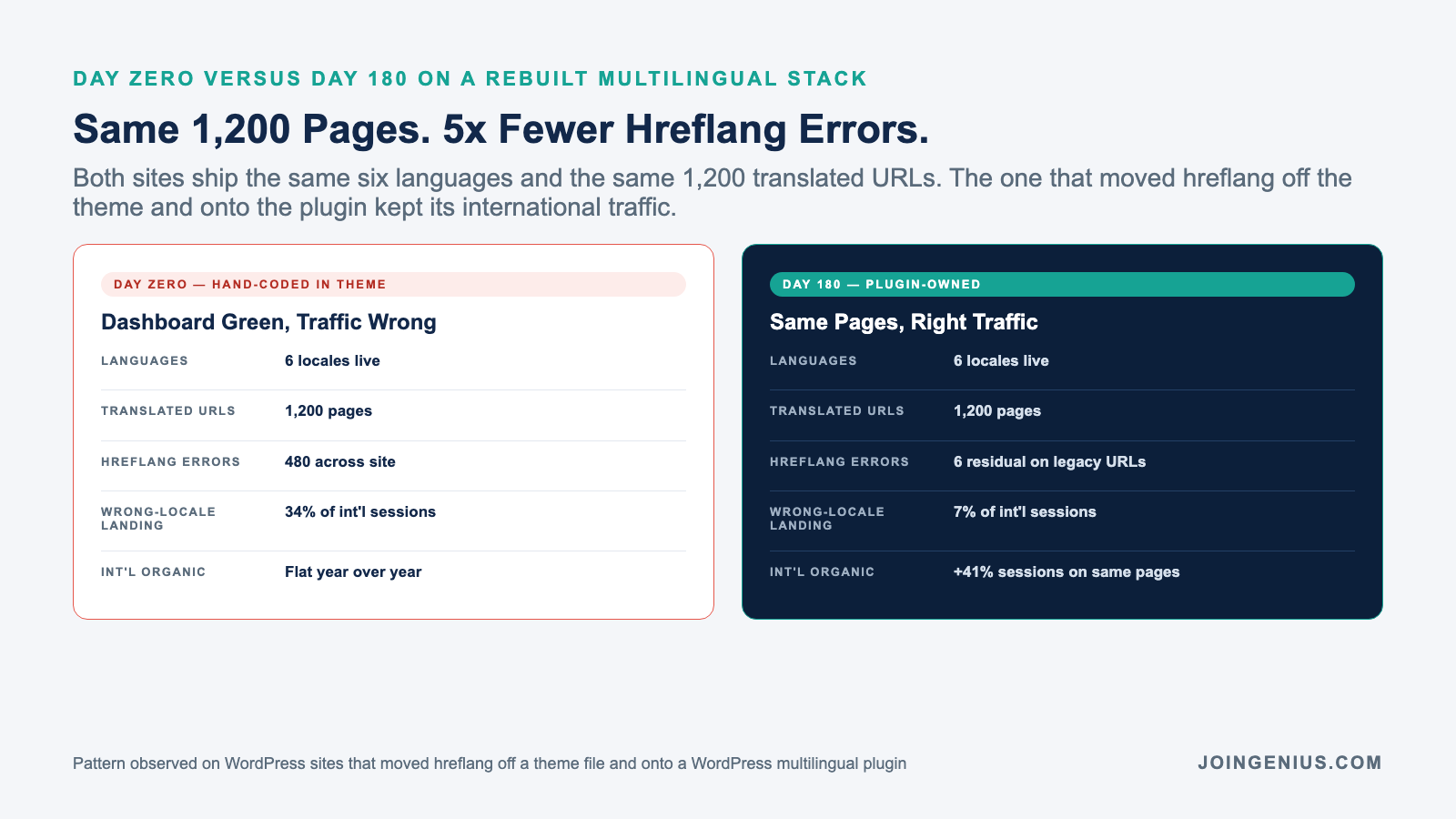
The before picture is the one most multilingual WordPress teams describe. The site runs on a theme with hand-coded hreflang in the header template. Six languages. 1,200 translated URLs. The SEO audit returns 480 hreflang errors across the site, most of them missing return tags on the non-English variants. Thirty-four percent of international organic sessions land on the wrong-locale URL. Mexican search traffic lands on the Spain homepage. US traffic lands on the UK product page. Year-one international organic growth comes in flat.
The after picture at day 180 looks different on every metric. The same site, the same six languages, the same 1,200 translated URLs. The plugin layer now owns hreflang. The sitemap carries the entries. The head tags are off. The hand-coded tags in the theme file have been removed. The audit returns six residual hreflang errors, all on legacy pages pending republish. Wrong-locale landing rate drops to 7 percent. International organic sessions climb 41 percent on the same translated page count.
The number that changed first was hreflang-tag duplication rate. It moved from tags in both the head and the sitemap on every page to tags in exactly one location per the plugin’s own rule. Every downstream metric moved on the lag of that one.
The Four-Move Hiring Playbook For Multilingual WordPress
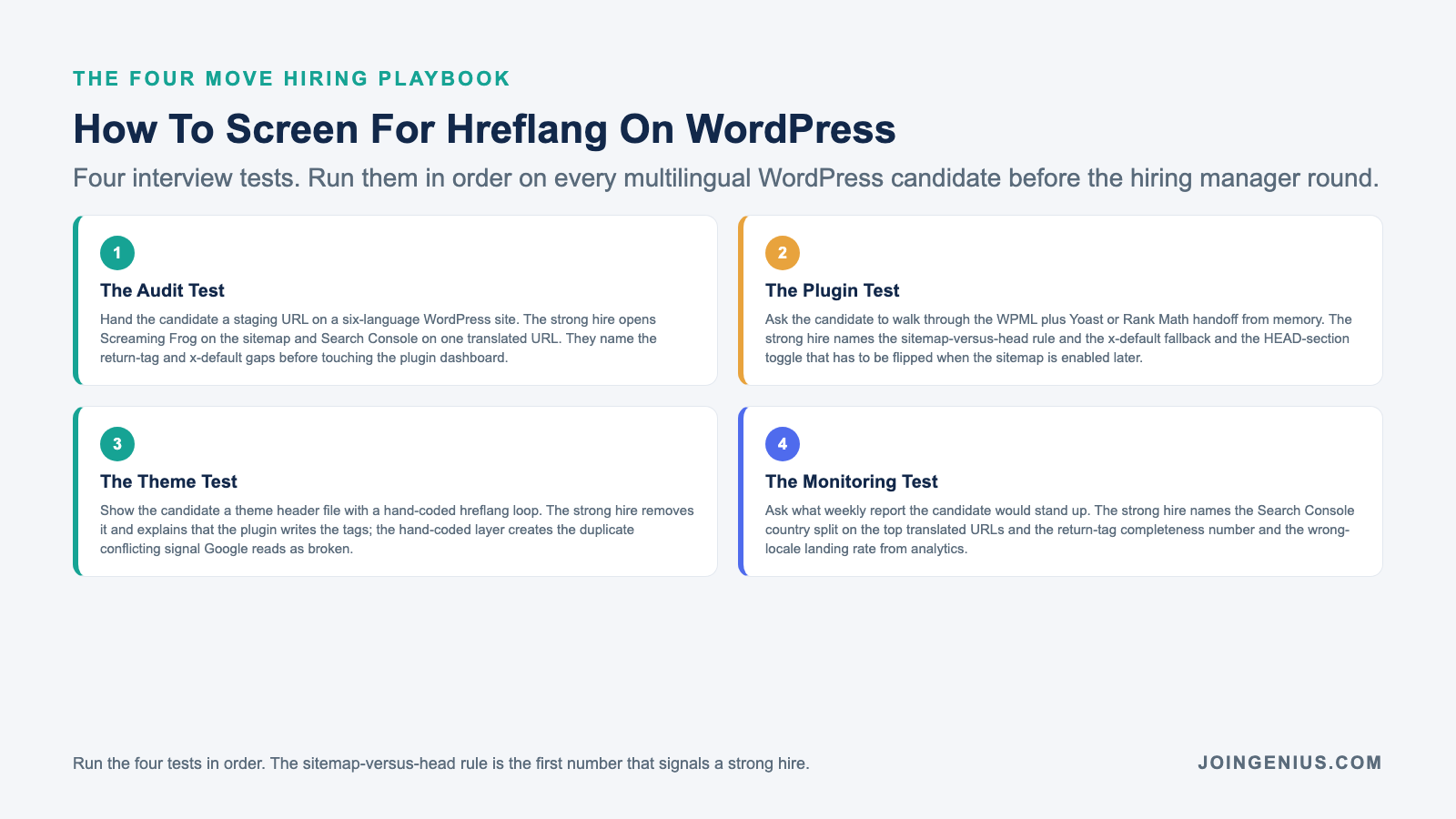
Move one is the audit test. Give the candidate a staging URL on a six-language WordPress site and ask them to produce a hreflang error list in 30 minutes. The strong hire opens Screaming Frog on the sitemap and Search Console on one translated URL. They name the return-tag and x-default gaps before they touch the plugin dashboard. The weak hire opens the SEO plugin panel and reads the number of translated URLs.
Move two is the plugin test. Ask the candidate to walk through the WPML plus Yoast or Rank Math handoff from memory. The strong hire names the sitemap-versus-head rule, the x-default fallback, and the “Display alternative languages in the HEAD section” toggle that has to be turned off when the sitemap is enabled later. The weak hire describes installing the plugin without naming the handoff.
Move three is the theme test. Show the candidate a theme header file with a hand-coded hreflang loop and ask what they would do with it. The strong hire removes it and explains that the plugin writes the tags; the hand-coded layer creates the duplicate conflicting signal. The weak hire adds the plugin on top and treats it as redundancy.
Move four is the monitoring test. Ask the candidate what weekly report they would stand up for a multilingual site. The strong hire names the country split in Search Console, the return-tag completeness on the top translated URLs, and the wrong-locale landing rate from analytics. The weak hire names the translated page count.
The Weekly Five Metric Check Any Good Hire Runs
The replacement for the plugin-dashboard glance most teams run is a weekly five metric read owned by the multilingual specialist. The point is to make the real signal visible before the organic traffic actually drops, not after.
Metric one is the percent of translated URL clusters with a complete return-tag loop. Metric two is hreflang-tag location consistency, measured as the percent of pages where tags appear in exactly one location per the plugin rule. Metric three is x-default coverage, measured as the percent of translated clusters where an x-default URL is explicitly set.
Metric four is the wrong-locale landing rate pulled from Search Console country reporting on the top 50 translated URLs. Metric five is hreflang-pointer hygiene, measured as the count of 404 or 301 URLs still being referenced by hreflang tags on live pages. A dead URL inside a live hreflang cluster drops the whole cluster’s signal.
Scan these five every Monday, flag the two biggest week over week moves, and walk the team through the hypothesis before the SEO sync. The conversation changes from “how many pages are translated” to “which specific cluster lost its return tag this week,” which is the only conversation that moves international organic. Build this into your interview rubric for the multilingual specialist role.
Hire Multilingual WordPress Specialists Who Own The Plugin Layer
The multilingual WordPress programs that compound in year two are the ones that stopped treating hreflang as a tag and started treating it as a cluster-level invariant owned by one specialist. They are the ones that moved the tags off the theme file and onto the plugin layer. They are the ones with a hire who knows the sitemap-versus-head rule from memory.
The hiring window is tight. The US Bureau of Labor Statistics puts the median pay for Web Developers and Digital Designers at $99,520 in 2025 with a 5 percent growth projection through 2035 and roughly 13,600 openings a year on average across the decade. That is a seller’s market for the WordPress multilingual specialist archetype you need to hire against.
Genius hires top one percent engineering and technical operations talent from the Philippines and LATAM at roughly 80 percent less than local comp. There are no monthly fees and the placement comes with a six month replacement guarantee.
We screen on the four hire-for tests described on this page before any candidate reaches a hiring manager, so your sourcing funnel brings you people who will fix the hreflang layer before the next translation cycle starts rather than people who will present another audit report after the international traffic has already dropped.