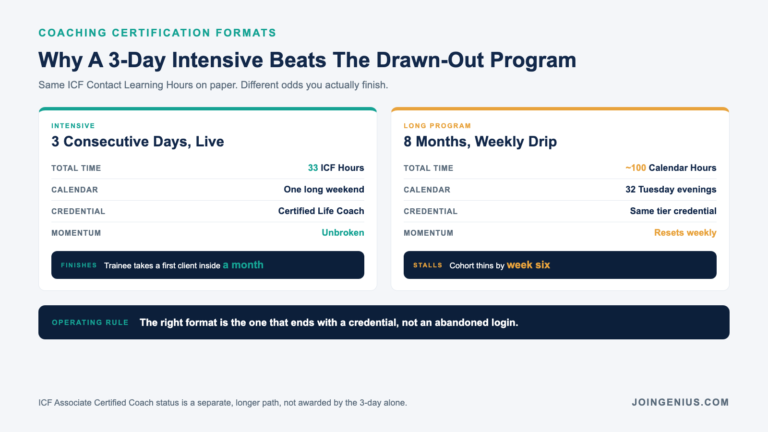
Most working adults who start a coaching certification never actually finish it. The 3-day intensive coaching certification exists because a modern career life cannot clear its calendar week after week for eight months in a row. It can, however, clear a long weekend without a fight.
An 8-month drip program and a 3-day intensive aim at similar ICF Contact Learning Hours. The failure mode is rarely the material itself. It is the weekly attrition between sessions and the dropped momentum between them. Life events arrive every Tuesday and keep arriving. Current leadership development data makes the trade-off visible for anyone deciding between formats this year.
Why Long Programs Stall In The Middle
Long certification programs do not fail on the curriculum, they fail on the calendar. The attrition pattern repeats across cohorts and mirrors low morale at work: early energy, then a quiet drop-off.
The First Six Weeks Look Fine
Week one of an 8-month program fills easily. The cohort chat is active, the first session runs long because everyone shows up, and the facilitator reads it as engagement. By week six, the same roster has quietly thinned. Half the class watches the replay on triple speed.
The drop is predictable. People start when motivation is high. They continue through the first assignment. Then real life intervenes, and the drip format gives attendees forty more chances to miss a session than the 3-day intensive gives them to miss a day.
Momentum Is The Hidden Curriculum
Coaching skills are practice-dependent. The gap between learning a technique on Tuesday and using it with a peer the following Tuesday is where retention leaks. A 3-day block lets the technique move from slide to triad in minutes. Feedback and the retry happen inside a single working memory window.
An 8-month program spreads that loop across weeks. The learner has to rebuild context each session. By the time the credential is awarded, they have practiced in fragments. No cohort relationship is deeper than a shared text thread, and the skills never finish consolidating.
What The Numbers Say About Intensive Formats
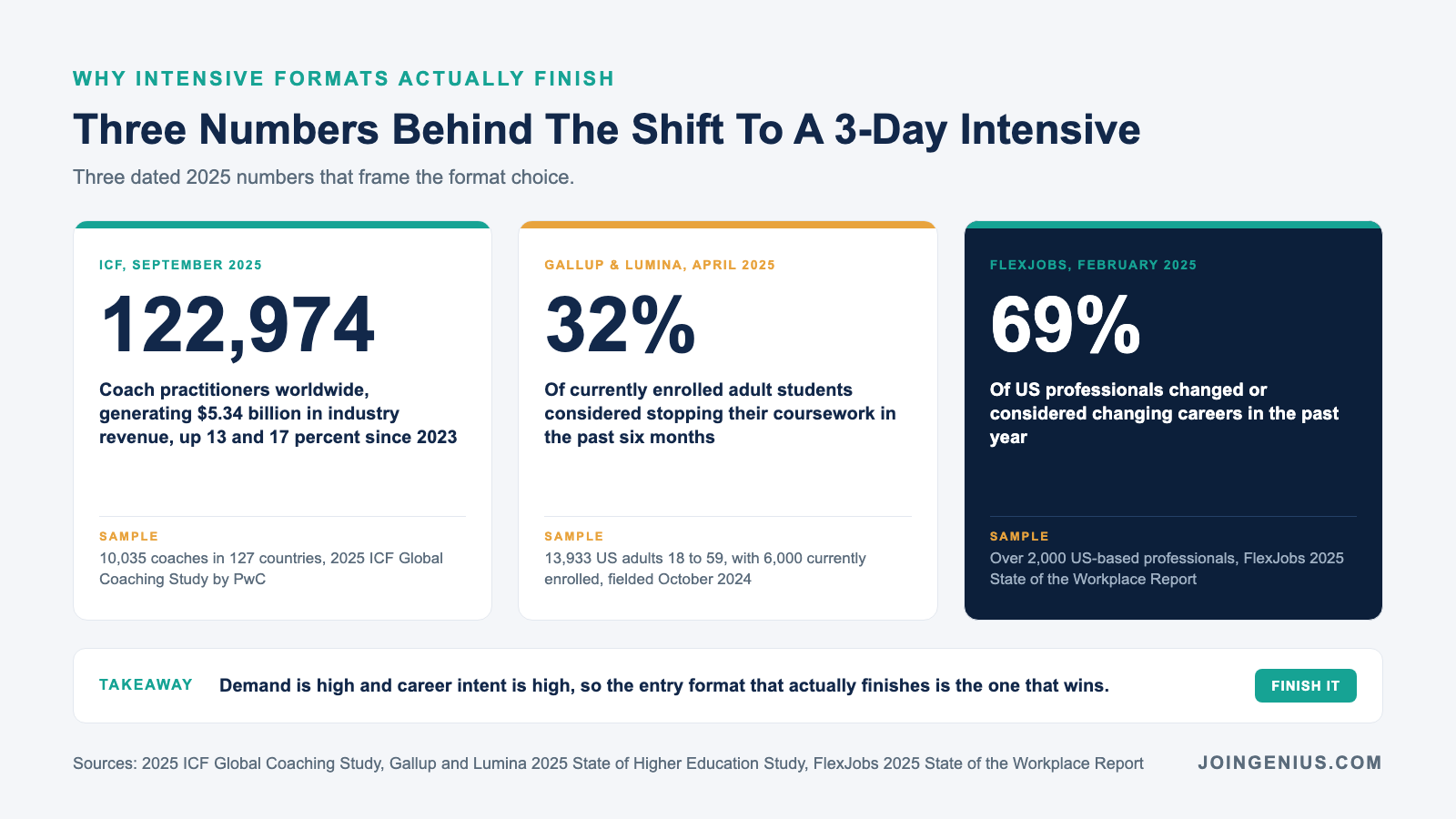
Three recent numbers frame the trade-off between drip and intensive. They come from the coaching industry and from workplace learning research. One US workforce study anchors the third.
The 2025 ICF Global Coaching Study, published September 15, 2025, counts 122,974 coach practitioners worldwide and $5.34 billion in annual industry revenue. That is a 13 percent practitioner increase and a 17 percent revenue lift since the 2023 study. The entry bottleneck is a format a working adult can finish.
A Gallup and Lumina State of Higher Education Study, published April 30, 2025, found 32 percent of currently enrolled adult students have considered stopping their coursework in the past six months. The sample included 6,000 enrolled adults across degree and certificate programs. Attrition risk tracks with program length.
The FlexJobs February 2025 State of the Workplace Report surveyed over 2,000 US professionals. It found 69 percent had changed or considered changing careers in the past year. The intent curve is high. The bottleneck is turning that intent into a credential inside a calendar that actually holds.
What Three Days Actually Covers
Three days is not a shortcut. It is the same ICF Contact Learning Hours block, compressed into consecutive mornings and afternoons with observed practice at every stage. What changes is the delivery, not the content, and the shape of the three days is predictable across reputable programs.
Day One Through Day Three
A 3-day intensive follows a repeatable arc. Day one sets the coaching framework. Day two drills the techniques. Day three turns the trainee into a practitioner who can take a first client the following Monday.
| Day | Focus | Practice | Output |
|---|---|---|---|
| Day 1 | Foundations: coaching framework and the session agreement | Live triad with facilitator feedback | Agreed definition of the coach role |
| Day 2 | Techniques: inquiry and reframing | Two 20-minute practice sessions, observed | Written feedback from two peers |
| Day 3 | Business: client acquisition and ethics | Role-play with a prospect scenario | Draft intake template and ethics statement |
The table above is a composite, not a specific vendor spec. Different programs sequence the three days differently. The ICF Contact Learning Hours count is what the credentialing body cares about, and that count is what the trainee carries forward.
Where Coaching 101 Fits
The Coaching 101 program is one named example of the format. Three consecutive days of live Zoom instruction deliver 33 ICF Contact Learning Hours. The Certified Life Coach credential lands at the end. ICF Associate Certified Coach status is a separate, longer path. It is not awarded by the 3-day alone.
The point is not the vendor. It is that a 3-day intensive compresses the entry credential into a block an adult can actually clear without rearranging the next eight months. Executive peer groups have the same operating logic: short, concentrated sessions that put retention first.
The Hidden Costs Of A Long Program
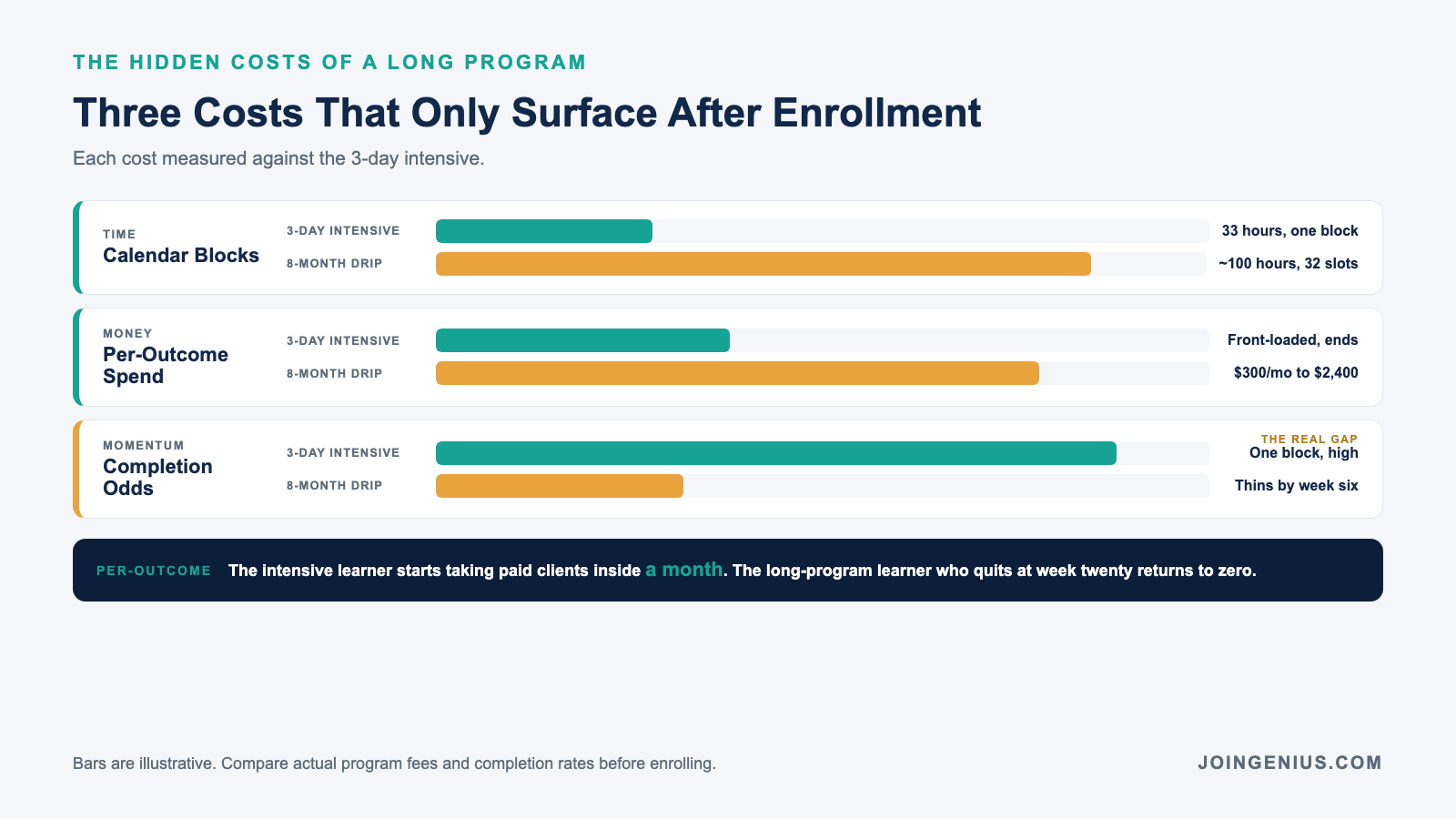
The sticker price of an 8-month program hides three costs that only surface after enrollment. They are the costs that push completion rates down and refund requests up.
Time And Attention
Eight months of weekly sessions eats into a working adult’s calendar management in a way the sticker price never shows. Most of the hours are low-density: one 90-minute session a week with homework around it. A 3-day intensive asks for 33 consecutive hours but ends.
An adult paying for the program is also paying the opportunity cost. Eight months of Tuesday evenings is eight months of sidelined client work and family time. The intensive bills the opportunity cost once over a long weekend. The ledger closes the following Monday.
Money And Momentum
Long programs cost less per month, more per outcome. A $300 monthly plan over eight months reaches $2,400 before anyone earns the credential. The 3-day intensive front-loads fees. The completion rate is where the per-outcome math actually changes.
Momentum is the harder number to price. A learner who finishes in a long weekend starts taking paid clients inside a month. A learner who grinds through eight months and quits at week twenty often returns to zero. The gap is wider than the fee column.
Who The 3-Day Intensive Is Not For
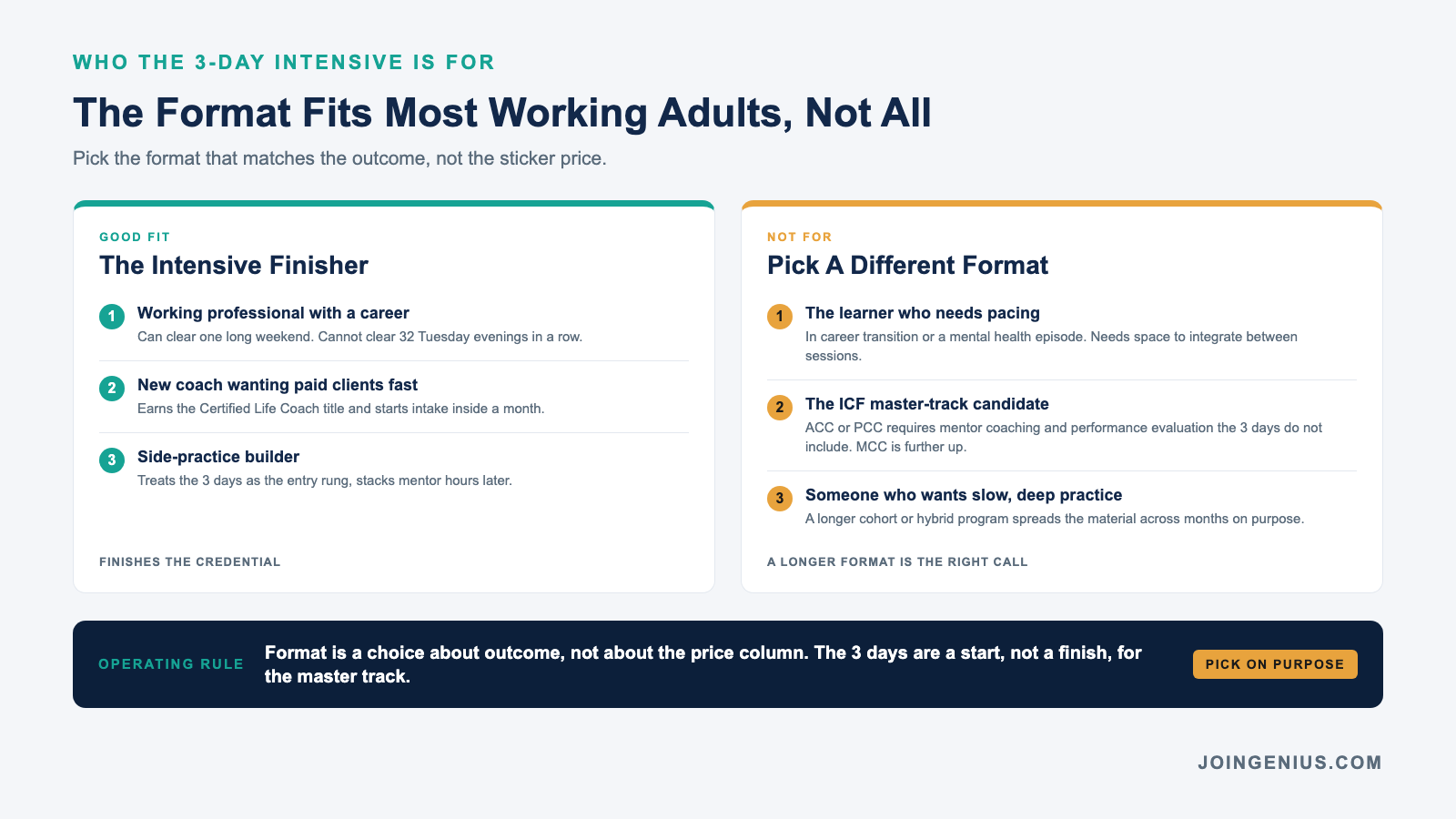
The 3-day intensive is not a universal answer. Two groups should pick a different format on purpose rather than default to speed.
The Learner Who Needs Pacing
People processing a career transition or a mental health episode usually need pacing more than they need completion speed. Weekly sessions give space to integrate the material between meetings. An intensive front-loads the emotional load into one weekend, which can be too compressed.
The right call for this group is a longer cohort format or a hybrid program. The 3-day intensive is wrong for them even when the sticker price looks better. The outcome the learner actually needs is spread, not speed.
The Learner Who Wants Master Credentials
The ACC and PCC credentials require more mentor coaching hours and client log hours than any three-day block provides. MCC is a further step on top of both. A 3-day intensive earns the Certified Life Coach title and the ICF Contact Learning Hours. It does not earn the ACC.
Candidates targeting an ICF Level 1 or Level 2 credential should treat the 3-day intensive as the entry rung. Finish it, then stack the mentor hours and the exam separately. The three-day format is a start, not a finish, for anyone heading toward the master track.
Pick The Format That Fits The Life You Actually Have
The right certification format is the one that ends with a credential, not an abandoned login. Pick the format that matches the life you can actually clear, then plan the rest of the coaching career from there.
A 3-day intensive compresses the entry work. The practice stacks differently from there. Mentor coaching and client logs follow, and supervision fills out the rest of a coaching career. The intensive is not the whole story. It is the only chapter one most working adults will actually finish.
Genius places client success leads and lifecycle specialists in the top 1 percent of Philippines and LATAM applicants. US and EU companies pay roughly 80 percent less than a local hire. No monthly fees, and every match comes with a 6-month talent guarantee. The interview rubric is built around the operator traits coaches need in a chief of staff.