A new hire watches a 25-minute onboarding video on a Monday, clicks “complete” and moves on. On Friday a customer asks the exact question the video answered, and the new hire cannot remember the answer. That is an illustration, not a case study, but it shows the gap between finishing a video and remembering it.
This guide explains why quizzes tend to help material stick and how to check that in your own onboarding. It covers what testing research shows, why video-only training can feel better than it works, how to turn a video into a short quiz, how to run a fair comparison and a table of warning signs. The research on testing is solid, but we found no study that compares quizzes with video-only training in workplace onboarding, and none that tests live game-style quizzes with leaderboards. “Stick” here means remembered days later, which is our definition. The advice rests on three studies, vendor material from Kvistly and our reasoning.
What We Mean by Video-Only and Quiz
In our usage, video-only training means a recorded session that learners watch once, with completion as the only check. A quiz means a short set of questions that asks learners to recall what they watched, answered without looking at the video. Those definitions are ours.
Our guide on why onboarding courses fail covers passive course design and how to measure results, so this piece stays on one question: what happens when you add recall. Our job orientation guide covers the wider first-week plan.
What Research Shows About Testing
The best-known finding is the testing effect: recalling material helps it last longer than rereading it.
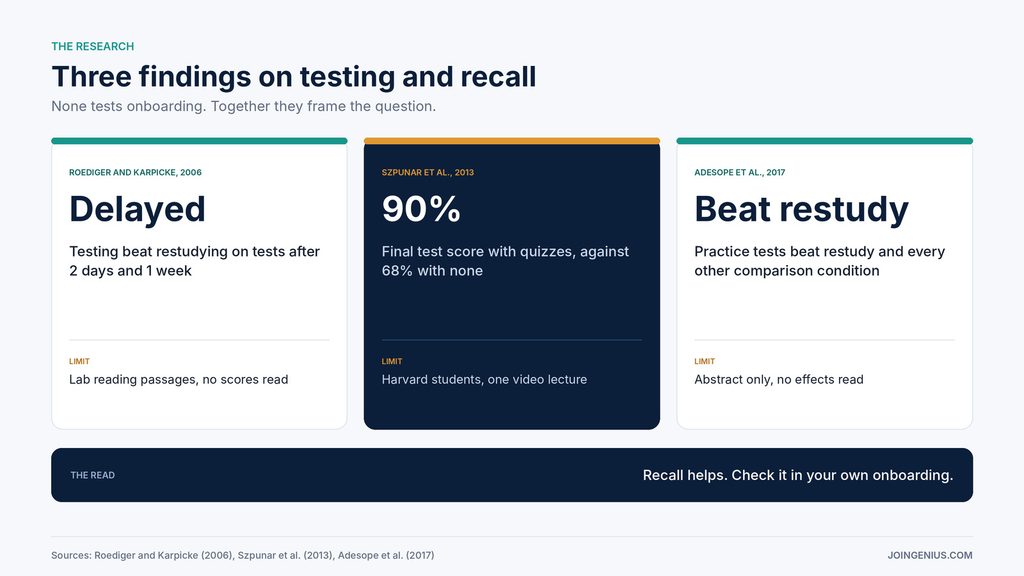
In a 2006 study in Psychological Science, Henry Roediger and Jeffrey Karpicke had students study prose passages, then either take recall tests or restudy. A final test came 5 minutes, 2 days or 1 week later. At 5 minutes, restudying did better. On the delayed tests, prior testing produced substantially greater retention. The abstract we read gives no scores and no sample size, and the work used reading passages in a lab.
A 2013 study in PNAS by Karl Szpunar, Novall Khan and Daniel Schacter is closer to training. Students watched a 21-minute statistics video split into four segments. One group was quizzed after each segment, a second restudied the answers and a third did unrelated arithmetic. On the final test, the quizzed group scored 90%, the restudy group 76% and the group with no quizzes 68%. The two experiments had 32 and 48 students. The students were Harvard undergraduates, the video was a single lecture and, in our reading, as we read the paper, the final test came soon after, so we cannot say what happens weeks later or with working adults.
A 2017 meta-analysis in Review of Educational Research by Olusola Adesope, Dominic Trevisan and Narayankripa Sundararajan compared practice tests with other conditions. The abstract says practice tests were more beneficial than restudying and all other comparison conditions. We read only the abstract, so we cannot report study counts or effect sizes.
Why Video-Only Can Feel Better Than It Works
Roediger and Karpicke also reported that repeated studying raised students’ confidence that they would remember, even though it did not produce better delayed retention. Our reasoning is that a smooth video can create the same feeling: the content looks familiar, so it seems learned.
Attention may matter too. In the PNAS study, the other groups did arithmetic or restudied between segments, and the quizzed students stayed with the lecture better. When students were probed, they reported mind wandering on 19% of probes when quizzed, against 39% for the restudy group and 41% for the group without quizzes. The quizzed group also took more notes. That is one lecture with students, not a new hire’s first week, so treat it as a signal. Completion rates tell you who clicked, not who remembers, and that is an inference rather than a finding.
Turn Your Existing Training Video Into a Short Quiz
You do not need to rebuild the video. Add a short quiz after each section or at the end, and ask learners to answer from memory. Kvistly, an AI quiz platform, describes its onboarding quizzes as built by an AI question extractor that takes uploaded files, pasted text or a link and creates 10 questions, each with one correct answer and three incorrect ones. Its page advises no more than 15 questions per game.
That is the vendor’s description, and we treat it as a claim. The same page cites figures on forgetting, engagement and replay interest with no sources, so we skip them. Kvistly’s inDrive case study says onboarding changed from “a one-way lecture” to interactive sessions, but it reports no numbers, so we do not rely on it either. The page also describes live play with a confidence bet: each player wagers credits before answering. Our reasoning is that asking people how sure they are could expose overconfidence, but nothing we read tests that.
If you use a tool like this, review the generated questions yourself. These points are our suggestions, not findings. Tie each question to something the new hire must do, such as which form to file or what to say to an unhappy customer, not to a detail from the narration. Write wrong answers that a careful person might actually choose. Keep the quiz short enough to finish in a few minutes, and show the right answer afterward. Kvistly’s page suggests answer windows of about 17 to 20 seconds per question, which fits quick recall rather than long essays. Name one person who owns the questions and updates them when a process changes, since an outdated quiz teaches the wrong thing with confidence. Our training matrix guide can help you list which skills need a check.
Run Your Own Comparison Before You Roll It Out
Because no workplace study settles this, run a small pilot. This design is our suggestion. Split a group of new hires, or two consecutive cohorts, into two. Both get the same video. One group takes a short quiz right after; the other does not. A week later, give both groups the same short scenario check and compare.
Keep the check fair: the same questions, the same format and a scorer who does not know which group a person was in. Do not judge success by how much people enjoyed the session, since enjoyment and remembering are different things, which is what the research above suggests. Small groups give noisy results, so repeat the pilot before you treat the answer as settled. Our cross-training guide covers how to give people hands-on practice alongside the quiz.
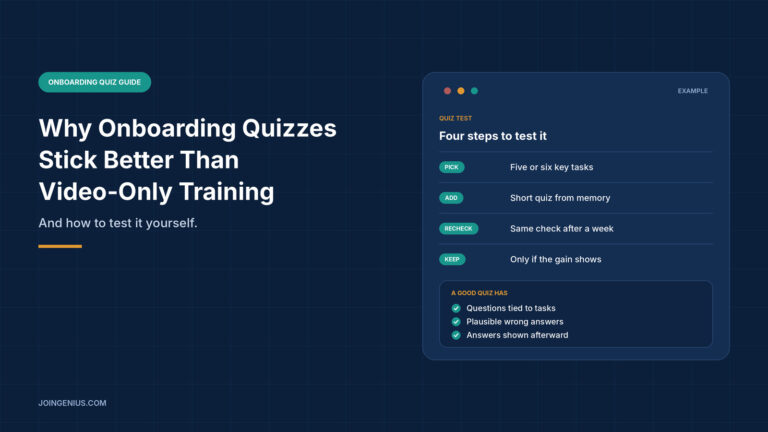
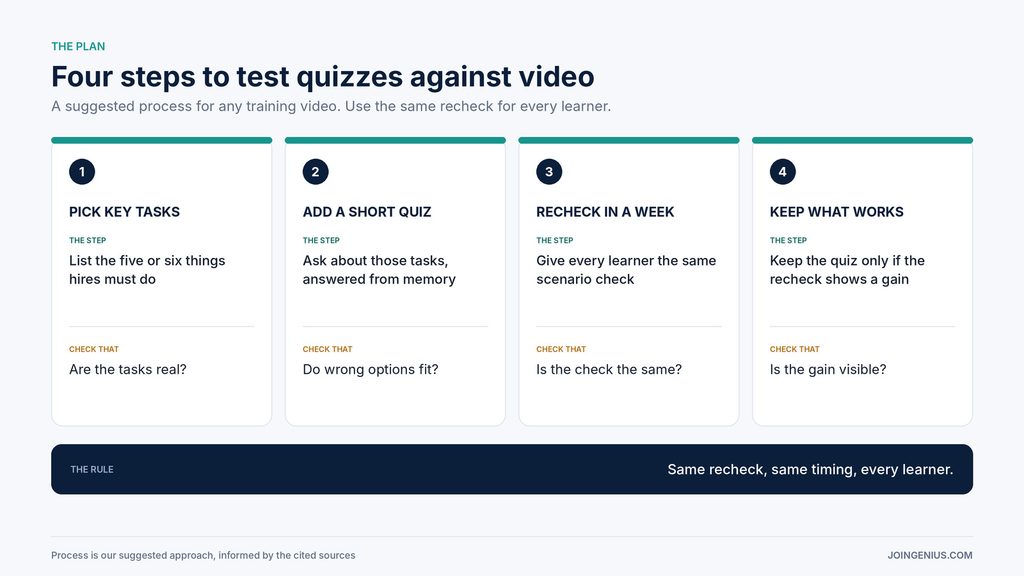
A Four-Step Plan to Test Quizzes Against Video
Use this four-step plan for any training video. It is our suggested process, informed by the sources above.
- Pick the key tasks. List the five or six things a new hire must be able to do.
- Add a short quiz. Write questions about those tasks and ask for answers from memory.
- Recheck after a week. Give every learner the same short scenario check.
- Keep what works. Keep the quiz only if the recheck shows a gain you can see.
The recheck matters because the research above found that the advantage of testing shows up on delayed tests, not right away.
Measure Whether It Works
Track scenario check scores after a week, how many new hires can do the key tasks unaided in their second week, how often they ask for the same answer again and how long it takes them to reach independent work. Judge over several cohorts, since one group proves little, and be careful about crediting the quiz for changes caused by a new manager or a new process. Ask a few new hires what they remember without looking. These measures are our suggestions, not findings. Our AI knowledge tools piece covers how support teams shorten onboarding with searchable answers.
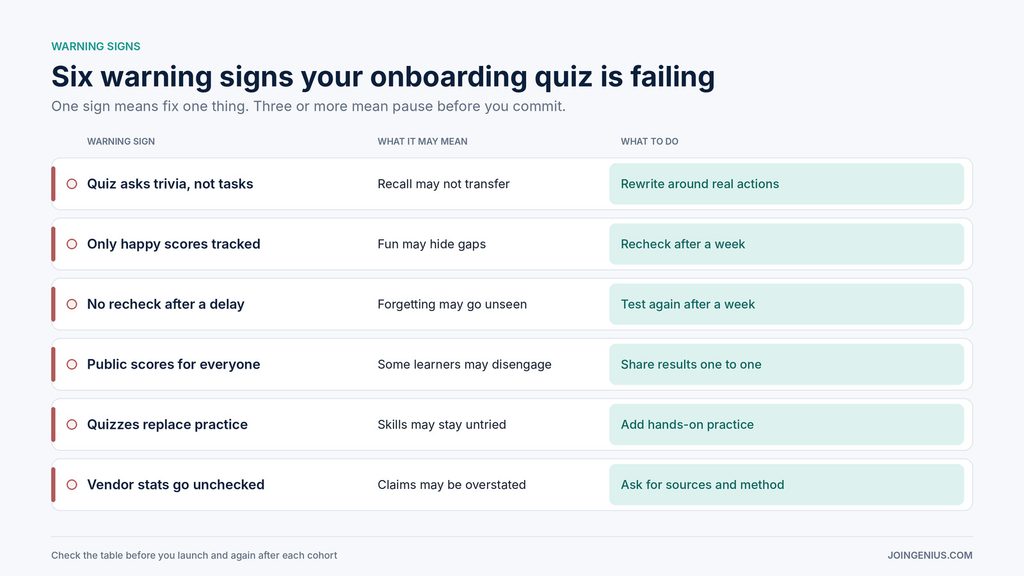
Warning Signs Your Onboarding Quiz Is Not Working, and What to Do About Each
Check this table before you launch and after each cohort. One sign means fix one thing. Three or more mean pause before you scale.
Test the Quiz, Then Keep It or Drop It
The testing research gives a good reason to add recall to onboarding: quizzed learners did better on delayed tests, and video alone can feel more effective than it is. It does not prove that a particular quiz tool, or a live game with leaderboards, will improve your onboarding. Pick the key tasks, add a short quiz, recheck after a week and keep it only if the results show a gain. If new hires can do the work unaided in their second week, you have a better reason to keep the quiz than any vendor statistic.