Every head of talent in fintech has met two recruiters with the same resume. One closes 14 roles a year while the other closes four. The gap is not luck, and it is not territory. The best fintech recruiters run a different process at every stage of the talent acquisition funnel, and the gap compounds over a full year.
If you are rebuilding a recruiting function for a new product line or market, understanding what the closers actually do is where the real gains sit. A closer builds pipeline. A non-closer builds a lead list. The lead list looks like pipeline until the second week.
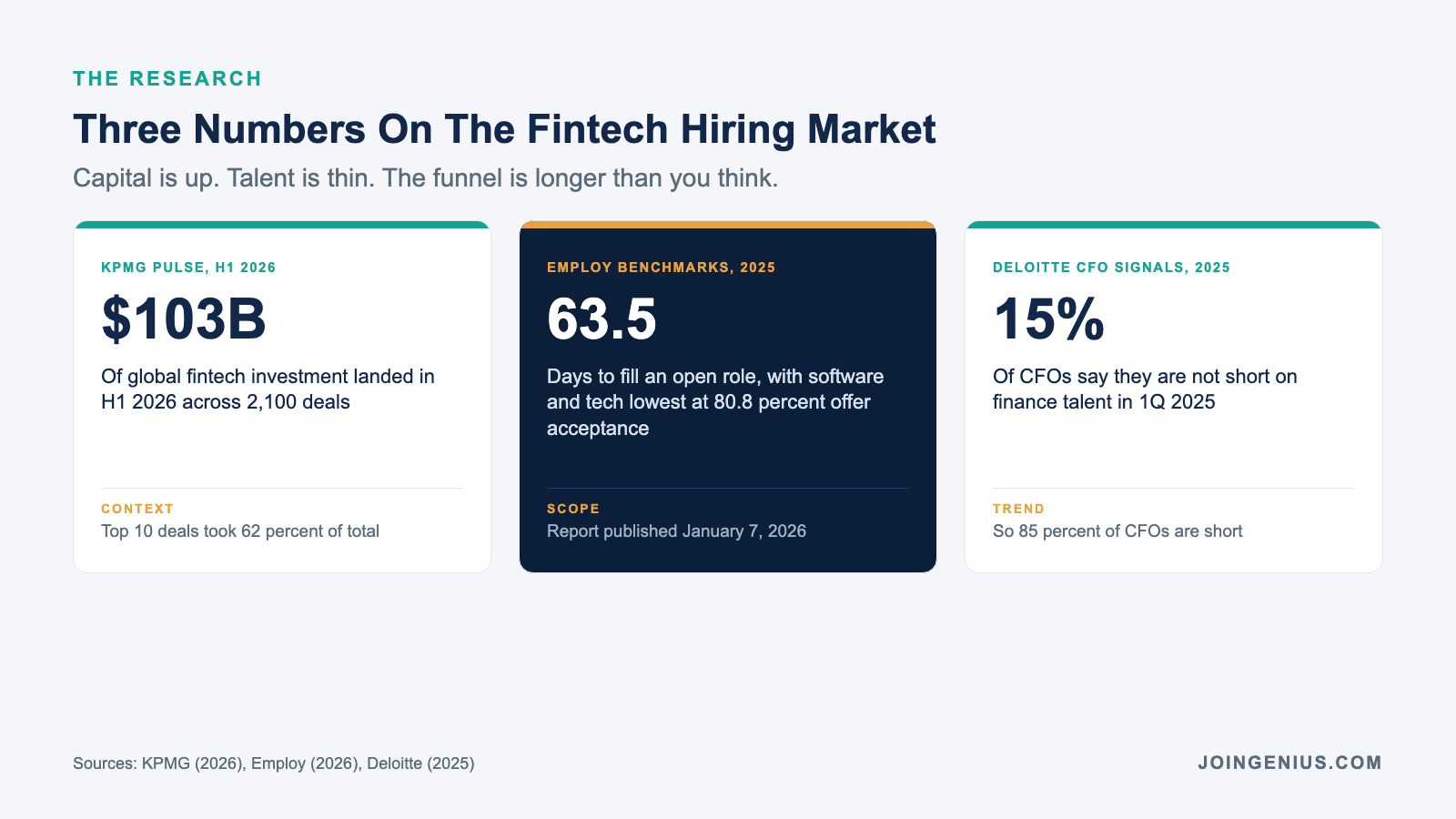
The market is tightening. KPMG published Pulse of Fintech H1 2026 in September 2026, reporting $103.1 billion of global fintech investment across 2,100 deals. The top ten deals swallowed 62 percent of the total.
Capital is concentrating. Hiring plans are concentrating with it. The pool of candidates who can ship compliant software in a regulated environment has not grown at the same rate.
Why Most Fintech Recruiters Stop At The Shortlist
The recruiter who does not close usually runs the top of the funnel well. They source quickly, build a decent shortlist, and hand it to the hiring manager inside a week. Then the pipeline stalls.
It stalls because the recruiter has not done the pre-work that lets them steer the back half. They do not know the comp band at the three closest competitors. They do not know which specific team the candidate would join or which product surface they would own. They do not know what the hiring manager will budge on.
Employ published its 2025 Hiring Benchmarks on January 7, 2026. The report put average time to hire at 63.5 days and offer acceptance for software and tech at 80.8 percent, the lowest of any sector measured. In fintech those two numbers compound. A candidate dragged across 60 days of process, then handed an underwhelming offer, says no and keeps interviewing.
What Closers Do Before The First Call
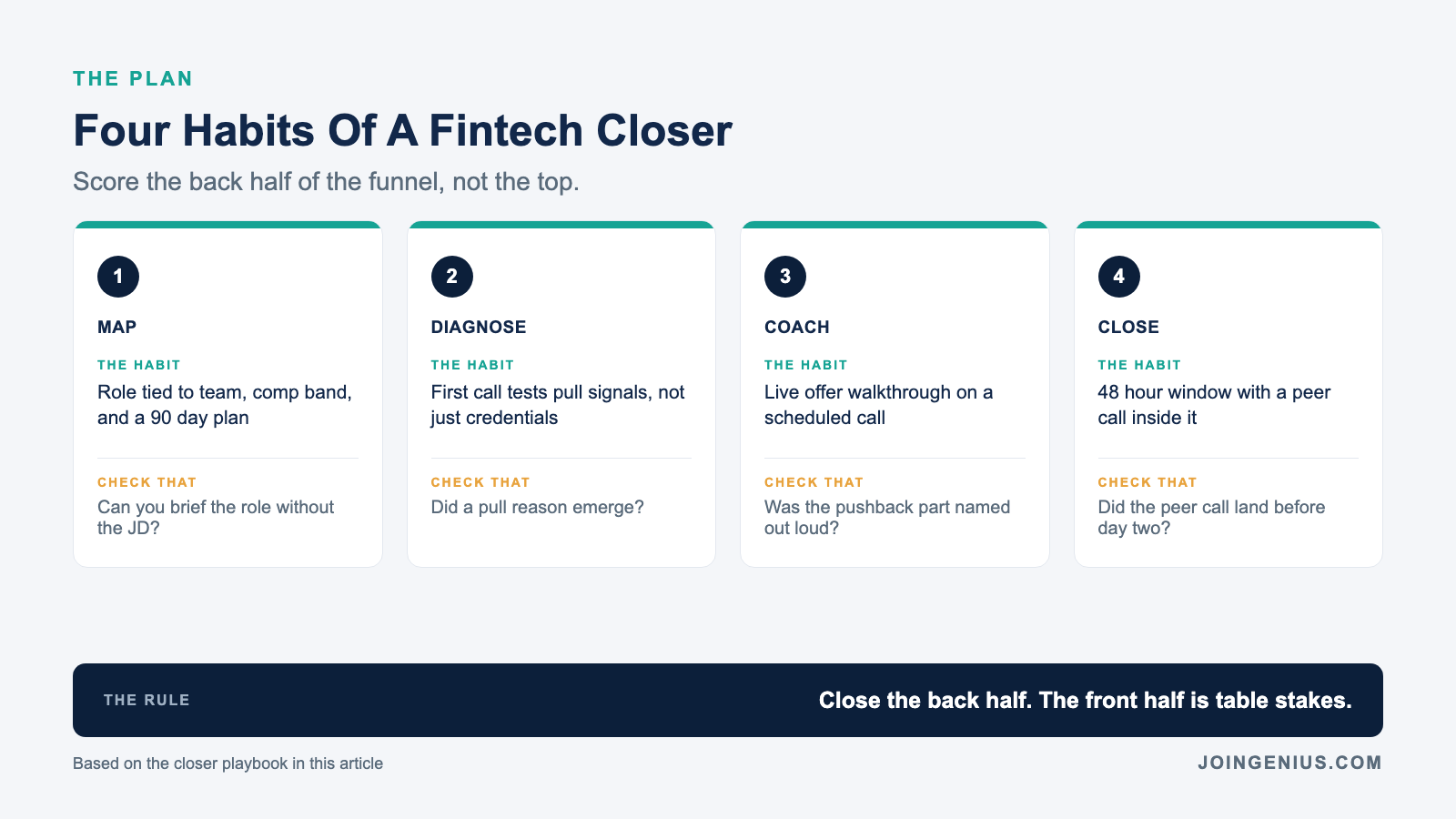
The closers do the research the shortlist recruiter skipped. Before they open LinkedIn or an outreach tool, they map the role to a product and a team. They nail the comp band for that specific pairing.
They know whether the role is a hands-on IC seat or a lead with budget authority. They can describe the first 90 days in two sentences without a glance at the job spec.
They also map the compliance edges of the role. A payments role at a licensed money transmitter is a different sell than the same title at a crypto exchange. The regulatory posture of the employer sets the candidate pool.
A closer knows this before the first touch. Candidates will ask about it on the first call and get a vague answer from a weaker recruiter, so the pre-work pays off within minutes of dialing.
The last piece of pre-work is the “no” they are prepared for. Deloitte’s 1Q 2025 CFO Signals Survey found only 15 percent of CFOs said they were not short on finance talent.
The closer knows the hiring manager is competing for the same ten people as the three fintechs down the street. They have a specific angle for why this role beats those. They can defend it under pressure from a candidate who has three live offers in hand.
The Closer’s Playbook On The First Call
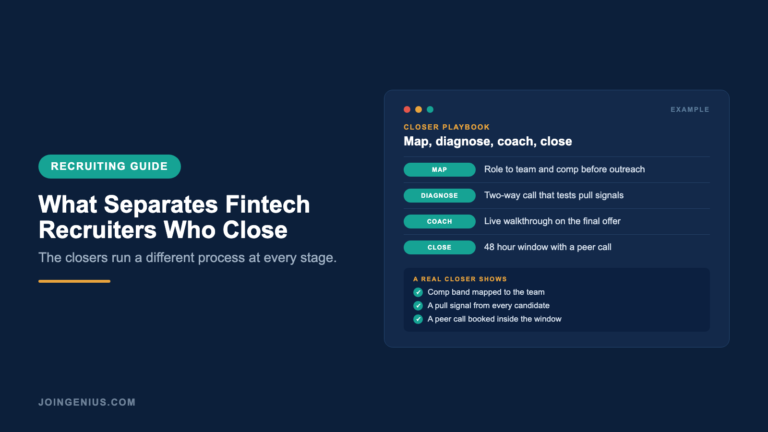
The first candidate call is where most pipelines leak. The recruiter who does not close runs a credential interview. The closer runs a two-way diagnosis. They are learning what the candidate wants and testing whether this role fits, in the same conversation.
The closer opens with a specific hook grounded in the candidate’s work. A merged PR counts. A product launch or a conference talk counts. Then they ask what is pulling the candidate forward, not just what is pushing them away. The push answer is table stakes. The pull answer is where the close lives.
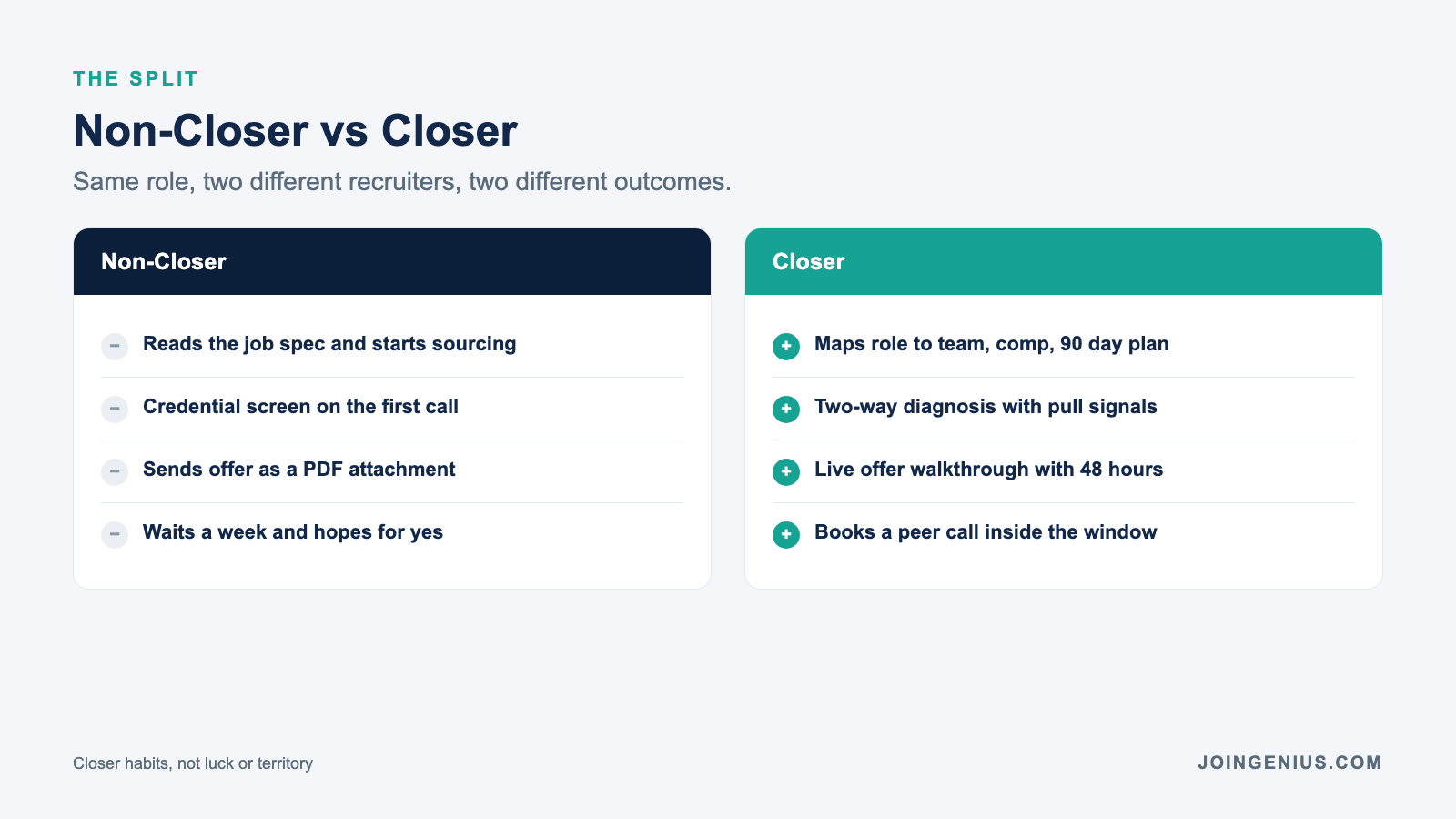
Mid-call, they qualify compensation inside a band rather than an exact number. They test for competing offers and the stage each offer is at. They name the two things the hiring manager will care most about so the candidate can prepare the right examples. The candidate feels like they have a partner, not a filter.
By the end of the call, the closer has a yes-or-no decision on moving forward, a comp band aligned to the role, and a timeline for the candidate’s other processes. They end the call with next steps on the calendar, not “we’ll follow up this week.”
Where Closers Actually Find Fintech Candidates
A general job board returns volume. A fintech recruiter who closes is working off sources with real signal. The specialist surfaces include finance-specific job boards and niche Slack or Discord communities. They also include licensed-conference alumni lists and the authored content of candidates who already write about the stack.
Specialist job boards sit at the top of this list for a reason. The candidates who browse them are already filtering for finance and fintech roles, not drive-by applicants from unrelated sectors.
SmartMoneyMatch’s fintech jobs board is one example of a surface built for this audience. Roles are posted by fund managers and fintech employers that read as finance-native, which filters the inbound before a recruiter ever opens an application.
The move is to post the role on the right surface and work the inbound against the outbound. Treat the inbound applicant from a specialist board as a warm lead because they self-selected for the sector.
The closer replies within 24 hours with a short note that references the applicant’s background, not a template. That reply is the actual first impression of the company, not the careers page copy.
The second surface is the authored content pool. A software engineer who publishes a blog post on payment settlement is a stronger candidate than one with a resume full of fintech logos but no public artifacts. The closer sources against the work, then approaches with a specific question about it.
The reply rate from this approach is not 8 percent. It is closer to a warm referral, because the opener names a specific decision the candidate made in public. The content pool rewards the recruiter who reads before they write.
The Last Mile Is The Offer, Not The Interview
Most recruiters treat the offer as a transaction. The closer treats it as the final interview. They coach the hiring manager to make the offer in a live call, not an emailed PDF. They prepare the candidate for what will be in the offer before the number is sent, so there are no surprises on either side.
The offer walkthrough itself is scripted. Base and bonus first. Equity and start date second. The closer names the two parts most likely to generate pushback and defends them. They give the candidate 48 hours rather than an open window, and they offer a reference call with a current team member inside that window.
| Stage | Non-Closer | Closer |
|---|---|---|
| Pre-call research | Reads the job spec | Maps role to team, comp, 90 days |
| First call | Credential screen | Two-way diagnosis with pull signals |
| Offer | Emailed PDF with 7 day window | Live walkthrough with 48 hour window |
| Close week | Hopes for a yes | Reference call plus text thread |
In the 48 hour window the closer stays available. They send a short note on day one with a referral or an article the candidate mentioned on the call. They do not pressure. The candidate feels seen and signs. The non-closer waits and then sends a bland follow-up on day seven, by which point the counteroffer has arrived.
The hiring manager plays a role in this window too. The closer briefs the hiring manager on a 15 minute peer call to run during the 48 hours. The call is not a sell. It is a question-and-answer about the actual day-to-day of the role.
Candidates who have the peer call sign at a rate that is visibly higher than those who do not. The closer tracks this and uses it to coach future hiring managers on what the real close looks like.
Hire Fintech Recruiters Who Close
You can learn the closer habits inside six months if the discipline is in place. You can hire the habits in week one if the discipline is not. Either way the gap is the same.
The recruiter who closes runs the back half of the funnel with the same intention a founder runs a sales close. The one who does not keeps blaming the market.
If you want to build a fintech recruiting bench faster than the local market will allow, Genius sources the top 1 percent of recruiter talent from the Philippines and LATAM. The roles come in at about 80 percent less than US rates. No monthly fees. A six month replacement guarantee.
We vet for closer signal, not just activity metrics. Explore how global outsourcing and payroll work when you are hiring recruiters across borders. The search for a fintech recruiter who actually closes becomes a tractable project.