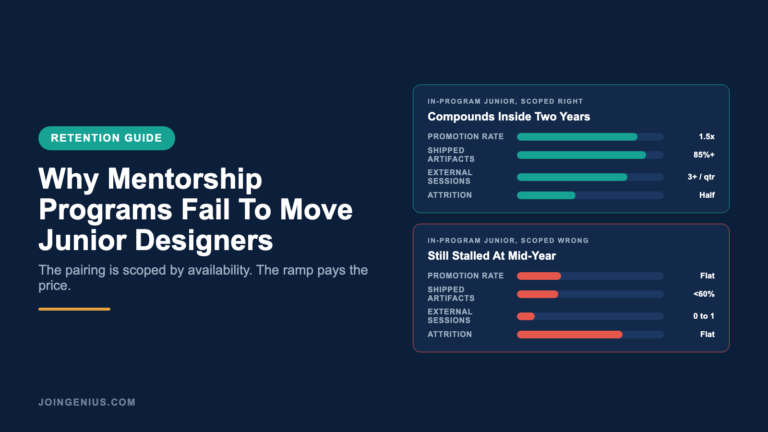
The design team runs a formal mentorship program. Pairings get made in Q1, sessions get booked, calendar holds get honored for a quarter, and by the time the mid-year review lands the junior designer is still working on the same scope they started with. The sponsor is confused. The junior is quietly job searching. The program lead reports the mentorship numbers at the quarterly design review and nobody is sure why the ramp did not move. This is not a rare pattern. It is the usual outcome, and it is the single biggest reason junior designers leave inside their first two years.
The failure is almost never the mentor and almost never the junior. It is the design of the program, and specifically the way the program is scoped relative to the career lever it is supposed to pull. Modern hiring workflows have shortened time to hire for design roles, but the ramp inside the role is where retention is quietly lost. Below we cover where design mentorship programs actually break and the career signal junior designers need and almost never get. We also cover how to design a mentorship program that actually ships, and how to measure whether the one you run is moving the needle.
Where Most Design Mentorship Programs Break Down
The failure mode of a formal design mentorship program is predictable. It almost always sits in one of four places, and all four compound.
The Pairing Is Scoped By Availability, Not By Goal
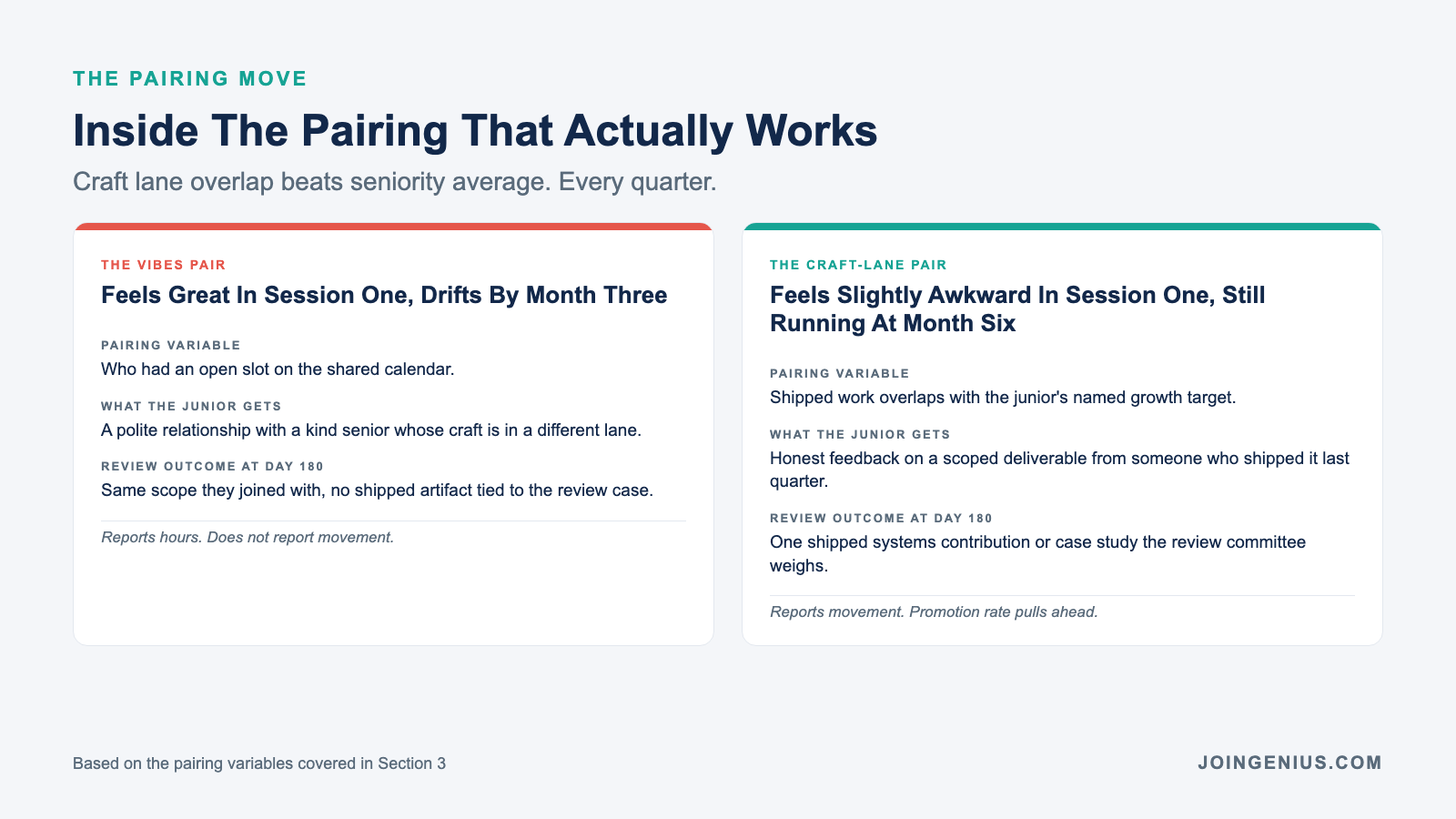
Most pairings happen because a senior designer had an open slot in their calendar, not because the junior’s goal matched that senior’s craft lane. A product designer trying to level up on systems thinking paired with a brand designer with time to spare does not produce a leveled-up product designer. It produces a polite relationship that stalls in month three.
The Manager Is Not In The Loop
The mentor sees the work the junior wants to show. The manager sees the work the junior is actually shipping. When those two views never reconcile, the mentorship conversation and the review conversation drift apart. The junior ends up optimizing for the mentor’s feedback and getting reviewed on something else.
There Is No Named Career Outcome
A program that reads “quarterly 1:1s with a senior” has no finish line. A program that reads “ship two systems contributions and present them at a design critique by day 90” does. Programs without a named outcome produce reflection, not movement. Reflection is a nice-to-have. Movement is why the junior joined.
The Sponsor Has No Skin In The Game
Mentors who volunteer with no accountability drift. Mentors whose own performance review includes “developed one junior to the next scope level this half” show up every time. The design org gets what it measures.
The Career Signal Junior Designers Need And Almost Never Get
A junior designer’s first two years are a search for one specific signal: proof the market and the manager will trust them with harder work. The mentorship program is one of the clearest places to generate that proof, and most programs do not.
The Portfolio Needs A Scoped Promotion, Not A Side Project
Junior designers are hired on their portfolio, promoted on their shipped work, and reviewed on the gap between the two. The mentorship program should close that gap by scoping one shipped piece as a promotion case, not by producing a side project the review committee does not see.
The Feedback Needs To Come From Outside The Immediate Team
Internal feedback has a ceiling. The junior’s manager, their lead, and their tech partner all share context, which means they share blind spots. External feedback (another company’s senior, a cross-industry peer, a specialist in a lane the junior is trying to grow into) is what breaks the ceiling.
The Network Needs To Form Before They Need It
The strongest designers do not start networking the week they start job searching. They started building the network the quarter they joined. A mentorship program that only produces a 1:1 relationship and no second-degree introductions is leaving the biggest career lever on the table.
The Confidence Signal Compounds Faster Than Craft
Craft improves on a slow curve. Confidence improves on a fast one, which is why the junior who gets honest feedback from someone they respect every two weeks runs circles around the junior who gets it every six months. The compounding is where the retention lever lives.
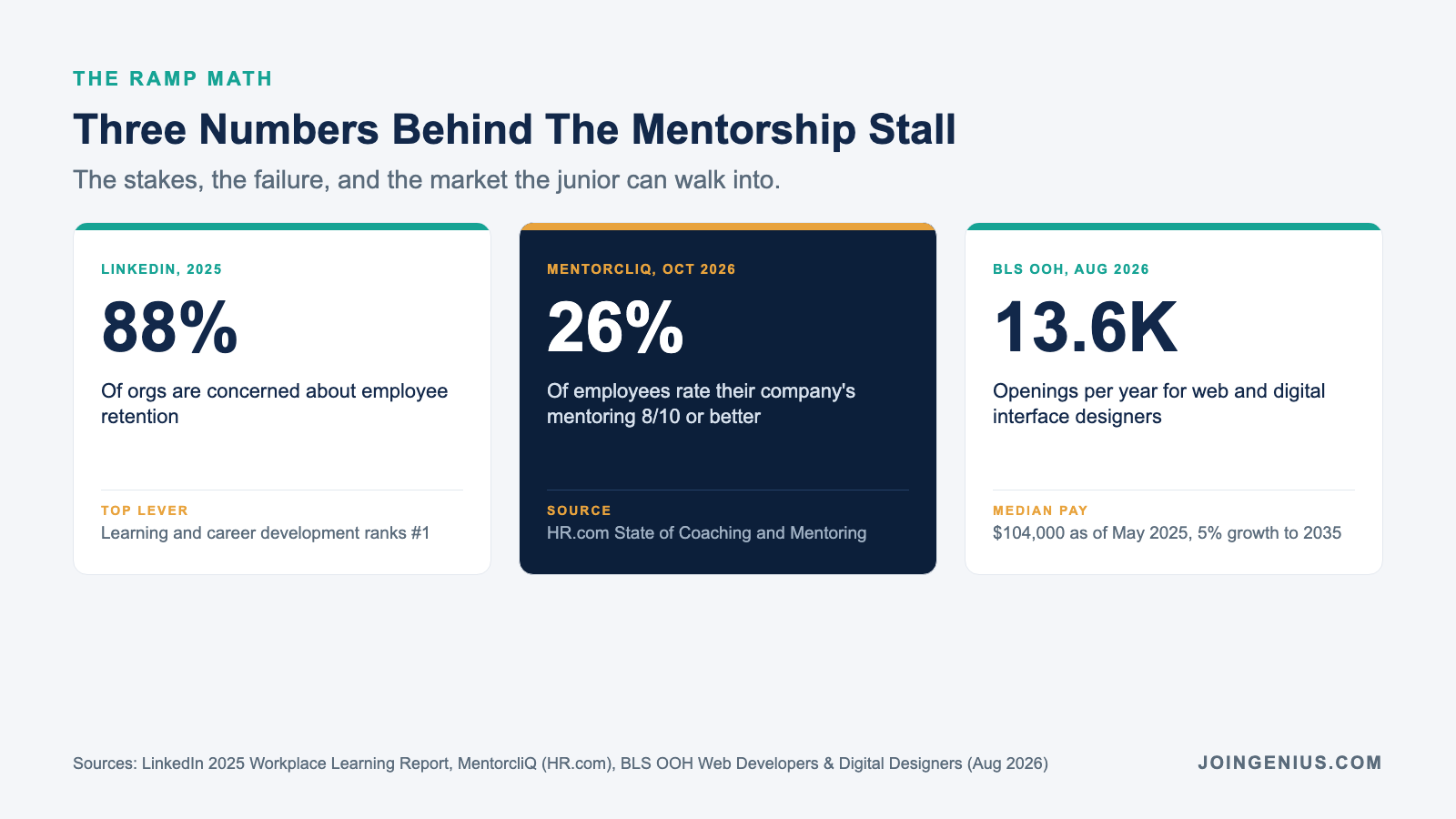
LinkedIn’s 2025 Workplace Learning Report, based on a survey of 937 L&D and HR professionals and 679 learners across 28 locations in four regions with LinkedIn platform data as of September 2024, found that 88% of organizations are concerned about employee retention and that providing learning opportunities ranks as the number one retention strategy among respondents. The spend is going in, which means the real question is whether the mentorship program the junior is sitting inside is actually delivering the signal the research says is the strongest retention lever. For most juniors in most design orgs, it is not.
Design A Mentorship Program That Moves Juniors, Not Just Calendars
The strongest design orgs treat mentorship the way they treat a hiring pipeline. There is a scoped intake, a scoped output, named owners, and a review cadence. The weakest treat it the way they treat an all-hands topic.
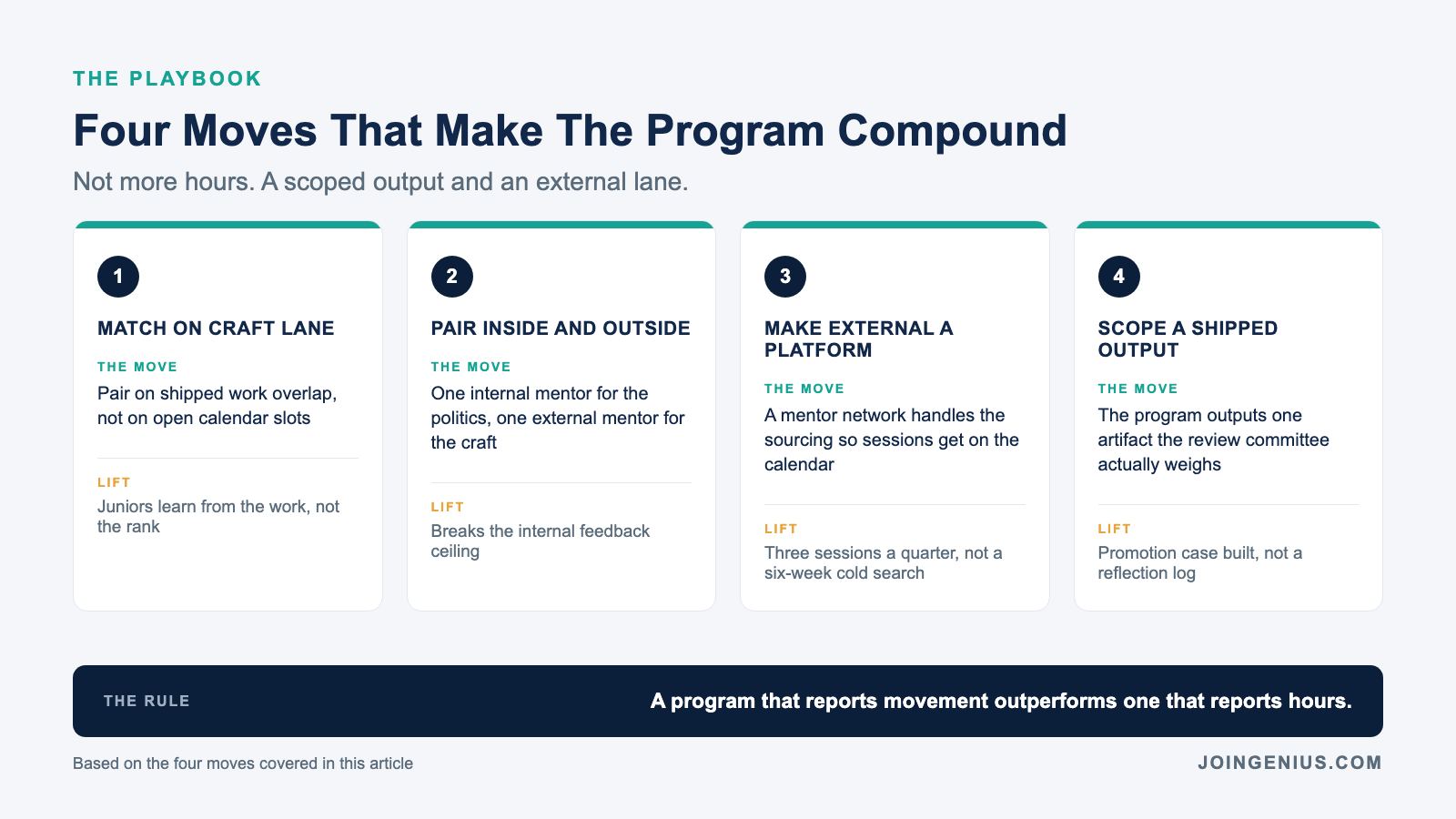
Match On Craft Lane, Not On Seniority Average
The pairing variable that moves the needle is craft lane overlap. A junior product designer growing into design systems should be matched with a senior who ships systems work, even if that senior is at a different company. Rank is not what the junior is learning from. The shipped work is.
Pair Inside The Company With A Second Pair Outside
Internal mentors handle the political work (how this org actually promotes, what the review committee weighs, which stakeholders matter). External mentors handle the craft and career work (what the market pays for, what the next level looks like somewhere healthier, how the junior reads outside their current bubble). A program with only one of those lanes leaves the other job half-done.
Make The External Lane A Platform Decision, Not A Favor Economy
Hunting for the right senior designer at another company via a cold DM is slow and inconsistent, and most juniors will not do it. Pointing them at a mentor network like ADPList turns the external pairing into a scheduled thirty-minute session with a vetted senior from a different company instead of a six-week search that most juniors abandon. The platform collapses the friction between “I need external feedback” and “I am sitting with it on a Tuesday afternoon.”
Scope A Shipped Deliverable, Not A Reflection Session
The mentorship program’s output should be a shipped piece of work the junior can take to their manager and their next recruiter screen. One systems contribution. One case study on a scoped project. One critique presentation to a wider audience. Programs that output “reflections” produce slower designers. Programs that output shipped work produce promoted ones.
The US Bureau of Labor Statistics Occupational Outlook Handbook for Web Developers and Digital Designers, last updated August 27, 2026, projects about 13,600 openings per year on average for the combined SOC category and a median annual wage of $104,000 for web and digital interface designers as of May 2025. The design hiring market a stalled junior can step into stays persistently open, which is why a mentorship program that does not produce a shipped artifact tied to a review case is quietly also a retention program that is not pulling its lever.
What To Stop Doing (It’s Draining The Program)
Four moves consistently drain mentorship programs even when the design org thinks they are investing. Cut these first.
Pair On Vibes
The vibes pair feels good in the first session and drifts by month two. The craft-lane pair feels slightly awkward in the first session and still runs by month six. Pick the second one every time.
Measure Hours, Not Shipped Work
The program that reports “47 mentorship hours logged this quarter” is reporting activity. The program that reports “three juniors shipped a systems contribution tied to a review case” is reporting outcomes. Low morale at work frequently traces to activity-coded programs that do not change what the review committee actually sees.
Keep The Mentor Pool Internal Only
Internal-only pools reinforce the house style and cap the junior at the ceiling the current team already represents. The junior will outgrow that ceiling and leave. External pairing is the hedge that keeps them, and the pattern applies in adjacent roles too, which is why why marketing ops hires don’t stay past their first 18 months names the same mechanism from a different angle.
Treat Mentorship As A Perk, Not A Hiring Expense
A mentorship program that gets cut in a tight quarter was never a retention program. It was a perk, which is a different thing. The orgs that keep juniors through downturns treat the external pairing budget the way they treat the recruiter retainer. It is pipeline, not a nice-to-have.
How To Measure Whether The Program Is Actually Moving Juniors
A working design mentorship program shows up in the data in four places.
Promotion Rate Of Juniors In The Program Vs Juniors Not In It
If the two populations promote at the same rate inside 24 months, the program is a social club. If the in-program population promotes at least a half-level faster, the program is doing its job.
Count Of Shipped Deliverables Tied To The Review Case
How many juniors came out of the program with a specific shipped artifact (systems contribution, critique presentation, scoped project) that the review committee actually weighed? If the answer is below 60% of the cohort, the output scoping is too loose.
External Session Count Per Junior Per Quarter
If the number is zero, the external lane is not real. If it is below two, the compounding is not happening. If it is three or four, the junior is building the network they will need in year three.
Attrition Of The Program’s Juniors Vs The Design Org Average
The strongest leading indicator of program health. Juniors in the program should leave the org at a materially lower rate than juniors not in it. If the number is the same, the program is not pulling the retention lever it was built to pull.
A Design Mentorship Program Scorecard
| What To Measure | Weak Signal | Strong Signal |
|---|---|---|
| Promotion rate inside 24 months | Same as non-program population | 1.5x the non-program rate |
| Shipped artifacts tied to review | Under 60% of the cohort | 85%+ with a named deliverable |
| External sessions per quarter | 0 to 1 | 3 or more |
| Attrition vs org average | Flat or worse | Half the design-org rate |
MentorcliQ’s mentoring statistics compendium, last updated October 23, 2026, cites HR.com’s State of Coaching and Mentoring research showing that only 26% of employees would rate their company’s mentoring programs an 8 out of 10 or better. Three in four participants rate their own org’s mentoring program below the bar they would call good, which is the exact gap the scorecard above is designed to close. The programs look fine on the org chart and move nothing for the junior. The orgs that fix the gap are the ones measuring shipped work and external session count instead of hours logged.
Conclusion
A design mentorship program fails or succeeds on four decisions, and all four sit upstream of the first session. Match on craft lane. Pair internally and externally. Scope a shipped deliverable. Measure promotion and attrition, not hours. The juniors who stay are the ones whose program moved them. The ones who leave are the ones whose program reflected with them.
We built Genius so design leaders can staff the people who make that compounding real. We place the top 1% of design and operations talent from the Philippines and Latin America, at around 80% less than comparable local hires. The relationship stays direct, with no monthly agency fees and a 6-month replacement guarantee on every placement. If the next design hire is the one who finally sticks past year two, see how we source and place the design talent that compounds.