You want to hire SEO specialists who shrink the gap between where your pages rank and where your revenue lives. That is a harder task in 2026 than it was two years ago. The role has split into content and technical work, with AI search bolted on top. The resumes have not caught up with the split.
If you are planning your talent acquisition pipeline for the first half of the year, SEO is one of the roles where the signal and the title no longer match. The right hire for 2024 is often the wrong hire for the back half of 2026.
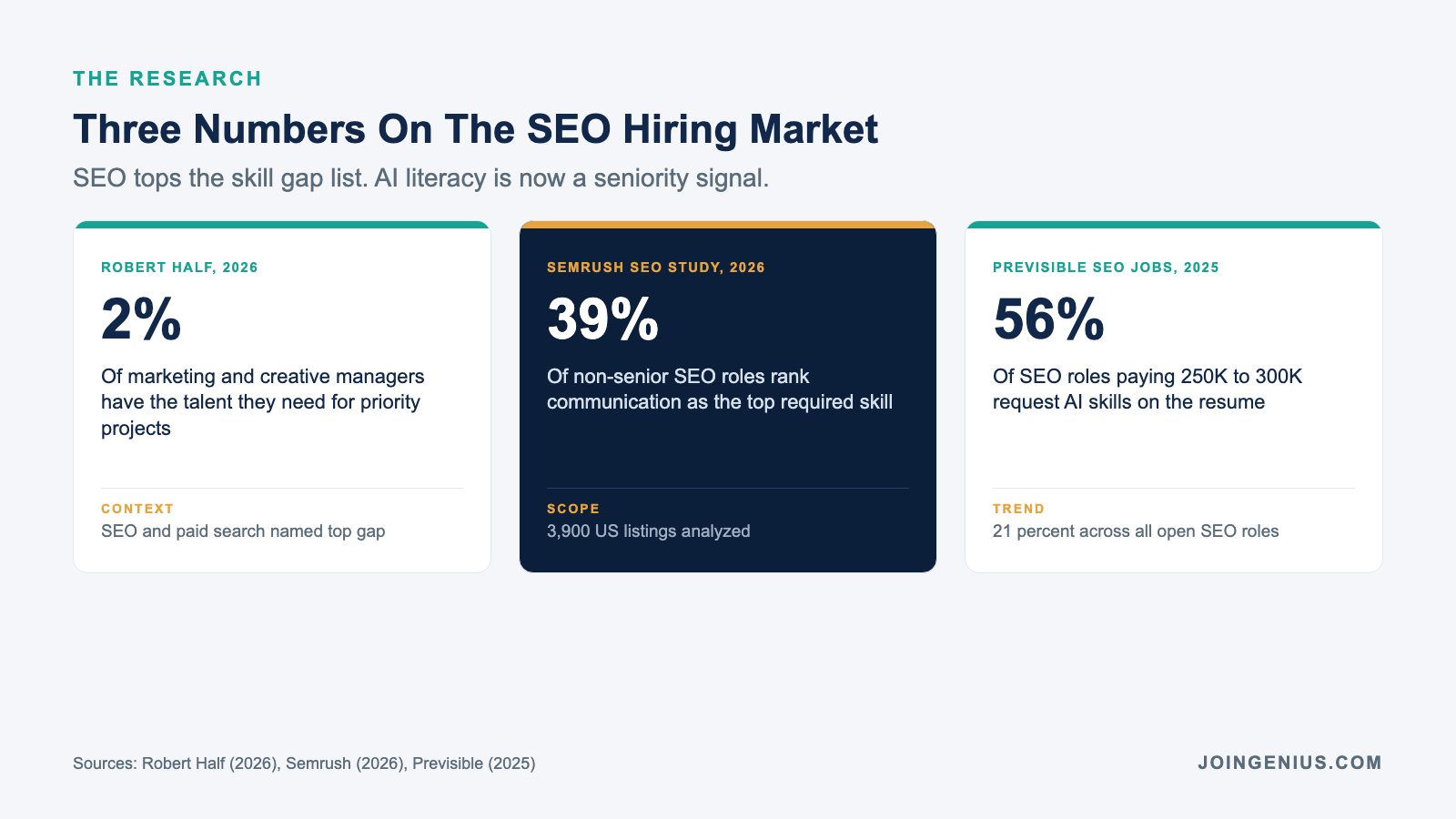
Robert Half surveyed 1,500 hiring managers in November 2025 and published the results on February 2, 2026. Only 2 percent of marketing and creative leaders said they had the talent they needed for priority projects. The top skill gap area they named was SEO and paid search. That is the market you are hiring into.
Why SEO Hiring Fails Before The Interview
Most SEO hires fail because the job description was written from a tool list, not a backlog. A posting that names Ahrefs and Screaming Frog tells you nothing about what the specialist will own on Monday morning.
The posting filters for people who recognize tool names. It filters against the specialist who knows what to do when a redirect chain tanks a priority page.
The second failure happens in the interview. Hiring managers ask about ranking factors and backlink tactics. The real work is figuring out why organic traffic dropped 18 percent in a month, or whether a 3,000 page site should be pruned or expanded. Those are judgment calls, not multiple choice answers.
The third failure is the test. A take-home audit on a demo site gives you a polished PDF that any mid-level SEO can produce. It does not tell you how they would act when the data is incomplete, which is the usual condition.
What A Modern SEO Specialist Actually Does In 2026
Semrush analyzed 3,900 US SEO job listings pulled in late November 2025. The study was published on March 30, 2026 and the findings reshape how the role is written. Communication showed up as the top skill in 39.4 percent of non-senior listings. Project management appeared in 37.1 percent of them. Google Analytics was named in 47.7 percent.
These are not technical SEO skills. They are the skills of someone who ships work through other people. The specialist writes briefs for content writers and files tickets with engineers. The specialist also reports to a VP who wants a number, not a methodology.
If the resume does not show that someone has done this, the person is not ready for the role you are hiring for. The gap between a technical SEO and a specialist who runs a function is the gap between a contributor and an owner.
The technical layer is still there. Core Web Vitals showed up in 18 percent of senior listings. SQL in 9.5 percent. Experimentation in 23.9 percent. But those sit on top of the communication layer, and a candidate who has only the technical layer will stall at the first stakeholder meeting.
The newest layer is AI search. Semrush found 31 percent of senior listings now mention general AI skills, and almost 10 percent require LLM or AI familiarity by name. That shift matters because AI overviews are already eating click share on informational queries, and the specialist who cannot plan for that is already behind.
The Resume Signals That Actually Predict Performance
The 2025 Previsible State of SEO Jobs Report found that 21 percent of open SEO positions requested AI skills. In the top salary band of $250,000 to $300,000, that figure jumped to 56 percent. The AI skill has become a seniority signal, not a nice-to-have. Read every resume against that lens.
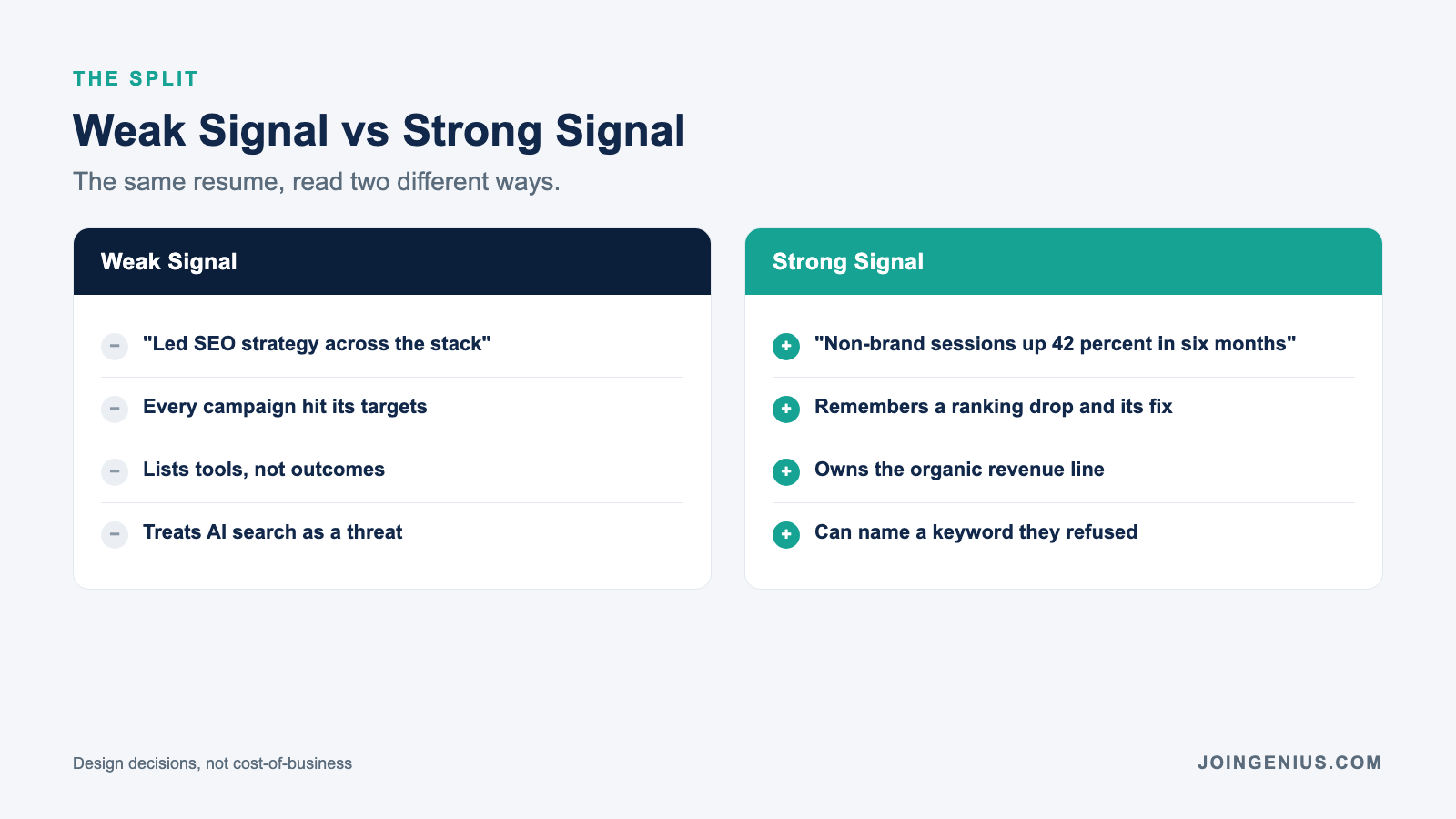
A weak resume lists Ahrefs and Semrush and claims experience with technical SEO. A strong resume names the site, the problem, the fix, and the number. “Rebuilt 400 product pages into a hub-and-spoke model, lifted non-brand organic sessions 42 percent in six months.” That sentence is worth more than a page of certifications.
Ownership is the second signal. Ask who ran the project. If the candidate says “my team” without specifying their decision, they were a passenger. A specialist you want to hire from a global pool should be able to name a tradeoff they argued for and lost, and what they learned from it.
The third signal is a refused project. Great specialists have told a stakeholder no. They have refused to write a thin keyword page that would get sandboxed, or declined to chase a vanity term with no commercial intent. Ask for that story and listen for the reasoning.
A Portfolio Test That Beats The Live Interview
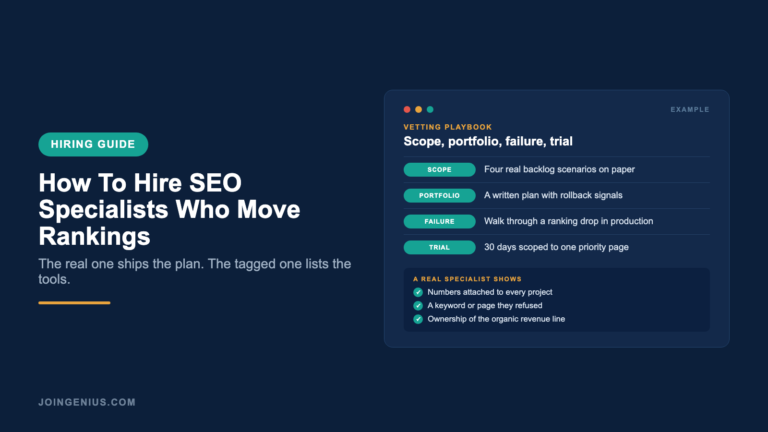
Replace the take-home audit with a written plan. Give the candidate four scenarios drawn from your real backlog. A ranking drop on a priority page. A pruning decision on a 300 URL cluster. An AI overview appearing above a converting term. A migration decision between subdomain and subfolder. Pay them for the time and ask for one page per scenario.
Score the plan on three things. First, do they ask the questions a specialist would ask before acting, or do they jump to tactics. Second, can they name a failure mode for their own plan and the signal that would trigger a rollback. Third, could your operations team act on the plan without them in the room.
| Scenario | What A Weak Plan Does | What A Strong Plan Does |
|---|---|---|
| Priority page ranking drop | Rebuild the page | Diagnose first, then act |
| 300 URL pruning decision | Delete thin pages | Map intent, consolidate signals |
| AI overview appearing | Add FAQ schema | Rewrite for citation, measure |
| Migration platform choice | Pick by preference | Model risk vs reward |
A specialist who writes a strong plan on paper will usually ship strong work in the role. One who writes a weak plan on paper will not get better once hired. The written artifact gives you something concrete to compare across candidates. It is also the closest proxy to the Monday morning version of the job.
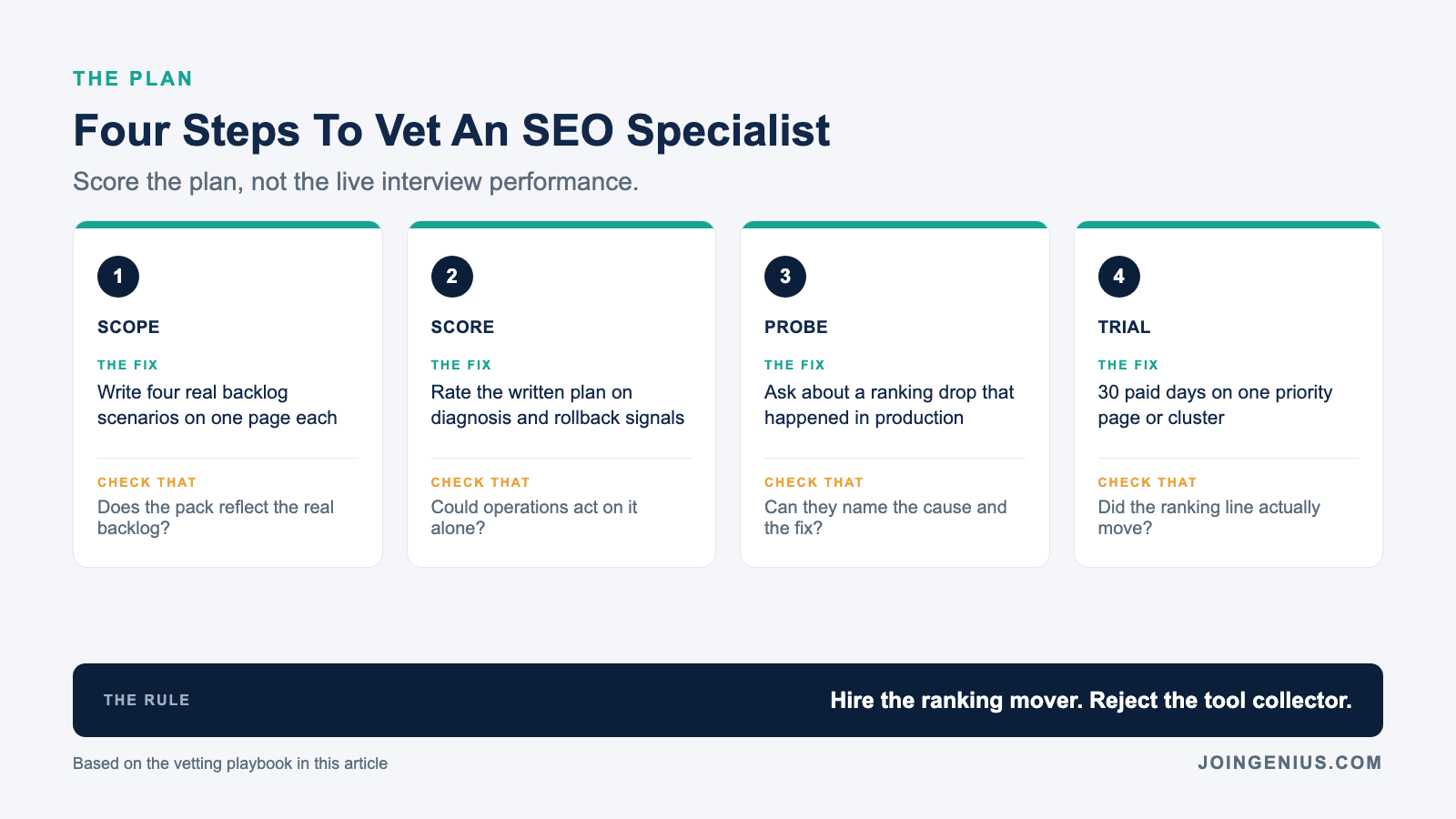
Finish the loop with a 30 day paid trial on a single real workflow. Scope it tight. One priority page, one cluster, or one AI search response. The outcome is the test. If the backlog actually moved, you have the hire. If the specialist tried to boil the ocean, you have your answer the other way.
When A Managed Platform Beats The Hire
Sometimes the right call is not a hire at all. If your site is a small or mid sized business running on WordPress, a full-time specialist is often overkill. The weekly workload is a few hours of content and technical cleanups.
The role will stretch into filler work. The specialist will leave. You will restart the search in 11 months with the same posting that failed before.
WPSEOAI’s WordPress platform is one example of this build-vs-buy option. It runs AI agents inside WordPress for topical maps and keyword research. The same platform also writes content, suggests internal links, runs technical audits, and tracks AI visibility. A dedicated human success manager sits on top of the agents.
The platform is built for SMBs that do not have a full in-house team. It is positioned to work alongside the specialists they do have, not to replace them. That framing matters because it tells you what the platform expects you to still own on your side.
The decision rule is simple. If your SEO work is a strategic function with headcount and multiple content producers, hire the specialist. If it is a priority but not a full-time job, a managed platform usually wins on cost and time to value.
The failure mode is hiring a specialist for a job that was really a platform job and watching them get bored. The other failure mode is buying a platform for a job that needed strategic ownership and watching the backlog stall.
Either path still needs a human owner. If you choose the platform, assign one person on your team as the business owner of the platform. If you choose the hire, decide which parts you will automate and which you will reserve for the specialist. The worst outcome is nobody owning the surface.
Hire SEO Specialists Who Actually Move Rankings
The specialists who move rankings in 2026 are communicators first and operators second. The tool fluency is table stakes. They can write a plan and defend a tradeoff. They can refuse the wrong project. They see AI search as a new surface to win rather than a threat to resist.
Hire against that, and the role pays for itself inside the first two quarters. Hire against a tool list, and you will be reposting the role before the fiscal year closes.
If you want to hire that specialist faster than the local market will allow, Genius sources the top 1 percent of SEO talent from the Philippines and LATAM. The roles come in at about 80 percent less than US rates. No monthly fees. A six month replacement guarantee.
We handle the sourcing and the vetting so you can get back to the roadmap. Explore how global outsourcing and payroll work for distributed SEO hires. The search for a specialist who actually moves rankings becomes a tractable project.