Why journalist outreach fails before you hit send is usually not a talent problem. It is a research problem. The pitch that never had a chance to work was sent before the research even started, and the journalist you wrote to had already moved off that beat two newsletters ago and never updated their LinkedIn tag.
Below we cover the pitch volume reality in 2026, the research phase most PR pros skip, the writing mechanics that earn a reply, the timing and channel choices that move the response rate, and the signals that a pitch is working. Start with the campaign metrics that matter context.
The 2026 Reality: Journalists Are Buried In Pitches
The economics of the pitch inbox have flipped. The number of pitches going out climbed through 2025 while newsroom headcount kept shrinking, and the result is a filter that treats most PR email as noise by default. Two 2025 reports put the pattern in hard numbers.
Volume And Relevance Have Both Collapsed
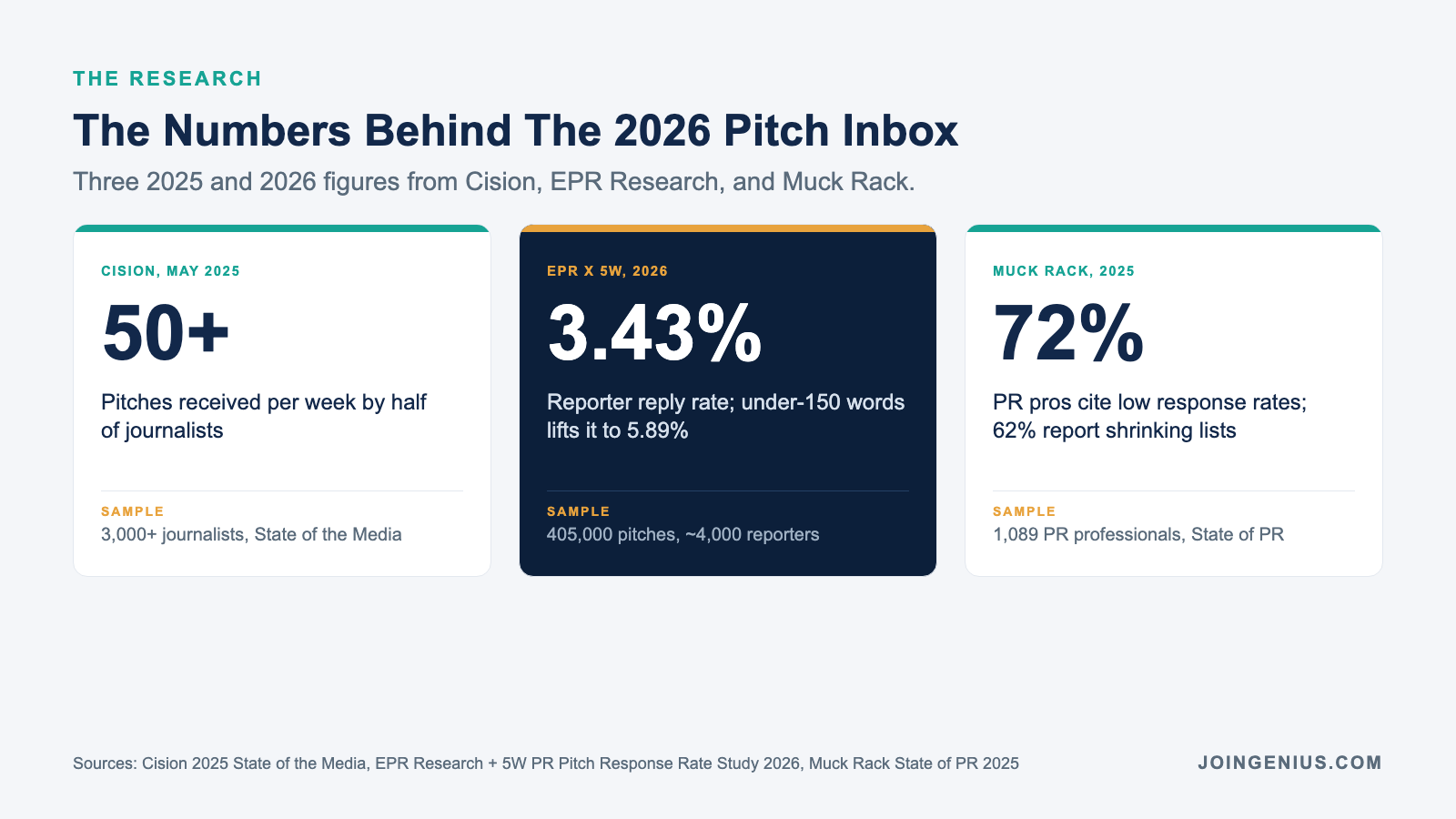
Cision’s 2025 State of the Media report of more than 3,000 journalists found half receive over 50 pitches per week, 86% cite a lack of relevance as the top reason they reject, and 78% say irrelevant pitches will get the PR pro blocked. The pitch inbox is now a hostile filter.
Two things drove the shift. AI pitch assistants dropped the cost of sending to near zero, so any agency with a list can send 500 emails before coffee. Newsroom teams got smaller at the same time, which means the people filtering those emails have less time on each one.
Industry Research Confirms The Pattern
Muck Rack’s State of PR 2025 report, drawn from 1,089 PR professionals surveyed June through July 2025, found 72% cite low journalist response rates and 62% report shrinking media lists in the beats they cover. Only 2% say earning coverage has not become harder.
The Research Phase That Most PR Pros Skip
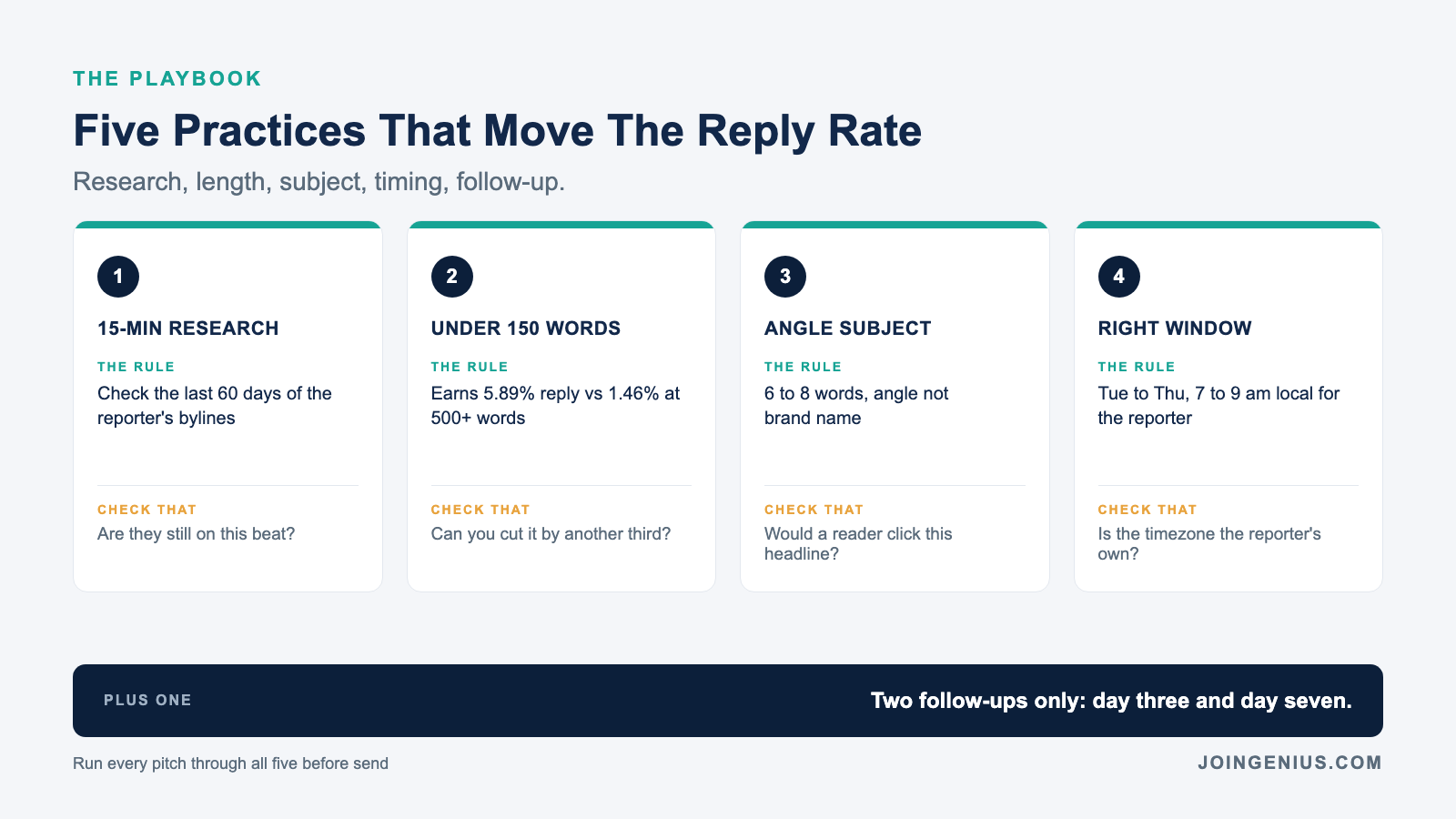
Every one of the volume problems above traces back to the same root cause. The pitch went out without a research pass on the reporter and the outlet. A 15 minute check before the draft is written is what separates the pitch that earns a reply from the pitch that earns a block.
Reading The Byline Pattern Before The Pitch
Every reporter has a rhythm. Two features a week, three news hits, one think piece a month. Read the last six bylines and the shape becomes visible. Pitch a feature angle when they are in a news cycle and the email is already dead before they open it.
Checking The Beat In The Last 60 Days Of Coverage
Beats shift faster than most PR lists update. A reporter who covered fintech for three years can be on the climate desk this quarter, and nothing on their LinkedIn will say so for another month.
A Muck Rack search across the reporter’s last 60 days of bylines tells you whether they still cover your beat, which is the single highest-impact check before you write a word of the pitch.
The Outlet Context That Changes The Angle
Same reporter, two outlets, two different angles. A business outlet wants the revenue number. A trade outlet wants the mechanism. A tier-one national outlet wants the founder or the customer who proves it is real. Reading the last three stories the outlet ran on your category is a ten minute cost that reshapes the pitch.
Put together, a 15 minute research pass gives you a reporter who covers the right beat, an angle that fits the outlet, and a hook the reader will click on. The PR teams that run this pass as a habit report reply rates two to three times the industry baseline.
Writing A Pitch That Earns A Reply
Research sets up a pitch that can connect. Writing is where most still fail. The behavioral data is now clear enough that the rules are not opinions, and the shortest version earns the most replies.
Under 150 Words Or It Does Not Get Read
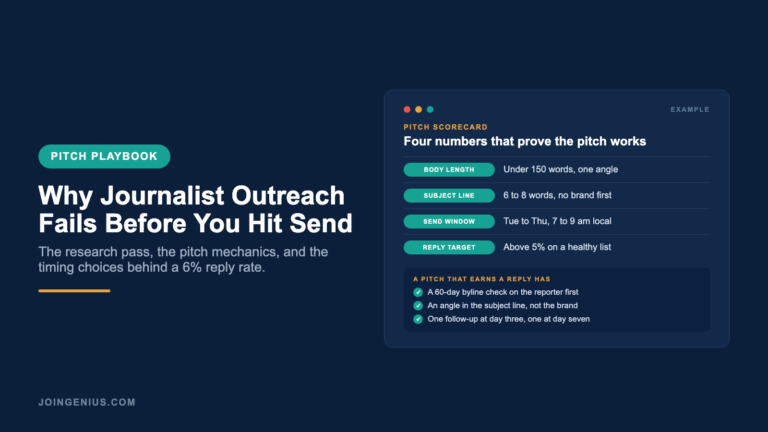
The EPR Research and 5W PR Pitch Response Rate Study 2026, built on 405,000 pitches sent to about 4,000 reporters on the Propel platform, found a baseline reply rate of 3.43%. Pitches under 150 words earn 5.89%. Pitches over 500 words drop to 1.46%. The short pitch is not a stylistic choice. It is a response rate choice.
The Subject Line Does The Work
Six to eight words, no all-caps, no emoji, no brackets. The subject carries the angle, not the brand. “New data on Gen Z saving habits” beats “Partnership announcement from Acme Inc” every time, because the first one tells the reporter what their reader will click on.
An Angle, Not A Product Announcement
The pitch that reads like a press release is the pitch that gets filtered. The pitch that reads like a tip from a source gets a reply. Lead with the story, not the company. Think of it the same way that B2B lead scoring ignores real buyers when it starts from the product instead of from the person reading.
The table below is the quick checklist for every pitch before it goes out. Any row scored wrong is a reason to rewrite.
| Pitch Element | What It Should Be | Common Failure Mode |
|---|---|---|
| Subject line | 6 to 8 words, angle in plain language | Brand name first, ALL CAPS, or over 10 words |
| Opening sentence | Why this reporter, right now | Generic greeting with no beat reference |
| Body length | Under 150 words, one angle | Over 400 words, three angles, all CTA |
| Proof point | One number, one customer, one source | No number, three customer logos as PDF |
| Ask | One sentence, one next step | “Let me know if there is interest” with no date |
The Timing And Channel Choices That Change The Response Rate
The right pitch at the wrong time is the wrong pitch. Two choices matter more than everything else combined: the day and hour the email arrives, and whether the channel is email at all.
The Day And Hour That Moves The Dial
Tuesday through Thursday, 7 am to 9 am local time for the reporter is the window with the highest open rate across modern PR trackers. Friday after 2 pm and Monday before 9 am are the two worst. Response rates follow the same shape as why survey response rates tanked: the inbox is saturated before the sender wakes up.
Follow-Up Rhythm Without The Nag
One follow-up at day three, one at day seven, zero after that. Each follow-up is a one-sentence add, not a resend. A new data point, a timing reason, or a new angle the reporter can use. The third follow-up is the signal to a reporter that their silence was an answer.
Email Versus Social Versus DM
Email is still the primary channel in 2026 for a real pitch. Social is for warming up the relationship, not placing the story. A DM is appropriate once, after an email has been read and not answered, and only for a story that is already running. Reversing that order is how PR pros get blocked across every channel at once.
Signals A Pitch Campaign Is Working (Or Not)
The feedback loop on journalist outreach is slow enough that most PR teams rely on anecdote. The teams that measure the right four numbers see the problem three weeks before the campaign review and still have time to change course.
Leading Indicators Through Week Two
Open rate on pitches sent, reply rate on pitches opened, median time to first reply, and percentage of replies that asked for more information. A healthy campaign in 2026 sees opens above 40%, replies above 5%, and an information request from at least a quarter of the replies.
Lagging Indicators Through Week Six
Placements secured, tier of outlet, inclusion of the message that was pitched, and link back to the asset the story was built around. A campaign that earns coverage without the pitched message got lucky. The pitch was not the reason the story ran.
Metrics Worth Tracking Past Week Six
Past the six-week review, the long numbers that matter are earned coverage per hour of PR time, cost per placement, and share of placements that drove a tracked business outcome. A campaign that earned six stories but drove zero signups or interviews is a vanity campaign, not a results campaign.
Warning Signs The Campaign Is Broken
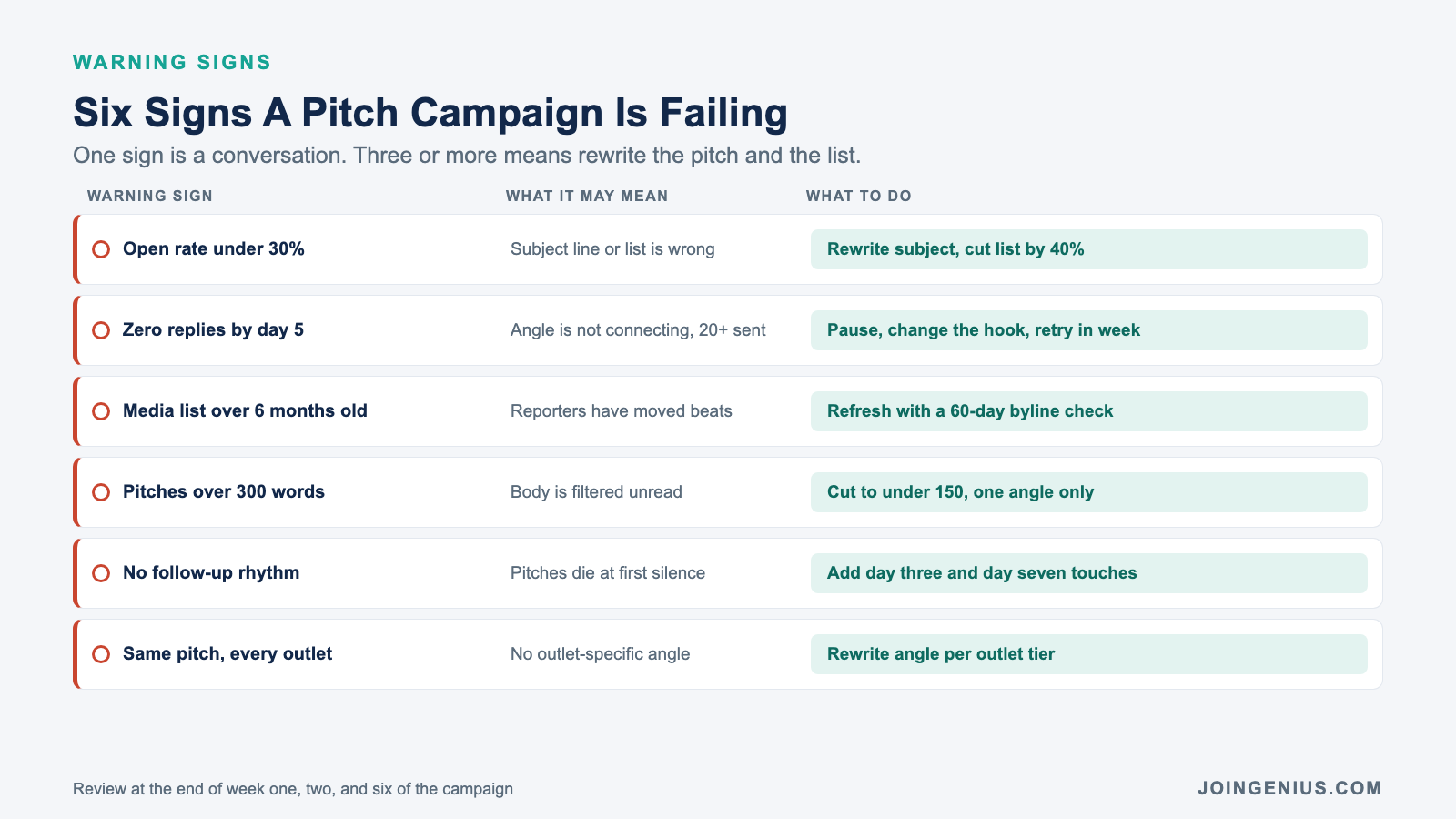
If the leading indicators above have been flat for two weeks, the warning signs below are almost certainly present at the same time. One sign is a conversation with the team. Three or more means the campaign needs a rewrite of the pitch and the list, not another round of follow-ups.
Conclusion
Journalist outreach fails before you hit send when the research was skipped, the pitch was too long, or the timing was wrong. A 15 minute reporter check, a sub-150 word pitch with an angle in the subject line, and a Tuesday morning send turns a 3% reply rate into something closer to 6%.
For more on building a modern PR and marketing engine, see our full marketing guides.